

How Semiconductor Demand Affects Metals (October 2026) Guide

Stronger chip orders pull real metal through the supply chain, but not every metal reacts the same way. How semiconductor demand affects metals comes down to three things: where the metal sits in the manufacturing flow, whether its supply is primary or a by-product of something else, and how long the lag is between a chip order and a spot price. Copper responds on tonnage and mostly moves direction, while silver and the platinum group metals respond on value per ounce and move magnitude.
That distinction is the whole argument, and it is the part most commentary leaves out.
Data as of October 2026. Chip capital spending cycles turn over fast, so treat every figure here as a snapshot rather than a live quote.
How Semiconductor Demand Affects Metals
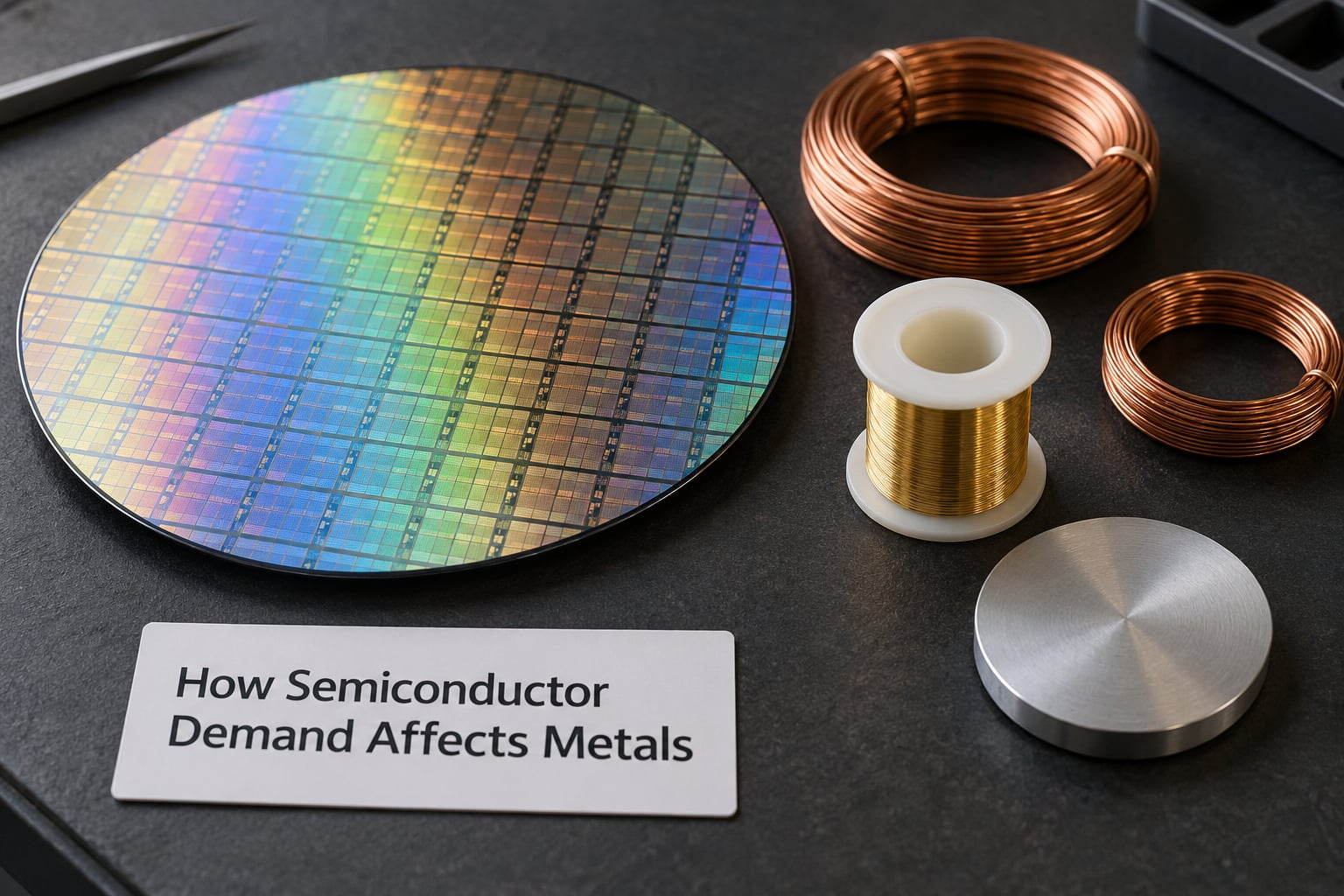
It affects them by pulling metal into fabs, packaging lines and data centre electrical systems, and it hits industrial and precious metals very differently. Stronger semiconductor production raises demand for specific industrial and precious metals, but the size of the effect depends on the metal, supply conditions, timing and what the rest of the economy is doing.
A chip is mostly silicon, sand-derived glass and a lot of chemistry, so the metal bill per wafer looks small. The catch is volume: advanced nodes run tiny features across large wafer counts, packaging volumes are enormous, and the buildings that house all of it are copper-hungry on a scale that has nothing to do with the chip itself.
Four channels do the work, and they arrive on different clocks:
- Structural electronics. Interconnect layers, seed and barrier films, bonding wires, leadframe plating, probe pins. Consumption tracks wafer starts and packaged units.
- Buildings and power. Busbar, cable, switchgear, bus ducts, cooling and grid connections for fabs and data centres. This is copper demand in the plainest sense.
- Margin and cash flow. When fab utilisation rises, chipmakers earn more, cash flow improves, and the spending that follows lands back in equipment orders and materials a couple of quarters later.
- Grid and electrification spillover. New power demand pulls transmission and grid spending, which is a far bigger copper sink than the fabs themselves.
BloombergNEF has put copper at close to 6% of the capital cost of a data centre project, which makes it one of the few genuinely new industrial demand sources for the metal this decade. S&P Global Commodity Insights, reported in January 2026, argued that AI could lift copper demand by around 50% by 2040 and that more mines are needed to keep supply even with it.
Which Metals Are Most Connected to Semiconductor Demand?
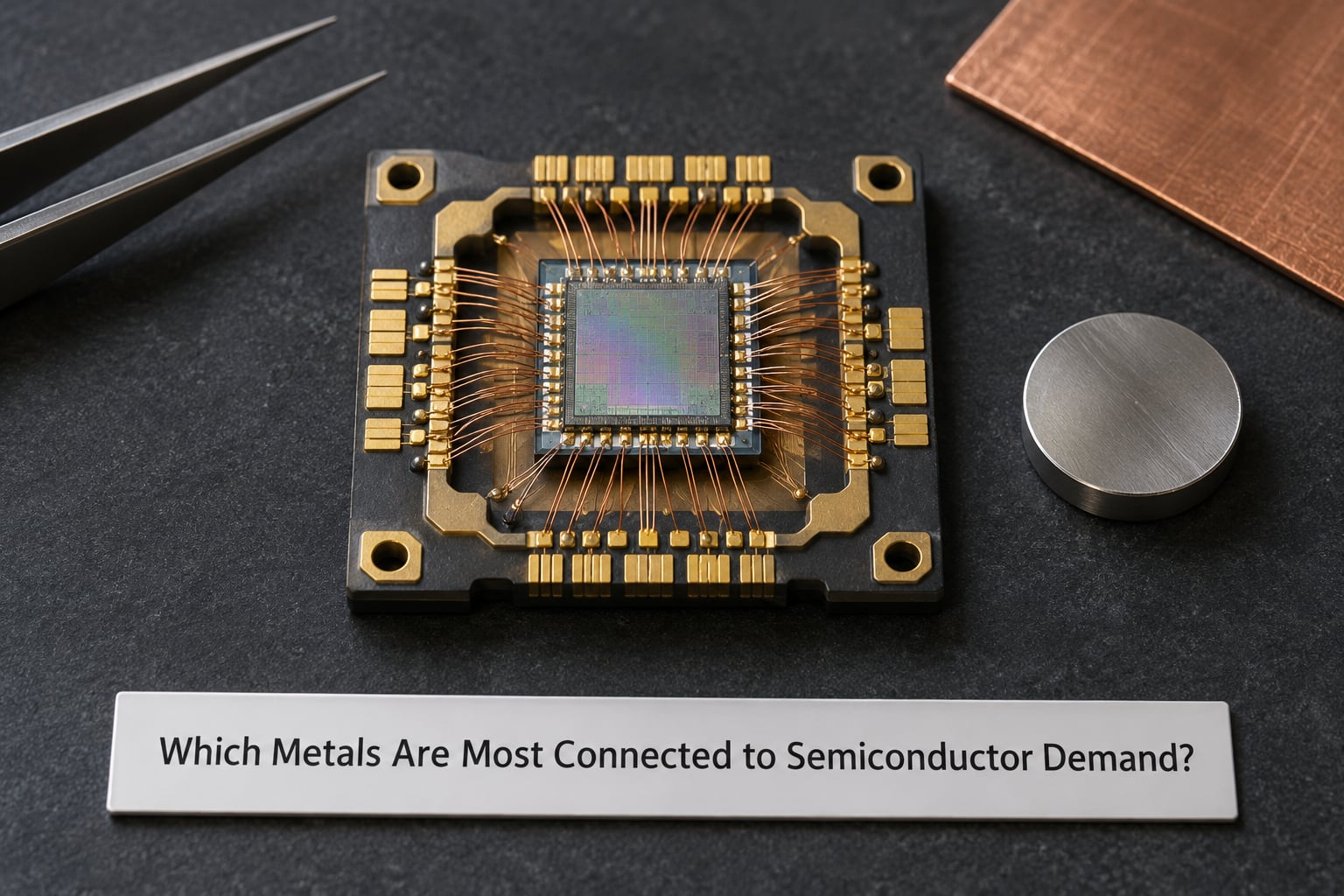
Copper, gold, silver, aluminium, titanium, tantalum, tungsten and the platinum group metals are the ones readers should track, with copper and the noble metals the most direct. The list below is split by where the metal physically goes, because a metal used one gram per accelerator behaves nothing like a metal used in the building that powers it.
Metals used in semiconductor manufacturing, in rough order of how connected they are to chip demand:
- Copper. Seed and plating layers inside the chip, and an enormous amount of it in cabling, busbar and switchgear around and inside the fab. The link to chip demand is real and measurable.
- Gold. Bonding wires for years, plus plating on leadframes, connectors and contact surfaces, and gold in probe cards. Copper substitution has been eating into the bonding wire share for a decade.
- Silver. Conductive contacts, solder and paste. Small per device, and competing directly with solar paste demand.
- Aluminium. The workhorse of older interconnect layers and still a deposition metal today. Also the main substitution threat to copper in cabling.
- Tantalum. Capacitors and barrier films. A small share of the bill with an outsized effect on capacitor pricing.
- Titanium and tungsten. Adhesion and barrier layers, nitride films, sputtering targets. Unglamorous and consistently in every node.
- Platinum, palladium and rhodium. Electrodes, capacitors, hard-disk and fuel-cell components, probe pin materials. Small tonnage, high value, and the metals where a chip-order change shows up most violently.
Silicon deserves a footnote rather than a place on the list. Wafers come from metallurgical silicon, which is overwhelmingly an aluminium input, so the silicon chain is a parallel story with its own cycle rather than a metals story.
A metal that moves with general capital spending rather than with chips is one you can mostly ignore for this thesis. Grid copper and structural steel move on power build-out, not on wafer starts.
How Semiconductor Demand Affects Metals, Step by Step
The mechanism runs in five stages, and the lag between stage one and the last one is where most mistakes happen.
- End demand. Orders for accelerators, memory and other devices build.
- Capex. Foundries and memory makers raise spending and announce new capacity. Announcements move sentiment quickly; actual spending takes quarters.
- Construction and equipment. Fab shells, cleanroom fit-out, power distribution and cooling are built. Copper offtake happens here, early and large.
- Wafer starts. Tools run, deposition metals are consumed per wafer, and packaging lines ship at volume.
- Metal offtake and price. Refiners see the orders, inventories draw down, and the spot price reacts once stock cover falls. Mines respond years later, if at all.
Utilisation sits across stages three and four. A fab running flat still consumes metals per wafer, but a fab running hard also generates the cash that funds the next round of capacity. That is why a chip upcycle tends to reach materials demand twice, first through volume and later through investment.
Does a Semiconductor Boom Mean Every Metal Price Will Rise?
No. Semiconductor demand is a marginal demand source for most of these metals, not the marginal source, and several forces routinely outweigh it.
Substitution. Copper displacing gold in bonding wires, and aluminium displacing copper in power cabling, are both live. If substitution accelerates, demand growth arrives without any price signal at all.
Recycling. Scrap is the fastest supply valve in the market. A price spike pulls scrap out of hiding within months, which caps exactly the kind of spike the chip narrative tends to predict.
Inventories. Exchange holdings and trader stock absorb demand before it reaches the visible market. A strong offtake story can be real and still leave the price flat, because someone was holding metal the whole time.
Mine supply and treatment charges. Smelter treatment and refining charges are the cleanest read on whether the market is actually tight. When they sit low, concentrates are scarce and the physical story is genuine. When they rise, refiners have plenty to process and the shortage talk is cheap.
Currency and rates. A metal priced in dollars moves when the dollar moves. In 2021 and 2022 chip demand was roaring, and copper still gave back part of its spike as the dollar strengthened and construction demand wobbled. Both things were true at once.
Investment flows. Retail positioning in gold and silver can overwhelm an industrial signal for weeks. It is worth asking whether a move is industrial or speculative before assuming chip demand caused it.
What Commodity and Mining Investors Should Monitor
Track the confirmed side of the chain and the supply side at the same time, because they are the two halves of the trade. Here is the shortlist I use, roughly in order of how much warning it gives you.
- Semiconductor billings and forecasts. WSTS and the Semiconductor Industry Association publish monthly and quarterly data. Billings lead orders.
- Foundry and memory capex guidance. The distinction that matters is announced capacity versus committed spending. Guidance is closer to metal.
- Wafer starts and utilisation. The most direct read on deposition metal consumption, and the hardest number to get publicly. Supplier commentary fills the gap.
- Smelter treatment and refining charges. Cheap charges mean concentrates are tight. Rising charges mean the shortage narrative has outrun the physics.
- Exchange inventories. LME and COMEX warehouse holdings tell you how much of the demand story is already absorbed.
- Data centre announcements versus offtake. Headline project values are not metal purchases. Grid connection agreements and equipment orders are closer.
- Mine supply events. Disruptions, grade decline and permitting timelines move prices faster than demand ever does.
- Rates and the dollar. They explain more of the variance in these prices than the chip cycle usually gets credit for.
None of this is investment advice. These are general relationships that have held across several cycles, not a view on any security, and metals and mining equities can lose value quickly.
How Semiconductor Demand Affects Metals in Different Market Phases
The same chip headline means different things for metals depending on where the cycle sits, and reading a chip-cycle signal as an immediate commodity-price signal is the classic error.
Early recovery. Billings turn, inventories are still high, and prices mostly ignore the news. This is usually when the narrative gets loudest and the physical confirmation is weakest.
Expansion. Capex guidance rises, utilisation climbs, wafer starts follow. Structural metals and equipment-linked consumption pick up first. Precious metals lag because their demand share of the total is tiny.
Peak. Prices have already moved, so the good news stops working. Expect positioning to be crowded and inventory to be rebuilding. Being right about the cycle and still losing money at the top is normal.
Slowdown. Capex guidance gets cut, orders fall, and the expectation unwinds faster than the physical demand. This is where the by-product metals behave worst, because their supply does not fall with it. If silver or PGMs were repriced on chip optimism, that repricing unwinds regardless of what industrial users actually do.
Regional concentration adds another wrinkle. Advanced fabs and packaging sit heavily in Taiwan, South Korea and Japan, with new capacity in the US, the EU and India. Metal logistics follow that geography, and it means regional premiums, qualification rules and export controls can move a specific metal price without global demand changing at all.
Frequently Asked Questions
Yes, through three channels rather than one. Copper sits in seed and plating layers on the wafer, but the bigger effect is physical: fabs and data centres need cable, busbar, switchgear and cooling. BloombergNEF puts copper near 6% of data centre project capital cost, and S and P Global Commodity Insights argued in January 2026 that AI could lift copper demand roughly 50% by 2040. Expect the effect on price with a lag of quarters, not weeks.
Yes, but in small quantities per device. Silver appears in conductive contacts, solder and paste, and in test and packaging hardware. The interesting part is supply, not use: roughly three quarters to four fifths of silver output arrives as a by-product of copper, lead, zinc and gold mining. Producers cannot simply expand silver output in response to price, so incremental electronics demand can tighten the market more than the tonnage suggests.
For structural metals, months. Copper for a fab or data centre is ordered during construction, which follows capex guidance by a few quarters. Deposition metals follow wafer starts within the same cycle. Price response comes last, once exchange inventories draw down. Mine supply responds over years rather than quarters, which is why a chip boom can tighten the market long before new material arrives, and why the reversal is equally slow.
Not really. Semiconductor and electronics uses exist for both, including capacitors, electrodes and probe materials, but the volumes are tiny next to automotive, industrial and hydrogen applications. What makes them interesting is that supply is concentrated in South Africa and Russia and moves slowly, so a small industrial demand change can produce a large price move. Copper is the reverse: huge tonnage, broad end uses, thinner per-unit impact.
Copper first by a wide margin, mostly in power distribution, cabling and grid connections rather than inside the servers. Aluminium is next because of cabling volume, partly at copper’s expense. Silver and the platinum group metals see small tonnage with outsized price sensitivity. The number to check is capital cost share: copper at close to 6% of data centre project capital cost, according to BloombergNEF, is what turns this from a footnote into a demand story.
Watch three pairs of indicators. Chip side: semiconductor billings from WSTS and the Semiconductor Industry Association, then foundry and memory capex guidance, then wafer starts and utilisation. Metal side: smelter treatment and refining charges, exchange inventories at LME and COMEX, and mine supply disruptions. When bills and charges move together, the demand story is real. When bills rise while charges stay high, the metal market is telling you there is already enough material.
Conclusion
Chip demand is a genuine and growing source of industrial metal demand, but it reaches prices through a chain with real lags, and it reaches different metals in different ways. Copper responds on tonnage and mostly sets direction; silver and the platinum group metals respond on value per ounce and set the magnitude because their supply does not respond to price at all.
Start with one habit: put a confirmed demand signal next to a metal-specific supply signal before you act on it. WSTS billings and capex guidance on one side, treatment and refining charges and exchange inventories on the other. When they agree, the story has a foundation. When only the headline agrees, it is a narrative.
Source: https://www.pgm-blog.com/how-semiconductor-demand-affects-metals/
Anyone can join.
Anyone can contribute.
Anyone can become informed about their world.
"United We Stand" Click Here To Create Your Personal Citizen Journalist Account Today, Be Sure To Invite Your Friends.
Before It’s News® is a community of individuals who report on what’s going on around them, from all around the world. Anyone can join. Anyone can contribute. Anyone can become informed about their world. "United We Stand" Click Here To Create Your Personal Citizen Journalist Account Today, Be Sure To Invite Your Friends.
LION'S MANE PRODUCT
Try Our Lion’s Mane WHOLE MIND Nootropic Blend 60 Capsules
Mushrooms are having a moment. One fabulous fungus in particular, lion’s mane, may help improve memory, depression and anxiety symptoms. They are also an excellent source of nutrients that show promise as a therapy for dementia, and other neurodegenerative diseases. If you’re living with anxiety or depression, you may be curious about all the therapy options out there — including the natural ones.Our Lion’s Mane WHOLE MIND Nootropic Blend has been formulated to utilize the potency of Lion’s mane but also include the benefits of four other Highly Beneficial Mushrooms. Synergistically, they work together to Build your health through improving cognitive function and immunity regardless of your age. Our Nootropic not only improves your Cognitive Function and Activates your Immune System, but it benefits growth of Essential Gut Flora, further enhancing your Vitality.

Our Formula includes: Lion’s Mane Mushrooms which Increase Brain Power through nerve growth, lessen anxiety, reduce depression, and improve concentration. Its an excellent adaptogen, promotes sleep and improves immunity. Shiitake Mushrooms which Fight cancer cells and infectious disease, boost the immune system, promotes brain function, and serves as a source of B vitamins. Maitake Mushrooms which regulate blood sugar levels of diabetics, reduce hypertension and boosts the immune system. Reishi Mushrooms which Fight inflammation, liver disease, fatigue, tumor growth and cancer. They Improve skin disorders and soothes digestive problems, stomach ulcers and leaky gut syndrome. Chaga Mushrooms which have anti-aging effects, boost immune function, improve stamina and athletic performance, even act as a natural aphrodisiac, fighting diabetes and improving liver function. Try Our Lion’s Mane WHOLE MIND Nootropic Blend 60 Capsules Today. Be 100% Satisfied or Receive a Full Money Back Guarantee. Order Yours Today by Following This Link.


| Visits: | 1,834,037,191 |
| Stories: | 8,715,887 |
Whistler Blowers, Insiders

