

Why Recycling Catalytic Converters Matters (October 2026)

Why recycling catalytic converters matters comes down to three scarce metals. A converter holds platinum, palladium and rhodium in a concentrated, recoverable form, and sending one to a refiner returns those metals to manufacturing instead of leaving them in a scrapyard or landfill. That recovered supply, sometimes called urban mining, cuts demand for newly mined ore and softens the exposure of buyers to metal that comes from very few places on earth.
The rest of this guide covers what is actually inside the unit, how the six-step recovery process works, and what it means for supply and prices. It is written for anyone who owns an old converter, runs a scrap business, or simply wants to understand the trade.
What Is a Catalytic Converter and Why Does It Matter?
A catalytic converter is an exhaust component. Its job is to turn three of the nastiest by-products of a petrol engine into less harmful ones before they leave the tailpipe.
Physically it is a steel canister holding a ceramic honeycomb substrate. Thousands of tiny channels give the exhaust gas a large surface area to touch, and the walls of those channels carry a washcoat loaded with platinum-group metals. In a three-way catalyst, that mix of platinum, palladium and rhodium converts carbon monoxide and unburned hydrocarbons into carbon dioxide and water, while reducing nitrogen oxides into nitrogen.
The converter also carries a diagnostic sensor and sometimes an oxygen sensor port. If the unit fails an emissions test, the vehicle often shows a check-engine light and the catalytic converter monitor sets a code.
Lifespan is usually tied to mileage and fuel quality rather than to a fixed schedule. Many units last well beyond 100,000 miles, and when one finally fails it is because the washcoat has degraded, the substrate has melted or cracked from heat, or the coating has been poisoned by coolant or oil.
That failed or end-of-life unit is exactly the feedstock the recycling industry wants. It contains the same platinum, palladium and rhodium as a working converter, just concentrated into something nobody wants to keep.
Why Recycling Catalytic Converters Matters
Six reasons, each on its own terms:
- It recovers metals that are genuinely scarce. Platinum, palladium and rhodium are produced in tiny quantities relative to how widely they are used.
- It reduces pressure on primary mining. Every tonne of recovered metal is a tonne not excavated, smelted and shipped from an ore body.
- It returns material to the emissions-control supply chain. The refiner’s output goes back into new catalysts, not into a museum case.
- It takes high-value material out of the waste stream. Auto recycling advocates put the legal end-of-life figure at more than 30 million converters a year.
- It diversifies supply away from a handful of producing countries. South Africa dominates primary platinum and Russia is the major palladium source, so secondary material matters strategically.
- It keeps the material traceable. Documented recycling programmes give authorities something to follow when converters are stolen.
A concrete example of how that loop works: an end-of-life vehicle arrives at an authorised dismantler, the converter is removed and its part number and serial are recorded, the unit is decanned and assayed, and the resulting platinum, palladium and rhodium are refined back to specification. That batch of metal then feeds a catalyst manufacturing line, and a new converter goes onto a new vehicle. The same atoms, back in service.
None of this means the loop is closed automatically. Scrapyard forums are full of people asking where their material actually went, and a processor that will not explain the chain of custody is not contributing to any of the points above.
Which Precious Metals Are Recovered?
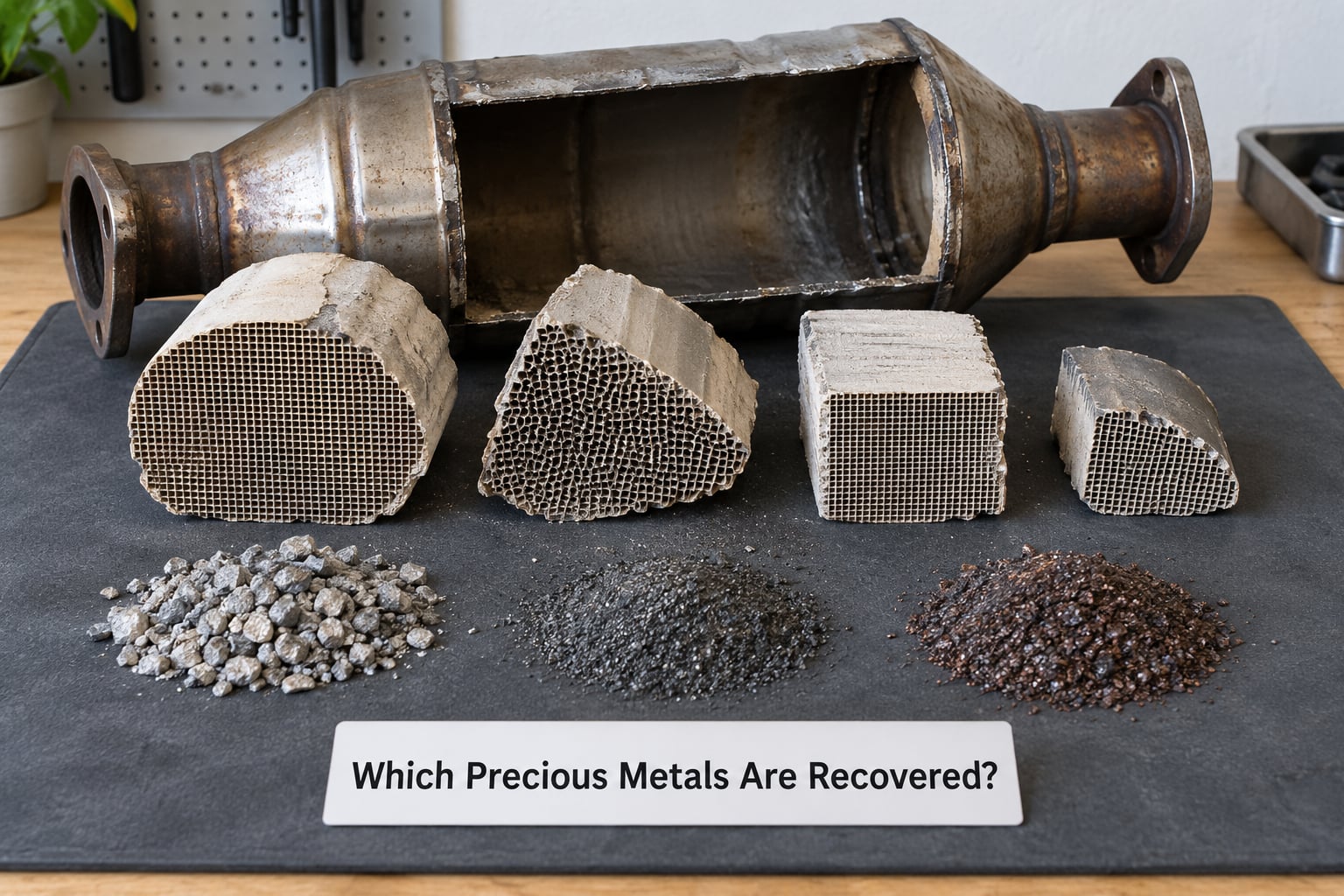
Three metals do nearly all the work, and each plays a different chemical role. Formulations vary widely by manufacturer, engine and emission standard, so any percentage breakdown you see quoted is a range, not a specification.
| Metal | Role in the catalyst | Rough availability | Why recycling matters |
|---|---|---|---|
| Platinum | Oxidises carbon monoxide and unburned hydrocarbons | By-product of nickel and copper mining, heavily concentrated in South Africa | Large and growing industrial demand runs against slow, hard-to-expand mine supply |
| Palladium | Handles the oxidation side of the three-way reaction | Mostly a byproduct of Russian and South African nickel and copper output | Petrol demand drives it, so it swings hard with fuel-economy policy |
| Rhodium | Reduces nitrogen oxides | Extremely rare relative to how much is used | No practical substitute exists at the same effectiveness, so recovered units are a key source |
Older diesel units often carry a different balance again, leaning on platinum and palladium for oxidation with less rhodium. Assays decide, not labels.
How Does the Recycling Process Work?
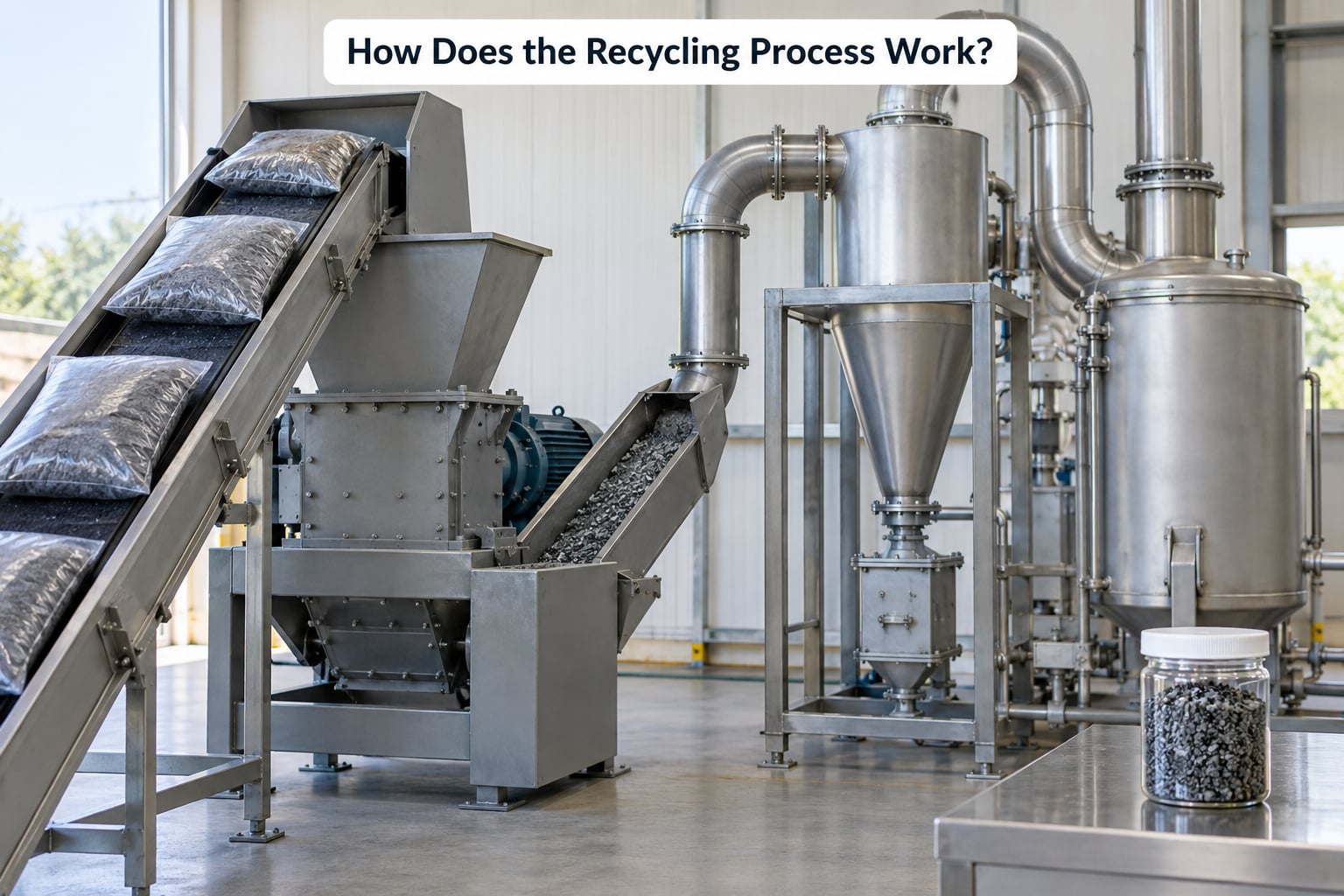
The sequence runs in a fixed order, and each stage exists for a reason.
1. Collection and inspection
The converter is removed, usually by a licensed automotive specialist or an authorised dismantler. Markings, part numbers and any serial engraving are photographed and recorded before the unit is shipped.
2. De-canning
The steel shell is cut away to expose the ceramic honeycomb. This step runs under dust extraction, because the exposed washcoat is fine particulate that has to be captured rather than released.
3. Milling and screening
The brick is crushed and screened so catalyst-bearing powder is separated from clean ceramic and steel fragments.
4. Sampling and assay
A representative sample is taken. XRF gives a fast screening read, while ICP is the method refiners treat as authoritative.
5. Smelting
The powder is fused with a collector metal, usually copper or iron. Smelting is not the finish line; it is a concentrating step that gives the refinery something workable.
6. Refining
The collector alloy is leached and the platinum, palladium and rhodium are separated and refined to the purity a catalyst maker will accept.
Only qualified processors and refiners should handle concentrated catalyst material. This is not a garage project, and the widely repeated advice to de-can at home is where hobbyists lose money rather than make it.
How Does Recycling Affect Metals Supply and Prices?
Recovered material is a real supply source, but it is not a switch that sets the price on its own. Prices are set by the balance between mined output, automotive demand, industrial offtake and substitution, and recycling sits inside that balance.
Why recycling converters matters for the metals market
Converter scrap is urban mining with an unusual property: the feedstock is already manufactured, already concentrated, and already sitting in circulation. That makes it faster to bring to market than a new mine.
A few effects worth watching. When metal prices rise, more scrap is pulled out of storage and old vehicles are processed more aggressively, so secondary supply responds. When prices fall, that flow slows. It is a self-correcting valve rather than a ceiling.
There is a harder supply issue on the horizon too. Electric vehicles do not have catalytic converters, so as they take share, the long-run flow of end-of-life converters thins. Every unit recovered today is a unit that will not be available later.
One more wrinkle: theft. Metal that leaves a vehicle illegally never reaches a documented recycler, so it disappears from the legitimate supply chain entirely. Where theft is rampant, secondary supply tightens even when the scrap exists.
What Are the Environmental and Safety Benefits?
The case is real but not one-sided, and an honest version has to include the footprint of recovery itself.
| Factor | Secondary recovery | Primary mining and refining |
|---|---|---|
| Energy input | Lower; feedstock is already concentrated and high-grade | High; ore is excavated, milled, smelted and refined |
| Land disturbance | Confined to existing processing sites | Open pits, tailings dams and new infrastructure |
| Water use | Modest, and largely contained within plant wastewater treatment | Substantial, and contested in several producing regions |
| Waste stream | Diverts a high-value material from landfill and roadside debris | Produces tailings and slag at scale |
| Downside | Transport, acid leaching, energy for smelting and refining | Same downstream steps, on top of everything mining adds |
So the correct summary is narrower than the usual marketing line. Recycling avoids the mining footprint for that unit of metal; it does not avoid the refining footprint, and refining is shared between primary and secondary feed.
On safety, two things matter for owners. First, an opened ceramic substrate is treated as hazardous waste, because breathing the washcoat dust is genuinely bad for you. Second, catalytic converter theft is a crime in most jurisdictions, and buying a converter you cannot prove you own is how people end up in trouble.
Long-running enthusiast forums keep returning to the same point: the honest path is a long relationship with a transparent refiner who shows assay numbers, not chasing the highest posted offer from an anonymous buyer.
How to Recycle a Catalytic Converter Responsibly
Whether you are clearing a failed part or running a dismantling yard, the sequence is the same.
Confirm where it sits. The vehicle service information will tell you the location and the removal procedure. If removal is needed, use a licensed automotive specialist and follow the manufacturer’s instructions.
Prove ownership. Keep the bill of sale, the vehicle title or registration record, the VIN, and the removal invoice. Photos of the converter in the vehicle help.
Ask how they value it. A reputable refiner or processor should be able to explain their assay method and show you pricing referenced to converter part numbers rather than to physical size. Forum posters repeatedly report that size is a poor proxy for value and that newer, smaller units often carry higher loadings.
Check the paperwork. You want insurance, an environmental permit where relevant, and a documented chain of custody that shows the material is not being resold onward into a grey market.
Understand the payment terms. Settlement against assay, with a stated settlement window. Freight costs can erase the margin on a small batch, so ask who pays shipping before you commit.
Red flags are easy to spot once you know them. A buyer who cannot explain where the material goes, an offer that refuses to name an assay method, and any scheme that pays you to mail in a converter under a vague “catalytic control” label all deserve a walk-away.
Frequently Asked Questions
It is possible to remove a converter yourself if the vehicle manufacturer allows it, but processing the contents is a different question. De-canning releases fine catalyst-bearing dust that must be captured with industrial extraction, and the separation and refining steps need licensed equipment. Experienced scrap users generally conclude that small-scale processing costs more than it returns, and that a documented refiner captures more value anyway.
Frequently yes, and the reason is emissions standard rather than the powertrain. Hybrids such as small four-cylinder petrol models use tight-leveraging three-way catalysts, and some converters with a smaller footprint carry higher platinum-group metal loadings than larger conventional units. Never assume from the vehicle type alone, though. Value follows the assay result, not the badge on the car, so treat any model-based pricing table as a starting point.
By sampling and assaying. Part of the ceramic brick or the collected powder is sent to a laboratory, where X-ray fluorescence gives a fast screening estimate of platinum, palladium and rhodium, and inductively coupled plasma analysis provides the authoritative result. Processors can also cross-reference the converter’s stamped part number against known loadings, which narrows the range before any destructive test is done.
No. Payment is normally linked to an assay result multiplied by the metal price on a settlement date, so it moves with both the recovered grade and the market. Rhodium in particular has traded at extreme highs and lows in recent years. Anyone offering a flat, no-questions figure before assaying is either guessing or hoping you will not check. Ask how the settlement price is set and on what date it is struck.
Proof that the converter came off a vehicle you own: the vehicle title or registration, the VIN, the date of removal, and a repair or removal invoice naming the part. Photograph the converter before it leaves the vehicle, and keep the stamped part number visible. Then keep the seller’s invoice, assay report and settlement statement. That chain of custody is what protects you if a recovered converter is later linked to a theft.
Conclusion
Why recycling catalytic converters matters is really a question about supply: three rare metals, concentrated in a part that is already in circulation, can be returned to manufacturing instead of being lost to waste or to theft. The environmental gain is real but partial, and the safest version of the trade runs through documented, licensed processors.
If you have a converter to dispose of, do one thing first. Route it through a documented specialist or refiner who will show you an assay method and a chain-of-custody record, rather than storing it, listing it online or handing it to whoever happens to be at the yard.
Article updated for October 2026.
Source: https://www.pgm-blog.com/why-recycling-catalytic-converters-matters/
Anyone can join.
Anyone can contribute.
Anyone can become informed about their world.
"United We Stand" Click Here To Create Your Personal Citizen Journalist Account Today, Be Sure To Invite Your Friends.
Before It’s News® is a community of individuals who report on what’s going on around them, from all around the world. Anyone can join. Anyone can contribute. Anyone can become informed about their world. "United We Stand" Click Here To Create Your Personal Citizen Journalist Account Today, Be Sure To Invite Your Friends.
LION'S MANE PRODUCT
Try Our Lion’s Mane WHOLE MIND Nootropic Blend 60 Capsules
Mushrooms are having a moment. One fabulous fungus in particular, lion’s mane, may help improve memory, depression and anxiety symptoms. They are also an excellent source of nutrients that show promise as a therapy for dementia, and other neurodegenerative diseases. If you’re living with anxiety or depression, you may be curious about all the therapy options out there — including the natural ones.Our Lion’s Mane WHOLE MIND Nootropic Blend has been formulated to utilize the potency of Lion’s mane but also include the benefits of four other Highly Beneficial Mushrooms. Synergistically, they work together to Build your health through improving cognitive function and immunity regardless of your age. Our Nootropic not only improves your Cognitive Function and Activates your Immune System, but it benefits growth of Essential Gut Flora, further enhancing your Vitality.

Our Formula includes: Lion’s Mane Mushrooms which Increase Brain Power through nerve growth, lessen anxiety, reduce depression, and improve concentration. Its an excellent adaptogen, promotes sleep and improves immunity. Shiitake Mushrooms which Fight cancer cells and infectious disease, boost the immune system, promotes brain function, and serves as a source of B vitamins. Maitake Mushrooms which regulate blood sugar levels of diabetics, reduce hypertension and boosts the immune system. Reishi Mushrooms which Fight inflammation, liver disease, fatigue, tumor growth and cancer. They Improve skin disorders and soothes digestive problems, stomach ulcers and leaky gut syndrome. Chaga Mushrooms which have anti-aging effects, boost immune function, improve stamina and athletic performance, even act as a natural aphrodisiac, fighting diabetes and improving liver function. Try Our Lion’s Mane WHOLE MIND Nootropic Blend 60 Capsules Today. Be 100% Satisfied or Receive a Full Money Back Guarantee. Order Yours Today by Following This Link.


| Visits: | 1,834,037,191 |
| Stories: | 8,715,887 |
Whistler Blowers, Insiders

