

What Is the Nuclear Fuel Cycle? Updated for 2026

What is the nuclear fuel cycle? It is the full set of industrial steps that takes uranium from the ground into a reactor, through its use to generate heat and electricity, and on to the safe management of the spent fuel it leaves behind. Those steps are usually grouped into three parts: the front end, the service period, and the back end.
Most of it is ordinary chemical and mechanical work. Crush rock, leach it, spin a gas in a centrifuge, press powder into a ceramic pellet, seal it in a metal rod, and eventually put the whole assembly in a concrete building and watch it get quieter every year.
The part that surprises people is where the difficulty sits. Mining gets all the attention, but uranium ore is not the scarce input. Conversion and enrichment capacity are the chokepoint, and that is the part most likely to raise prices or delay a reactor programme.
What Is the Nuclear Fuel Cycle? Quick Guide
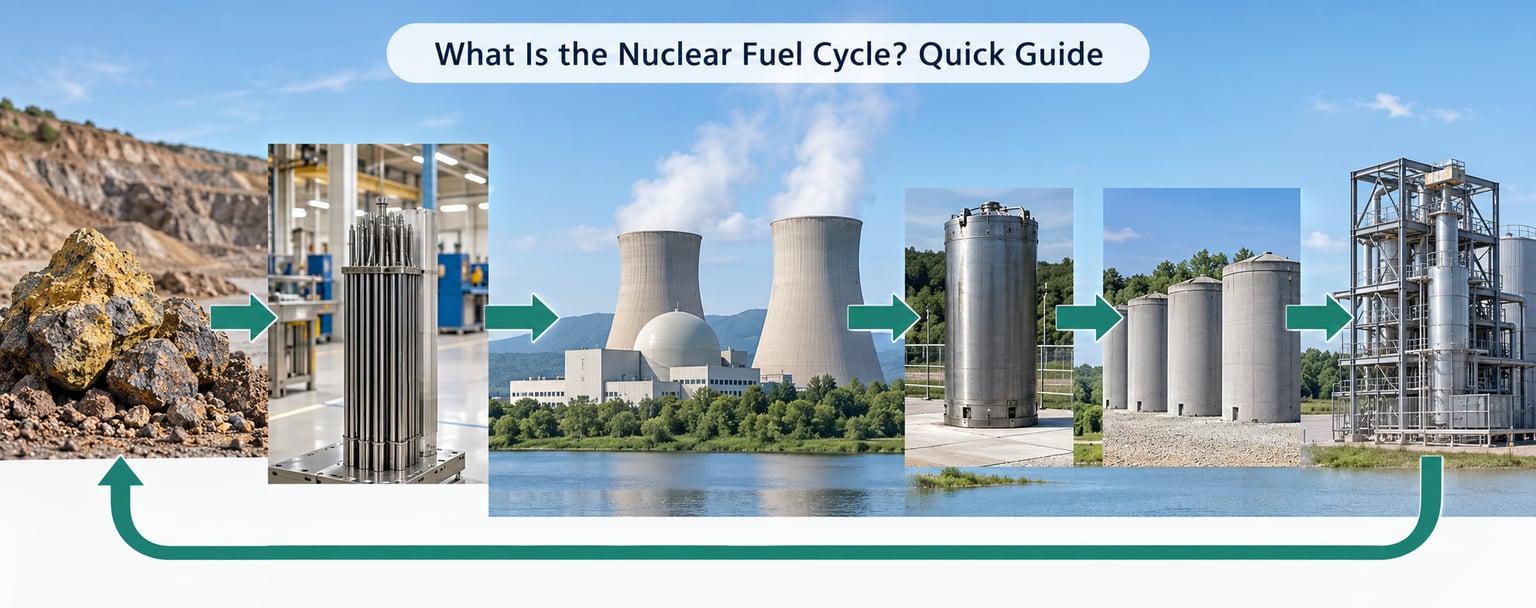
| Phase | Stage | What changes |
|---|---|---|
| Front end | Exploration | Drilling maps where uranium sits, at parts per million in ordinary rock |
| Front end | Mining and milling | Ore becomes yellowcake, U3O8, roughly 60 to 70% uranium by weight |
| Front end | Conversion | U3O8 becomes uranium hexafluoride, UF6, a solid that sublimes near 57 C |
| Front end | Enrichment | U-235 rises from its natural 0.71% to about 3 to 5% in most power reactors |
| Front end | Fuel fabrication | UO2 powder becomes pellets, fuel rods and square assemblies |
| Service | Reactor operation | Fission makes heat; an assembly stays in core three to five years |
| Back end | Cooling in a pool | Used assemblies sit under water for five to ten years |
| Back end | Dry cask storage | Fuel moves to concrete-and-steel casks, passively cooled for decades |
| Back end | Reprocessing | Some countries recover plutonium and uranium for MOX fuel |
| Back end | Disposal | Vitrified waste goes deep underground in a geological repository |
Two versions of that back end exist. The once-through, or open, cycle disposes of the used assemblies once. The closed cycle sends them to a reprocessing plant to extract material for new fuel. Which one a country uses shapes its costs, its safeguards burden, and its politics.
Why the Nuclear Fuel Cycle Matters
Fuel security is the first reason. A reactor with no fuel produces nothing, and a country relying on imported enrichment has handed a fraction of its grid to whoever controls that supply. That concern has driven much of the recent interest in domestic conversion and enrichment plants.
Reliability follows from it. Outage planning, refuelling schedules and reserve requirements all assume a reliable supply of enriched fuel. Utilities that contracted years ahead have an advantage over ones that did not.
The back end is the other half of the story. Until spent fuel has somewhere permanent to go, every new reactor adds a liability alongside its output. That is the constraint that shapes public opinion and licensing timelines far more often than reactor physics does.
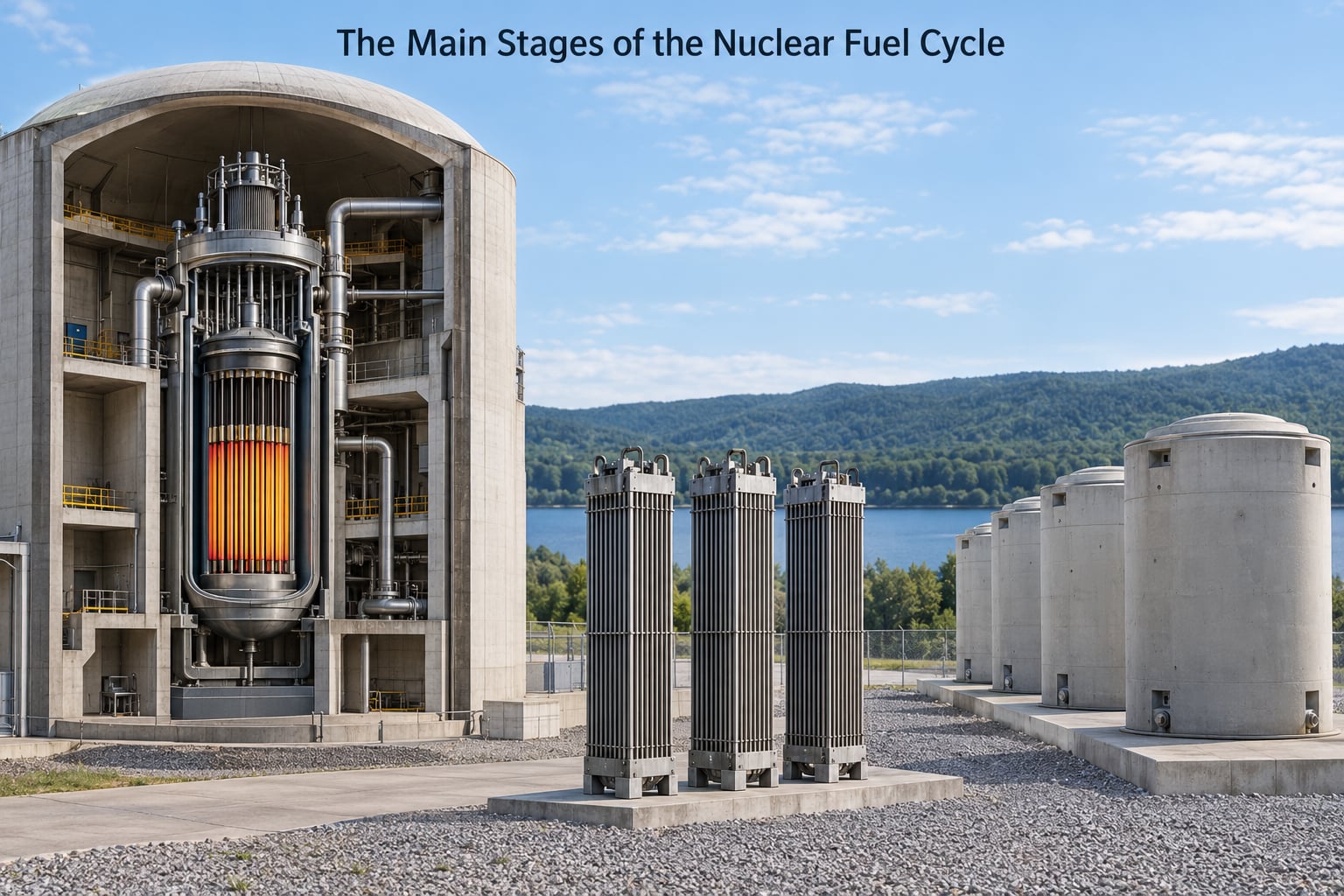
The Main Stages of the Nuclear Fuel Cycle
1. Uranium Mining and Milling
Uranium occurs in ordinary rock at concentrations of roughly 2 to 4 parts per million. Exploration drilling measures what is there; mining extracts the ore, either by open pit, underground method, or in-situ recovery where ore is leached in place and recovered from solution without moving the rock at all.
Milling is where the tonnage turns into a concentrate. Near a mill, ore is crushed and leached, and uranium is precipitated as a powder called yellowcake, formally triuranium octoxide, or U3O8. Despite the name, the powder is usually brown or black, not yellow.
Resources and reserves are different numbers, and the gap matters. Reserves are the portion of identified resources considered economically recoverable with current technology and prices. Resources are everything geologically present, including material that would need new prices, new methods, or both.
2. Conversion
Yellowcake is not in a form an enrichment plant can use. Conversion chemically turns U3O8 into uranium hexafluoride, or UF6, which is a solid at room temperature and sublimes into a gas a little above 57 C. That gas is what centrifuges actually spin.
There is a second branch. Reactors that use ordinary water as both coolant and moderator, such as the CANDU design, take fuel as uranium dioxide, or UO2, and their material never passes through UF6 at all.
Conversion plants are few and heavily scrutinised. Because UF6 is chemically toxic as well as radioactive, these facilities sit under unusually tight regulatory and security supervision.
3. Enrichment
Enrichment is isotope separation. Natural uranium is about 99.28% U-238, which absorbs neutrons without splitting, and 0.71% U-235, the only naturally occurring isotope that sustains a chain reaction with ordinary reactors. Raising that 0.71% to roughly 3 to 5% produces low-enriched uranium, or LEU, which is what commercial power reactors run on.
Higher grades exist. High-assay low-enriched uranium, or HALEU, sits somewhere between 5% and 20% and is needed for certain research reactors and most small modular reactor designs. It is a thin market, and recent interest in advanced reactors has tightened it further.
Gas centrifuges replaced gaseous diffusion decades ago because they need far less energy per unit of work. The economics come from cascade design: many small centrifuges in series, each slightly enriching the gas as it passes, and each costing less to run than a large one. That structure is why enrichment is capital-intensive and slow to expand.
Between 90 and 96 percent of the material fed into a cascade leaves as tails, or depleted uranium. It is chemically useful and mildly radioactive, and roughly three quarters of it is typically blended into fuel for the heavier Russian-designed reactors.
4. Nuclear Fuel Fabrication
Enriched UF6 arrives at a fabrication plant, where it is converted to UO2 powder, pressed into ceramic pellets about the size of a fingertip, ground to a precise size, then stacked into fuel rods and sealed inside zirconium alloy cladding chosen for how little it absorbs neutrons.
Rods go into a square assembly, typically dozens of them plus structural and control components, and the assembly is the unit a reactor actually handles. Fuel design is reactor-specific. A different cladding, pellet density or rod spacing changes how much heat the assembly survives, so fuel is never a commodity that can be swapped between designs.
5. Use in a Nuclear Reactor
Inside the core, a neutron hits a U-235 nucleus and it splits, releasing heat and more neutrons. Those neutrons are slowed by a moderator, which is ordinary water in most designs and heavy water in others, and the chain reaction settles into a steady rate set by control rods that absorb neutrons when it needs to slow down.
Heat boils water into steam, steam turns a turbine, the turbine drives a generator. Fuel stays in core three to five years before a refuelling outage removes it. By then the U-235 is largely consumed and the assembly is hot, intensely radioactive, and full of fission products including caesium-137 and strontium-90.
6. Spent Fuel Cooling and Storage
Used assemblies stay in the reactor’s water pool for five to ten years. That is not for convenience. They keep producing heat for a while after shutdown, and water both cools them and shields anyone standing nearby.
Then they go into dry casks, either at the reactor site or at an independent spent fuel storage installation, which is the industry abbreviation ISFSI. A cask is a steel canister inside a thick concrete wall, cooled by natural convection, needing no pumps or power, and designed to be inspected indefinitely.
Interim storage is not disposal. It isolates the fuel and lets its radioactivity decay, and countries that intend to reprocess keep assemblies far longer than those that intend to bury them.
7. Reprocessing and Recycling
Reprocessing dissolves the assemblies chemically, usually by the PUREX process, and separates uranium and plutonium from the fission products. Recovered material can be blended with uranium oxide to make MOX fuel, which several hundred reactor assemblies have already burned.
It is worth being precise about the recycling claim often repeated online. Roughly 95 to 96 percent of spent fuel is uranium that could in principle be reused. About one percent is plutonium, and the remaining three to four percent is fission products and minor actinides, which are genuinely waste and still require permanent disposal.
Reprocessing does not eliminate the waste problem. It concentrates it, reduces its volume, and adds a facility that handles separated fissile material under safeguards. France, Russia, Japan, the United Kingdom and India operate reprocessing plants. The United States does not, a policy choice that has its own logic and its own costs.
8. Permanent Disposal
Disposal means putting vitrified waste, a glassy solid with the fission products locked inside it, several hundred metres underground in stable rock. Spent fuel itself can also be packaged whole. Sites like Finland’s Onkalo in granite, Sweden’s Forsmark, and the US Waste Isolation Pilot Plant for defence waste follow this model.
The design relies on multiple barriers rather than one. The fuel cladding, the copper or steel canister, bentonite clay that swells when wet, the backfill, and the rock itself each hold materials back on a different timescale. Designed for something like a hundred thousand years, monitored in reality.
How the Cycle Differs by Country
The United States runs an open cycle. There is no licensed deep geological repository for commercial spent fuel, which is the practical reason the back end keeps running back into storage: used assemblies pile up at reactors that already have limited pool space.
France reprocesses at scale and leans on MOX, backed by a large domestic enrichment programme. Russia does the same and also exports conversion and enrichment services at scale, which has made fuel supply a geopolitical question for its customers.
Japan reprocesses but has restarted commercial reactors slowly after the 2011 earthquake. The United Kingdom closed its reprocessing capacity and now leans on open-cycle storage. India operates a closed cycle with its own fast breeder programme and a large thorium resource.
There is no single global model. Enrichment capacity, waste policy, non-proliferation commitments and domestic politics all push countries toward different answers to the same eight stages.
Key Materials and Companies in the Nuclear Fuel Cycle
Value in the chain sits in different hands at each step, and the companies differ a lot in what actually drives their revenue.
| Segment | What it does | Names to recognise |
|---|---|---|
| Mining | Produces yellowcake | Kazatomprom, Cameco |
| Conversion | U3O8 to UF6 | Orano, Cameco, ConverDyn |
| Enrichment | Raises U-235 assay | Urenco, Orano, Rosatom/Tenex |
| Fabrication | Pellets, rods, assemblies | Westinghouse, Framatome, BWX Technologies |
| Reactors | Builds and operates plants | Westinghouse, GE Vernova, Rolls-Royce SMR |
| Back end | Casks, transport, disposal | Holtec, Deep Isolation, Orano |
Uranium equities react to the spot price and to contract terms. Enrichers and fabricators react to reactor buildout volume and to their own capacity, which is why the two do not always move together.
What Could Disrupt the Nuclear Fuel Cycle?
Seven or eight things move this chain, and they move it in different directions.
- Uranium supply. Mine restarts, production growth and reserve revisions move the input price.
- Conversion capacity. A handful of plants serve the world, and outages tighten things quickly.
- Enrichment capacity. This is the structural bottleneck. New cascades take years to build and licence.
- HALEU supply. Advanced reactor designs assume a fuel grade that almost no one makes in quantity yet.
- Reactor construction. Every new order eventually becomes demand for enriched fuel, years out.
- Regulation and licensing. Both new enrichment plants and new repositories are slow, and the repository’s absence has real consequences.
- Waste policy. Once a host country commits to disposal or reprocessing, the whole back end changes shape.
- Accidents and geopolitics. A serious accident in any nuclear state can reshape supply and sentiment across the industry within months.
Why the Nuclear Fuel Cycle Matters for Investors
This is the commercial angle, kept separate from the technical sections above, and it is not investment advice.
Uranium demand is created by the fuel cycle, not by the electricity market directly. Every new operating reactor adds a recurring requirement for enriched fuel, and enrichment work is contracted years ahead of delivery, which is how a utility decision today becomes a fuel order later.
Bottleneck capacity is where pricing power tends to concentrate. Mining can respond over years, and mines are long-lived assets. Enrichment is capital-heavy and slow, so incremental demand has historically shown up in price rather than volume.
The consequence for a portfolio is that the fuel-cycle services layer behaves differently from the mining layer. Services companies carry utilisation, contract coverage and capital plans as the drivers of their results. Mining companies carry grade, recovery rates, jurisdiction and uranium price.
Read filings with that split in mind: a miner reporting strong production but weak realised prices is in a different situation from a converter reporting a full order book and a second plant in permitting. Rules change by country and over time, and none of this predicts where any individual security trades.
Frequently Asked Questions
Not for centuries on current projections. Identified uranium resources are far larger than annual consumption, reserve growth from exploration adds to the identified base, and monazite sands hold thorium that could fuel a second cycle. Recycling recovered material multiplies supply again. The binding constraint is not ore, but conversion, enrichment and fabrication capacity, which is why the fuel cycle discussion keeps returning to those stages rather than to the ground.
The main reasons are policy and cost rather than technical inability. The once-through approach was locked in under the Nuclear Waste Policy Act of 1982 and later reinforced on non-proliferation grounds, since separating plutonium is a proliferation-sensitive step requiring heavy safeguards. There is also no licensed commercial repository to send reprocessed waste, and studies have generally found recycling cost more per unit of energy generated than open-cycle storage and disposal.
The figure refers to spent fuel that is uranium by composition. Around 95 to 96 percent of used assemblies are uranium that could be reused, and roughly one percent is plutonium usable in MOX fuel. The remaining three to four percent is fission products and minor actinides, the genuinely long-lived fraction, and it requires permanent disposal no matter what. Recycling also requires a reprocessing plant, which the United States does not operate.
No. Used fuel assemblies are not volatile and have no smell. That idea comes from a faint, sharp smell sometimes attributed to ozone near irradiated material in research settings, which is a normal effect of radiation acting on air and has nothing to do with the fuel itself. A more useful comparison is volume: all commercial spent fuel ever produced in the United States would cover roughly a single football field, which is usually more persuasive than the smell question.
Because gas centrifuges are capital-intensive and slow to build and license, while uranium ore is comparatively abundant. Feed material per unit of output falls as enrichment levels rise, but the cost is driven by the cascade rather than the ore. Expanding capacity takes years, so demand from new reactors can arrive before supply does. HALEU for advanced reactor designs makes the same problem sharper because very few facilities produce it at all.
HALEU is uranium enriched above 5% but below 20%. Most commercial reactors run on low-enriched uranium at 3 to 5%, but certain research reactors and most advanced small reactor designs need a higher assay. Only a handful of plants worldwide can produce it, and existing capacity is small, optimised for specific research uses rather than fuel production. Interest in advanced reactors has therefore run ahead of the fuel supply chain built for them.
Where to Start Learning About Nuclear Energy
Start by learning the stages in order, because most confusion about nuclear energy is really confusion about sequence. Once-through versus closed cycle is the second thing to understand, since it explains nearly every difference between national policies.
Then pick the part of the chain you care about. For market questions, follow enrichment capacity and contract terms. For policy questions, follow repository siting and licensing. For technical questions, follow burnup and waste chemistry. They are separate literatures and reading them in the wrong order is what makes the topic feel harder than it is.
This page was written and reviewed in 2026, and the technical figures follow World Nuclear Association, IAEA and US NRC reference material.
Source: https://www.pgm-blog.com/what-is-the-nuclear-fuel-cycle/
Anyone can join.
Anyone can contribute.
Anyone can become informed about their world.
"United We Stand" Click Here To Create Your Personal Citizen Journalist Account Today, Be Sure To Invite Your Friends.
Before It’s News® is a community of individuals who report on what’s going on around them, from all around the world. Anyone can join. Anyone can contribute. Anyone can become informed about their world. "United We Stand" Click Here To Create Your Personal Citizen Journalist Account Today, Be Sure To Invite Your Friends.
LION'S MANE PRODUCT
Try Our Lion’s Mane WHOLE MIND Nootropic Blend 60 Capsules
Mushrooms are having a moment. One fabulous fungus in particular, lion’s mane, may help improve memory, depression and anxiety symptoms. They are also an excellent source of nutrients that show promise as a therapy for dementia, and other neurodegenerative diseases. If you’re living with anxiety or depression, you may be curious about all the therapy options out there — including the natural ones.Our Lion’s Mane WHOLE MIND Nootropic Blend has been formulated to utilize the potency of Lion’s mane but also include the benefits of four other Highly Beneficial Mushrooms. Synergistically, they work together to Build your health through improving cognitive function and immunity regardless of your age. Our Nootropic not only improves your Cognitive Function and Activates your Immune System, but it benefits growth of Essential Gut Flora, further enhancing your Vitality.

Our Formula includes: Lion’s Mane Mushrooms which Increase Brain Power through nerve growth, lessen anxiety, reduce depression, and improve concentration. Its an excellent adaptogen, promotes sleep and improves immunity. Shiitake Mushrooms which Fight cancer cells and infectious disease, boost the immune system, promotes brain function, and serves as a source of B vitamins. Maitake Mushrooms which regulate blood sugar levels of diabetics, reduce hypertension and boosts the immune system. Reishi Mushrooms which Fight inflammation, liver disease, fatigue, tumor growth and cancer. They Improve skin disorders and soothes digestive problems, stomach ulcers and leaky gut syndrome. Chaga Mushrooms which have anti-aging effects, boost immune function, improve stamina and athletic performance, even act as a natural aphrodisiac, fighting diabetes and improving liver function. Try Our Lion’s Mane WHOLE MIND Nootropic Blend 60 Capsules Today. Be 100% Satisfied or Receive a Full Money Back Guarantee. Order Yours Today by Following This Link.


| Visits: | 1,834,037,191 |
| Stories: | 8,715,887 |
Whistler Blowers, Insiders

