

What Is Working Capital? A Simple Guide for 2026

Working capital is the difference between what a business can convert to cash within a year and what it owes within a year. Working capital = current assets minus current liabilities. It is the cushion that pays wages, suppliers and tax bills without raising new money.
The number sounds dry until you see it move. A design studio with 148,000 in current assets and 103,500 in current liabilities has 44,500 of working capital. Miss a 30,000 invoice for 60 days and that cushion can disappear in a week, no matter how profitable the studio looks on paper.
Below I walk through what belongs on each side of the calculation, a full example you can copy for your own accounts, and what investors and lenders read into the result. Definitions and reporting conventions vary by country and by accounting framework, so check the rules that apply where you file.
What Is Working Capital?
Working capital is the money a business has available to fund day-to-day operations and meet obligations that fall due within the next twelve months. The standard measure is current assets minus current liabilities. Current assets are cash and other items you expect to turn into cash within a year, such as unpaid customer invoices and inventory. Current liabilities are bills and obligations due out within the same year.
It is an accounting measure, not a bank balance and not a credit score. Two businesses can report identical working capital and behave very differently in practice, because one holds 90,000 of cash while the other holds 90,000 of inventory that takes six months to move.
People also use the term more loosely to mean short-term funds generally, including the cash sitting in a deposit account and money a lender has committed but not yet drawn. That informal use shows up in conversations with brokers and bankers, so it is worth asking which definition is meant before comparing two numbers.
The measure matters because cash and profit are not the same thing. A company can report record earnings and still miss payroll if money is sitting in unpaid invoices or tied up in stock. Working capital is the scoreboard for that gap.
What Counts as Current Assets and Current Liabilities?
Classification rules are technical, but the practical test is simple: will this item become cash within twelve months, and is this bill due within twelve months?
Items commonly counted as current assets:
- Cash and cash equivalents, including money in operating accounts and undeposited checks
- Accounts receivable, meaning invoices customers owe you
- Inventory held for sale, plus raw materials and supplies for the next cycle
- Prepaid expenses such as annual software subscriptions and prepaid insurance
- Short-term investments that mature within a year
- Deposits and other amounts recoverable within twelve months
Items commonly counted as current liabilities:
- Accounts payable owed to suppliers and contractors
- Accrued payroll, including wages and taxes withheld but not yet paid
- Short-term debt, the current portion of a term loan and revolving credit balances
- Credit card balances
- Taxes payable, such as quarterly sales or payroll tax
- Deferred revenue or customer deposits not yet earned
- Warranty provisions and other short-term accruals
Two classification choices change the answer more than most people expect. Inventory moves from current to non-current only when it becomes slow-moving enough to fall outside the ordinary course, and that treatment differs across frameworks. Deferred revenue sits in current liabilities even though no cash has left; customers have already paid, and you owe them the goods or the refund.
Working capital management is therefore partly a bookkeeping question and partly an operational one. Sorting the ledger tells you where you stand. Speeding up collections and extending supplier terms is what moves the number.
How Working Capital Differs from Cash and the Current Ratio
Cash is what sits in the account right now. Working capital includes cash plus items that will become cash, minus everything due out. A firm with 40,000 in cash and 80,000 due to suppliers next quarter has negative working capital even though the bank balance looks healthy.
Related measures answer narrower questions:
| Measure | Formula | What it tells you |
|---|---|---|
| Current ratio | Current assets / current liabilities | Coverage of near-term bills, expressed as a multiple |
| Quick ratio | (Current assets − inventory and prepayments) / current liabilities | Whether bills can be met without selling inventory |
| Working capital turnover | Revenue / average working capital | How productively each dollar of the cushion is used |
| Cash conversion cycle | Days inventory outstanding + days sales outstanding − days payable outstanding | How many days of operation the business must fund itself |
Read the three together. A current ratio near 1.0 built on slow inventory is a weaker position than 1.1 built on receivables that customers reliably pay in 30 days. Investors who look only at the headline ratio miss that distinction more often than you would think.
Working Capital Formula With a Simple Example
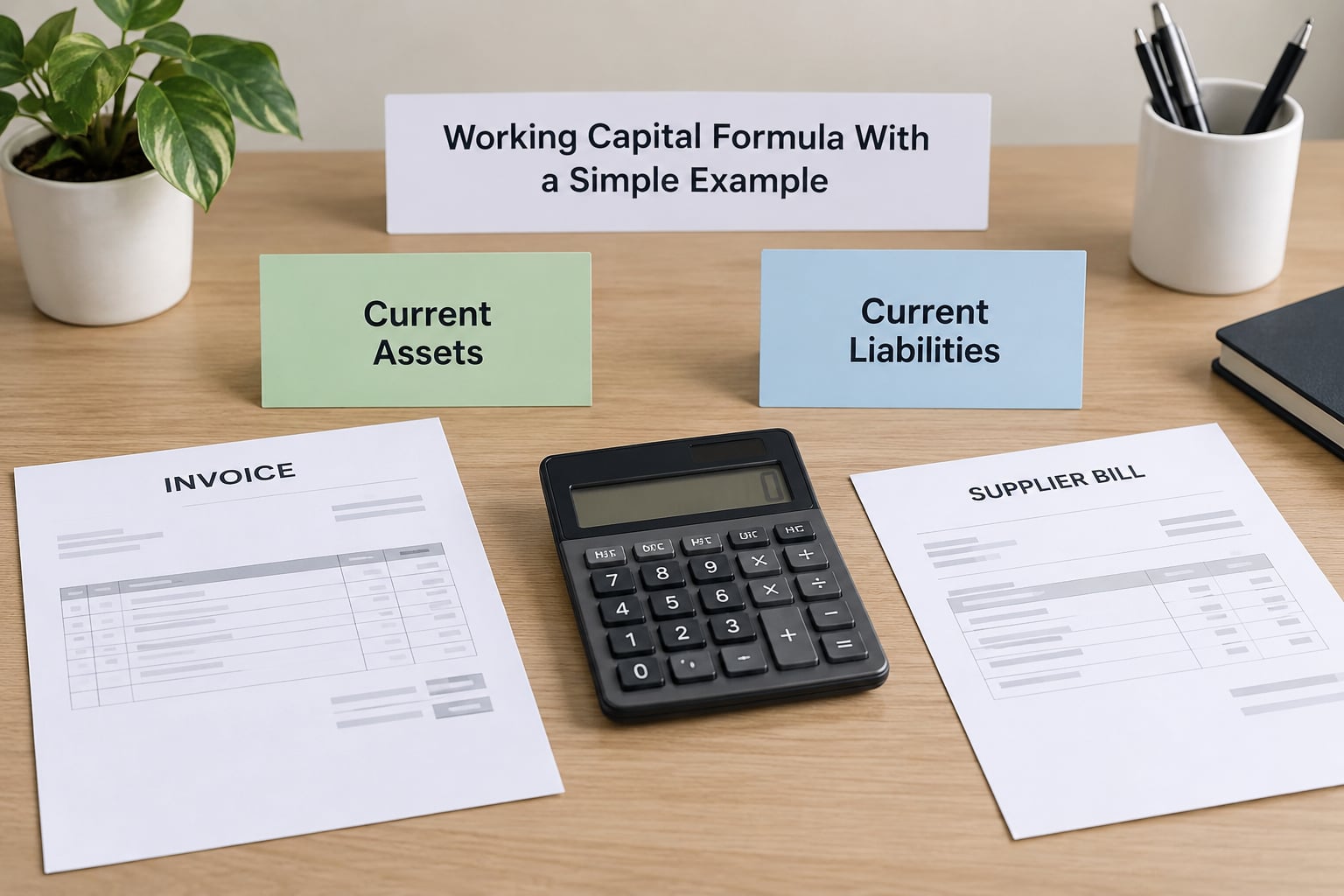
Here is a small design studio, Harbour Lane Design, with its balance sheet at the end of a quarter. The figures are illustrative but the structure is the one any accountant would use.
| Current assets | Amount |
|---|---|
| Cash and equivalents | 26,000 |
| Accounts receivable | 74,000 |
| Prepaid software and insurance | 8,000 |
| Supplies on hand | 6,000 |
| Short-term deposit | 34,000 |
| Total current assets | 148,000 |
| Current liabilities | Amount |
|---|---|
| Accounts payable | 41,000 |
| Accrued payroll and withheld taxes | 22,500 |
| Sales tax payable | 14,000 |
| Customer deposits to deliver on | 16,000 |
| Credit card balance | 10,000 |
| Total current liabilities | 103,500 |
Working capital = 148,000 − 103,500 = 44,500. The current ratio is 148,000 ÷ 103,500, or 1.43. The quick ratio, stripping out supplies and prepayments, is 1.30.
Now change one line. A client pays an overdue 20,000 invoice. Current assets rise to 168,000 and working capital rises to 64,500, with no new revenue and no new borrowing. That single collection is worth more than the studio’s profit margin suggests, because it removes the interest cost of the money it was replacing.
Receivables cut the other way too. Suppose 30,000 of that 74,000 sits with one client who has missed two deadlines. If that invoice is not collectible on schedule, the practical cushion is 14,500 rather than 44,500. A positive number proves arithmetic, not health.
Positive vs. Negative Working Capital
Negative working capital means current liabilities exceed current assets. Many strong businesses run this way permanently, because customers pay before the business pays its own suppliers.
Subscription software, retail and restaurants are standard examples. Deferred revenue and prepaid orders land in the bank first, so the company holds customer money before it has incurred the cost of delivering. A construction firm billing at milestones collects ahead of subcontractors. Inventory-light resellers that turn stock in days can stretch supplier terms longer than they hold inventory.
The distinction that matters is whether the structure is deliberate or accidental.
| Situation | Why it happens | How to read it |
|---|---|---|
| Customer prepayment model | Cash collected before delivery | Structural strength, provided delivery costs are predictable |
| Seasonal trough | Inventory built ahead of a busy period, billed after delivery | Manageable with a line of credit sized to the peak |
| Slow collection | Revenue booked on invoices customers dispute or delay | Warning sign; fix collections before adding debt |
| Persistent losses | Operating costs exceed what the business ever brings in | Negative working capital with no path out |
Owners trading on forums with accountants and business brokers describe negative working capital in inventory-heavy trades as ordinary operating reality rather than failure. The same owners get uncomfortable when a broker tells them that in sub-five-million deals the working capital adjustment usually lands on the buyer, because it decides whether the first post-purchase bill gets paid.
Two habits settle the argument. Read operating cash flow alongside the balance: negative working capital funded by steady collections is a different animal from negative working capital funded by borrowings. And look at the direction of travel over eight quarters rather than at one snapshot.
Why Working Capital Matters for Investors and Business Owners
Working capital tells you whether a business can operate through a quiet month, a delayed customer payment or a jump in supplier prices without stopping. That resilience is what the number measures, and it is the first thing an owner checks after revenue.
It also shapes how much a business can safely grow. Growth consumes working capital, not profit, because every new sale adds receivables and every larger order adds inventory. Two companies with identical revenue can require very different funding at the next 50 percent of growth, and the difference sits in their operating cycles.
Lenders and trade suppliers read it too. A thin cushion turns a normal quarter into a financing conversation, and financing conversations cost money in fees and time. Buyers in an acquisition look for it because working capital delivered with a business is part of what they paid for.
For an investor, working capital is one input among several. Profit tells you whether the engine makes money; cash flow from operations tells you whether the engine keeps running; working capital tells you how much the engine must be fed to stay going. None substitutes for the others, and a strong business can carry a thin cushion by design just as a weak one can hide behind a fat one.
How to Improve or Manage Working Capital
Start by knowing your cash conversion cycle in days. Days inventory outstanding plus days sales outstanding minus days payable outstanding gives the number of days the business must fund itself, and it gives you a before-and-after measure for every change you make.
Then work through these moves in order:
- Shorten the gap on invoices. Bill on completion rather than on a monthly cycle, state payment terms on the first page, and automate reminders at day 7, 21 and 35. A five-day reduction in days sales outstanding is pure funding.
- Ask for deposits. A 30 to 50 percent upfront payment on new projects moves the collection to before the cost. Deposits also tell you something about the buyer before you commit the work.
- Clear the arrears. Chase invoices older than 60 days weekly. Money already billed is the cheapest liquidity available to you.
- Negotiate terms in writing. Ask suppliers for 45 or 60 days instead of 30. Many will trade a modest price adjustment for payment reliability, and the trade is usually worth it when inventory is cheap to hold.
- Cut slow-moving stock. Sell, discount or write off inventory that has not moved in a year. Dead stock sits in current assets while quietly lowering every ratio that includes it.
- Forecast weekly, not yearly. A 13-week cash flow forecast shows the trough before it arrives. Most owners who get caught short had a budget that was accurate and useless, because it never showed a weekly gap.
- Hold a reserve in months of expenses. Three months of fixed costs is a common starting target for a stable business, one to three for a seasonal one, more when suppliers demand it in cash.
- Arrange a facility before you need it. A revolving line, invoice financing or a short-term facility costs little when unused and is far more expensive when lenders can see panic in the numbers.
Keep the cost side in view too. Capital tied up in receivables and stock has a price even when nothing is borrowed, because you could hold it in an interest-bearing account or fund other work with it. Owners rarely quantify that, and it is usually the strongest argument for tightening collections.
Limitations of the Working Capital Measure
Working capital is a snapshot, and snapshots mislead. A business can look strong at year end after a seasonal collection spike and be fragile three weeks later when the lean months arrive. Trend beats level for almost every business except a very young one.
Quality of the components matters as much as the total. Slow receivables, obsolete inventory and prepayments that never convert are current assets in name only. Adjusted or quick measures exist precisely because the standard calculation does not discount those items.
Growth distorts the ratio in the opposite direction. A fast-growing company converts working capital into revenue quickly and may run a thinner balance than a stagnant peer with a large one. That is efficiency, not distress, but you need the growth rate to read it correctly.
Industry norms differ so much that a single benchmark is close to useless. A construction contractor can sensibly operate at negative working capital while a family-owned manufacturer cannot. Compare against businesses with the same payment terms, the same inventory cycle and the same customer base.
Accounting treatment also varies. Deferred revenue, accrued liabilities and slow-moving stock are handled differently under different frameworks and by different preparers, so two figures for the same company are not always comparable. Verify the basis before drawing a conclusion.
Finally, the change in working capital matters more than the level for anyone reading a cash flow statement. The change equals current assets at the end of the period minus current assets at the start, less the same calculation for current liabilities; a rise means cash moved into the business, a fall means it moved out. In an acquisition, buyers negotiate an agreed target figure, and the purchase price adjusts by the difference between the delivered level and that target. Under the direct method the line appears as an operating cash flow item; under the indirect method it is typically folded into the adjustments to reconcile net income to operating cash flow, so a reader may need the notes to find it.
One last caution: the measure says nothing about profit. A business can hold comfortable working capital for years while losing money on every transaction, and it can run a deficit while earning a healthy margin and collecting fast. Read both.
Frequently Asked Questions
No. Working capital includes cash plus items that will become cash within a year, such as unpaid invoices and inventory, minus everything due out within that year. A company with 40,000 in the bank and 80,000 of supplier bills due next quarter still has negative working capital. Cash is one line inside a wider accounting measure.
It depends entirely on what sits behind it. A 1.0 current ratio built on inventory that takes months to move is thin. A 1.0 ratio built on receivables that customers pay within 30 days is comfortable. Judge the ratio alongside the quick ratio, the cash conversion cycle and the trend over several quarters rather than the single figure.
Yes, and many do permanently. Subscription software, retailers, restaurants and milestone-billed contractors collect from customers before they pay suppliers, so current liabilities exceed current assets by design. The figure is only a warning sign when the cause is slow collection, growing losses or borrowing used to plug an operating gap.
There is no universal number, so express it as time rather than as a total. Many owners target three months of fixed operating costs in reserve, with seasonal businesses holding more ahead of a peak and fast-paying industries holding less. Compare your figure with the working capital requirement implied by your own cash conversion cycle.
Public companies list current assets and current liabilities on the balance sheet, and the cash flow statement shows the period-on-period change. Private company figures usually arrive in a set of accounts prepared by an accountant. In a sale, a broker will produce a normalized working capital figure from those accounts as part of the deal.
Conclusion
Working capital is current assets minus current liabilities, and it is the cash cushion that keeps a business running between the moment it pays for something and the moment it gets paid for it.
Start by pulling the last eight quarters of current assets and current liabilities from your accounts, subtract one from the other, and read the trend rather than the last line. Then check the quality of the receivables and inventory behind that number, look at operating cash flow beside it, and list the obligations due over the next 90 days. If you are weighing an offer to buy a business, the working capital figure in those accounts deserves as much attention as the price.
Source: https://www.pgm-blog.com/what-is-working-capital/
Anyone can join.
Anyone can contribute.
Anyone can become informed about their world.
"United We Stand" Click Here To Create Your Personal Citizen Journalist Account Today, Be Sure To Invite Your Friends.
Before It’s News® is a community of individuals who report on what’s going on around them, from all around the world. Anyone can join. Anyone can contribute. Anyone can become informed about their world. "United We Stand" Click Here To Create Your Personal Citizen Journalist Account Today, Be Sure To Invite Your Friends.
LION'S MANE PRODUCT
Try Our Lion’s Mane WHOLE MIND Nootropic Blend 60 Capsules
Mushrooms are having a moment. One fabulous fungus in particular, lion’s mane, may help improve memory, depression and anxiety symptoms. They are also an excellent source of nutrients that show promise as a therapy for dementia, and other neurodegenerative diseases. If you’re living with anxiety or depression, you may be curious about all the therapy options out there — including the natural ones.Our Lion’s Mane WHOLE MIND Nootropic Blend has been formulated to utilize the potency of Lion’s mane but also include the benefits of four other Highly Beneficial Mushrooms. Synergistically, they work together to Build your health through improving cognitive function and immunity regardless of your age. Our Nootropic not only improves your Cognitive Function and Activates your Immune System, but it benefits growth of Essential Gut Flora, further enhancing your Vitality.

Our Formula includes: Lion’s Mane Mushrooms which Increase Brain Power through nerve growth, lessen anxiety, reduce depression, and improve concentration. Its an excellent adaptogen, promotes sleep and improves immunity. Shiitake Mushrooms which Fight cancer cells and infectious disease, boost the immune system, promotes brain function, and serves as a source of B vitamins. Maitake Mushrooms which regulate blood sugar levels of diabetics, reduce hypertension and boosts the immune system. Reishi Mushrooms which Fight inflammation, liver disease, fatigue, tumor growth and cancer. They Improve skin disorders and soothes digestive problems, stomach ulcers and leaky gut syndrome. Chaga Mushrooms which have anti-aging effects, boost immune function, improve stamina and athletic performance, even act as a natural aphrodisiac, fighting diabetes and improving liver function. Try Our Lion’s Mane WHOLE MIND Nootropic Blend 60 Capsules Today. Be 100% Satisfied or Receive a Full Money Back Guarantee. Order Yours Today by Following This Link.


| Visits: | 1,834,037,191 |
| Stories: | 8,715,887 |
Whistler Blowers, Insiders

