

Hegseth’s Holy War: Livestream Execution of Nidal Hasan Linked to Ben-Gvir’s Gallows

Why Pete Hegseth singled out Nidal Hasan for execution, well before other death row inmates, and how a small group of Pentagon officials crafted plans to livestream the event in service of a global crusade.
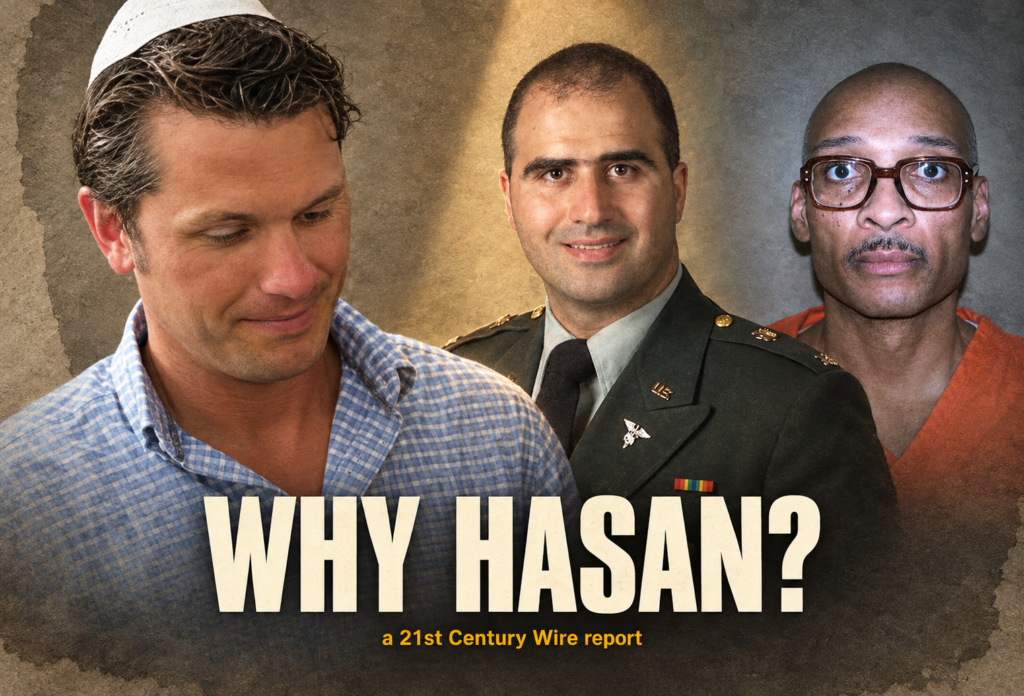
Freddie Ponton
21st Century Wire
Former US Army psychiatrist, Nidal Hasan, is scheduled to be executed by military firing squad at Fort Hood base on December 3, 2026, at 1 p.m. CST, returning him to the site of the infamous mass shooting in 2009, in which he murdered 13 people and attempted to murder another 32. In his defense, Hasan stated in his trial that he had switched sides in what he called an American “war on Islam,” and believed the American soldiers at Fort Hood were about to deploy to Afghanistan, and pose an immediate danger to Muslims and Taliban militias there.
President Donald Trump approved his death sentence on October 2, at the recommendation of Defense Secretary Pete Hegseth, according to a post on X from Pentagon spokesperson Sean Parnell.
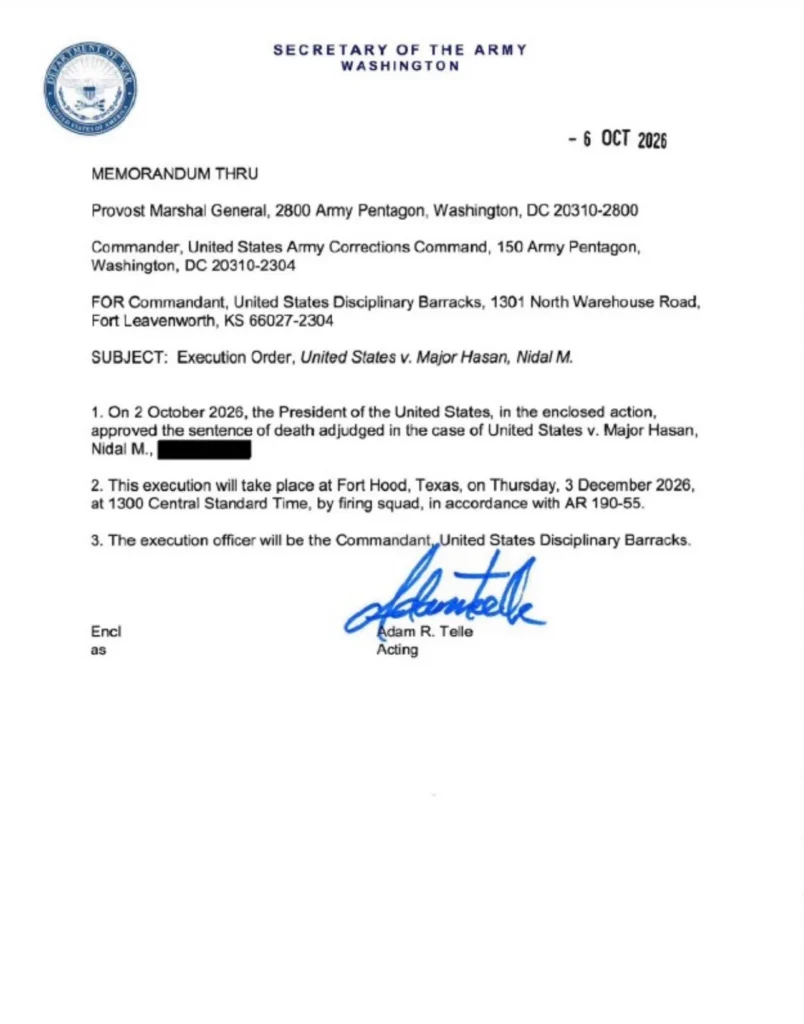
IMAGE: Acting Army Secretary Adam Telle’s October 6 order directing Nidal Hasan’s execution by firing squad at Fort Hood on December 3, 2026 (Source: Office of the Secretary of the Army)
Rather than being executed behind the walls of the federal facility at Terre Haute, Indiana, where the Army normally sends condemned prisoners, Hasan will face an Army firing squad at the scene of his crime.
More crucially, Hegseth has also proposed a worldwide livestream of the event, which would be an unprecedented global media broadcast of an American execution—civilian or military.
The cancellation of the proposed broadcast left unanswered why Hasan was chosen ahead of prisoners who had spent decades longer on military death row.
Why did Hegseth move Hasan ahead of Gray and Akbar?
Of the four prisoners under military death sentences at Fort Leavenworth, Ronald Adrin Gray, Hasan Akbar, Timothy Hennis and Nidal Hasan, Hasan is the most recent arrival.
Gray, a Black former Army specialist convicted of multiple murders and rapes committed around Fort Bragg, has been on military death row since 1988.
Hasan was not the only Muslim on military death row. Hasan Akbar, a 34-year-old Muslim from South Los Angeles, had been sentenced to death way back in 2005 for killing two US military officers in Kuwait.
After President George W. Bush approved Gray’s execution in July 2008, the Army set a date of December 10 of that year, but a federal judge issued a stay on November 26. The stay was eventually lifted in 2016, yet Gray continued pursuing federal habeas challenges, and according to the Army’s own 2026 legal-journal account, the Army had not set a new execution date.
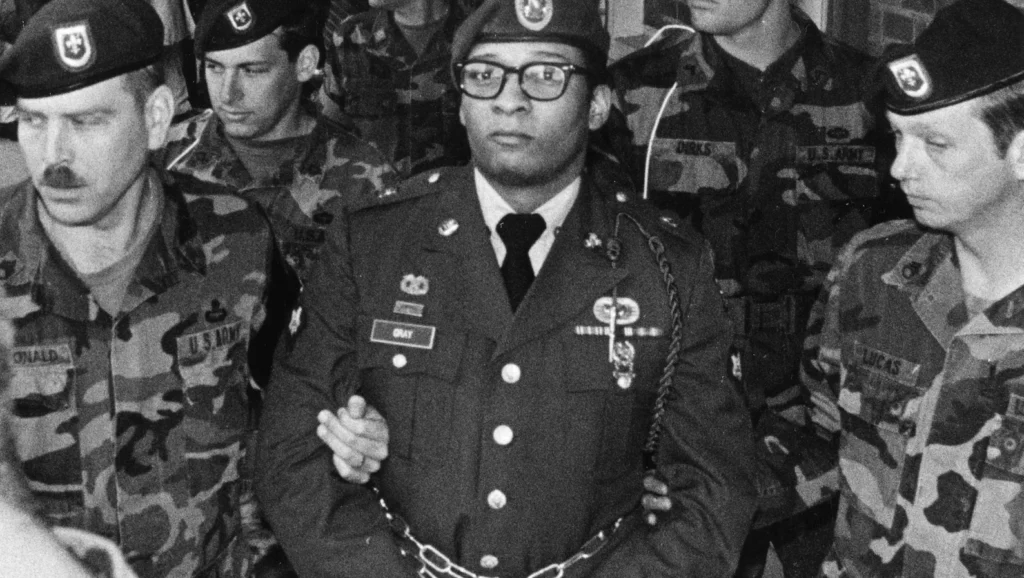
IMAGE: Ronald Gray leaves a Fort Bragg courtroom under military escort on April 6, 1988. President George W. Bush approved his execution twenty years later, but a federal judge stayed it (Source: The Fayetteville Observer)
To this day, Gray remains on military death row at Fort Leavenworth, having filed a new habeas petition in December 2018 that raised 19 challenges to his convictions and sentence, as detailed in a June 2021 federal-court order. The proceedings continued into at least March 2024, when a further order described the issues as “extremely complex.”
Hasan’s case reached presidential review after the Supreme Court declined his petition in March 2025, completing his direct appeals. He could still seek federal habeas relief, the same avenue Gray has pursued.
Gray’s litigation history may help explain the different treatment, but it does not establish why the Army left him unscheduled—while Hegseth publicly prioritised Hasan. The Pentagon advanced Hasan’s execution after the presidential approval in 2026, while Gray still remained without a date—no less than 18 years after his sentence received the very same authorisation.
Why Hasan, then? Gray already had presidential approval, and Akbar’s presence on death row means Nidal Hasan’s Muslim identity alone cannot explain why he has been fast-tracked by the Trump administration.
Hasan’s political usefulness offers one possible explanation, since his punishment at Fort Hood could turn the scene of his attack into a stage for “fighting radical Islam” which Hegseth has publicly associated Hasan’s execution. This theme becomes even more relevant when married with the fact that the Trump administration is struggling to justify two costly war of aggression it is prosecuting against Muslim countries—on Iran, and Yemen.
Did Hegseth set Hasan’s execution machine in motion?
Five months later, in February 2026, the Army circulated Operation Resolute Justice, an internal plan for the potential execution of all four prisoners. It assigned responsibilities and set timelines for transporting the prisoners, arranging witnesses, and coordinating with the official federal execution facility at Terre Haute.
Hegseth’s push to execute Hasan appears to have helped turn dormant procedures into active preparations. An Army legal-journal article linked his request to renewed attention to execution procedures among military lawyers, and described an accelerated timeline in Hasan’s case.
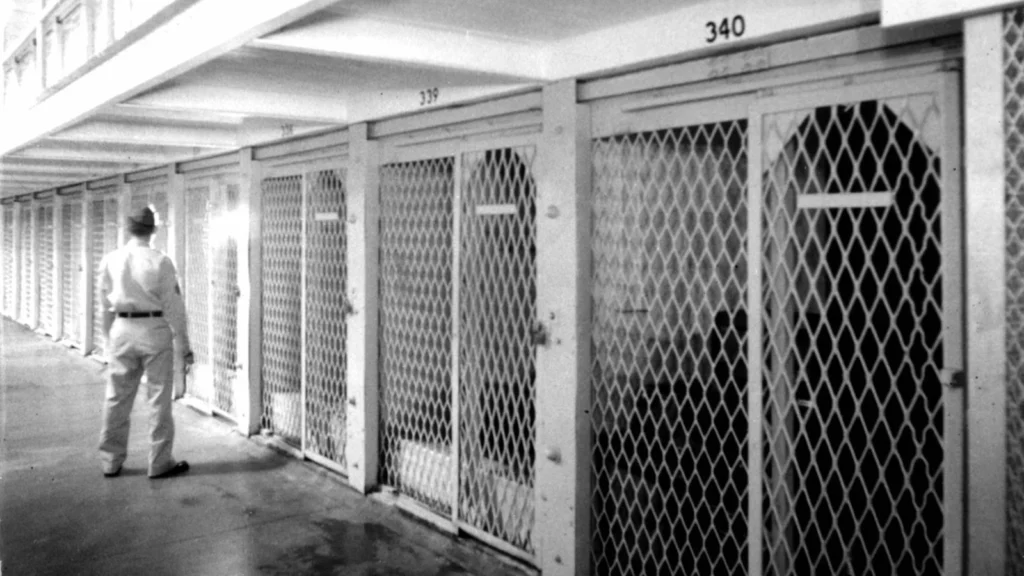
IMAGE: Cells in the original U.S. Disciplinary Barracks at Fort Leavenworth, known as the “Castle”. The Army reproduced this archival photograph in its 2026 review of execution procedures following Hegseth’s push to execute Hasan (Source: U.S. Army / The Army Lawyer)
It’s true that Trump’s Executive Order 14164 had already established a federal policy favouring capital punishment, but it did not expressly order military executions. Again, it must be noted that Hegseth gave that broader agenda a specific target when he publicly demanded Hasan’s execution—months before the Army circulated its four-prisoner plan in Operation Resolute Justice.
The originating instruction remains outside of the public record examined here, leaving unresolved whether or not Hegseth’s demand launched the plan, or accelerated work already underway. His intervention placed Hasan at the centre of the military’s return to executions, and the arrangements that followed have clearly designated his death as more important than those of the other prisoners that would’ve been scheduled ahead of Hasan.
Operation Resolute Justice reportedly called for transferring condemned prisoners to Terre Haute, where the federal government already had the personnel and infrastructure to carry out their executions by lethal injection. However, in the case of Hasan, standard procedures have suddenly been rewritten. Fort Hood replaced Terre Haute, and Army riflemen replaced lethal injection, bringing Hasan back to the scene of his crime to face execution.
Hegseth’s proposed livestream execution would have broadcast Hasan’s death to a global audience, which Trump had initially endorsed the livestream, but then subsequently reversed his support for the broadcast, ruling it out on October 15, while still allowing victims’ immediate families to attend in person.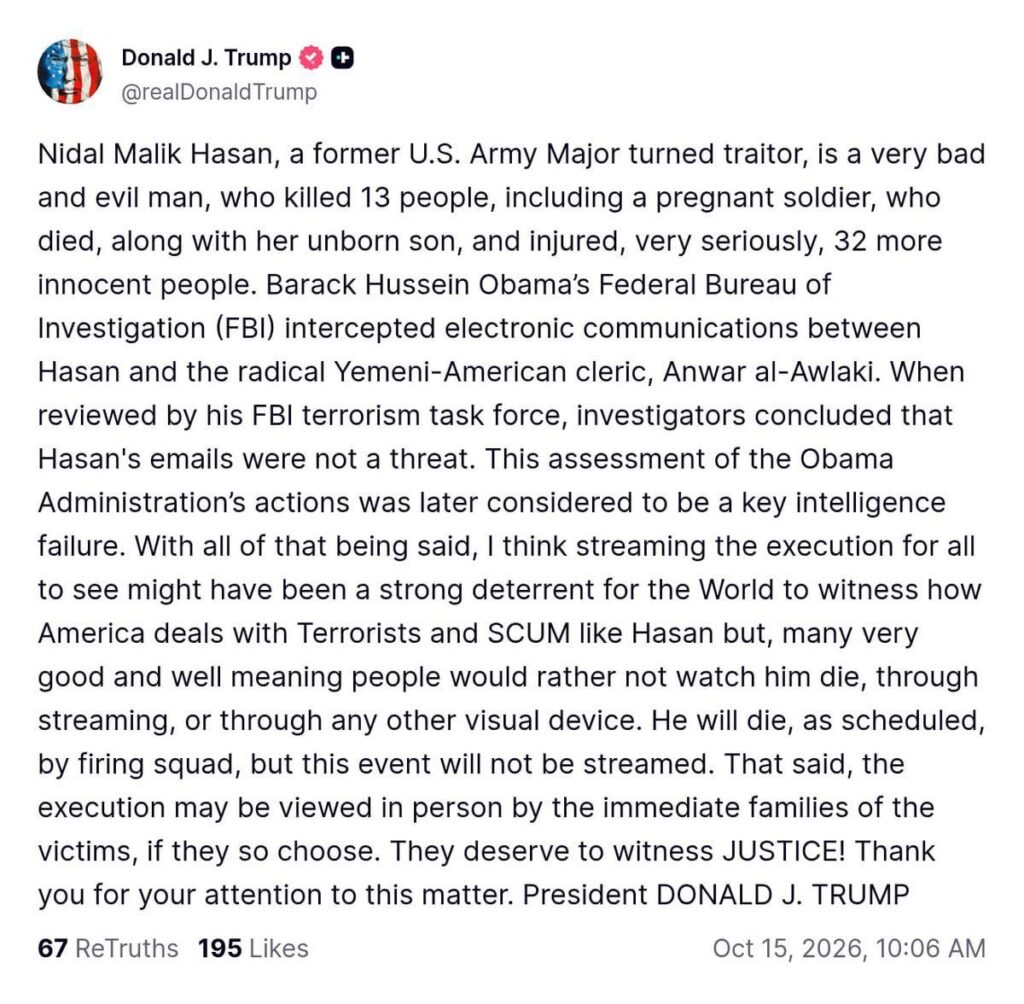
Army Regulation 190-55 limits attendance to approved witnesses, including military personnel, families, and victims’ representatives, and at least two news-media representatives, and bars anyone under 18. Broadcasting the execution to an unrestricted global audience would have taken it well beyond the normally controlled arrangements.
The evidence now indicates that the proposed livestreamed killing was the work of a small group at the Pentagon. According to CNN, citing sources around the decision process, Hegseth, acting Army Secretary Adam Telle, Pentagon spokesperson Sean Parnell, and Parnell’s staff, had decided that his promise of a “public” execution meant an online broadcast. Three sources told the network that the announcement caught Pentagon and Army officials ‘off guard’.
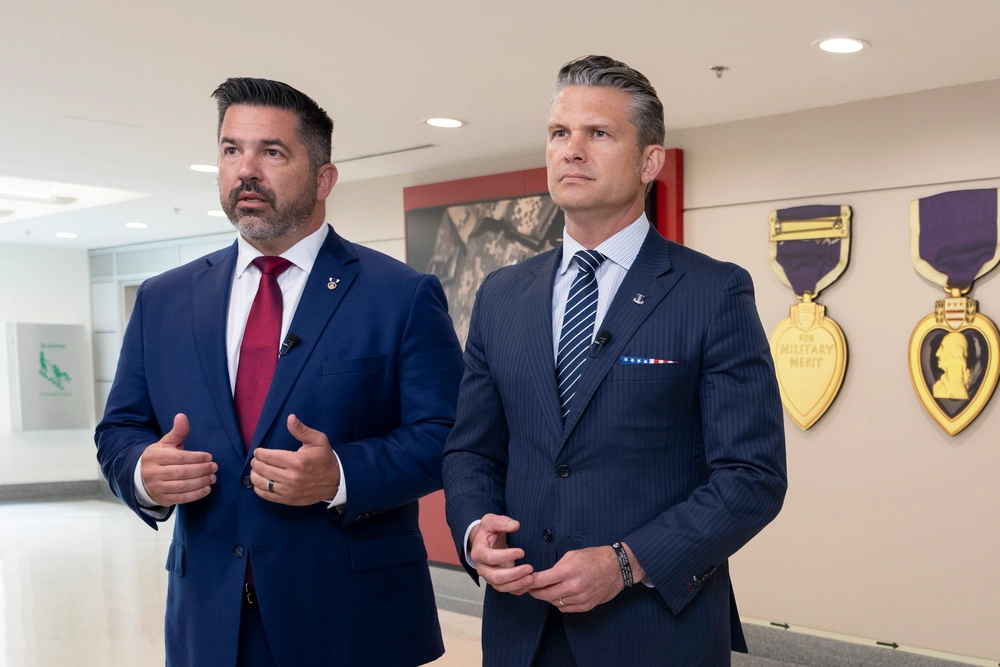
IMAGE: Pete Hegseth and Sean Parnell recording Pentagon remarks in August 2025. CNN later identified both among the officials who decided Hasan’s execution would be livestreamed (Source: U.S. Department of Defense / DVIDS)
As Trump asserted that the final decision on livestreaming would be his, advisers explored ways to limit what viewers would see. By October 13, ABC News reported, they were considering cutting away before the shooting or placing the camera outside the execution area. The Pentagon continued to insist that the broadcast would proceed, with a defence official telling ABC, “The Secretary is correct. It will be live streamed. Details will follow.”
Two days after Hegseth’s announcement, a media backlash ensued, and Trump then withdrew his endorsement of the broadcast, although he still argued that streaming it might have served as a deterrent by showing the world how America ‘deals with terrorists’.
Trump likely judged that, with opposition intensifying and the midterm elections approaching, the political risks of broadcasting the execution could be immense.
Hegseth’s livestreamed global provocation
Pentagon spokesperson Sean Parnell and his staff are reported to have helped make the decision that Hasan’s execution would be livestreamed, placing the Army leadership in a potentially compromising position. Taking the execution beyond approved witnesses and onto a global platform would have politically exposed the Pentagon in ways that previous administrations could hardly have imagined. Once released, the footage would then take on a life of its own—far beyond what would normally be carefully crafted and tightly controlled messaging by the Pentagon. The same images intended to demonstrate American strength could be recut and recirculated, over and over, and more likely by a plethora of Islamic organizations, not to mention the very ‘radical’ organisations which Hegseth was seeking to confront through this incredible public spectacle.
SEE ALSO: Crusader-in-Chief: Pete Hegseth’s Christian Zionist Mission to Help Israel Confront Iran
The irony here is that it was originally Hasan’s desire to be killed during the mass shooting, as he believed that would make him a martyr—a fate he was unable to attain, due to the fact that he was wounded by military police during his attack. By fast-tracking his execution, and broadcasting it globally, Hegseth was clearly giving Hasan the very religious platform he was seeking. Indeed, Hasan has stated that his execution would fulfil martyrdom, according to a George Washington University case study drawing on correspondence with him. Few could argue that by broadcasting footage of American soldiers killing him would provide great propaganda and recruitment material for jihadist groups and their supporters to promote the martyrdom he sought.
DOCUMENT: A GWU study records Hasan’s belief that execution would make him a martyr (Source: George Washington University)
HASAN A CASE STUDY
ABC News reported concerns inside the administration that the recording could be used for recruitment. Lawmakers and national-security critics also warned of the broadcast’s wider consequences.
Hegseth’s ‘American Crusade’ against Islam
Hegseth called Hasan’s crime a “radical Islamist attack in uniform”, and emphasised that American soldiers would carry out the punishment, as Rolling Stone reported. His language presented the firing squad as military retribution against the ‘Islamist enemy’, injecting a clear ideological and geopolitical theme into the livestream broadcast.
In his book, American Crusade, Hegseth rejects the description of Islam as “a religion of peace”, and invokes the Christian crusades beginning in the 11th century as directly connected to today’s Christian nationalist anger, as NPR’s examination of his published work demonstrates. This also ties directly to Hegseth’s own extremist Christian Zionist believes, including his controversial public calling for the rebuilding of a Jewish Third Temple on the present Islamic holy site of the Al Aqsa Mosque in Jerusalem—a brazen move which which almost certain ignite a global religious war, pitting Christian Zionists and Jewish Zionists against the global Muslim community.

IMAGE: Hegseth’s American Crusade, published in 2020, lays out the worldview examined here (Source: Hachette Book Group))
Moreover, Trump’s self-styled “Secretary of War” Hegseth also has the crusader iconography tattooed over large parts of his body, featuring a large Jerusalem Cross on his chest, and the latin phrase “Deus Vult” tattooed on his right arm, along with the word “Infidel” written in Arabic along the bottom of his right bicep. These reinforce Hegseth’s own radical political worldview in which Christianity and America face a shared enemy, and that military power must be deployed to fight this holy war.
An Army officer who attacked fellow soldiers and later described his desire for martyrdom, Hasan embodied the Islamist enemy inside the gates’ of the West, further fueling the obvious ‘clash of civilizations‘ which is being aggressively deployed by the conservative right in order to frame the highly emotive immigration issue that is dominating large sections of the western political discourse. Thus, by emphasising that US soldiers would carry out his capital punishment, Hegseth could present the execution as the military confronting and destroying that enemy.
There is also an obvious revanchist theme, as Hegseth also views a military firing squad as a return to the ‘greatest generation’, engendering “the mentality we had in World War II, which was to win.”
The message is clear: the public spectacle of Hasan’s execution could dramatise the confrontation between America and radical Islam—a clear motive that runs through Hegseth’s published work.
While this political motive does not prove why he was selected ahead of Gray, it undeniably sharpens the question of how his case became the priority.
Was Hasan talking to a federal informant?
The story of Nidal Hasan eventually leads us to one Anwar al-Awlaki, the infamous American Islamic cleric with whom Hasan corresponded, and who later became associated with al-Qaeda. But al-Awlaki was already known to the government long before Hasan began writing to him, as the National Security Archive’s collection of documents shows.
Whenever Awlaki is mentioned in conjunction with the Nidal Hasan case, it is reflexively framed as Awlaki somehow radicalising Hasan, thus reinforcing the narrative that Hasan’s criminal act was inspired by al-Qaeda. However, many journalists and researchers have previously highlighted al-Awlaki as a ‘person of interest’—not necessarily as a ‘terror mastermind’, but as a possible government informant.
In February 2002, reports revealed al-Awlaki as having visited the Pentagon as an invited luncheon speaker—while under FBI investigation. Surveillance logs record agents following him to the building. A peculiar dilemma: one part of the government was welcoming the man, while another was watching him.

IMAGE: FBI surveillance of Anwar al-Awlaki on February 5, 2002, the day he attended a Pentagon luncheon (Source: Fox News)
It turns out that FBI agents had previously interviewed al-Awlaki repeatedly following September 11 and placed him under round-the-clock surveillance, according to records in the National Security Archive’s collection. Reporting on the precarious Pentagon visit raised more questions—a narrative at odds with the government’s public characterization of him as a leading ‘terror’ figure.
When pressed on the matter, the Pentagon publicly described the seemingly unlikely invitation as outreach to the Muslim community, according to CBS’s reporting. But the same report said officials also regarded al-Awlaki as a potential investigative source. That leaves an open question as to whether their contact served more than one purpose, without establishing that the luncheon itself was an attempt to recruit, or debrief him as a military intelligence asset. However, it confirms that at the very least, al-Awlaki had a relationship with the US government.
Before al-Awlaki returned to the United States from the UK in October 2002, his case had already reached the FBI director and the attorney general. A Fox News investigation drawing on records obtained by Judicial Watch identified an October 3 memorandum from Robert Mueller to John Ashcroft, marked secret and bearing an al-Qaeda-related designation. The substantive text was entirely redacted, revealing the level at which his case was being discussed, but not what officials intended to do.
When al-Awlaki arrived at JFK on October 10, 2002, customs officers detained him. However, FBI special agent Wade Ammerman intervened, and authorised his release—despite what Fox News described at the time as an active arrest warrant. The Justice Department withdrew the warrant that same week, saying the underlying passport-fraud case was weak. The case becomes more compelling, after Al-Awlaki later appeared with a government witness at the home of Ali al-Timimi, a Virginia-based Islamic scholar under investigation by Ammerman’s counterterrorism investigation, although the reporting could not establish whether or not the FBI had arranged that visit.
Twelve days after the airport release, an October 22 FBI memorandum bearing al-Awlaki’s name carried the synopsis “Asset reporting,” according to the same investigation. Al-Timimi’s defence attorney interpreted the document as indicating that al-Awlaki either was an asset, or had been put in contact with one. Note that this was the attorney’s assessment, and not a confirmed finding. Certainly the wording warrants further examination, although it does not, by itself, establish that al-Awlaki was an informant in this instance. Nor can this potentially important detail be ignored, as it could form a trail of evidence that would indicate that al-Awlaki may have much more than the public face of an ‘American al-Qaeda’.
More questions began to mount. Asked about a possible recruitment effort in 2013, Mueller said he had no personal knowledge of one, but could not rule out an approach elsewhere in the FBI or another agency, according to Fox’s account of the exchange. Al-Timimi’s lawyers were also seeking evidence that al-Awlaki had been a government informant when the men met in October 2002. Prosecutors maintained that they had disclosed everything required and declined to say whether al-Awlaki had been an informant, according to the Associated Press report.
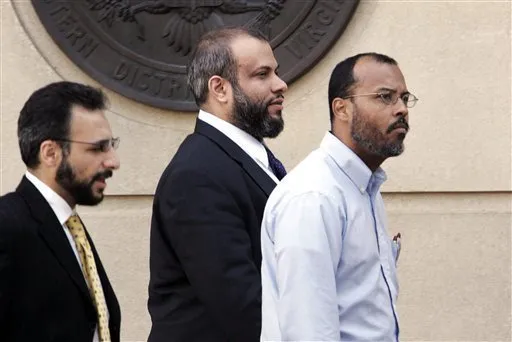
IMAGE: Ali al-Timimi outside court in 2005. His lawyers later sought records on al-Awlaki’s possible informant role. (Source: San Diego Union-Tribune)
Mueller’s answer left the recruitment question unresolved, while the discovery dispute brought the possibility that al-Awlaki had worked with the government in relation to the court case. Another key unanswered question is what US government officials sought from the cleric, and whether those earlier dealings shaped how they assessed him when Nidal Hasan began writing to him years later.
Hasan began writing to al-Awlaki in December 2008, repeatedly seeking religious guidance and approval. The cleric sent only two direct replies—one of which was addressing Hasan’s search for a Muslim wife, according to an examination of the messages published after the Webster Commission’s review. Neither reply contained terror attack instructions or overt operational planning. The correspondence reveals Hasan’s attraction to al-Awlaki, but does not show the cleric recruiting him or directing the attack. The FBI was intercepting their messages before the shooting, yet it’s Washington’s assessment that these were consistent with Hasan’s professional psychiatric research, and so they did not pursue a fuller terrorism investigation, according to the Senate investigation into ‘missed warnings’. After the massacre, the Webster Commission identified shortcomings in how the bureau reviewed information, handled investigative leads and resolved disagreements between offices, as the FBI acknowledged in its response to the findings. Thus, it was concluded that investigators had access to the correspondence, but failed to assess its significance and act on the warnings it contained.
DOCUMENT: The Webster Commission recorded an unresolved FBI disagreement over Hasan—and no further action by either field office. (Source: Webster Commission report, hosted by CNN)
william.webster
The emails received a different kind of scrutiny at Hasan’s court-martial. Judge Tara Osborn excluded the correspondence, concluding that the redactions needed to avoid unfair prejudice by association would diminish its evidentiary value. Messages that had helped shape the public account of Hasan’s radicalisation therefore never became trial evidence of recruitment or direction by Anwar al-Awlaki.
What remains undisclosed is whether Hasan’s defence received records concerning possible source recruitment, the classified October 2002 activity, the JFK release, or the informant allegations raised in al-Timimi’s case. The record examined here does not establish what Hasan knew about those dealings, or whether he knew anything at all. But if he learned that the cleric whose guidance he sought had worked with the government, that knowledge could have changed his understanding of this critical chain of events. Establishing whether any such relationship existed, and whether Hasan knew of it, requires examining what his defence requested and what the government searched, disclosed or withheld.
Regardless, Hasan’s responsibility for the Fort Hood murders does not settle those questions. So before officials turn his execution into the closing scene of an American soldier’s recruitment by an ‘al-Qaeda enemy’, they should also account for their own dealings with that supposed outsider. CBS reported that officials had regarded al-Awlaki as a potential investigative source, years before the government intercepted Hasan’s appeals to him. Executing him would foreclose any further opportunity to question him about them. Yet another good reason why there should be a full disclosure of these communications before an execution, and not left to languish in speculation for years afterwards.
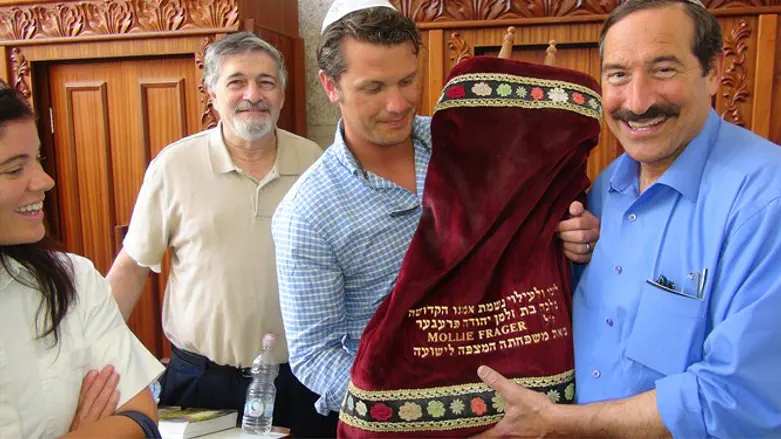
IMAGE: Hegseth holds a Torah scroll donated by Joseph Frager’s family during a Frager-organised visit to Hebron in August 2016 (Source: Israel National News)
Israel’s role in elevating Pete Hegseth in the Trump administration
While the mainstream media narrative tells the story that Donald Trump’s decision to select Pete Hegseth as Secretary of Defense was because of his high-visibility position as a Fox News host, the reality is that pro-Israel advocacy and conservative Zionist networks played the decisive role in elevating and positioning, and lobbying US senators for this key cabinet position. Details from multiple investigations reveal how the Israel lobby had already positioned Hegseth as a trusted, hardline Christian Zionist ally long before his nomination in late 2024.
His Christian nationalist confrontation with Islam gives Hasan’s execution even more political significance, and connects Hegseth’s insistence on staging this public spectacle to his intimate relationships with hard-right Israeli and Christian-Zionist circles. These connections include Joseph Frager, the Israel Heritage Foundation and Jonathan Burkan. The details of these relationships leave no doubt as to how Hegseth was shortlisted for his current role. Examining those relationships helps explain the radical religious political world in which Hegseth has been operating in, and how Israel capitalized on its influence to shape Hegseth into its most malleable tool within the Trump administration. This includes how Israel has successfully pulled the US into the disastrous Iran war.
Hegseth was not the only official involved in shaping the execution’s public presentation. It was Acting Army Secretary Adam Telle who set the date and location and reportedly joined the livestream decision, previously led the Trump White House’s Senate liaison operation. His official Army biography credits him with helping deliver the Abraham Accords, placing another participant in the execution planning within the administration’s broader project of strengthening Israel’s regional position.
Pentagon spokesperson Sean Parnell brought his own outspoken support for Israel and Netanyahu. In May 2021, he publicly affirmed Israel’s right to defend its people, and following October 7, 2023, he praised Netanyahu’s leadership and demanded uncompromising retaliation against Hamas. Again, it was Parnell and his staff who decided that Hasan’s execution should be livestreamed. Undoubtedly, Hegseth’s portrayal of America and Israel as partners in a civilizational struggle gives the proposed spectacle its wider political significance. The killing of an ‘Islamist enemy’ could have become an image of vindication for constituencies already persuaded that overwhelming force must be deployed in defence of Western civilisation, which is ‘under siege from radical Islam’. Their language and clarion call echo near-identical rhetoric by Israeli Prime Minister Benjamin Netanyahu (currently wanted by the International Criminal Court for crimes against humanity), who has repeatedly framed Israel’s various wars of aggression a defense of “Western and Judeo-Christian civilization against radical Islam”. From a political perspective, the radical Christian nationalist and Zionist beliefs and alliances of Hegseth, Telle, and Parnell make the intended message a matter of public accountability.
These men owe the public an explanation as to exactly whose interests, and whose security would have been served by broadcasting Hasan’s death to the world, as well as what role their own ideological and religious beliefs have played in rewriting US military procedures on executions.
Ben-Gvir and Hegseth seek to weaponise state executions for political ends
It’s important to note here that Israel’s controversial National Security Minister, Itamar Ben-Gvir, has made capital punishment for Palestinians convicted of ‘terrorism’ by Israeli military courts a central pillar of his radical political project. The execution facilities and observation booths for victims’ families give that project a physical form, making the prisoner’s death something to witness, with the state’s power on full display.
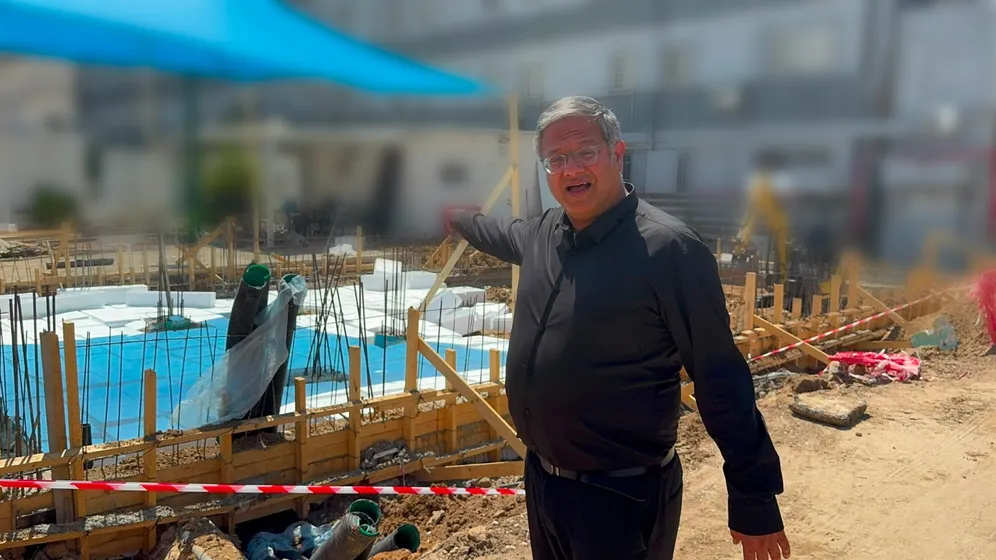
IMAGE: Ben-Gvir presents the execution facility under construction, announcing plans for observation areas for victims’ families (Source: i24NEWS)
It must also be stressed that Ben-Gvir’s medieval-style gallows and Hegseth’s livestreamed spectacle would have served different audiences, but both placed spectatorship at the centre of capital punishment. One offered victims’ families a view of the execution, while the other would have opened it to the world. Both are invoking similar themes of a civilisational war on ‘Islamic terror’. In both, the condemned prisoner could become a stand-in for a larger enemy, his killing presented as proof that the state could deliver the retribution its leaders had promised.
That said, the timing of Ben-Gvir and Hegseth’s state spectacles should not be treated as coincidence. These two archaic initiatives are very much linked, and stem from the same political and ideological source, and carry the same objectives.
In both cases, Ben-Gvir and Hegseth are weaponising the death sentence to promote their beliefs, turning the killing of a prisoner into a public demonstration of how they intended to confront their enemies. Ben-Gvir had invoked American precedent to defend observation booths where families of victims could watch executions. Hegseth proposed taking that spectacle to a global audience, using an execution to project a message of power far beyond the prison walls. Both cast Christians and Israelis as allies in a civilisational struggle against an Islamic enemy, which makes the spectacle an instrument of incitement in a global religious war.
How Hasan’s death could become the military’s new template
Operation Resolute Justice covers all four military death-row prisoners, and the arrangements developed for Hasan could shape the executions that follow. Decisions about the method, personnel, execution site, witnesses, security and public access could outlast the controversy surrounding this incident.
A 2019 revision of Army Regulation 190-55 removed the requirement for lethal injection and gave the Army secretary authority to choose the method of execution. The regulation also requires execution protocols, trained personnel and after-action reports, providing an institutional framework through which preparations for one execution can inform the next. The choices surrounding Hasan could therefore help establish how a reactivated military-execution system operates—whether or not his death is broadcast.

IMAGE: The Army’s execution checklist requires coordinated facilities, trained personnel and a protocol for the chosen method. Highlighting added (Source: U.S. Army regulation, hosted by FederalLibrary.us)
Military-commission cases at Guantánamo fall under a separate statutory framework, which authorises the defence secretary to prescribe execution procedures and requires presidential approval and completed judicial review before a death sentence can be carried out. Any extension of the arrangements developed for Hasan to those cases would require separate examination of the governing rules and litigation.
Hasan may be the politically easiest prisoner through whom to reactivate that system, a man so reviled that the machinery assembled to kill him attracts much less scrutiny than the man does. His notoriety gives officials room to establish new practices that could remain on the books long after his execution.
Ronald Gray already had presidential approval for his execution, yet he remained unscheduled, while Hegseth advanced Hasan. Gray offered an established route to resuming military executions. Hasan offered a political opportunity—a prisoner whose crime and identity matched the enemy Hegseth has spent years telling his audience America must confront.
Hegseth has urged Christians, alongside ‘their Jewish allies’ and the Israeli military, to take up a struggle against the Islamic enemy. An American firing squad killing Hasan at Fort Hood would have turned that rhetoric into a global media spectacle, giving Hegseth a massive platform to promote his Christian crusade.
Trump stopped the broadcast, but Hasan is the prisoner chosen to die first, while other longer serving inmates are left waiting. While Hasan will surely die for his crime, will Hegseth and company ever be held accountable for the rank politicisation of his death?
READ MORE US NEWS AT: 21st CENTURY WIRE US News ARCHIVES
SUPPORT OUR INDEPENDENT MEDIA PLATFORM – BECOME A MEMBER @21WIRE.TV
VISIT OUR TELEGRAM CHANNEL
21st Century Wire is an alternative news agency designed to enlighten, inform and educate readers about world events which are not always covered in the mainstream media.
Source: https://21stcenturywire.com/2026/10/20/hegseths-holy-war-livestream-execution-of-nidal-hasan-linked-to-ben-gvirs-gallows/
Anyone can join.
Anyone can contribute.
Anyone can become informed about their world.
"United We Stand" Click Here To Create Your Personal Citizen Journalist Account Today, Be Sure To Invite Your Friends.
Before It’s News® is a community of individuals who report on what’s going on around them, from all around the world. Anyone can join. Anyone can contribute. Anyone can become informed about their world. "United We Stand" Click Here To Create Your Personal Citizen Journalist Account Today, Be Sure To Invite Your Friends.
LION'S MANE PRODUCT
Try Our Lion’s Mane WHOLE MIND Nootropic Blend 60 Capsules
Mushrooms are having a moment. One fabulous fungus in particular, lion’s mane, may help improve memory, depression and anxiety symptoms. They are also an excellent source of nutrients that show promise as a therapy for dementia, and other neurodegenerative diseases. If you’re living with anxiety or depression, you may be curious about all the therapy options out there — including the natural ones.Our Lion’s Mane WHOLE MIND Nootropic Blend has been formulated to utilize the potency of Lion’s mane but also include the benefits of four other Highly Beneficial Mushrooms. Synergistically, they work together to Build your health through improving cognitive function and immunity regardless of your age. Our Nootropic not only improves your Cognitive Function and Activates your Immune System, but it benefits growth of Essential Gut Flora, further enhancing your Vitality.

Our Formula includes: Lion’s Mane Mushrooms which Increase Brain Power through nerve growth, lessen anxiety, reduce depression, and improve concentration. Its an excellent adaptogen, promotes sleep and improves immunity. Shiitake Mushrooms which Fight cancer cells and infectious disease, boost the immune system, promotes brain function, and serves as a source of B vitamins. Maitake Mushrooms which regulate blood sugar levels of diabetics, reduce hypertension and boosts the immune system. Reishi Mushrooms which Fight inflammation, liver disease, fatigue, tumor growth and cancer. They Improve skin disorders and soothes digestive problems, stomach ulcers and leaky gut syndrome. Chaga Mushrooms which have anti-aging effects, boost immune function, improve stamina and athletic performance, even act as a natural aphrodisiac, fighting diabetes and improving liver function. Try Our Lion’s Mane WHOLE MIND Nootropic Blend 60 Capsules Today. Be 100% Satisfied or Receive a Full Money Back Guarantee. Order Yours Today by Following This Link.


| Visits: | 1,835,425,246 |
| Stories: | 8,723,695 |
Whistler Blowers, Insiders

