

The News-to-Death Ratio Strikes Again

Authored by Carl Henegan and Tom Jefferson via The Brownstone Institute,
There is a peculiar arithmetic that governs modern health reporting, one that has very little to do with actual risk. Hans Rosling captured it neatly during the 2009 swine flu episode, when he calculated a “news-to-death ratio” of 8,176-to-1. In other words, for every death attributed to swine flu, there were over eight thousand news stories. Tuberculosis, by contrast, received less than 0.1 news stories per death over the same period.
If that sounds absurd, it is, and yet very little has changed.
Take the current hantavirus scare. A cruise ship, the MV Hondius, sits off Cape Verde. There are 7 cases in total (2 confirmed, 5 suspected) and 3 deaths, including a Dutch couple and a German national. Passengers have been confined to their cabins while evacuations and disinfection efforts are organised. It is, undeniably, a dramatic story: a floating Petri dish, a whiff of quarantine, and a hint of the exotic.
In the past week alone, there have been at least 10 to 15 unique news stories, generating hundreds of articles. For a disease that, in normal times, struggles to attract even a single weekly mention, this represents a surge bordering on the hysterical.
And yet it is worth stepping back for a moment and asking, what are we actually looking at?
Hantavirus is a rare disease. In the United States, which diligently tracks such cases, there have been 890 laboratory-confirmed instances since 1993. In the UK, the situation is even less clear: from 2012 to early 2025, only 11 domestically acquired symptomatic cases have been recorded. Surprisingly, nine of these cases were not linked to cruise ships or exotic travel, but rather to a more mundane source—exposure to “pet fancy rats” or rodents bred as reptile feed.
This is not a pathogen ready to spread through the Home Counties. However, the rarity is not the issue; visibility is.
Diseases that afflict the poor, quietly and persistently, rarely command attention. Tuberculosis killed 1.23 million people globally in 2024. Over a million deaths every year, largely concentrated in less affluent parts of the world. It is one of the most lethal infectious diseases known to medicine, and yet it barely registers in the Western news cycle.
Why? Because TB is familiar, it is slow; It lacks narrative flair, and it does not trap well-heeled passengers in their cabins while helicopters circle overhead.
If you want coverage, you need something else entirely. You need novelty, uncertainty, and above all, proximity to affluence. A cruise ship outbreak ticks every box: a disease with a balcony suite.
This is the uncomfortable truth behind Rosling’s ratio: the media does not report risk, it reports drama. And drama requires context that audiences can imagine themselves in.

A rodent-borne virus in some remote rural setting barely registers. Put that very same virus aboard a cruise ship with buffet queues, balcony cabins, and a passenger list that looks uncomfortably like the readership, and suddenly it becomes headline news.
The result is a profound distortion of public perception. We are invited to worry about the improbable while ignoring the inevitable and reality. A handful of hantavirus cases generates dozens of headlines; a million tuberculosis deaths pass with barely a murmur.
If we were to apply Rosling’s lens to the present moment, the imbalance would be obvious. Three deaths linked to a suspected hantavirus cluster have produced hundreds of reports in a matter of days. Meanwhile, tuberculosis continues its relentless toll with scarcely a fraction of that attention.
The modern “news-to-death ratio” may not be precisely 8,176-to-1, but the underlying pattern remains intact.
The lesson here isn’t truly about hantavirus; instead, it’s about how we collectively determine what is significant.
Diseases associated with poverty—those that are endemic, predictable, and devastating—often fail to attract media attention because they don’t instill fear in the right audience or in the right way. No one is interested in the thousands of cholera deaths that are too remote, too ordinary, and lack the dramatic impact that draws interest. What commands attention are diseases that puncture our sense of safety, the kind that can slip past the gangway and make themselves at home on a cruise ship.
This post was written by two old geezers who live in a world where risk is misread, priorities are skewed, and the arithmetic of attention bears little resemblance to the arithmetic of death.
Republished from the authors’ Substack
Tyler Durden Thu, 05/21/2026 – 13:00
Source: https://freedombunker.com/2026/05/21/the-news-to-death-ratio-strikes-again/
Anyone can join.
Anyone can contribute.
Anyone can become informed about their world.
"United We Stand" Click Here To Create Your Personal Citizen Journalist Account Today, Be Sure To Invite Your Friends.
Before It’s News® is a community of individuals who report on what’s going on around them, from all around the world. Anyone can join. Anyone can contribute. Anyone can become informed about their world. "United We Stand" Click Here To Create Your Personal Citizen Journalist Account Today, Be Sure To Invite Your Friends.
LION'S MANE PRODUCT
Try Our Lion’s Mane WHOLE MIND Nootropic Blend 60 Capsules
Mushrooms are having a moment. One fabulous fungus in particular, lion’s mane, may help improve memory, depression and anxiety symptoms. They are also an excellent source of nutrients that show promise as a therapy for dementia, and other neurodegenerative diseases. If you’re living with anxiety or depression, you may be curious about all the therapy options out there — including the natural ones.Our Lion’s Mane WHOLE MIND Nootropic Blend has been formulated to utilize the potency of Lion’s mane but also include the benefits of four other Highly Beneficial Mushrooms. Synergistically, they work together to Build your health through improving cognitive function and immunity regardless of your age. Our Nootropic not only improves your Cognitive Function and Activates your Immune System, but it benefits growth of Essential Gut Flora, further enhancing your Vitality.
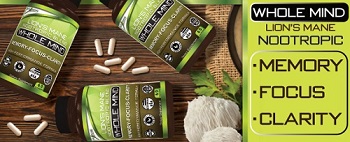
Our Formula includes: Lion’s Mane Mushrooms which Increase Brain Power through nerve growth, lessen anxiety, reduce depression, and improve concentration. Its an excellent adaptogen, promotes sleep and improves immunity. Shiitake Mushrooms which Fight cancer cells and infectious disease, boost the immune system, promotes brain function, and serves as a source of B vitamins. Maitake Mushrooms which regulate blood sugar levels of diabetics, reduce hypertension and boosts the immune system. Reishi Mushrooms which Fight inflammation, liver disease, fatigue, tumor growth and cancer. They Improve skin disorders and soothes digestive problems, stomach ulcers and leaky gut syndrome. Chaga Mushrooms which have anti-aging effects, boost immune function, improve stamina and athletic performance, even act as a natural aphrodisiac, fighting diabetes and improving liver function. Try Our Lion’s Mane WHOLE MIND Nootropic Blend 60 Capsules Today. Be 100% Satisfied or Receive a Full Money Back Guarantee. Order Yours Today by Following This Link.


| Visits: | 1,808,672,484 |
| Stories: | 8,646,896 |
Whistler Blowers, Insiders

