

The Sunlight Factor: Why Death, Disease, and Flu All Rise When the Light Disappears

Sickness Spikes Every Winter (And It’s Not What Your Doctor Tells You)
Every winter, the same quiet pattern repeats itself. More people die. Not just from the flu, but from heart attacks, strokes, dementia, cancer, and respiratory disease. The numbers climb right on schedule, year after year, like clockwork.
Now, doctors blame bad genes, aging, stress, or “seasonal viruses.” But when you line up decades of data and follow the curve honestly, a far more uncomfortable truth shows up—one that almost no one talks about. Because once you see what actually changes just before death rates spike, you can’t unsee it. And it isn’t a virus, a holiday meal, or a crowded room. It’s the moment the light disappears.
Everyone expects cold and flu season to hit hard as the holidays roll in—at least across North America and much of Europe. We’re told it’s about winter bugs, crowded rooms, and nonstop gatherings. And sure, that story feels familiar.
But underneath those surface explanations lies something far more unsettling—and far more powerful. When you zoom out and look at the data, it becomes clear that sunlight itself, or the lack of it, quietly shapes not only when we get sick, but when we’re most likely to die from our biggest killers.
This isn’t folklore. It’s written plainly in mortality charts, pandemic records, and modern immunology.
When Death Follows the Darkest Days

Start with a simple graph. Plot deaths from heart disease, cancer, kidney disease, Alzheimer’s, respiratory illness, and influenza across the calendar year. What emerges is chillingly consistent.
As the days shorten and the sun sinks low in the sky, the curves rise together like a slow, dark tide. Death rates peak roughly one to three weeks after the shortest day of the year. Then, as daylight gradually stretches longer, those same curves begin to fall—bottoming out one to three weeks after the longest day.
In other words, as sunlight returns, deaths from both infectious and non-infectious diseases tend to retreat. And when the light pulls back, mortality surges again.
It’s almost as if the planet itself is breathing—health expanding with the light, vulnerability creeping in with the dark. That pattern alone tells us we’re not just dealing with germs, bad luck, or aging. We’re dealing with biology that’s deeply synced to the sun.
Why Holiday Crowds Don’t Tell the Whole Story
Most of us grew up hearing the same explanation for flu season: people crowd indoors, viruses spread faster, end of story. And yes, proximity matters. More contact creates more opportunities for infection.
But spreading a virus isn’t the same thing as weakening the body’s defenses.
Here’s the part that breaks the old narrative. While Americans and Europeans are packing into houses, offices, churches, and airports in December, Australians are doing the exact same thing. Same holidays. Same parties. Same crowded rooms.
The difference? It’s summer there. Sunlight is abundant.
If gatherings alone caused flu season, Australia should be flooded with influenza at Christmas. Instead, their flu season doesn’t arrive until June and July—when their sunlight dips low and days shorten. The virus didn’t change. Human behavior didn’t change. The sun did.
The Equator’s Quiet Secret
Now strip away seasonality almost entirely by looking near the equator.
Take Singapore, for example—barely 80 miles from the equator, where daylight stays remarkably consistent year-round. There, influenza doesn’t arrive in dramatic winter waves. Instead, cases appear sporadically, at low levels, scattered throughout the year.
Without months of sunlight withdrawal, there’s no explosive flu season. From a distance, the pattern is unmistakable: the more stable the sun exposure, the harder it is for large seasonal disease surges to take hold.
Sunlight vs. Temperature: A Natural Experiment
Of course, winter brings cold along with darkness, which makes teasing them apart tricky. But occasionally history gives us a clean experiment.
That happened in 2009 with the H1N1 influenza pandemic. Instead of arriving in fall, the virus swept through the northern hemisphere in spring and summer. Temperatures were relatively mild—but sunlight levels still varied dramatically by location.
Researchers at Harvard analyzed detailed solar radiation data alongside influenza rates across the U.S., adjusting for latitude, cloud cover, and geography. Their conclusion was refreshingly blunt: sunlight strongly protects against getting influenza.
As sunlight exposure increased, flu incidence dropped—independent of temperature. Light, not cold, was doing much of the work.
What the Spanish Flu Accidentally Taught Us
This insight isn’t new. During the 1918–1919 Spanish flu, hospitals were overwhelmed so quickly that many patients were moved outdoors into tents and open-air wards.
Records suggest that patients treated with sunlight and fresh air often fared better than those kept indoors. At the time, medicine lacked antibiotics and effective antivirals, so forward-thinking physicians leaned on basic elements: light, air, cleanliness, and physical support.
That mindset shaped institutions like the Battle Creek Sanitarium, run by John Harvey Kellogg, which drew on European tuberculosis clinics, high-altitude care, and ultraviolet light therapy. Leaders, industrialists, and explorers traveled there seeking cutting-edge care rooted in nature rather than drugs.
Fever, Aspirin, and a Costly Misstep
At the same time, another idea took hold—that fever itself was the enemy.
After aspirin entered the market in 1899, doctors began using it aggressively during World War I and the Spanish flu. High doses were given to suppress fever, pain, and chills. In hindsight, that may have blunted one of the immune system’s most powerful weapons.
The overall fatality rate during that pandemic reached several percent—far higher than modern COVID-19—largely because pneumonia followed viral infection, and antibiotics didn’t exist. In many army hospitals, fever was driven down while sunlight and fresh air were neglected.
Older “Sanitariums” Worked With the Body
Meanwhile, a group of sanitariums in the northeastern U.S. took a different path. Led by physicians like Dr. Wells Rubel—later head of what became Loma Linda University—these centers refused to reflexively suppress fever.
Instead, they supported it.
Patients were exposed to sunlight, fresh air, and hydrotherapy designed to raise body temperature. Rubel later compared outcomes from these sanitariums with army hospitals. Far fewer patients progressed to pneumonia—the usual death sentence of that era.
Once pneumonia set in, mortality was still high everywhere. But the key difference was that fewer patients ever crossed that line when early immune responses were supported rather than suppressed.
How Heat and Light Prime Immunity
Modern immunology finally explains what those doctors observed intuitively.
The innate immune system—our first line of defense—relies heavily on interferons, signaling molecules that launch rapid antiviral responses. Elevated body temperature enhances this response. Certain forms of hydrotherapy do as well.
Sunlight adds another layer: vitamin D production, nitric oxide release, circadian rhythm alignment, and reduced indoor viral buildup. None of this requires advanced technology or fragile supply chains. It’s grounded in elements humans evolved with.
The Same Sun Shapes Modern Killers
Fast-forward to today. Sunlight’s influence extends far beyond flu.
Heart disease, diabetes, cognitive decline, and many cancers are driven more by lifestyle and environment than genetics. Exercise is now recognized as one of the most powerful “medicines” available. Diet, sleep, and stress matter enormously.
Yet sunlight rarely gets equal billing—despite quietly shaping hormones, immunity, metabolism, and mitochondrial health every single day.
Your Cells, Your Mitochondria, and a Light Deficiency
At the center of this story sit mitochondria—the power plants of your cells. They regulate energy, inflammation, immune signaling, and cell survival.
Healthy sun exposure supports mitochondrial function through vitamin D, nitric oxide signaling, and circadian alignment. But modern life is built to block light. Offices, cars, screens, and artificial lighting leave most people wildly overestimating their sun exposure.
A walk to the car doesn’t count. Light through a window doesn’t count. The result is a chronic, invisible light deficiency layered on top of poor diet, inactivity, and stress.
Staying in Step With the Sun
Pull all of this together—the mortality curves, hemispheric differences, equatorial patterns, pandemic records, and modern biology—and a simple picture emerges.
Sunlight isn’t a backdrop. It’s an active player shaping who gets sick, how severely, and when. Long-term studies show that people with consistent daylight exposure experience lower mortality over time.
Sunlight isn’t a cure-all. But the question is no longer whether it matters. The real question is how different our health outcomes might look if daily life actually made room for it.
Because sometimes, the most powerful medicine isn’t hidden in a lab—it’s rising quietly over the horizon every morning.
Source: https://www.offthegridnews.com/alternative-health/the-sunlight-factor-why-death-disease-and-flu-all-rise-when-the-light-disappears/
Anyone can join.
Anyone can contribute.
Anyone can become informed about their world.
"United We Stand" Click Here To Create Your Personal Citizen Journalist Account Today, Be Sure To Invite Your Friends.
Before It’s News® is a community of individuals who report on what’s going on around them, from all around the world. Anyone can join. Anyone can contribute. Anyone can become informed about their world. "United We Stand" Click Here To Create Your Personal Citizen Journalist Account Today, Be Sure To Invite Your Friends.
LION'S MANE PRODUCT
Try Our Lion’s Mane WHOLE MIND Nootropic Blend 60 Capsules
Mushrooms are having a moment. One fabulous fungus in particular, lion’s mane, may help improve memory, depression and anxiety symptoms. They are also an excellent source of nutrients that show promise as a therapy for dementia, and other neurodegenerative diseases. If you’re living with anxiety or depression, you may be curious about all the therapy options out there — including the natural ones.Our Lion’s Mane WHOLE MIND Nootropic Blend has been formulated to utilize the potency of Lion’s mane but also include the benefits of four other Highly Beneficial Mushrooms. Synergistically, they work together to Build your health through improving cognitive function and immunity regardless of your age. Our Nootropic not only improves your Cognitive Function and Activates your Immune System, but it benefits growth of Essential Gut Flora, further enhancing your Vitality.
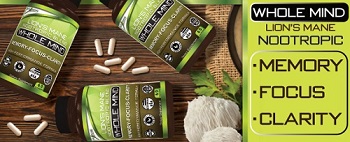
Our Formula includes: Lion’s Mane Mushrooms which Increase Brain Power through nerve growth, lessen anxiety, reduce depression, and improve concentration. Its an excellent adaptogen, promotes sleep and improves immunity. Shiitake Mushrooms which Fight cancer cells and infectious disease, boost the immune system, promotes brain function, and serves as a source of B vitamins. Maitake Mushrooms which regulate blood sugar levels of diabetics, reduce hypertension and boosts the immune system. Reishi Mushrooms which Fight inflammation, liver disease, fatigue, tumor growth and cancer. They Improve skin disorders and soothes digestive problems, stomach ulcers and leaky gut syndrome. Chaga Mushrooms which have anti-aging effects, boost immune function, improve stamina and athletic performance, even act as a natural aphrodisiac, fighting diabetes and improving liver function. Try Our Lion’s Mane WHOLE MIND Nootropic Blend 60 Capsules Today. Be 100% Satisfied or Receive a Full Money Back Guarantee. Order Yours Today by Following This Link.


| Visits: | 1,760,596,176 |
| Stories: | 8,553,172 |
Whistler Blowers, Insiders

