

New Research Says “One Egg A Week” Cuts Alzheimer’s Risk in Half… Here’s Why Homesteaders Should Pay Attention

The Brain-Saving Food Hiding in Your Chicken Coop
Alright, nobody plans to lose their mind.
It doesn’t show up on a calendar or come with a warning label. It creeps in quietly—missed names, lost keys, a growing dependence on systems you thought you’d never need. Meanwhile, doctors spend billions chasing Alzheimer’s with drugs that barely move the needle, while a dirt-simple, dirt-cheap brain food sits warm in a nesting box out back.
And that’s the part that should stop you cold—because the same egg most people treat as a throwaway breakfast may be quietly protecting memory, independence, and clear thinking… especially for folks smart enough to raise their own.
To begin with, eggs are one of the most concentrated, practical brain foods you can raise right outside your back door. No complicated processing. No shipping containers. No cold chain. Just hens, feed, forage, and a nesting box.
Inside that shell, the yolk delivers a powerful trio: choline, omega-3 fats, and lutein. Together, they support memory, learning, and long-term cognitive health as the years roll on. In fact, research now shows that older adults who eat eggs at least once a week tend to have a significantly lower risk of developing Alzheimer’s dementia. Even more striking, they show less Alzheimer’s-type damage in brain tissue after death compared with people who rarely eat eggs at all.
So when you step into the coop on a cool morning and lift a warm egg from the straw, you’re not just thinking about breakfast. You’re thinking about preserving clarity, independence, and sharp thinking—for yourself and for the people you love—using something your own land produced.
What the Science Is Really Saying About Eggs and the Brain

Interestingly enough, this isn’t based on a short-term lab trial or a trendy nutrition headline. One large, long-term study followed over a thousand older, community-dwelling adults for nearly seven years, tracking their diets and cognitive health.
The results were hard to ignore. Those who ate at least one egg per week had roughly half the risk of being diagnosed with Alzheimer’s dementia compared with people who ate fewer than one egg per month. And that was after adjusting for age, body weight, physical activity, education level, and other dietary habits like vegetable and seafood intake.
Even more telling, when researchers examined the brains of a subgroup after death, the egg eaters showed fewer of the classic plaques and tangles that define Alzheimer’s disease.
In other words, every egg cracked at the kitchen counter may be doing quiet, preventive work years—sometimes decades—before memory loss ever shows up.
Choline: The Homestead Nutrient Nobody Talks About
Now, this isn’t just a vague “eggs are healthy” claim. A big part of the story comes down to one underappreciated nutrient: choline.
Choline is essential for making acetylcholine, the neurotransmitter your brain relies on for memory, attention, and learning. It also helps maintain the structure of brain cell membranes and influences how genes related to cognition get switched on and off over time.
Eggs happen to be the single richest source of choline in the typical diet. When researchers dug deeper into the data, they found that nearly 40 percent of the brain-protective effect linked to egg consumption could be explained by choline intake alone.
So when you pasture your birds, feed them well, let them chase bugs and pick at greens, and then cook up those deep-orange yolks, you’re not just making breakfast—you’re creating a farm-made brain supplement that no factory food can match for freshness, flavor, or independence.
Omega-3s, Lutein, and the Power of Pasture-Raised Eggs
Beyond choline, eggs also serve as a steady delivery system for omega-3 fats and antioxidant pigments like lutein. Omega-3s help calm inflammation in the nervous system and support the flexible membranes of brain cells. Lutein, meanwhile, accumulates in both the retina and brain tissue and is linked with better visual performance and sharper cognition as people age.
Here’s where the backyard advantage really shines.
When hens are given access to pasture, garden edges, fallen fruit, insects, and omega-3-rich feed sources, their eggs consistently show higher levels of these protective compounds. The way you manage your flock—rotating them through orchard rows, letting them scratch under trees, supplementing wisely—directly shapes the nutrient density of the food on your plate.
And over years, that nutrient density quietly shapes your family’s resilience, health, and ability to age well right where you are.
Off-Grid Eggs as Everyday Insurance
At the same time, there’s a deeply practical off-grid angle to all of this. Alzheimer’s disease now costs the healthcare system hundreds of billions of dollars every year. Yet here’s a low-tech, dirt-under-the-fingernails strategy that costs little and produces daily returns.
Eggs are soft, easy to chew, and widely accepted—even by older adults who may lose their appetite for tougher meats. That makes them one of the most sustainable, age-friendly proteins you can rely on when the goal is to stay independent on your land for as long as possible.
So when you invest in a sturdy coop, good fencing, and a small flock, you’re not just buying chickens. You’re building a renewable insurance policy that pays out in protein, fat, and brain-protective nutrients—regardless of what happens to the grid, the grocery stores, or the healthcare system.
From Store Dependency to Backyard Abundance
Meanwhile, compare that with the typical store-bought routine. Long supply chains. Fragile distribution. Eggs laid in crowded facilities you’ll never see, hauled across states, and priced at the mercy of fuel costs and policy shifts.
In that world, you’re always one trucking strike or power failure away from empty shelves.
By contrast, a few backyard hens can turn kitchen scraps, garden trimmings, and a bit of grain into a steady, reliable harvest right where you live. Over months and years, that consistency builds confidence. You know breakfast will still be there—even when the lights aren’t.
And because the egg-and-brain research focused on everyday people aging in place, it fits perfectly with the homestead vision: staying sharp, staying active, and staying rooted in a place you’ve prepared with care.
Chickens, Community, and the Rhythm of a Good Day
Beyond nutrition and preparedness, raising chickens brings a different kind of richness into daily life. Stepping outside at first light. Topping off waterers. Scattering feed. Listening for that satisfied cackle that says an egg is waiting.
Those small rituals anchor your day in something living and real.
They pull kids, grandkids, and neighbors into the rhythm too, teaching where food actually comes from—feathers, scratching, and patience, not shrink wrap and barcodes. Over time, that daily contact reinforces a mindset that says, we can take care of ourselves.
And as the years pass, those chores quietly double as movement and mindfulness—walking, bending, lifting, paying attention. Exactly the kind of physical and mental engagement that works hand-in-hand with the brain-protective diet science keeps pointing toward.
Time to Build Your Own Egg Basket
In the end, the growing science around eggs and Alzheimer’s risk is just one more nudge toward what homesteaders have always known in their bones: producing your own food strengthens the body, steadies the mind, and feeds the soul.
A small flock of hens lets you trade fragile systems for daily abundance. It puts choline, omega-3s, protein, and rich flavor back under your control—wrapped in a shell you gathered yourself.
So as you look out at your yard, your pasture, or that unused corner by the garden, picture a simple coop, a handful of curious hens, and a basket of golden-yolked eggs waiting each morning. Then let that picture pull you one step closer to the off-grid, brain-strong life you’re building—one egg at a time.
Source: https://www.offthegridnews.com/off-grid-foods/new-research-says-one-egg-a-week-cuts-alzheimers-risk-in-half-heres-why-homesteaders-should-pay-attention/
Anyone can join.
Anyone can contribute.
Anyone can become informed about their world.
"United We Stand" Click Here To Create Your Personal Citizen Journalist Account Today, Be Sure To Invite Your Friends.
Before It’s News® is a community of individuals who report on what’s going on around them, from all around the world. Anyone can join. Anyone can contribute. Anyone can become informed about their world. "United We Stand" Click Here To Create Your Personal Citizen Journalist Account Today, Be Sure To Invite Your Friends.
LION'S MANE PRODUCT
Try Our Lion’s Mane WHOLE MIND Nootropic Blend 60 Capsules
Mushrooms are having a moment. One fabulous fungus in particular, lion’s mane, may help improve memory, depression and anxiety symptoms. They are also an excellent source of nutrients that show promise as a therapy for dementia, and other neurodegenerative diseases. If you’re living with anxiety or depression, you may be curious about all the therapy options out there — including the natural ones.Our Lion’s Mane WHOLE MIND Nootropic Blend has been formulated to utilize the potency of Lion’s mane but also include the benefits of four other Highly Beneficial Mushrooms. Synergistically, they work together to Build your health through improving cognitive function and immunity regardless of your age. Our Nootropic not only improves your Cognitive Function and Activates your Immune System, but it benefits growth of Essential Gut Flora, further enhancing your Vitality.
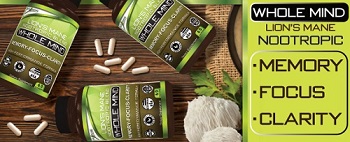
Our Formula includes: Lion’s Mane Mushrooms which Increase Brain Power through nerve growth, lessen anxiety, reduce depression, and improve concentration. Its an excellent adaptogen, promotes sleep and improves immunity. Shiitake Mushrooms which Fight cancer cells and infectious disease, boost the immune system, promotes brain function, and serves as a source of B vitamins. Maitake Mushrooms which regulate blood sugar levels of diabetics, reduce hypertension and boosts the immune system. Reishi Mushrooms which Fight inflammation, liver disease, fatigue, tumor growth and cancer. They Improve skin disorders and soothes digestive problems, stomach ulcers and leaky gut syndrome. Chaga Mushrooms which have anti-aging effects, boost immune function, improve stamina and athletic performance, even act as a natural aphrodisiac, fighting diabetes and improving liver function. Try Our Lion’s Mane WHOLE MIND Nootropic Blend 60 Capsules Today. Be 100% Satisfied or Receive a Full Money Back Guarantee. Order Yours Today by Following This Link.


| Visits: | 1,760,596,176 |
| Stories: | 8,553,172 |
Whistler Blowers, Insiders

