

The Hidden Biology of Repairing And Rebuilding Tendons and Ligaments

Peptides… Plants… and the Science Doctors Rarely Talk About
If your tendon still hurts months after the injury, here’s the uncomfortable truth most people never hear: time alone doesn’t heal tendons — signals do. You can ice it, baby it, stretch it, and “wait it out,” but if the right biological messages never reach that tissue, it just sits there half-healed, stiff, and a bit angry.
That’s why so many tendon and ligament injuries don’t fail all at once… they fail quietly, dragging on for months or years, until you start wondering if this is just how your body works now. It isn’t. Beneath the pain, your cells are still listening. They’re just missing the instructions.
That gap between injury and real healing is where the research gets interesting. Tendons and ligaments don’t fail because your body forgot how to repair itself; they fail because these dense collagen cables live on a thin biological budget — low blood flow, slow cell turnover, and very little margin for error.
Bad Signals Mean Slow Healing and Pain

When inflammation runs wild or the right growth signals never arrive, the tissue doesn’t rebuild… it patches. Scar replaces structure. Stiffness replaces strength. And once you understand that, the conversation shifts from “what painkiller helps?” to a better question: what actually tells a frayed tendon how to become strong again?
When a tendon or ligament goes bad, it doesn’t just hurt — it changes how you move through the world. Suddenly every step, reach, or twist feels like it’s testing a frayed cable somewhere deep inside your body. You know something is torn, overstretched, or inflamed, and your brain starts guarding that weak link without asking your permission.
Yet beneath the pain and stiffness, something quieter is happening. Your body is trying to rebuild. Cells are migrating, collagen fibers are being laid down, and inflammation is either doing its job — or getting in the way. And that’s where both cutting-edge peptides and old-school natural compounds start to matter. Not as miracles, but as nudges — small signals that can tilt the repair process toward strength instead of scar tissue.
Why Tendons and Ligaments Heal Like Molasses in Winter
To understand why these injuries linger, you have to look at the material they’re made of. Tendons and ligaments aren’t soft, juicy muscle. They’re dense, tightly braided ropes of collagen, engineered for strength and load transfer, not rapid self-repair.
More importantly, they’re poorly supplied with blood. While muscle gets a rich flow of oxygen, nutrients, and immune cells, tendons and ligaments exist on a kind of metabolic ration. When injury strikes, growth factors and repair cells arrive slowly, which is why a “minor” sprain can drag on for months and a tendinopathy can feel permanent.
So when people look beyond ice, rest, and ibuprofen, what they’re really searching for is anything that can improve blood flow, stimulate collagen production, and guide inflammation so it heals instead of hardening into dysfunction.
Peptides: The Body’s Text Messages for Repair
Over the last few decades, researchers have been paying close attention to peptides — short chains of amino acids that act less like building blocks and more like instructions. Think of them as biological text messages, telling cells when to move, divide, calm down, or get to work.
That signaling role is what makes peptides intriguing for soft-tissue repair. Instead of forcing growth, they appear to amplify the body’s own healing language. And that’s where compounds like BPC-157, TB-500, and GHK-Cu enter the conversation, even if they’re still firmly in experimental territory.
BPC-157: From the Gut to the Tendon Matrix
BPC-157 began its life as a fragment of a natural protein found in gastric juice. But researchers quickly noticed that it didn’t stay confined to the gut. In animal models, it showed a remarkable ability to influence healing throughout the body.
In rat Achilles tendon injuries, BPC-157 accelerated defect closure, improved collagen fiber organization, and increased tensile strength. In simple terms, it helped damaged tendons behave less like frayed twine and more like tightly woven rope again.
On a cellular level, BPC-157 appears to stimulate tendon fibroblasts, increase growth-hormone receptor expression, and activate focal adhesion kinase signaling — all pathways involved in tissue repair and structural integrity.
That said, the gap between promising animal data and proven human outcomes remains wide. Orthopedic and pharmacology reviews consistently point out the lack of large, controlled human trials. Its strong angiogenic and cytoprotective effects also raise legitimate questions about long-term safety. This is where enthusiasm and caution collide — and why BPC-157 still lives in the gray zone between research and real-world use.
TB-500 and Thymosin Beta-4: Moving the Repair Crew In
TB-500 is a lab-synthesized fragment of thymosin beta-4, a peptide your body already uses to help cells migrate, survive, and organize connective tissue during healing.
In soft-tissue injury models, thymosin beta-4–type peptides promote new blood vessel growth, guide repair cells into damaged regions, and reduce chaotic, scar-heavy healing. Instead of forming stiff knots, the tissue tends to remodel into something more flexible and functional.
For tendons and ligaments, this shows up as improved cell migration, better angiogenesis, and higher-quality repair tissue in preclinical studies. That’s why you’ll often see TB-500 stacked with BPC-157 in experimental sports-medicine circles.
Just like BPC-157, most of the evidence remains in animal models and anecdotal reports. Regulatory approval hasn’t followed, and anyone venturing outside conventional care has to accept a degree of uncertainty along with the potential upside.
GHK-Cu and the Expanding Peptide Toolbox
Beyond the headline peptides, others are quietly gaining attention. GHK-Cu, a copper-binding tripeptide, has shown the ability to boost collagen synthesis, enhance antioxidant defenses, and accelerate wound healing — sometimes even at sites distant from where it’s applied.
That systemic effect hints at something bigger: a shift in the body’s overall repair environment. Reviews now include GHK-Cu among peptides capable of remodeling inflammation, blood flow, and extracellular matrix dynamics — all key players in stubborn tendon and ligament injuries.
At the same time, researchers are experimenting with peptide-infused scaffolds and hydrogels, embedding these signaling molecules directly into engineered tissues. This is where orthopedics and regenerative medicine start to blur, pointing toward a future where damaged tendons are reinforced with living, biologically active matrices rather than just stitched and immobilized.
Collagen: Supplying the Raw Materials
If peptides act like software updates, collagen is the hardware. Tendons and ligaments are mostly collagen, and without a steady supply of the right amino acids, even the best signals fall flat.
Collagen hydrolysate — pre-digested collagen peptides — has been shown in both human and animal studies to support cartilage and joint structures, increase tissue thickness, and provide antioxidant protection. Side effects are usually mild and limited to digestion.
Pairing collagen with vitamin C, copper, and adequate protein intake helps ensure those fibers are properly cross-linked, producing tissue that’s not just thick, but strong, elastic, and load-bearing. That’s why many rehab-focused protocols start with collagen and micronutrients, then layer on more experimental tools if needed.
Plant Compounds That Calm and Rebuild
Certain plant-derived compounds act like subtle foremen on the job site, calming runaway inflammation while encouraging real regeneration.
Curcumin, from turmeric, has been shown in tenocyte and animal tendon models to increase collagen I and II production, improve fiber alignment, and reduce peritendinous adhesions — meaning smoother movement and less sticky scar tissue.
Resveratrol tells a similar story. In tendon-healing models, including diabetic animals with impaired repair, it improved collagen synthesis and reduced inflammatory signaling. Polyphenols like quercetin, kaempferol, and sea-buckthorn flavones have also been shown to enhance collagen deposition and stress tolerance, suggesting that diet can directly influence how well those collagen ropes rebuild.
Apigenin and the Bone–Tendon Interface
Apigenin, found in chamomile, parsley, and celery, adds another important layer to the picture. In rat models of critical-size bone defects, apigenin outperformed both resveratrol and curcumin, up-regulating genes like RUNX2, SMAD5, and collagen types central to bone formation.
That matters because tendons don’t just float — they anchor into bone. A stronger, healthier attachment point reduces reinjury risk and improves long-term resilience. Reviews also show apigenin protecting cartilage and modulating inflammatory pathways tied to degenerative joint disease, making it a quiet but strategic ally for chronic insertion-site injuries.
Stacking Signals for Real-World Healing
In the end, tendon and ligament healing rarely hinges on one compound or one intervention. It’s about stacking smart signals and raw materials so the body remembers how to repair itself.
On one side are high-tech peptides interacting with growth-factor pathways and cellular messaging systems that excite researchers but remain experimental. On the other are collagen, polyphenols, and plant compounds quietly shaping inflammation, structure, and resilience with longer safety track records.
When movement therapy, nutrition, targeted peptides, and time align, that frayed rope doesn’t just scar over. It slowly becomes a stronger, more flexible cable — restoring confidence in your body’s weakest link and giving you back the freedom to move without hesitation.
Ask your doctor if peptides are right for you.
Source: https://www.offthegridnews.com/pain-free-living-off-the-grid/the-hidden-biology-of-repairing-and-rebuilding-tendons-and-ligaments/
Anyone can join.
Anyone can contribute.
Anyone can become informed about their world.
"United We Stand" Click Here To Create Your Personal Citizen Journalist Account Today, Be Sure To Invite Your Friends.
Before It’s News® is a community of individuals who report on what’s going on around them, from all around the world. Anyone can join. Anyone can contribute. Anyone can become informed about their world. "United We Stand" Click Here To Create Your Personal Citizen Journalist Account Today, Be Sure To Invite Your Friends.
LION'S MANE PRODUCT
Try Our Lion’s Mane WHOLE MIND Nootropic Blend 60 Capsules
Mushrooms are having a moment. One fabulous fungus in particular, lion’s mane, may help improve memory, depression and anxiety symptoms. They are also an excellent source of nutrients that show promise as a therapy for dementia, and other neurodegenerative diseases. If you’re living with anxiety or depression, you may be curious about all the therapy options out there — including the natural ones.Our Lion’s Mane WHOLE MIND Nootropic Blend has been formulated to utilize the potency of Lion’s mane but also include the benefits of four other Highly Beneficial Mushrooms. Synergistically, they work together to Build your health through improving cognitive function and immunity regardless of your age. Our Nootropic not only improves your Cognitive Function and Activates your Immune System, but it benefits growth of Essential Gut Flora, further enhancing your Vitality.
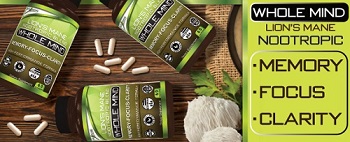
Our Formula includes: Lion’s Mane Mushrooms which Increase Brain Power through nerve growth, lessen anxiety, reduce depression, and improve concentration. Its an excellent adaptogen, promotes sleep and improves immunity. Shiitake Mushrooms which Fight cancer cells and infectious disease, boost the immune system, promotes brain function, and serves as a source of B vitamins. Maitake Mushrooms which regulate blood sugar levels of diabetics, reduce hypertension and boosts the immune system. Reishi Mushrooms which Fight inflammation, liver disease, fatigue, tumor growth and cancer. They Improve skin disorders and soothes digestive problems, stomach ulcers and leaky gut syndrome. Chaga Mushrooms which have anti-aging effects, boost immune function, improve stamina and athletic performance, even act as a natural aphrodisiac, fighting diabetes and improving liver function. Try Our Lion’s Mane WHOLE MIND Nootropic Blend 60 Capsules Today. Be 100% Satisfied or Receive a Full Money Back Guarantee. Order Yours Today by Following This Link.


| Visits: | 1,760,596,176 |
| Stories: | 8,553,172 |
Whistler Blowers, Insiders

