

Book Week 2025, Day 7: Three favorites by Knut Schmidt-Nielsen

” data-medium-file=”https://svpow.com/wp-content/uploads/2025/12/animal-physiology-5th-ed-cover-1.jpg?w=232″ data-large-file=”https://svpow.com/wp-content/uploads/2025/12/animal-physiology-5th-ed-cover-1.jpg?w=386″ class=”size-full wp-image-24827 aligncenter” src=”https://svpow.com/wp-content/uploads/2025/12/animal-physiology-5th-ed-cover-1.jpg” alt=”" width=”386″ height=”500″ srcset=”https://svpow.com/wp-content/uploads/2025/12/animal-physiology-5th-ed-cover-1.jpg 386w, https://svpow.com/wp-content/uploads/2025/12/animal-physiology-5th-ed-cover-1.jpg?w=116&h=150 116w, https://svpow.com/wp-content/uploads/2025/12/animal-physiology-5th-ed-cover-1.jpg?w=232&h=300 232w” sizes=”(max-width: 386px) 100vw, 386px” />
I have been a fanboy of prominent animal physiologist Knut Schmidt-Nielsen for a long time. I first encountered his papers back in the late 90s, working on my MS thesis at OU. I realized that vertebral pneumaticity in sauropods implied, among other things, that I had better get to reading about birds. Probably the first Schmidt-Nielsen paper I read was, “Temperature regulation and respiration in the ostrich” (1969). It’s still a good read, focused, concise, containing much that is useful and interesting for people who care about dinosaurs, and at least right now it’s freely available here.
I believe that Vic Hutchison at OU, himself a pretty legendary animal physiologist, was the first to put me onto Schmidt-Nielsen’s magisterial textbook, Animal Physiology: Adaptation and Environment. I was used to textbooks written by committee, often not by the people leading their respective fields, which did workmanlike duty introducing undergrads to fundamentals, and which serious researchers would soon outgrow. Schmidt-Nielsen’s Animal Physiology was different; it was written by one person, who at the time of its writing was one of the world leaders in animal physiology; it covered so much so well that it seemed to have transcended the category of things that could be outgrown; and most importantly, it was well-written. Really well-written, to the point of being readable for pleasure (if you like learning how animals work). And, I thought then and still think today, a model for good science communication. A copy of the 5th and final edition sits within arm’s reach of my desk, and if the house ever starts sliding into a sinkhole or I see zombies coming down the street, I’ll put it on the stack of things to run out with, between the sauropod monographs and Brown’s Composition of Scientific Words. If you want a taste of the ideas and the writing but don’t want to lug around a 600-page textbook, try How Animals Work, a slim volume based on a lecture series that covers a lot of the same ground in 124 pages.
So what is it about this animal physiologist that made him one of my scientific heroes? I envy people who communicate well, and I find Schmidt-Nielsen’s papers to be models of clarity at every level. Each paper tends to be about a single thing, something you could relay in one sentence. They have short, punchy titles. They’re readable.
I should say right here that the Schmidt-Nielsen style is not the Wedel style. I have friends whose offices are so uncluttered that they look like model rooms in an IKEA store. I have an office at work and another at home, and both of them look like habitable cabinets of curiosities at best, and like hoarder nightmares at worst. I have come to accept that I am a maximalist — in my physical-space-arranging, in my writing, and in my choice of study organisms — and that’s that. But I can admire the minimalist aesthetic, and learn from it. I may never craft anything as elegantly lean as a Schmidt-Nielsen paper, but maybe by studying his writing I can ensure that underneath all the asides and digressions and racing stripes and feathers, my papers will have airworthy frames.
It was that attitude of careful study that led me to pick up Schmidt-Nielsen’s autobiography, The Camel’s Nose. I learned that a lot of the qualities I’d been admiring were not accidental at all, but deliberately chosen and cultivated. Schmidt-Nielsen was born and raised in Norway. English was his adopted language, not his first, and he wrote in simple, direct sentences to reduce the opportunities for being misunderstood. He’d stayed active for so long because he was driven by simple curiosity, about how animals got on in the world. When the time came around for a new edition of Animal Physiology, he basically made that his project for a year or so. He’d gather all the top papers and latest research on each topic, distill what was interesting and important, and write. That’s why the book is so good: one of the world’s top physiologists, who strove for clear communication, basically shelved everything else for a year at a time to make sure he was caught up on the literature, and then wrote.
That level of pure commitment doesn’t sound like a recipe for work-life balance. I’m sure there are exceptions, but in my experience the most driven people are not usually the ones with happy home lives. In The Camel’s Nose, Knut Schmidt-Nielsen relates how his marriage to his spouse, fellow physiologist Bodil Mimi Schmidt-Nielsen (née Krogh — she was descended from physiological royalty on both sides), unraveled because they were both too driven, too close to the work, too competitive. Schmidt-Nielsen relays all this with a tinge of sadness, but otherwise in his typical style — directly, concisely, matter-of-factly. It would be interesting to know Bodil’s side of the story. The dissolution of their marriage was certainly not a career-ender for her — she went on to be a department chair at Case Western Reserve, a full-time researcher at Mount Desert Island Biological Laboratory, and the first woman president of the American Physiological Society. On one hand, having two people at the top of their field — at the top of the same field — in the same household sounds pretty relentlessly intense to me, like trying to force the north poles of two magnets together. On the other hand, Knut Schmidt-Nielsen seems to me to have been pretty relentlessly intense all by himself, and I wonder if anyone’s inherent north-pole-ness (in this metaphor, we all prolly have a little) could have survived near him without being pushed away. As with his writing style, I can look and learn without being tempted to emulate.
Confession time: I’ve never made it to the end of The Camel’s Nose. For me, the ratio of new insights into Schmidt-Nielsen’s process and his discoveries in the field, on one hand, compared to increasingly dense chunks of self-congratulation on the other, becomes unfavorable in the final chapters. I already admired him before I picked up the book; indeed, that’s why I picked it up in the first place. Reading about his honors, however well-deserved and however fairly relayed, doesn’t help me (except maybe as a What Not To Do for Future Matt, and sometimes Present Matt). Possibly in skipping the last couple of chapters I’ve missed some gold nugget of advice or perspective, but I doubt it. I came for insights into Schmidt-Nielsen’s process of research and writing, I got what I was after, and I still recommend the book on that basis. Like the rest of his works, it’s remarkably clear in both vision and execution, and it’s probably the most readable of all his books. If you make it to the end, I’d be curious to hear what I missed.
All of these books are old. How Animals Work was first published in 1972, Animal Physiology 5th ed. in 1997, and The Camel’s Nose in 1998. They’re all still relevant, readable, and worth learning from. Do what I did and find used copies.
That’s it for Book Week 2025. There are of course legions of deserving books that I didn’t cover — feel free to shout ’em out in the comments.
Reference
Source: https://svpow.com/2025/12/03/book-week-2025-day-7-three-favorites-by-knut-schmidt-nielsen/
Anyone can join.
Anyone can contribute.
Anyone can become informed about their world.
"United We Stand" Click Here To Create Your Personal Citizen Journalist Account Today, Be Sure To Invite Your Friends.
Before It’s News® is a community of individuals who report on what’s going on around them, from all around the world. Anyone can join. Anyone can contribute. Anyone can become informed about their world. "United We Stand" Click Here To Create Your Personal Citizen Journalist Account Today, Be Sure To Invite Your Friends.
LION'S MANE PRODUCT
Try Our Lion’s Mane WHOLE MIND Nootropic Blend 60 Capsules
Mushrooms are having a moment. One fabulous fungus in particular, lion’s mane, may help improve memory, depression and anxiety symptoms. They are also an excellent source of nutrients that show promise as a therapy for dementia, and other neurodegenerative diseases. If you’re living with anxiety or depression, you may be curious about all the therapy options out there — including the natural ones.Our Lion’s Mane WHOLE MIND Nootropic Blend has been formulated to utilize the potency of Lion’s mane but also include the benefits of four other Highly Beneficial Mushrooms. Synergistically, they work together to Build your health through improving cognitive function and immunity regardless of your age. Our Nootropic not only improves your Cognitive Function and Activates your Immune System, but it benefits growth of Essential Gut Flora, further enhancing your Vitality.
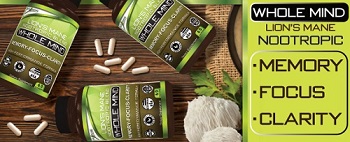
Our Formula includes: Lion’s Mane Mushrooms which Increase Brain Power through nerve growth, lessen anxiety, reduce depression, and improve concentration. Its an excellent adaptogen, promotes sleep and improves immunity. Shiitake Mushrooms which Fight cancer cells and infectious disease, boost the immune system, promotes brain function, and serves as a source of B vitamins. Maitake Mushrooms which regulate blood sugar levels of diabetics, reduce hypertension and boosts the immune system. Reishi Mushrooms which Fight inflammation, liver disease, fatigue, tumor growth and cancer. They Improve skin disorders and soothes digestive problems, stomach ulcers and leaky gut syndrome. Chaga Mushrooms which have anti-aging effects, boost immune function, improve stamina and athletic performance, even act as a natural aphrodisiac, fighting diabetes and improving liver function. Try Our Lion’s Mane WHOLE MIND Nootropic Blend 60 Capsules Today. Be 100% Satisfied or Receive a Full Money Back Guarantee. Order Yours Today by Following This Link.


| Visits: | 1,754,036,349 |
| Stories: | 8,542,590 |
Whistler Blowers, Insiders

