

Former IDF soldiers are challenging the normalization of the occupation

This article Former IDF soldiers are challenging the normalization of the occupation was originally published by Waging Nonviolence.

A tour group stood on Hebron’s Al-Shuhada Street, listening as a former Israel Defense Forces soldier pointed out, on a map, the nine roads in the West Bank city that Palestinians are restricted or prohibited from accessing.
Once a bustling market hub, Al-Shuhada Street was now quiet and devoid of pedestrians, aside from a nearby guard post from which three or four soldiers were coming and going, watching the group.
The visitors were taking part in a guided tour run by Breaking the Silence, or BTS, an organization founded by former IDF soldiers. BTS uses soldiers’ testimonies, political tours and advocacy to expose how Israel’s occupation of the Palestinian territories functions on the ground and to challenge Israelis to confront the moral cost of maintaining it.
As the group listened to their guide explain the separation policy in Hebron, a private tour passed by. “That’s Breaking the Silence. They spread lies about Israel, about us,” their guide said loudly.
Joel Carmel, the BTS advocacy director and guide that day, nodded in the man’s direction without pausing his explanation.
“Our right-wing detractors accuse us of not showing both sides [of the occupation],” Carmel said, speaking on the phone a few days after the tour. “It’s ironic, because what we’re showing is the Israeli side — whether our detractors like it or not.”
“We want to show what the occupation looks like, from the perspective of the perpetrators,” he continued. “What the commands were and what the interactions look like between soldiers and Palestinians.”
BTS publishes anonymous testimonies from soldiers who have served in the occupied Palestinian territories on its website in collections, such as “Occupying Hebron: Soldiers’ Testimonies from Hebron 2011-2017.”
“The point of the testimony collection is not to draw out specific incidents and say, ‘Look how terrible this soldier was,’” Carmel said, “it’s to show that what we’re being sent to do is a policy that comes from above.”
He explains that each testimony is like a puzzle piece. “Put them all together [and] you get a good sense of what it actually means to be an occupying force over millions of people, subjected to a military regime.”
On Breaking the Silence’s website, thousands of testimonies detail soldiers’ experiences in the military, from the routine to the extreme. They reveal explanations of code names, warfare tactics, operation objectives, recollections of conversations with officers, and often the moments that led soldiers to testify.
Testimonies are categorized under headings that range from “law enforcement,” “patrols” and “checkpoints” to “desecration of bodies,” humiliation” and “human shields.”
Founded in 2004, BTS initially set out to collect testimonies from soldiers who served during the Second Intifada of 2000-2005. Since then, more than 1,500 former soldiers have come forward.
An entire category is dedicated to the genocide in Gaza: Since it began, BTS has seen an influx of new testimonies, especially from reservists.
Carmel believes that the older age of reservists explains this increase in testimonies. “They are sent to do unbelievable things at a stage in their life when they have kids, a job, when they’ve made up their minds politically,” he said. “They stop and think ‘What am I doing here?’ in a way that maybe an 18 or 19-year-old doesn’t.”
Young Israelis have few spaces where conversations about the occupation are held — not even schools.
Carmel notes that, before joining the military, he had little opportunity to hear from Israelis who were critical of the occupation. “In our education system, the word occupation doesn’t feature at all.”
In addition to limited public discourse, many Israelis are too young to remember a time before the occupation. “So many people can’t even imagine a reality without constant war, constant fighting,” Carmel said. “For my generation and for my parents’ generation, we don’t know a time when we weren’t an occupying force.”
As a result, occupation has become a permanent part of Israeli identity. It also makes military actions taken in the name of “security” easy to justify to the Israeli public.
BTS sees tours and testimonies as tools to disrupt this normalization and raise the question: “To what extent should security justify the occupation and abuse of another population?”
“They’re meant to be wake-up calls, like — ‘do you realize how not normal this is?’” Carmel explained.
BTS runs two political tours: one in Hebron’s H2 area, the section of divided Hebron that is under Israeli military administration, and a second in the South Hebron Hills, focusing on the village of Masafer Yatta, where Palestinians face near-daily settler violence, home demolitions and displacement.

Tours trace how Israeli policies target Palestinians businesses, limit their movement and steadily push residents out of the area, while protecting Israeli settlers and the expansion of illegal settlements.
“If Hebron is the occupation at an urban level,” Carmel said, “Masafer Yatta provides the rural perspective.”
Participants also have the opportunity to meet with local Palestinians and hear their experiences of life under occupation. In Hebron, groups meet with Issa Amro, a Palestinian nonviolent activist and the founder of Youth Against Settlements, an organization based in H2 that seeks to end the expansion of illegal Israeli settlements and the end of occupation.
Amro explains that the Israeli military is everywhere in H2. “The city is full of surveillance and facial recognition cameras. It’s a violation of our privacy.”
On his Instagram account, Amro publishes videos and photographs of soldiers and settlers assaulting Palestinians. He says he sees BTS as an important voice in Israel, speaking out against the occupation. “I’ve been collaborating with Breaking the Silence for more than 20 years,” Amro said. “I feel we are partners in the same goal: to make peace and to make the occupation costly.”
For Amro, the collaboration offers a chance to speak with Israelis and international Jews directly. “I tell [Israeli visitors] to be changemakers, to be peacemakers,” he said. “I tell them to not stay silent about what’s going on around them or to be on the side of occupation. I remind them that ending the occupation is the only way for security for all.”
BTS’s tours attract tourists, diplomats and journalists, but recent protest movements within Israel have also brought new local participants, says Carmel. The mass protests that broke out in 2023 against Prime Minister Benjamin Netanyahu’s judicial reform proposals are leading more Israelis to open conversations about power and democracy. “People are beginning to think a little bit more critically,” Carmel said.
The consequences of ignoring the reality of occupation are already visible in Israeli society, Carmel says during the Hebron tour, from rising unemployment to increased alcoholism and domestic violence. “You can see how [being an occupying force] has been so toxic for Israeli society. There’s so much violence in our society, there’s so much aggression,” he said.
Beyond the social damage, BTS argues that the occupation is failing to fulfill its own stated claim of security, with considerable resources spent on protecting settlers and settlements over citizens.

Between 1,000 and 1,500 soldiers patrol the streets of H2, where 700 Israeli settlers live at the heart of the city. That’s one or two soldiers for every Hebron settler, according to Amro.
Hamas’s attack on Israel also exposes the imbalance of resources. On the morning of Oct. 7, 2023, BTS says there were more than 30 battalions of infantry and combat soldiers in the West Bank, and two and a half positioned across the entire Gaza border.
“Israel’s security policy for decades now, has been to ‘manage the conflict,’” BTS wrote in a report published days after the October attack.
“Apart from the unfathomable violation of human rights, we’ve created a massive security liability for our own citizens,” the report continued. “Our country decided — decades ago — that it’s willing to forfeit the security of its citizens in our towns and cities, in favor of maintaining control over an occupied civilian population of millions, all for the sake of a settler-messianic agenda.”
Despite these failings, organizations like BTS are sidelined as extreme, radical left, unpatriotic or traitors.
Carmel described representing BTS at mechinot, pre-military preparatory academies, where gap year students are offered programs on leadership and national identity, and presented with different viewpoints from Israeli society.
“[The students] have a tour or a lecture with us and then immediately after that they’ll meet with settlers, or hardcore right-wing groups,” he said. “It’s always so mind-blowing. They’ll have me, and then they’ll have [Itamar] Ben Gvir. It’s a testament to the way Israeli society perceives us.”
Previous Coverage
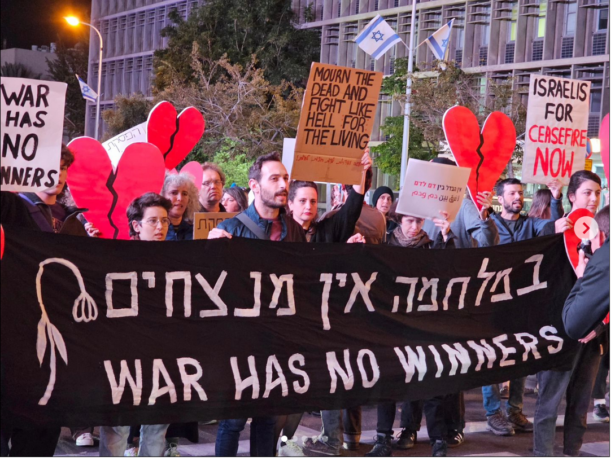 Why Israeli army refusers are crucial to ending the cycle of violence
Anger towards BTS’s message has led right-wing groups to attempt to discredit the organization’s work, which have included attacks on the veracity of testimonies, attempted infiltration and even physical threats.
In 2020, right-wing Israeli activist organisation Ad Kan petitioned the attorney general of Israel to open an investigation into BTS’s testimony collection for endangering national security. The criticism has caused many “middle-of-the-road” Israelis to not want to interact with a group considered radical, Carmel said.
The Israeli government has also sought to constrain the organization through legislation. In December 2025, the Israeli Knesset held its first reading of a bill targeting Israeli organizations receiving donations from foreign state entities.
Over half of BTS’s funding comes from foreign governmental entities, the organization’s website reads. The bill, which is worded to affect left-wing groups while protecting right-wing organizations, would make it impossible for BTS to do its work if it passes, Carmel said.
In 2016, the Israeli State Attorney sought a warrant for the disclosure of documentation regarding the identity of BTS testifiers who served in Gaza in 2014.
At the same time, opposition has raised BTS’s international profile and encouraged more Israelis to speak out about their military service.
For BTS, the current Netanyahu government’s methods — from the judicial overhaul to the funding bill — indicate that occupation policies are being replicated in Israel, with little public resistance.
“Israelis have become used to the idea that it’s somehow legitimate to have groups of people who simply aren’t eligible for democratic rights,” Carmel said. “Once that’s become normalized with regards to Palestinians from the occupied territories, it’s not a big leap to imagine that logic being rolled out here in Israel too.”
There’s a lot more work for BTS to do, such as continuing to collect testimonies from those who served in Gaza and drawing attention to what BTS calls a ‘Gaza-fication’ of the West Bank.
“A lot of what we saw in Gaza has already been translated into action in the West Bank,” Carmel said, pointing to the standards that became normal during the war in Gaza, the rules of engagement, the weaponry used and the military mindset from Gaza.
Waging Nonviolence depends on reader support. Make a donation today!
In Gaza, the October 2025 ceasefire and U.S. President Donald Trump’s Gaza peace plan have been framed as the end of fighting and the wider conflict.
Instead, BTS sees that the situation in Gaza has defaulted to how it was before Oct. 7, with Israel continuing to control the enclave. However, humanitarian conditions in Gaza are far more dire. Despite the ceasefire, Israeli strikes have killed at least 477 Palestinians in the past three months, according to the Gaza Health Ministry. With much of the enclave flattened by airstrikes, around 1 million Gazans lack adequate shelter and 1.6 million face high levels of acute food insecurity, the UN has reported.
“It’s just another form of managing the conflict, and it’s the same recipe that led us to October 7, and there’s no guarantee that it won’t happen again,” said Carmel. “It’s not a solution at all. We have to be clear with the Israeli public and the international community [that] there won’t be peace or security for Palestinians or Israelis until the occupation ends. That’s really our goal.”
This article Former IDF soldiers are challenging the normalization of the occupation was originally published by Waging Nonviolence.
People-powered news and analysis
Source: https://wagingnonviolence.org/2026/02/breaking-the-silence-idf-soldiers-challenging-normalization-occupation/
Anyone can join.
Anyone can contribute.
Anyone can become informed about their world.
"United We Stand" Click Here To Create Your Personal Citizen Journalist Account Today, Be Sure To Invite Your Friends.
Before It’s News® is a community of individuals who report on what’s going on around them, from all around the world. Anyone can join. Anyone can contribute. Anyone can become informed about their world. "United We Stand" Click Here To Create Your Personal Citizen Journalist Account Today, Be Sure To Invite Your Friends.
LION'S MANE PRODUCT
Try Our Lion’s Mane WHOLE MIND Nootropic Blend 60 Capsules
Mushrooms are having a moment. One fabulous fungus in particular, lion’s mane, may help improve memory, depression and anxiety symptoms. They are also an excellent source of nutrients that show promise as a therapy for dementia, and other neurodegenerative diseases. If you’re living with anxiety or depression, you may be curious about all the therapy options out there — including the natural ones.Our Lion’s Mane WHOLE MIND Nootropic Blend has been formulated to utilize the potency of Lion’s mane but also include the benefits of four other Highly Beneficial Mushrooms. Synergistically, they work together to Build your health through improving cognitive function and immunity regardless of your age. Our Nootropic not only improves your Cognitive Function and Activates your Immune System, but it benefits growth of Essential Gut Flora, further enhancing your Vitality.

Our Formula includes: Lion’s Mane Mushrooms which Increase Brain Power through nerve growth, lessen anxiety, reduce depression, and improve concentration. Its an excellent adaptogen, promotes sleep and improves immunity. Shiitake Mushrooms which Fight cancer cells and infectious disease, boost the immune system, promotes brain function, and serves as a source of B vitamins. Maitake Mushrooms which regulate blood sugar levels of diabetics, reduce hypertension and boosts the immune system. Reishi Mushrooms which Fight inflammation, liver disease, fatigue, tumor growth and cancer. They Improve skin disorders and soothes digestive problems, stomach ulcers and leaky gut syndrome. Chaga Mushrooms which have anti-aging effects, boost immune function, improve stamina and athletic performance, even act as a natural aphrodisiac, fighting diabetes and improving liver function. Try Our Lion’s Mane WHOLE MIND Nootropic Blend 60 Capsules Today. Be 100% Satisfied or Receive a Full Money Back Guarantee. Order Yours Today by Following This Link.


| Visits: | 1,773,917,224 |
| Stories: | 8,577,826 |
Whistler Blowers, Insiders

