

There Is No Such Thing as Good Industrial Policy. But Republicans And Democrats Keep Trying.

 Wisconsinart | Dreamstime.com” />
 American industry has been getting a lot of hands-on direction from Democrats and Republicans for quite some time now. Every few years, someone looks at the underwhelming results of this economic maneuvering and insists that real “industrial policy” has never been tried. The truth is that the left’s call for a “mission-oriented” state and the right’s yearning for a nationalist industrial revival may sound different, but they share the same conceit: that their own intentions can finally succeed where decades of intervention have failed.
The latest person to revive this evergreen fantasy is Mariana Mazzucato, the Italian-born economist who has made a career out of championing an assertive, big-spending state as the engine of innovation. In a new interview with Politico, she laments that President Donald Trump’s industrial policy—which includes tariffs and government equity stakes in private companies—is “an idiosyncratic hodgepodge,” not the “holistic” strategy she favors. Mazzucato wants the U.S. to have a “smart, capable” state to guide investment with purpose.
Back in the days of former President Joe Biden’s industrial policy, when subsidies, tax credits, and loans were flowing, an emerging Republican faction had a similar refrain, claiming that to revive American manufacturing, restore communities, and put men back to work, industrial policy simply had to be done right. We now know that this meant increasingly erratic tariffs, price controls, and government taking shares in companies.
Hope for both sides rests on quite a premise: that Washington can guide trillions of dollars to the right industries, produce a manufacturing boom, and maybe even heal America’s social fabric.
The problem isn’t that industrial policy has been done badly. It’s just bad economics.
Dreams of reviving manufacturing jobs face the reality that modern manufacturing is capital-intensive and largely automated. Even if subsidies or government loan guarantees spur a factory boom—and history suggests otherwise—it won’t bring back 1950s-style armies of industrial workers unless we somehow outlaw productivity. Today’s factories run on robots and engineers.
Nor will tariffs bring a manufacturing revival. Taxing inputs and components only raises costs, weakens U.S. competitiveness, and ultimately punishes the firms protectionists claim to support. True American industrial strength rests on productivity, innovation, competition, and access to global supply chains, not on coddling producers behind walls of higher prices.
Mazzucato and her ideological opposites commit the same error. They imagine a politics-free technocracy that can “direct” the economy. In the real world, politics always dominates economics. Subsidies and tariffs are never tools of neutral expertise; they are invitations to lobby. Every “strategic investment” quickly becomes a political IOU.
Biden’s programs came loaded with child care mandates, union preferences, and “Buy American” rules. Trump’s industrial interventions are indeed erratic, but the notion that his protectionism would work if wrapped in a more “mission-oriented” narrative is even sillier. Industrial policy doesn’t fail because it’s chaotic; it fails because it’s political, and human politicians are incapable of the precision markets achieve every day.
After conducting a sweeping review of five decades of U.S. industrial policy, economists Gary Clyde Hufbauer and Euijin Jung’s conclusion was unambiguous: Subsidies and trade protections for individual firms have been politically irresistible but economically ruinous. Government protection delays economic adjustments; innovation succeeds. In the rare cases when industrial policy showed positive results, the government limited itself to supporting open, competitive research and innovation—programs like the Defense Advanced Research Projects Agency or Operation Warp Speed—rather than shielding firms from competition or subsidizing failing industries.
Without that type of openness, supposed industrial policy wins will quietly lock in yesterday’s technology rather than helping discover tomorrow’s. France’s Minitel, a government-backed precursor to the internet, looked like a national triumph in the 1980s. Millions of households were connected, citizens used it for banking, shopping and communicating, and the state could boast of digital leadership. Yet the system’s centralized, permission-based design smothered innovation and prevented France from developing the open, global internet that would soon transform the world.
The illusion of progress turned out to be technological stagnation: a product that barely evolved over three decades. This is the unseen cost of industrial policy. By insulating favored industries and technologies, it freezes innovation in place and leaves a nation paying twice: once through taxes and again through missed opportunities.
So yes, real industrial policy has been tried—in many countries, by governments of every ideology, under every rhetorical banner from “innovation” to “resilience.” It fails every time for the same reason: The visible hand of the government is clumsy, self-interested and easily bought. If that’s what passes for a “smart state,” I’ll take the invisible hand of the market any day.
COPYRIGHT 2025 CREATORS.COM
The post There Is No Such Thing as Good Industrial Policy. But Republicans And Democrats Keep Trying. appeared first on Reason.com.
Source: https://reason.com/2025/11/20/there-is-no-such-thing-as-good-industrial-policy-but-republicans-and-democrats-keep-trying/
Anyone can join.
Anyone can contribute.
Anyone can become informed about their world.
"United We Stand" Click Here To Create Your Personal Citizen Journalist Account Today, Be Sure To Invite Your Friends.
Before It’s News® is a community of individuals who report on what’s going on around them, from all around the world. Anyone can join. Anyone can contribute. Anyone can become informed about their world. "United We Stand" Click Here To Create Your Personal Citizen Journalist Account Today, Be Sure To Invite Your Friends.
LION'S MANE PRODUCT
Try Our Lion’s Mane WHOLE MIND Nootropic Blend 60 Capsules
Mushrooms are having a moment. One fabulous fungus in particular, lion’s mane, may help improve memory, depression and anxiety symptoms. They are also an excellent source of nutrients that show promise as a therapy for dementia, and other neurodegenerative diseases. If you’re living with anxiety or depression, you may be curious about all the therapy options out there — including the natural ones.Our Lion’s Mane WHOLE MIND Nootropic Blend has been formulated to utilize the potency of Lion’s mane but also include the benefits of four other Highly Beneficial Mushrooms. Synergistically, they work together to Build your health through improving cognitive function and immunity regardless of your age. Our Nootropic not only improves your Cognitive Function and Activates your Immune System, but it benefits growth of Essential Gut Flora, further enhancing your Vitality.
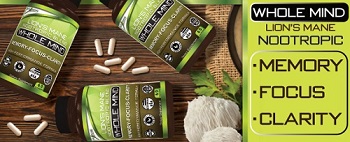
Our Formula includes: Lion’s Mane Mushrooms which Increase Brain Power through nerve growth, lessen anxiety, reduce depression, and improve concentration. Its an excellent adaptogen, promotes sleep and improves immunity. Shiitake Mushrooms which Fight cancer cells and infectious disease, boost the immune system, promotes brain function, and serves as a source of B vitamins. Maitake Mushrooms which regulate blood sugar levels of diabetics, reduce hypertension and boosts the immune system. Reishi Mushrooms which Fight inflammation, liver disease, fatigue, tumor growth and cancer. They Improve skin disorders and soothes digestive problems, stomach ulcers and leaky gut syndrome. Chaga Mushrooms which have anti-aging effects, boost immune function, improve stamina and athletic performance, even act as a natural aphrodisiac, fighting diabetes and improving liver function. Try Our Lion’s Mane WHOLE MIND Nootropic Blend 60 Capsules Today. Be 100% Satisfied or Receive a Full Money Back Guarantee. Order Yours Today by Following This Link.


| Visits: | 1,752,989,466 |
| Stories: | 8,540,480 |
Whistler Blowers, Insiders

