

Eye care is getting more personal, and that’s good news for Austin patients

One of the biggest shifts in modern ophthalmology is that eye care technology now supports much more customized treatment planning than it did in the past. In Austin, that means patients may be evaluated with a broader range of refractive, corneal, cataract, and dry eye tools before a doctor recommends any procedure at all. Instead of asking only whether a patient can have surgery, clinicians increasingly ask which platform, which timing, and which visual goal makes the most sense for that specific eye. That is a meaningful change for people who want not just sharper sight, but clearer explanations and more individualized choices.
In broad terms, Dr. Steven J. Dell explains it this way: “At Dell Laser Consultants, personalized diagnostics and thoughtful LASIK planning help turn a complicated vision problem into a treatment path that feels clearer and more appropriate for the individual patient.”
How customized testing can turn a confusing vision problem into a clear next step
Customized testing matters because symptoms are often nonspecific. A patient might report fluctuating blur, headaches, glare, dryness, or difficulty with night driving. Those symptoms can overlap with refractive error, dry eye, corneal irregularity, or early lens change. The Academy’s eye exam guidance emphasizes that a comprehensive examination is designed to evaluate not just visual acuity but also eye health more broadly.[1] That broad evaluation is what allows doctors to separate similar complaints that actually require very different treatment paths.
This is especially relevant in refractive surgery. A 2025 Q&A on laser refractive surgery stressed that candidacy is nuanced and that physicians must consider profession, hobbies, personality, tolerance for risk, and anatomy when selecting a procedure.[2] That means the modern workup is not simply technical. It is also strategic. The best test does not just answer, “Can this eye be treated?” It answers, “What approach is most likely to support the kind of vision this person actually wants?”
Why modern treatment planning feels less one-size-fits-all
Modern treatment planning feels less generic because technology has made subtle differences more visible. Topography-guided treatment planning can identify corneal features that might not be obvious through refraction alone. A 2023 study of topography-guided LASIK emphasized that patient-reported outcomes are an important complement to traditional measurements, because surgery success is also about satisfaction and visual quality.[3] A 2025 study of Phorcides-planned topography-guided LASIK similarly reported improved patient-reported satisfaction and fewer visual disturbances after surgery.[4] These studies support a practical conclusion. Better planning can improve not only the measured result, but the lived result.
This same principle extends beyond LASIK. Coverage of newer refractive approvals and workflows has shown how device integration is increasingly shaping surgical precision and efficiency.[5] A more connected workflow can help translate diagnostic information into a treatment plan with fewer gaps between measurement and execution. That kind of integration is especially valuable when patients are comparing procedures and trying to understand why one technology may be better suited to their eyes than another.
What high-tech eye care can mean for LASIK, cataracts, and chronic dry eye
High-tech eye care matters because the technologies now span multiple parts of ophthalmology rather than living in isolated silos. Refractive surgery benefits from improved laser platforms and mapping tools. Cataract surgery benefits from premium IOL choices and postoperative adjustability. Dry eye management benefits from tear osmolarity testing, inflammatory markers, meibography, and other ocular-surface diagnostics that can shape treatment earlier and more precisely. In a 2024 article on dry eye disease, experts highlighted the value of osmolarity and MMP-9 testing, describing them as foundational in understanding whether the tear film is in homeostasis and whether inflammation is present.[6] That diagnostic depth can change how quickly a patient moves from vague discomfort to targeted therapy.
The same logic applies in cataract care. The Academy explains that the light-adjustable lens is the only IOL type that can be customized after surgery.[7] It has also reported on how LAL technology is evolving, especially as surgeons refine postoperative refractive accuracy and stress ocular-surface optimization.[8] When paired with careful diagnostics, these technologies make the treatment path more responsive, not just more technical.
How personalized technology can help protect long-term vision, not just today’s sight
Technology can also protect long-term vision because it gives clinicians better ways to see risk earlier. Better corneal imaging can help identify who should avoid or delay refractive surgery. Better ocular-surface testing can improve comfort before and after procedures. Better glaucoma imaging and earlier interventional thinking can reduce the burden of late-stage decision-making. Reports in late 2025 highlighted how advanced imaging, earlier laser intervention, and minimally invasive glaucoma strategies are reshaping individualized glaucoma care.[9] That matters because protective technology is just as valuable as corrective technology.
The broader story for Austin patients is encouraging. Modern eye care is moving away from one-size-fits-all recommendations and toward more personalized, evidence-based planning. Better tools can reduce confusion. Better measurements can support better judgment. And better judgment is often what gives patients the confidence to move forward.
References
[1] American Academy of Ophthalmology, Eye Exam and Vision Testing Basics, February 14, 2024.
[2] Hura AS, Q&A: Advancements in Laser Refractive Surgery, November 16, 2025.
[3] Rush SW, Rush RB, Topography-Guided LASIK: A Prospective Study Evaluating Patient-Reported Outcomes, 2023.
[4] Brunson PB, Mann PM II, Hall B, Patient Reported Visual Outcomes, Dry Eye Symptoms, and Satisfaction Following Topography-Guided LASIK, September 12, 2025.
[5] Harp MD, FDA Approvals in 2025: What Changed and Why It Matters for Ophthalmologists, December 29, 2025.
[6] Periman LM, Epitropoulos AT, Pearls Detail Targeted Interventions for Management of Dry Eye Disease, August 14, 2024.
[7] American Academy of Ophthalmology, Factors to Consider in Choosing an IOL for Cataract Surgery, March 31, 2025.
[8] Stephenson PDG, Q&A: Optimizing the Ocular Surface for Light Adjustable Lens Technology, February 9, 2026.
[9] Simpson R, Soneru A, Stevenson S, Redefining Glaucoma Care: Where Innovation Meets Clinical Insight, November 10, 2025.
Anyone can join.
Anyone can contribute.
Anyone can become informed about their world.
"United We Stand" Click Here To Create Your Personal Citizen Journalist Account Today, Be Sure To Invite Your Friends.
Before It’s News® is a community of individuals who report on what’s going on around them, from all around the world. Anyone can join. Anyone can contribute. Anyone can become informed about their world. "United We Stand" Click Here To Create Your Personal Citizen Journalist Account Today, Be Sure To Invite Your Friends.
LION'S MANE PRODUCT
Try Our Lion’s Mane WHOLE MIND Nootropic Blend 60 Capsules
Mushrooms are having a moment. One fabulous fungus in particular, lion’s mane, may help improve memory, depression and anxiety symptoms. They are also an excellent source of nutrients that show promise as a therapy for dementia, and other neurodegenerative diseases. If you’re living with anxiety or depression, you may be curious about all the therapy options out there — including the natural ones.Our Lion’s Mane WHOLE MIND Nootropic Blend has been formulated to utilize the potency of Lion’s mane but also include the benefits of four other Highly Beneficial Mushrooms. Synergistically, they work together to Build your health through improving cognitive function and immunity regardless of your age. Our Nootropic not only improves your Cognitive Function and Activates your Immune System, but it benefits growth of Essential Gut Flora, further enhancing your Vitality.
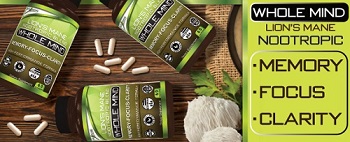
Our Formula includes: Lion’s Mane Mushrooms which Increase Brain Power through nerve growth, lessen anxiety, reduce depression, and improve concentration. Its an excellent adaptogen, promotes sleep and improves immunity. Shiitake Mushrooms which Fight cancer cells and infectious disease, boost the immune system, promotes brain function, and serves as a source of B vitamins. Maitake Mushrooms which regulate blood sugar levels of diabetics, reduce hypertension and boosts the immune system. Reishi Mushrooms which Fight inflammation, liver disease, fatigue, tumor growth and cancer. They Improve skin disorders and soothes digestive problems, stomach ulcers and leaky gut syndrome. Chaga Mushrooms which have anti-aging effects, boost immune function, improve stamina and athletic performance, even act as a natural aphrodisiac, fighting diabetes and improving liver function. Try Our Lion’s Mane WHOLE MIND Nootropic Blend 60 Capsules Today. Be 100% Satisfied or Receive a Full Money Back Guarantee. Order Yours Today by Following This Link.


| Visits: | 1,792,717,100 |
| Stories: | 8,614,096 |
Whistler Blowers, Insiders

