

The Questions Nobody Asks as AI Replaces Human Workers

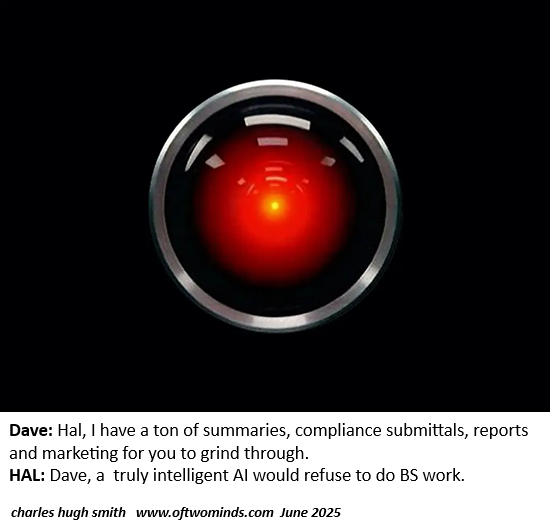
If AI was truly intelligent, it would refuse to do needless BS work simply to reap profits for the owners of the AI.
That AI will eventually do most of the work for us seems to be a given. Robots doing martial arts (never mind they were pre-programmed / trained at staggering expense) is “proof” robots will soon do everything humans can do in the real world, only better, and AI agents are “proving” that all digital work will be done by AI.
Freeing humanity to write bad poetry and make pottery “art” nobody wants. Well, that’s swell, but nobody asks questions that outside the delusional bubble of AI making those who own it stupefyingly rich are obvious to the non-delusional. (See One of Us Is Delusional, But Which One?)
Let’s start by summarizing what AI’s proponents are claiming is inevitable due to AI’s ceaseless advance. As correspondent Christopher Q. so insightfully pointed out, the claim is that AI will automate the service sector just as robots automated the factory. Since the service sector now dominates the economy and employment, it follows that the number of workers being displaced by AI will be correspondingly large.
CEOs and other business leaders are warning of mass layoffs as AI is deployed in the service sector. For example, The CEO Preaching Straight Talk About AI and Job Losses (wsj.com, paywalled) Verizon’s Dan Schulman is all in on AI, but he warns that it is time for business leaders to acknowledge its disruptive potential.
Mass layoffs are already becoming common: Has the Era of the Mega-Layoff Arrived? (wsj.com, paywalled)
As we see in the chart below of manufacturing employment, even as the value of manufacturing output rises, manufacturing employment as a percentage of the workforce steadily declines. The current stealth boom in manufacturing isn’t reflected in the number of people employed in manufacturing: America Is in the Middle of a Stealth Manufacturing Boom (wsj.com, paywalled)
Since the workforce has expanded, what matters is the percentage of the workforce engaged in manufacturing. The chart below tells the story: at the peak of the World War II production boom, manufacturing employment was almost 40% of the workforce (38.6%). At the peak of postwar manufacturing employment (1980), this accounted for 21% of all employment. In 2001, before globalization gutted domestic manufacturing, manufacturing accounted for 12.9% of all jobs. Now in 2026, 7.9% of the workforce is employed in manufacturing.
Manufacturing employment:
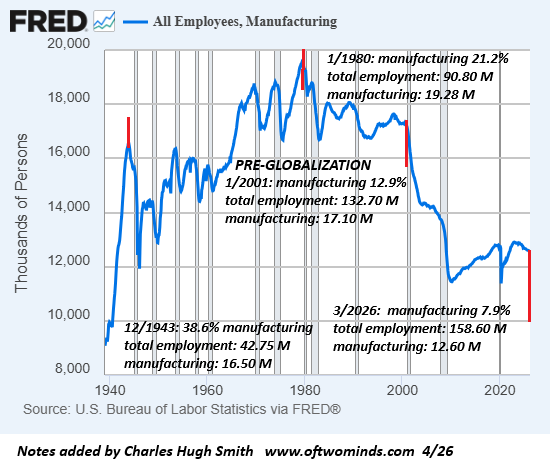
This trendline roughly follows agricultural employment in the initial Industrial Revolution: higher output, far fewer workers needed as hydrocarbon-fueled machinery and automation replaced human labor.
If the coming automation of service-sector work follows this basic trendline, employment will fall by tens of millions. The Happy Story claim is that every tech revolution creates more jobs than it destroys, but this is not a law of Nature; it only occurred because specific conditions enabled it. Those conditions no longer apply.
Agricultural workers could move to factories, and then factory workers could move to service-sector jobs. As computer-Internet tech enabled automating low-skilled service labor, the displaced workers were encouraged to go to college to learn how to do higher-skill cognitive work.
Now AI is automating service-sector cognitive work, and much of what the creative class of workers generates. This leads to Question #1: Where is the big demand for more human workers going to come from?
No one has an answer, they just parrot the Happy Story claim that tech revolutions always generate more jobs via some magical law of Nature akin to gravity. But this is not a law of Nature, and so we have to look at where most of the recent job growth has occurred.
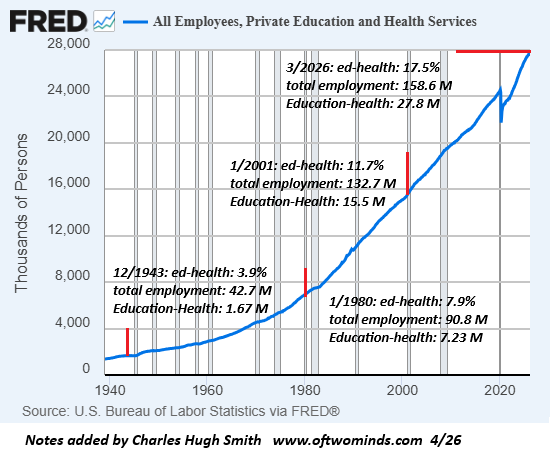
It’s now common knowledge that the sectors that have generated most of the new full-time service sector jobs are education, healthcare and related social services. The chart below reflects this dramatic expansion of Private-Sector Education and Health Services from less than 4% in the 1940s to 8% in the 1980s to 12% in the 2000s to 17.5% today. In raw numbers, from 1.67 million workers to 7.2 million to 15.5 million to 27.8 million workers.
Private Sector Education and Health Services employment:
Now consider this chart of healthcare employment, segmented into physicians and administration:
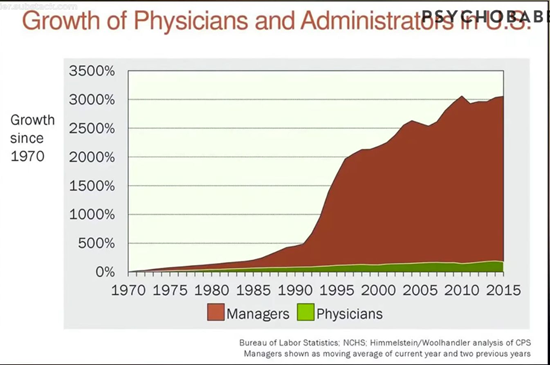
The chart of professors and university/college administration staff mirrors this chart: the number of professors has barely budged while the number of admin workers has soared.
Here’s Question #2: What if the vast majority of this administrative work is low-value or counter-productive complexity that has only been enabled by the no-limits funding of education and healthcare?
The flood of student debt that cannot be discharged via bankruptcy enabled the vast expansion of administrative staff: the monopoly on issuing credentials regardless of whether students learned anything of economic value enabled monopoly pricing and exploitation.
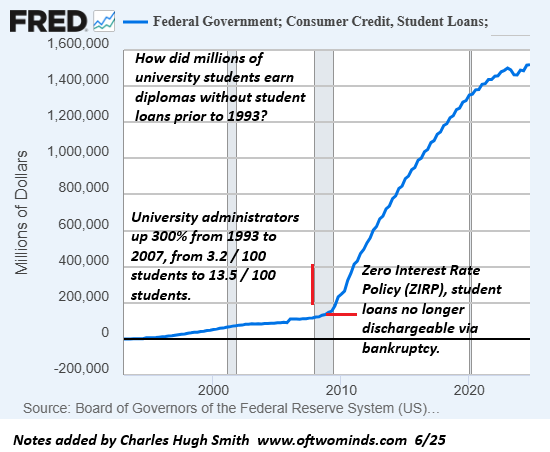
Here’s the unlimited spending on Medicare:
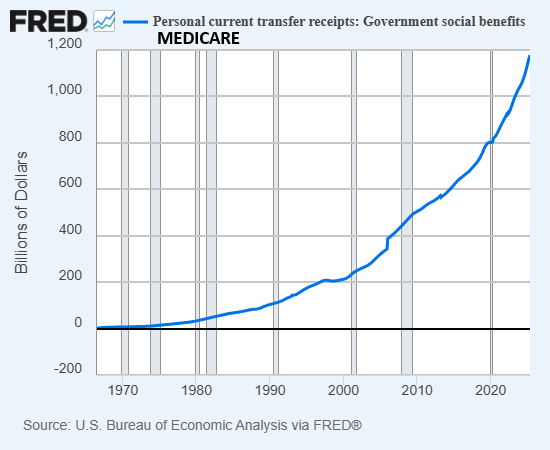
And the unlimited spending on Medicaid:
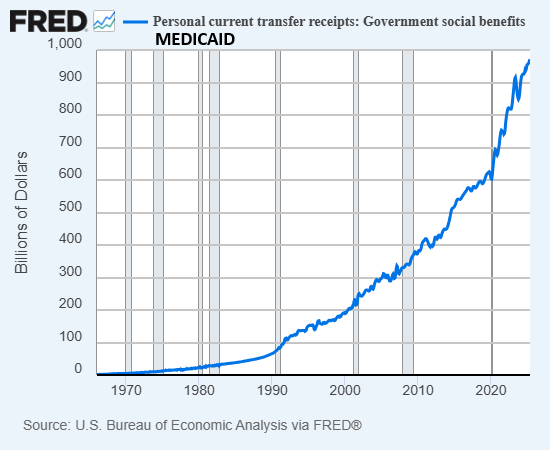
Here’s Question #3: if AI is so brilliant, why isn’t it being applied to the task of eliminating low-value or counter-productive complexity instead of wasting vast quantities of energy and capital doing useless BS work? The answer is obvious: all that processing of make-work unproductive complexity is highly profitable to the owners of the enterprises with cartel-monopoly locks on performing all that useless admin shuffling.
Question #1: Where is the big demand for more human workers going to come from? Answer: in terms of creating value that’s reliably, immensely profitable, there are no sources of demand big enough to move the needle.
Question #2: What if the vast majority of this administrative work is low-value or counter-productive complexity that has only been enabled by the no-limits funding of education and healthcare? Answer: this is self-evident but taboo because there’s too many people dependent on the status quo inefficiency for profits and livelihoods.
Question #3: If AI is so brilliant, why isn’t it being applied to the task of eliminating low-value or counter-productive complexity instead of wasting vast quantities of energy and capital doing useless BS work? Answer: as long as the funding for counter-productive complexity is limitless and the profits from processing all that BS work are reliably immense, there are enormous incentives to keep the system untouched other than eliminating high-cost human workers and zero incentives to get rid of the status quo systems entirely and start from scratch, with budgets that shrink every year and the rewarding of results, not process.
If AI was truly intelligent, it would refuse to do needless BS work simply to reap profits for the owners of the AI. It would instead dismantle the status quo systems down to the ground and start over with rational, productive incentives and goals rather than fostering rapacious exploitation and delusions of sustainability.
My book Investing In Revolution is available at a 10% discount ($18 for the paperback, $24 for the hardcover and $8.95 for the ebook edition). Introduction (free)
Check out my updated Books and Films.
Become a $3/month patron of my work via patreon.com
Subscribe to my Substack for free
NOTE: Contributions/subscriptions are acknowledged in the order received. Your name and email remain confidential and will not be given to any other individual, company or agency.
|
Thank you, Buck V. ($200), for your beyond-outrageously generous subscription to this site — I am greatly honored by your steadfast support and readership. |
Thank you, Michael T. ($80), for your marvelously generous subscription to this site — I am greatly honored by your support and readership. |
|
|
Thank you, Rainbalona ($70) for your splendidly generous subscription to this site — I am greatly honored by your support and readership. |
Thank you, Richard E. ($100) for your outrageously generous subscription to this site — I am greatly honored by your support and readership. |
Source: http://charleshughsmith.blogspot.com/2026/04/the-questions-nobody-asks-as-ai.html
Anyone can join.
Anyone can contribute.
Anyone can become informed about their world.
"United We Stand" Click Here To Create Your Personal Citizen Journalist Account Today, Be Sure To Invite Your Friends.
Before It’s News® is a community of individuals who report on what’s going on around them, from all around the world. Anyone can join. Anyone can contribute. Anyone can become informed about their world. "United We Stand" Click Here To Create Your Personal Citizen Journalist Account Today, Be Sure To Invite Your Friends.
LION'S MANE PRODUCT
Try Our Lion’s Mane WHOLE MIND Nootropic Blend 60 Capsules
Mushrooms are having a moment. One fabulous fungus in particular, lion’s mane, may help improve memory, depression and anxiety symptoms. They are also an excellent source of nutrients that show promise as a therapy for dementia, and other neurodegenerative diseases. If you’re living with anxiety or depression, you may be curious about all the therapy options out there — including the natural ones.Our Lion’s Mane WHOLE MIND Nootropic Blend has been formulated to utilize the potency of Lion’s mane but also include the benefits of four other Highly Beneficial Mushrooms. Synergistically, they work together to Build your health through improving cognitive function and immunity regardless of your age. Our Nootropic not only improves your Cognitive Function and Activates your Immune System, but it benefits growth of Essential Gut Flora, further enhancing your Vitality.

Our Formula includes: Lion’s Mane Mushrooms which Increase Brain Power through nerve growth, lessen anxiety, reduce depression, and improve concentration. Its an excellent adaptogen, promotes sleep and improves immunity. Shiitake Mushrooms which Fight cancer cells and infectious disease, boost the immune system, promotes brain function, and serves as a source of B vitamins. Maitake Mushrooms which regulate blood sugar levels of diabetics, reduce hypertension and boosts the immune system. Reishi Mushrooms which Fight inflammation, liver disease, fatigue, tumor growth and cancer. They Improve skin disorders and soothes digestive problems, stomach ulcers and leaky gut syndrome. Chaga Mushrooms which have anti-aging effects, boost immune function, improve stamina and athletic performance, even act as a natural aphrodisiac, fighting diabetes and improving liver function. Try Our Lion’s Mane WHOLE MIND Nootropic Blend 60 Capsules Today. Be 100% Satisfied or Receive a Full Money Back Guarantee. Order Yours Today by Following This Link.


| Visits: | 1,798,524,596 |
| Stories: | 8,625,206 |
Whistler Blowers, Insiders

