

How to Introduce Yourself at a Networking Event (Without Sounding Like a Robot)

How to introduce yourself at a networking event is simpler than most people make it: say who you help, what problem you solve, and stop talking. No titles. No company history. No rambling. The best networking introductions
Watch what happens at any networking event. Someone asks “what do you do?” and the answer is always a title and a company name — delivered with a smile, received with a polite nod, and forgotten before the person walks away. The snack table wins every time. Getting that to stop is easier than you’d think.
Why Most Networking Introductions Fall Flat
The default networking introduction sounds like this: “Hi, I’m Sarah. I’m a financial advisor with ABC Wealth Management.” Clean. Professional. Completely forgettable.
Here’s the problem. Titles mean nothing to strangers. “Financial advisor” puts you in a mental box with every other financial advisor they’ve met. There’s no hook, no curiosity, no reason for the conversation to continue.
According to research from Psychology Today, people form a first impression in as little as 7 seconds. Your introduction is your one shot to control that impression — and most people waste it on a job title that triggers zero emotional response.
The fix is not a longer introduction. The fix is a better one.
Why “Creative” Introductions Backfire Too
There’s a photographer at almost every networking event who says “I shoot people for a living.” It gets a laugh. It breaks the ice. And it tells you absolutely nothing useful.
The problem with clever introductions is the same problem as generic ones — the other person doesn’t know what box to put you in. And that box matters more than you think.
When you meet someone new, your brain immediately searches for a category. Accountant. Contractor. Marketing person. That categorization is how referrals happen. Someone hears your name three weeks later in a conversation about taxes and thinks “I know an accountant.” If they can’t categorize you, they can’t refer you — no matter how memorable your line was.
So the goal is not to eliminate the category. The goal is to own it first, then differentiate.
Say the category. Then say who specifically you serve.
“I’m a bookkeeper” tells me the box. “I’m a bookkeeper who works specifically with online creators who would rather be making and selling their art than dealing with their finances” tells me exactly who to send your way.
That two-part structure does both jobs. It gives people the mental file folder they need, and it gives them enough detail to know when to pull your name out of it.
The Formula for How to Introduce Yourself at a Networking Event
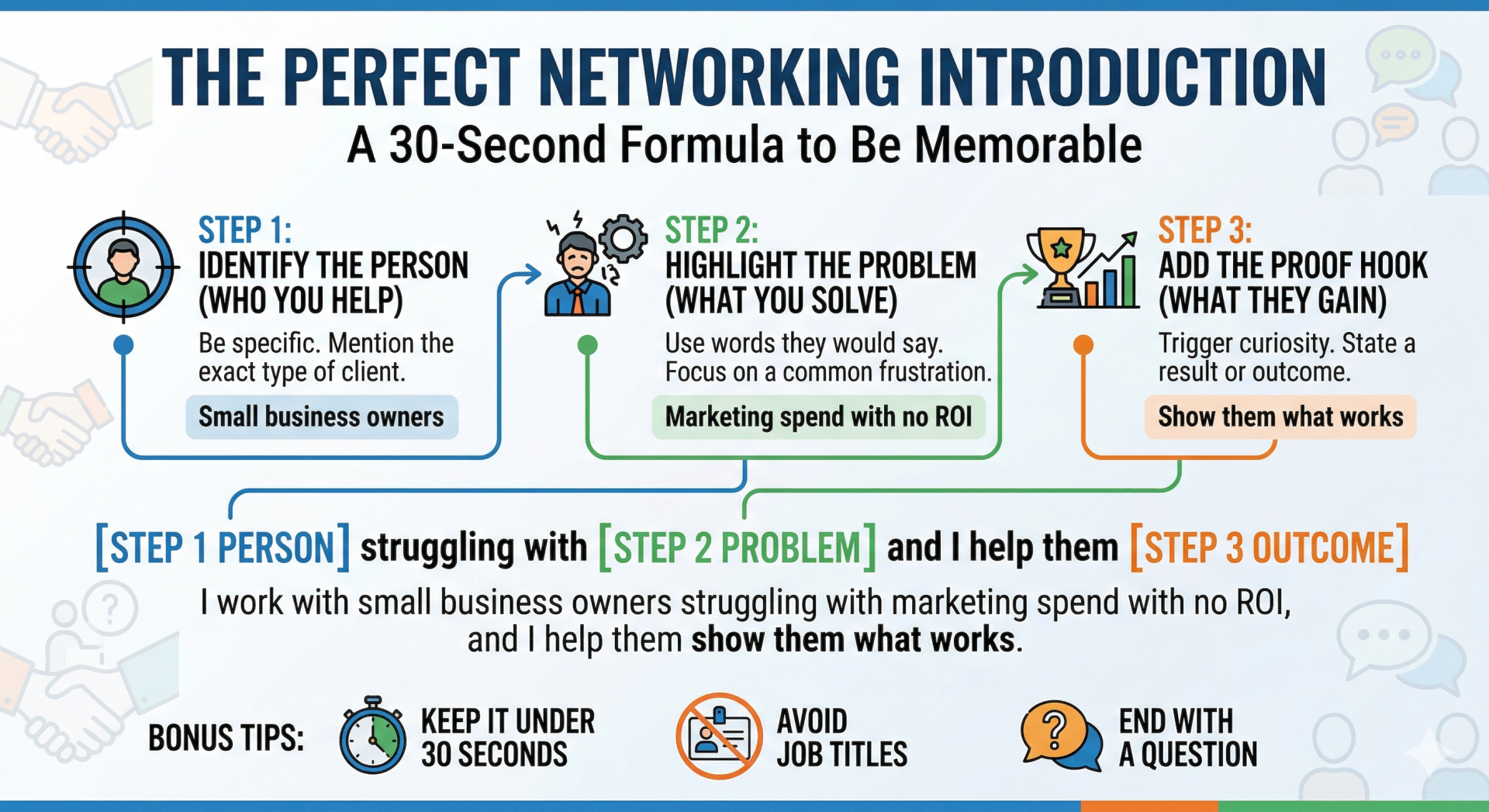
The most effective networking introductions follow a simple structure. Call it the Problem-Person-Proof formula:
- Person: Who do you work with? (Be specific — “small business owners” beats “businesses”)
- Problem: What problem do you solve for them? (Use words they’d actually say)
- Proof Hook: A result, stat, or curiosity-triggering line that makes them ask a follow-up question
Here’s what it sounds like in practice:
“I work with small business owners who are spending money on marketing but have no idea if it’s working. I help them figure out exactly what’s working and cut everything that isn’t — usually in one session.”
That introduction takes about 15 seconds. The person listening immediately thinks one of two things: “That’s me” or “I know someone like that.” Either way, the conversation continues.
What to Say When Someone Asks “What Do You Do?”
“What do you do?” is the most common question at any networking event — and most people answer it with the least effective possible answer.
When someone asks you this question, resist the title trap. Your title tells them your category. Your answer should tell them your value.
Try this framework — answer in three beats:
- Beat 1 — The Customer: “I work with [specific type of person]…”
- Beat 2 — The Problem: “…who are struggling with [specific frustration or challenge]…”
- Beat 3 — The Outcome: “…and I help them [achieve specific result].”
This works whether you’re an accountant, a contractor, a coach, or a marketing consultant. The specificity is what makes it land.
For example, a plumber could say: “I work with homeowners in older homes who are always dealing with mysterious leaks and drainage problems. I find the root cause and fix it once so they don’t keep calling someone every six months.”
That’s a referral-ready introduction. Anyone who hears it knows exactly who to send their way.
How to Introduce Yourself at a BNI or Structured Networking Meeting
BNI and other structured networking groups like it run on a specific format — you typically get 60 seconds per week to introduce yourself to the room. This is not the same as a hallway conversation, and it deserves its own strategy.
Your BNI introduction (also called a 60-second commercial) should rotate weekly so it stays fresh for members who hear it repeatedly. The structure stays the same; the examples and asks change.
A strong BNI-style introduction includes:
- Your name and business name (clearly stated)
- One specific type of customer you serve this week
- One specific problem you solve
- A specific referral ask (“I’m looking for introductions to…”)
- Your name again at the close (memory anchor)
The referral ask is where most people get lazy. “I’m looking for anyone who needs marketing” is useless. “I’m looking for an introduction to any restaurant owner in town who just opened a second location” is specific enough to trigger a name in someone’s head.
If you’re newer to BNI or evaluating whether it’s right for your business, the DIYMarketers BNI review covers the full picture — cost, results, and whether it’s worth your time.
Common Mistakes People Make When Introducing Themselves at Networking Events
Even experienced business owners get this wrong. Here are the four most common mistakes — and the quick fix for each.
Mistake 1: Leading with your title.
“I’m a marketing consultant” tells me your job category, not your value. Fix: Lead with who you help, not what you are.
Mistake 2: Going too long.
Anything over 45 seconds in casual conversation feels like a sales pitch. Fix: Practice a 15-second version and a 30-second version. Use the 15-second one first.
Mistake 3: Making it all about you.
“I founded my company in 2018 and we specialize in…” — nobody cares about your founding date at a networking event. Fix: Start with the customer, not yourself.
Mistake 4: Forgetting the ask.
An introduction with no clear direction for the conversation leaves the other person with nothing to do. Fix: End with a light ask or question that keeps things moving — “Do you work with a lot of [your ideal customer type]?”
How to Practice Your Networking Introduction Before the Event
Writing your intro is not enough. You have to say it out loud — multiple times — until it feels like a natural sentence and not a memorized speech.
Here’s a practice method that works: record yourself on your phone. Say your introduction three times in a row. Listen back. You’ll immediately hear what sounds stiff, what sounds too long, and what sounds like you’re reading from a teleprompter.
Then say it to someone who doesn’t know your industry. If they don’t understand it, neither will the stranger at the networking event.
The gold standard: your introduction should feel conversational at 8 AM before coffee. If it only sounds good when you’re in “presentation mode,” it’s not ready.
Networking Introduction Examples for Different Business Types
Here are real-world examples using the Person-Problem-Outcome formula. Use these as a starting point, then make them your own.
| Business Type | Weak Introduction | Strong Introduction |
|---|---|---|
| Bookkeeper | “I’m a bookkeeper at Smith Accounting.” | “I work with small business owners who are always surprised at tax time. I make sure they know their numbers every month so April is never a shock.” |
| HVAC Contractor | “I own an HVAC company.” | “I work with homeowners whose systems always seem to break on the hottest day of the year. I do maintenance plans so that never happens.” |
| Marketing Consultant | “I do digital marketing and social media.” | “I work with small business owners spending money on marketing who have no idea which part is working. I show them exactly where to focus so they stop wasting budget.” |
| Life Insurance Agent | “I sell life insurance.” | “I work with families who have young kids and haven’t gotten around to protecting their income yet. I make the process simple so it’s done in one conversation.” |
What to Do After You Introduce Yourself at a Networking Event
The introduction gets the conversation started. The follow-up is where the relationship actually forms — and where most people completely drop the ball.
Within 24-48 hours of meeting someone at a networking event, send a short personal note. Not a newsletter. Not a LinkedIn connection request with no message. A personal note that references something specific from your conversation.
“It was great to meet you last night. I loved what you said about [specific thing]. I’d love to grab a 15-minute call to learn more about your business.”
That’s it. Short, personal, specific. For a full follow-up email template and sequence, the DIYMarketers guide to getting referrals walks through exactly what to say and when.
Referrals don’t come from introductions. They come from relationships — and relationships start with good follow-up. The guide to asking for referrals covers the exact language to use when you’re ready to make the ask.
How Networking Groups Like BNI Fit Into a Referral Marketing Strategy
Your networking introduction is the entry point into a bigger system. If you’re attending events but not building a process around them, you’re treating networking as a one-off activity instead of a marketing channel.
Groups like BNI are built around structured referral marketing. You show up weekly, refine your introduction, build relationships over time, and generate referrals through a community of other business owners. It’s one of the most cost-effective marketing strategies available to a small business with a limited budget.
For a full comparison of your options, the guide to networking groups like BNI covers the alternatives — what they cost, how they work, and which type of business benefits most from each.
Referral marketing works because people trust people they know. According to Nielsen research, 92% of consumers trust referrals from people they know over any other form of advertising. Your introduction is the first domino in that chain.

Frequently Asked Questions About Networking Introductions
A networking introduction should be 15 to 30 seconds in casual conversation — roughly 40 to 75 words. For structured networking events like BNI, you typically get 60 seconds. The goal is to say enough to spark curiosity and start a conversation, not to explain everything you do.
Say who you work with, what problem you solve for them, and one memorable result or outcome. Avoid leading with your job title or company name. A strong formula: “I work with [specific person] who [specific problem]. I help them [specific outcome].” Keep it conversational and end with a light question to keep the dialogue going.
A good first impression at a networking event comes from listening as much as talking. Introduce yourself clearly, ask a genuine question about the other person’s business, and follow up within 24 hours. Most people show up to networking events focused on talking about themselves — the person who asks the best questions is the one people remember.
A 60-second networking introduction is a structured personal commercial used in formal networking groups like BNI. It includes your name, business name, who you serve, what problem you solve, a specific referral ask, and a closing memory hook. Members rotate their examples weekly so the introduction stays fresh for the same audience over time.
When you’re new to a networking group, keep your first introduction simple and honest. State your name, what you do in plain language, and who your ideal referral is. You don’t need to be polished right away — what matters is being clear and specific. Say something like: “I’m new here and still figuring out the format, but I work with [customer type] on [problem], and the best referral for me is someone who [specific situation].”
Additional Reading
- Is BNI Worth It? An Honest Review for Small Business Owners
- How to Get Referrals Without Feeling Pushy
- Networking Groups Like BNI: Your Full Comparison Guide
Low budget marketing strategies for CEOs with no marketing department. Join DIYMarketers.com for free marketing tips.
Source: https://diymarketers.com/how-to-introduce-yourself-at-a-networking-event/
Anyone can join.
Anyone can contribute.
Anyone can become informed about their world.
"United We Stand" Click Here To Create Your Personal Citizen Journalist Account Today, Be Sure To Invite Your Friends.
Before It’s News® is a community of individuals who report on what’s going on around them, from all around the world. Anyone can join. Anyone can contribute. Anyone can become informed about their world. "United We Stand" Click Here To Create Your Personal Citizen Journalist Account Today, Be Sure To Invite Your Friends.
LION'S MANE PRODUCT
Try Our Lion’s Mane WHOLE MIND Nootropic Blend 60 Capsules
Mushrooms are having a moment. One fabulous fungus in particular, lion’s mane, may help improve memory, depression and anxiety symptoms. They are also an excellent source of nutrients that show promise as a therapy for dementia, and other neurodegenerative diseases. If you’re living with anxiety or depression, you may be curious about all the therapy options out there — including the natural ones.Our Lion’s Mane WHOLE MIND Nootropic Blend has been formulated to utilize the potency of Lion’s mane but also include the benefits of four other Highly Beneficial Mushrooms. Synergistically, they work together to Build your health through improving cognitive function and immunity regardless of your age. Our Nootropic not only improves your Cognitive Function and Activates your Immune System, but it benefits growth of Essential Gut Flora, further enhancing your Vitality.

Our Formula includes: Lion’s Mane Mushrooms which Increase Brain Power through nerve growth, lessen anxiety, reduce depression, and improve concentration. Its an excellent adaptogen, promotes sleep and improves immunity. Shiitake Mushrooms which Fight cancer cells and infectious disease, boost the immune system, promotes brain function, and serves as a source of B vitamins. Maitake Mushrooms which regulate blood sugar levels of diabetics, reduce hypertension and boosts the immune system. Reishi Mushrooms which Fight inflammation, liver disease, fatigue, tumor growth and cancer. They Improve skin disorders and soothes digestive problems, stomach ulcers and leaky gut syndrome. Chaga Mushrooms which have anti-aging effects, boost immune function, improve stamina and athletic performance, even act as a natural aphrodisiac, fighting diabetes and improving liver function. Try Our Lion’s Mane WHOLE MIND Nootropic Blend 60 Capsules Today. Be 100% Satisfied or Receive a Full Money Back Guarantee. Order Yours Today by Following This Link.


| Visits: | 1,795,574,955 |
| Stories: | 8,619,761 |
Whistler Blowers, Insiders

