

The Maidan Killings and the False-Flag Case

Freddie Ponton
21st Century Wire
Before the killings that helped bring down Ukraine’s president in February 2014, American diplomats were discussing who should enter its government. In a leaked telephone call, senior State Department official Victoria Nuland told US ambassador Geoffrey Pyatt, “I think Yats is the guy,” referring to opposition leader Arseniy Yatseniuk. Washington had clear preferences and was working to advance them. Later that month, Yatseniuk became prime minister.
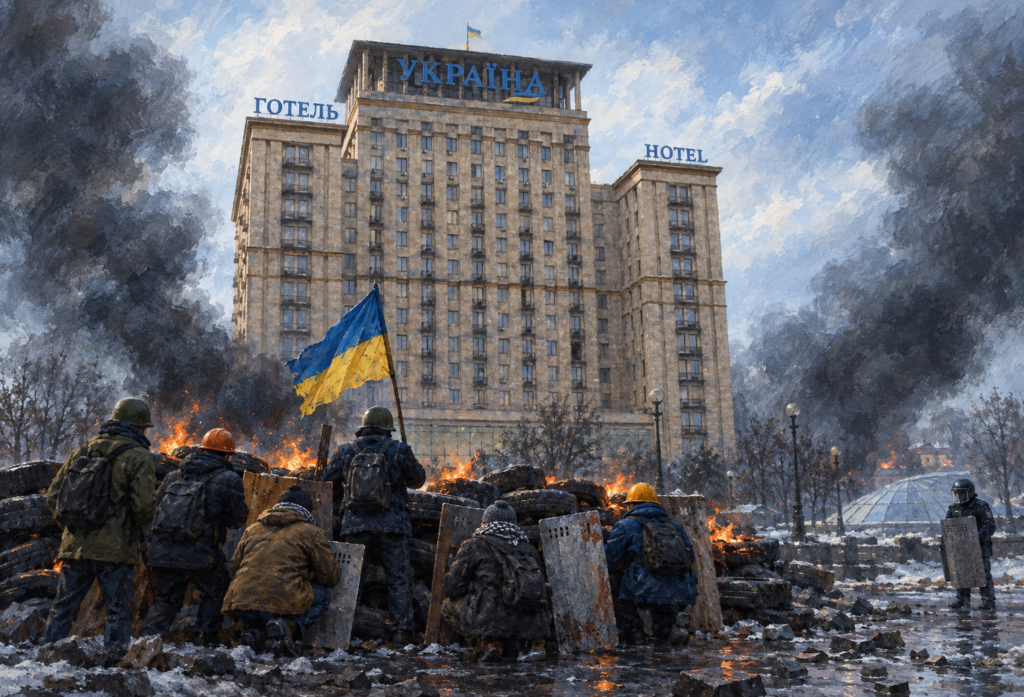
Ivan Katchanovski’s The Maidan Massacre in Ukraine examines the violence that preceded that transfer of power. Drawing on television footage, witness testimony, forensic examinations and Ukrainian court proceedings, he argues that elements of the opposition shot protesters and police in a false-flag operation. His case centres on evidence of protesters being shot from opposition-controlled locations, including Hotel Ukraina, overlooking the killing ground.
The protests began in November 2013, when President Viktor Yanukovych suspended plans to sign an association agreement with the European Union. Demonstrators gathered in Kyiv’s Independence Square, known as the Maidan. Police violence, restrictive legislation and escalating clashes deepened the confrontation. On 20 February, scores were killed or injured. An agreement signed the following day failed to preserve Yanukovych’s presidency; he fled Kyiv, and parliament voted to remove him.
During the shootings, BBC correspondent Gabriel Gatehouse reported seeing what looked like a protester firing from a window of Hotel Ukraina. Katchanovski connects the BBC footage with ICTV recordings and an investigative finding that the room was occupied by a parliamentary deputy from the far-right Svoboda party. His account also cites a Maidan participant’s testimony that protesters had told him the gunman was “our sniper.”
VIDEO: BBC and ICTV footage that Katchanovski identifies as showing shooting from a Hotel Ukraina room occupied by a Svoboda deputy, directed towards protesters and the BBC crew. (Source: Ivan Katchanovski on X.)
Orwellian blackout & denial of false-flag Maidan massacre evidence:
· BBC & ICTV videos of sniper(s) in Hotel Ukraina room of far-right Svoboda deputy shooting Maidan protesters & BBC journalists
· Maidan activists, BBC journalist & verdict identifying them as Maidan sniper(s)
· CNN & Spilne TV videos of Maidan snipers on the same floor at that time
· ZDF, Itele, Sky News & Ukraina TV videos of far-right-linked Maidan snipers on different hotel floors
· ZDF & RT videos of far-right-linked Maidan snipers shooting from Hotel Ukraina ZDF room
· Confessions by 7 self-admitted Georgian snipers about false flag massacre by snipers in Hotel Ukraina & Musci Conservatory on orders of Maidan leaders
· Testimonies by 7 Maidan politicians and activists about specific involvement of specific Maidan leaders in the massacre
· Testimonies by over 300 witnesses, absolute majority of wounded Maidan protesters, and several dozen prosecution witnesses that they/or other Maidan protesters were shot from the Hotel Ukraina and other Maidan-controlled locations
· Verdict confirming that many Maidan protesters were killed and wounded from Hotel Ukraina and other Maidan-controlled locations, that there was nor massacre order by Yanukovych and his government, & no Russian involvement
· Forensic ballistic examinations by government forensic experts that bullet trajectories pointed to shooting by snipers in Hotel Ukraina and other Maidan-controlled-locations
· Forensic medical examinations by government forensic experts that nearly all killed and wounded Maidan protesters were shot from steep positions
· Synchronized videos showing that times and directions of specific gunshots by Berkut do not coincide with times and locations of shooting of specific Maidan protesters
· Statement by Svoboda, videos, verdict, and testimonies by Maidan Self-Defence commander that they controlled and guarded the Hotel Ukraina before, during, and after the massacre and checked hotel rooms during the massacre
· Maidan female activist testified that Svoboda deputies were in their Hotel Ukraina rooms during this shooting
· GPU: this hotel room was occupied by Svoboda deputy but still denies that there were snipers in Hotel Ukraina and “laughed” at & disappeared testimony of the Maidan activist that this was Maidan sniper.
· EtcAll this and numerous other evidence are presented in my open access book “The Maidan Massacre in Ukraine,” 4 peer-reviewed journal articles, 2 book chapters & 7 online video appendixes https://t.co/VJJQQRMeXx
— Ivan Katchanovski (@I_Katchanovski) October 4, 2026
Svoboda publicly announced that its activists had taken Hotel Ukraina under their control and protection on 25 January, according to the statement reproduced in Katchanovski’s chapter on witness testimony. He also cites a Maidan Self-Defence commander who described guarding the entrance and checking bags before, during and after the massacre. Other recordings and accounts place armed opposition groups inside.
Wounded protesters described shots coming from the hotel and other Maidan-controlled locations. Katchanovski compares those accounts with wound directions, ballistic findings and synchronised footage. In his reconstruction, protesters advancing towards the police were also being shot from elevated positions to their sides or behind them, in buildings controlled by their own movement.
BOOK: Read Ivan Katchanovski’s The Maidan Massacre in Ukraine, the open-access investigation examined in this article. The book brings together video analysis, witness testimony, forensic material and Ukrainian court proceedings to present the author’s case for a false-flag massacre. (Source: Ivan Katchanovski, The Maidan Massacre in Ukraine | Palgrave Macmillan, 2024)978-3-031-67121-0
Katchanovski’s examination of the October 2023 verdict exposes a contradiction within the proceedings. Passages he reproduces place particular fatal shootings in the direction of Hotel Ukraina, outside police-controlled territory. Yet the prosecution’s case against Berkut, Ukraine’s riot police, proceeded alongside evidence that, according to his analysis, pointed towards opposition-controlled positions. He identifies missing exhibits, altered bullet fragments and reversals of earlier forensic examinations, arguing that the investigation obscured the responsibility of opposition-linked shooters.
Self-described Georgian participants alleged that they received weapons and orders to shoot both police and protesters to disrupt a political settlement. Their accounts implicated opposition figures, including Serhii Pashynsky, a Ukrainian member of parliament from the Fatherland party and a Maidan opposition politician. Katchanovski compares details from those accounts with footage, shooting locations, and other testimony, though he acknowledges his study cannot verify allegations against named individuals.
The authorities emerging from the upheaval quickly sought new intelligence ties. A New York Times investigation traces the partnership to 24 February 2014, when Ukraine’s new security-service chief contacted the CIA and Britain’s MI6. It subsequently expanded into extensive cooperation, including 12 CIA-supported secret locations along Ukraine’s border with Russia, constructed over the eight years preceding the newspaper’s 2024 report.
At home, parliament’s attempt to repeal the regional-language law triggered widespread criticism. As language scholar Dominique Arel explains, acting president Oleksandr Turchynov blocked the repeal, leaving the law in force. The vote nevertheless intensified controversy over the new authorities’ approach to language rights.
The massacre helped determine who would govern Ukraine. Katchanovski concludes that elements of the opposition engineered the killings to turn public outrage against Yanukovych and seize power. His case brings together hotel footage, victims’ accounts, forensic material and evidence he identifies as investigative manipulation. The book challenges both the attribution of the shootings and the political account built upon them.
READ MORE UKRAINE NEWS AT: 21st CENTURY WIRE Ukraine FILES
SUPPORT OUR INDEPENDENT MEDIA PLATFORM – BECOME A MEMBER @21WIRE.TV
VISIT OUR TELEGRAM CHANNEL
21st Century Wire is an alternative news agency designed to enlighten, inform and educate readers about world events which are not always covered in the mainstream media.
Source: https://21stcenturywire.com/2026/10/05/the-maidan-killings-and-the-false-flag-case/
Anyone can join.
Anyone can contribute.
Anyone can become informed about their world.
"United We Stand" Click Here To Create Your Personal Citizen Journalist Account Today, Be Sure To Invite Your Friends.
Before It’s News® is a community of individuals who report on what’s going on around them, from all around the world. Anyone can join. Anyone can contribute. Anyone can become informed about their world. "United We Stand" Click Here To Create Your Personal Citizen Journalist Account Today, Be Sure To Invite Your Friends.
LION'S MANE PRODUCT
Try Our Lion’s Mane WHOLE MIND Nootropic Blend 60 Capsules
Mushrooms are having a moment. One fabulous fungus in particular, lion’s mane, may help improve memory, depression and anxiety symptoms. They are also an excellent source of nutrients that show promise as a therapy for dementia, and other neurodegenerative diseases. If you’re living with anxiety or depression, you may be curious about all the therapy options out there — including the natural ones.Our Lion’s Mane WHOLE MIND Nootropic Blend has been formulated to utilize the potency of Lion’s mane but also include the benefits of four other Highly Beneficial Mushrooms. Synergistically, they work together to Build your health through improving cognitive function and immunity regardless of your age. Our Nootropic not only improves your Cognitive Function and Activates your Immune System, but it benefits growth of Essential Gut Flora, further enhancing your Vitality.

Our Formula includes: Lion’s Mane Mushrooms which Increase Brain Power through nerve growth, lessen anxiety, reduce depression, and improve concentration. Its an excellent adaptogen, promotes sleep and improves immunity. Shiitake Mushrooms which Fight cancer cells and infectious disease, boost the immune system, promotes brain function, and serves as a source of B vitamins. Maitake Mushrooms which regulate blood sugar levels of diabetics, reduce hypertension and boosts the immune system. Reishi Mushrooms which Fight inflammation, liver disease, fatigue, tumor growth and cancer. They Improve skin disorders and soothes digestive problems, stomach ulcers and leaky gut syndrome. Chaga Mushrooms which have anti-aging effects, boost immune function, improve stamina and athletic performance, even act as a natural aphrodisiac, fighting diabetes and improving liver function. Try Our Lion’s Mane WHOLE MIND Nootropic Blend 60 Capsules Today. Be 100% Satisfied or Receive a Full Money Back Guarantee. Order Yours Today by Following This Link.


| Visits: | 1,834,080,909 |
| Stories: | 8,716,238 |
Whistler Blowers, Insiders

