

Black Bloc in France: Revolutionaries or Ammunition for the State?

Freddie Ponton
21st Century Wire
Their methods are documented, their political objectives acknowledged, and their international circulation known. Yet peaceful demonstrators repeatedly lose control of their own gatherings when black blocs appear. The consequences extend beyond the streets to the accusations governments make afterwards.
With the Gilets jaunes coordination calling for fresh demonstrations on 24 October, the question of protection is already urgent again. Will black-bloc groups once again be allowed to disrupt the mobilisation, leaving peaceful protesters and shopkeepers to bear the costs?
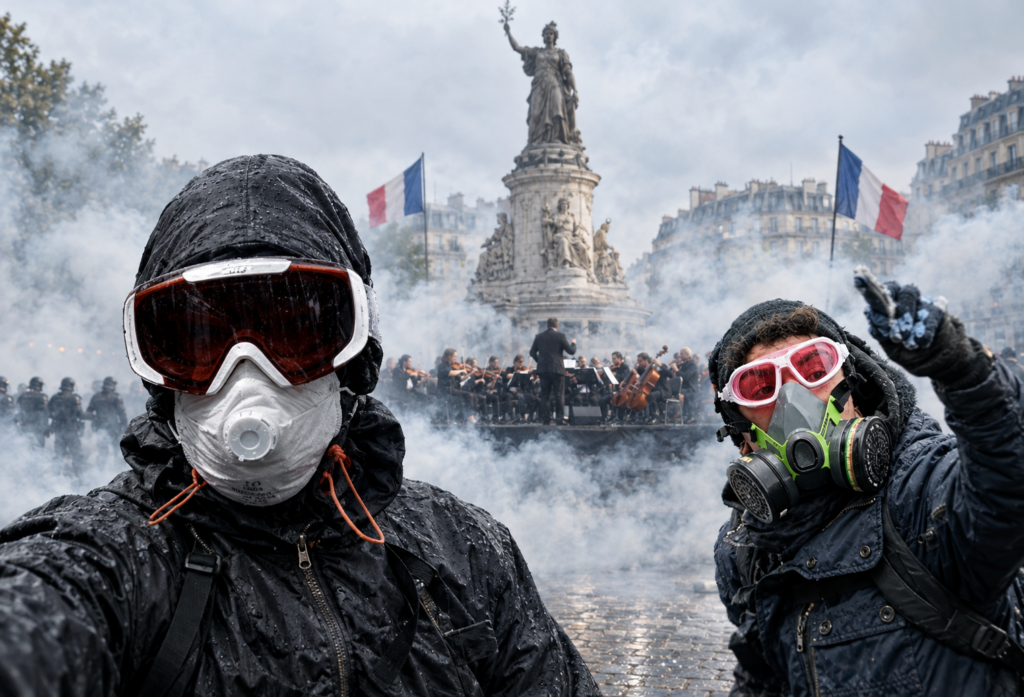
At approximately 12:20 on 17 October, tear gas reached the Orchestre du Nouveau Monde at Place de la République. The musicians had arrived around 11:30 to rehearse for a declared appearance supporting the mobilisation. The main procession was not due to leave until the afternoon. They continued playing for roughly twenty minutes before stopping and dispersing, according to the accounts published by Le Monde and Télérama.

IMAGE: The Orchestre du Nouveau Monde’s interrupted performance at République illustrates the exposure of peaceful participants before the march began (Source: The Paris Times)
The gathering at République formed part of a wider student mobilisation in Paris and across France. Franceinfo reported that organisers put nationwide turnout at 800,000, while Interior Minister Laurent Nuñez cited 550,000 across France, including 110,000 in Paris.
Before the march could properly assemble, masked, black-clad groups were already confronting police around the square. Reports describe projectiles and fireworks, followed by police charges, tear gas, and further clashes. People arriving to demonstrate found themselves inside a confrontation already underway.
The orchestra was among those affected. Its members had brought instruments, notified the authorities and organised a peaceful performance. In an interview afterwards, musician Étienne Cognet described being gassed as unprecedented in the ensemble’s five years of demonstrations.
Although the procession eventually departed, its departure neither restored the concert nor undid the dispersal of those who had gathered beforehand. A demonstration can be sabotaged without being cancelled when its assembly is disrupted, its participants scattered and its demands overshadowed by the violence before the first banner moves. Responsibility rests with those choosing confrontation, but also with authorities charged with protecting participants from a foreseeable threat rather than merely responding to the destruction afterwards.
Black blocs are hardly an unknown quantity. The Research Centre of the National Gendarmerie Officers’ School (CREOGN) has published descriptions of their methods, political objectives, and international connections. Parliamentary hearings have examined advance warnings, delayed orders, and alleged decisions not to intervene. That accumulated knowledge makes the authorities’ preparation and decisions at République central to any account of why peaceful participants were left exposed.
What is Black Bloc?
Black bloc is often described by the mainstream press and government as an amorphous,
radical activist movement which uses protest tactics in which individuals and affinity groups form a largely anonymous contingent within a demonstration. Participants are commonly associated with anarchist, anti-capitalist, anti-fascist and other far-left movements. Black clothing and face coverings help conceal their identities and make individuals harder to distinguish, while helmets, goggles and other protective equipment offer varying protection during confrontations with police.
However, critics believe those labels do not settle what their actions achieve. When they fracture a protest, eclipse its demands, and supply the government with images it can turn against its opponents, their professed purpose collides with their political effect. The government’s use of that disorder is its own responsibility. But militants who choose their targets for political reasons cannot dismiss the political consequences when their actions help the government discredit the protest.
That accumulated knowledge begins with a history more than four decades old. The practice emerged in West Berlin’s autonomous squatting milieu in the 1980s. In a July 2016 research note for the Gendarmerie officers’ research centre, Alice Cantiteau traced its spread through publications, activist culture, and international gatherings. Seattle’s 1999 demonstrations against the World Trade Organization brought major international visibility; the Nice European summit in 2000 became an early French milestone.
Subsequent French mobilisations, including Notre-Dame-des-Landes and the 2016 labour-law protests, gave authorities further opportunities to study the phenomenon. On 1 May 2018, a large black bloc assembled separately from the union procession at the beginning of the Paris demonstration, as a later parliamentary report records. Arriving early and occupying the front was already part of the record.
The familiar explanation that a black bloc is a tactic rather than an organisation captures its temporary form without fully accounting for the relationships that allow it to reappear. Cantiteau describes autonomous groups coordinating horizontally through shared practices. She also identifies political objectives, including opposition to capitalism and state authority. Her account describes organisation without a central hierarchy—not an absence of organisation.
StreetPress’s May 2016 immersion gives those relationships a more concrete form. Jonathan and Ahmad, two participants interviewed by the reporters, described an affinity group held together by friendship and political agreement. Members organised parties and concerts and met for football. Their ambitions extended beyond defeating the labour-law proposal: they wanted people to remain organised after the mobilisation and challenge the wider economic system.
The reporting also documented a division of roles. Supporters shielded participants from police observation while they changed clothing; others supplied material during confrontations. Some joined the clashes, while sympathisers helped preserve anonymity by dressing similarly without taking part in violence. Street medics treated injured people in the wider cortège de tête, but did not participate in the fighting. Not everyone at the front took part in the violence, or bore responsibility for it.

IMAGE: Shared clothing and practical support helped preserve anonymity during the 2016 labour-law protests. Photograph by Pierre Gautheron (Source: StreetPress)
The visible bloc could disperse at the end of a march without dissolving the relationships that brought it together. Friendship, shared political commitments and practical cooperation sustained activity beyond the demonstration. Describing the formation as leaderless does not account for those enduring relationships, or explain how influence operates within them.
The financial picture is less clear. Cantiteau’s observation that black blocs do not require substantial resources sits alongside her description of transnational mobility, including German and Italian participants attending demonstrations abroad. Such travel entails costs and practical arrangements, even where equipment is inexpensive. Her note does not establish who pays for transport, where participants stay or what support they receive. These are unanswered questions about resources—not evidence, by themselves, of a central treasury, or cross-border command.
Calling a black bloc a temporary formation leaves much of its organisation outside the frame. The relationships that bring participants together, provide practical support and transmit experience begin before the march and survive afterwards. An account confined to the masked formation in the street leaves those networks unexplained.
The same distinction must apply to the state’s response. Masks can obstruct identification during a confrontation; they do not, by themselves, explain what authorities knew beforehand, what they could substantiate, or how they acted on it.
“They disperse” describes what happens at the end of a confrontation—not an adequate explanation of why the next one remains so difficult to prevent. Failure is not an explanation.
The Government knew what was coming
The destruction in Paris on 16 March 2019 followed advance warning of black-bloc participation. The Senate Law Commission’s information report, published on 10 April 2019, examined why that warning had not produced a more effective response.
Interior Minister Christophe Castaner maintained that both participation and violence had been anticipated. Laurent Nunez said intelligence services were monitoring participants, but proving that they were collectively preparing violence remained difficult. Commission Chair Philippe Bas questioned why surveillance had not led to judicial action, asking what prevented authorities from bringing the people under surveillance before the courts.
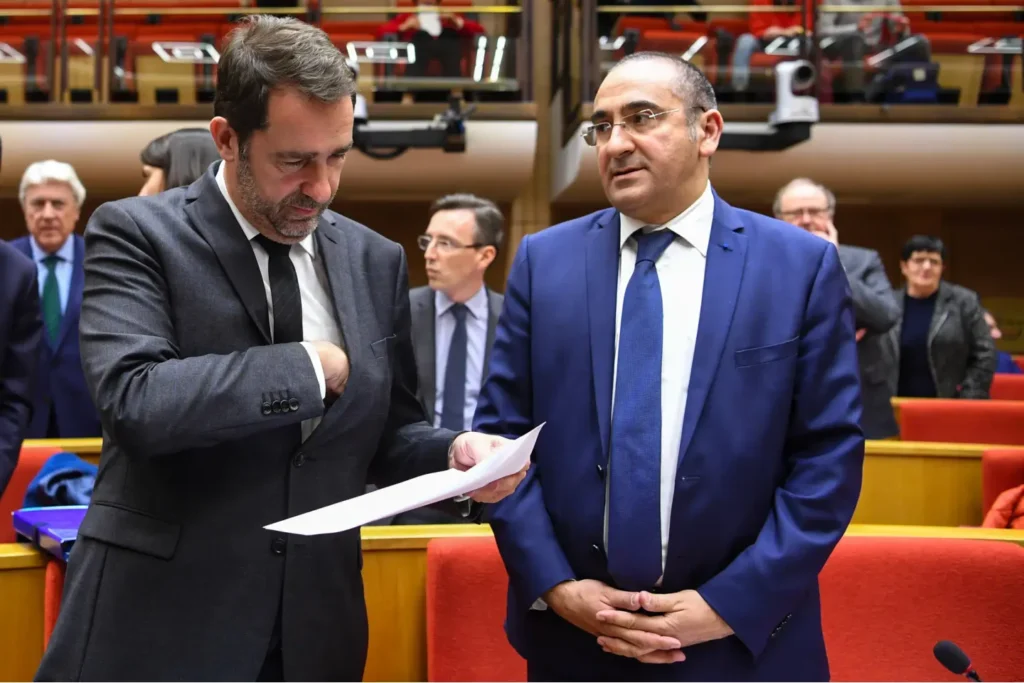
IMAGE: Christophe Castaner, left, and Laurent Nuñez at the Senate on 19 March 2019, facing parliamentary questions after the violence on the Champs-Élysées. Photograph by Eric Feferberg/AFP (Source: Paris Match)
These were people whom intelligence services had reportedly identified before the demonstration, not just masked figures investigators later tried to identify from footage. Yet the report noted limited use of the offence of collectively preparing violence. It also recorded accounts of delays of up to thirty minutes between requests for instructions and the orders that followed. Some units reportedly received instructions to hold back despite believing they could intervene.
The reported delays and instructions to hold back place the chain of command at the centre of the failure. Requests to intervene went unanswered while units waited for orders. Establishing who handled those requests and why intervention was delayed is necessary to distinguish operational constraints from errors of judgment, or failures of coordination. Calling the outcome a tactical failure does not explain the decisions that produced it.
The commission also described separate chains of command that hampered coordination between units maintaining public order and those making arrests, sometimes producing contradictory manoeuvres. These were weaknesses in the organisation of the police response, not surprises sprung by the crowd. Two years later, parliamentarians were still questioning why people said to be identified remained able to participate in further disorder.

IMAGE: Demonstrators near the Arc de Triomphe on 16 March 2019, during the mobilisation that prompted Senate scrutiny of police preparedness and command. Photograph by Sylvain Lefeuvre (Source: Radio Parleur)
During the 2021 debate on proposed administrative protest bans, Philippe Gosselin, then a Les Républicains MP, said several hundred individuals were clearly identified, yet not all had been subject to judicial measures. Stéphane Peu, then a member of the Groupe de la Gauche Démocrate et Républicaine (GDR) at the National Assembly, challenged police conduct during the Paris demonstration of 1 May 2018. He alleged that officers had allowed approximately a thousand black-bloc participants to assemble on the Pont d’Austerlitz in Paris while conducting checks elsewhere. Peu’s account placed the failure before the confrontation, when a large group was assembling at a known location.
Other MPs, including Paul Molac, Dimitri Houbron, and Sacha Houlié, questioned how protest bans could stop people whom police could not identify or apprehend. The National Assembly’s Laws Committee rejected the proposal’s sole article.
The disagreement exposed two separate problems. Some individuals were said to be known to police, but had not faced judicial measures. Others remained unidentified. Any additional protest ban would still depend on identifying the person concerned and enforcing the restriction.
The figures also need context and scrutiny. The 2021 report quoted the police union Alliance’s claim that courts had imposed only 32 supplementary protest-ban penalties over twenty years. But that figure covered one particular penalty, not every court-ordered restriction that could prevent someone from attending a protest. In the 2019 Senate hearings, Nicole Belloubet, then France’s justice minister, explained that courts also barred people from specified places.
The Senate’s 2019 report challenged the idea that judicial leniency was the main problem. It found that courts had responded quickly and firmly where sufficient evidence existed. But its figures covered arrests and convictions across the Yellow Vest protests, not specifically experienced black-bloc participants. Those totals could not establish how effectively the courts were dealing with that particular group.
Following the 17 October 2026 protests and the violence that weekend, the Senate’s Laws Committee again turned to police preparedness. Announcing its investigation into the events of 17–18 October, it said serious failures in anticipation and preparation had left police rapidly overwhelmed. Seven years after the 2019 hearings, the committee was again examining how the authorities had prepared for disorder, and why their response had failed.
The public record still does not show how many repeat participants were identified before a protest, prosecuted afterwards, and prevented from returning. The 2019 Senate report and the 2021 parliamentary debate provide figures and individual accounts, but no continuous picture of what happened to the same people. Without that accounting, announcements of arrests and prosecutions do not demonstrate whether the authorities have stopped repeat offending.
The acknowledgement also came from within the government. Speaking on France Inter on 19 October, Interior Minister Laurent Nuñez admitted a “loss of control” in certain large cities and shortcomings in anticipating the mobilisation and deploying sufficient police. He said he had offered his resignation, which President Emmanuel Macron refused. The failure of preparation was no longer simply an opposition allegation. The key minister responsible for this spectacular failure had acknowledged it himself.
The European dossier on Black Bloc
The gap between warning and preparation was not confined to France. In its account of the policing of Genoa’s 2001 G8 protests, dated 20 September 2001, Italy’s centre-left Ulivo opposition argued that police commanders had detailed knowledge of black-bloc methods. It cited an order issued by the police chief on 12 July and alleged that planned containment measures were not carried out. That order provided a concrete basis for assessing the commanders’ subsequent decisions.
Hamburg’s investigations after the 2017 G20 protests reveal a different problem. In September 2018, VICE reported that police had processed approximately 17 terabytes of video footage using facial-recognition software. According to a parliamentary answer cited in the article, the software had identified three people by that point.
Those interim results showed the limits of the technology at that stage. Processing vast quantities of footage had yielded few identifications, and identification still had to be followed by evidence of an offence. The scale of surveillance alone said little about its effectiveness in establishing responsibility for violence.
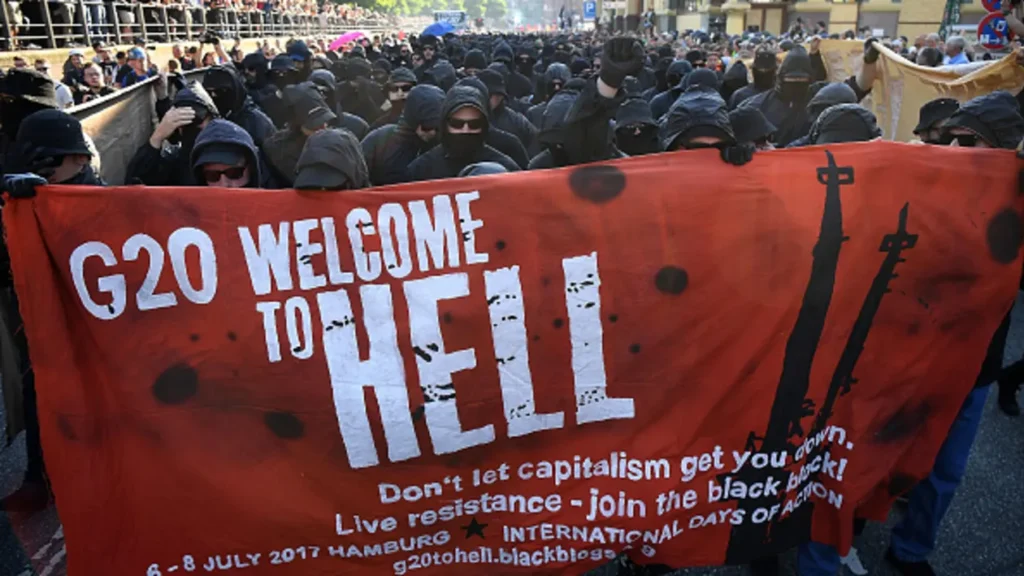
IMAGE: Black-bloc participants behind the “Welcome to Hell” banner in Hamburg on 6 July 2017, ahead of the G20 summit (Source: CNBC)
The French record also describes how participants gain experience across borders. In her 2016 research note, Alice Cantiteau linked German and Italian participation in demonstrations abroad to the spread of black-bloc tactics. Giving evidence to the Senate in 2019, police-union representative Claude Fourcaulx described foreign participants gaining experience in France, and French participants doing the same abroad. Methods learned in one country could then inform confrontations in another.
But learning is not confined to protesters. Police services also have opportunities to study successive confrontations and adapt their response. The circulation of experienced participants helps explain the challenge authorities face. It does not, on its own, explain why documented methods repeatedly catch them unprepared.
The methods were familiar, documented in French parliamentary reports long before the gathering at République. Repeated failures against a known threat leave the authorities answerable for their preparation, their operational decisions, and the political use they make of the resulting violence. Responsibility for discrediting a protest does not necessarily end with those throwing projectiles. It extends to a government when it uses that destruction to discredit people whose gathering it was supposed to protect.
A protest taken away
The musicians at République had organised their appearance, notified the authorities, and gathered before the march. Yet their performance ended under tear gas while the wider demonstration was still forming. They lost not only the space to perform, but the opportunity to give the protest a different cultural expression through art and music rather than confrontation.
Those choosing confrontation bore responsibility for their actions. But the police response also shaped what happened to everyone around them. Protecting the demonstration meant preventing violent participants from dictating the conditions for the peaceful majority. At République, the effects of that confrontation reached musicians who had taken no part in it.

IMAGE: A young woman rinses her eyes with saline after exposure to tear gas at Place de la République during the 17 October mobilisation. Photograph by Maxime Sirvins (Source: Politis)
The procession’s eventual departure should not conceal what disruption before the march could accomplish. A planned march brings people together along a declared route, supported by organisers, stewards, and a police deployment. Confrontation at the assembly point can undermine those arrangements before they take effect. People seeking to avoid the violence may retreat into side streets, or set off in smaller groups, separated from the organisers and stewards they expected to follow. That fragmentation can make it easier for troublemakers or looters to blend in with peaceful protesters, while making it harder for organisers to distinguish and isolate disruptive behaviour. Disruption at the outset can weaken the organisation of a march before it begins, leaving peaceful participants less able to maintain its character and direction.
Destruction can also displace the substance of a mobilisation. Images of broken windows, looted shops, and confrontations offer an immediate story, while explaining the grievances takes more time. Police are there to protect the demonstration and its participants, but Black-Bloc attacks can redirect their operations towards containing disorder. That shift can leave peaceful protesters facing police violence and dispersal measures where they were entitled to expect protection. Organisers, meanwhile, are pressed to account for actions they neither planned nor endorsed, while the government speaks about restoring order.
For the government to benefit from that shift, militants and ministers need to share neither intentions nor objectives. A group can attack the state while weakening the movement seeking to hold it to account. The political effect of an action is not necessarily the one its participants intend.
At République, peaceful participants had already borne the consequences of confrontation. Would students, the Yellow Vests, or an opposition party competing in the coming presidential election now be made to answer for it? And whose interests would that attribution serve?
Black blocs, police infiltration and the state
Police informants operate within the militant networks behind radical protest. Blast reported that one had supplied information for more than three years, maintaining more than 1,000 conversations with five police contacts and helping identify and locate activists. Behind the apparent anonymity of the crowd were sustained relationships with the services monitoring it.
An account of authorities perpetually taken by surprise leaves those relationships out. Recurring confrontation must be assessed against the information gathered beforehand and the decisions taken by those receiving it.
At Metz, L’Est Républicain described footage of a grenade deployment in the passage Blondel and quoted an unnamed police source identifying the masked men as BAC officers dressed like demonstrators. The source defended their disguise as necessary. That explanation addresses their appearance, not their actions.
In the recording circulated on X, a masked man makes a throwing motion into the passage before a loud detonation. A bystander protests that nothing was happening there. The three men subsequently leave accompanied by uniformed police.
French agents provocateur throw grenades on the street to coax police violence
They then NOD to the cops and leave TOGETHER with them https://t.co/vSK6XV8Rf1— The Gulag (@WelcomeTheGulag) October 19, 2026
L’Est Républicain also reports that fireworks mortars had been fired around the Place d’Armes. The bystander’s objection concerns the passage at that moment; it challenges the need for force at that particular location rather than establishing that the entire square was peaceful. The accessible article provides no operational explanation for the grenade deployment.
The sequence points towards a provocative intervention. The men’s departure alongside police places their conduct within the account of police responsibility. Their actions cannot disappear beneath a general label of protest violence. Neither can their disguise shield those responsible for their deployment from scrutiny.

IMAGE: Mark Kennedy, the undercover police officer who spent seven years inside activist networks and whose conduct the Court of Appeal described as “arguably, an agent provocateur.” (Source: Independent)
In Britain, undercover officer Mark Kennedy spent seven years among environmental and other activist groups. A parliamentary report records the Court of Appeal’s finding that he exceeded his authorisation and appeared to act as an enthusiastic supporter of a planned power-station occupation—“arguably, an agent provocateur.” Twenty activists’ convictions were overturned after evidence concerning his role and material supporting the defence had not been disclosed.
Kennedy’s involvement went beyond collecting names. The parliamentary account of the operation discusses his participation in preparations for the action. An official inspection report records his attendance at a briefing, reconnaissance for police activity and involvement in the team planning to climb the power-station structures. An officer embedded to gather intelligence had become involved in preparing the action itself.
The FBI’s domestic COINTELPRO programme pursued political disruption explicitly. The US Senate’s Church Committee documented covert operations intended to discredit organisations and turn potential allies against one another. FBI records held by the University of California, Berkeley include a fabricated warning of an impending ambush intended to intensify conflict between the Black Panthers and the rival US Organization. The authorities were cultivating antagonism, not merely recording it.
Black-bloc violence can achieve what the government cannot achieve through political argument alone. It pushes protesters’ demands aside and turns a mobilisation against government policy into a debate about public order. Instead of defending its policies, the government can demand that its opponents defend themselves against accusations of violence.
Black blocs may oppose the state, yet their violence can help the government discredit the protest and deflect attention from its demands. Intelligence infiltration and disguised police interventions make the state’s relationship with that violence part of the story—not merely its response afterwards.
One could argue that chaos becomes politically useful when it discredits the protest and supplies an accusation against the opposition. The government need not organise every confrontation to exploit the result. But when men identified by a police source as officers throw a grenade in what seems a deliberate attempt to create more chaos, while dressed like a member of the black bloc, the state is not merely responding to events—its own police are helping shape them.
Conveniently blaming the left
On 19 October, Mediapart published an investigation into how La France Insoumise was being blamed for the mobilisation around 17 October. It reported that police sources disputed the government’s emphasis on Jean-Luc Mélenchon’s party, and the ultra-left.
In written exchanges dated 18 October, which Mediapart’s journalists said they had consulted, a territorial-intelligence commissioner complained that officers were being instructed to implicate LFI despite the services’ contrary assessment, as Imaz Press reported in its coverage of the investigation. The Interior Ministry denied issuing those instructions.
The commissioner’s complaint exposes the conflict between the services’ findings and the account they were being asked to endorse. According to those written exchanges, the desired conclusion had already been selected, and responsibility was to fall on LFI, despite the services’ contrary assessment. This was pressure to make intelligence serve a political accusation rather than establish responsibility.
Paris prosecutor Laure Beccuau could not confirm the government’s identification of the perpetrators with the ultraleft, according to Mediapart. The political attribution was being challenged by the institutions charged with establishing responsibility. On 20 October, RTL reported Manuel Bompard’s announcement that he intended to refer Interior Minister Laurent Nuñez to the Cour de justice de la République over the reported instructions. The government’s handling of blame had itself become a matter of accountability.
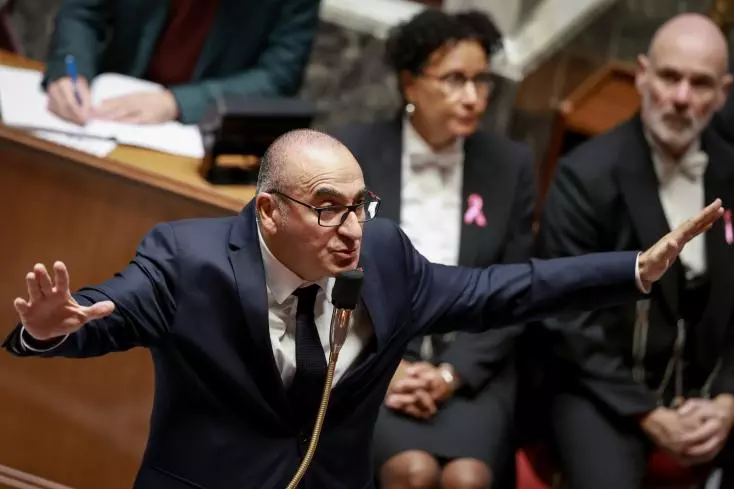
IMAGE: Interior Minister Laurent Nuñez addresses the National Assembly on 20 October 2026, amid controversy over the government’s attribution of responsibility for the protest violence. Photograph by Kenzo Tribouillard/AFP (Source: TV5Monde)
Black-bloc confrontations can disrupt a mobilisation, displace its demands, and expose peaceful participants to consequences they did not choose. Mediapart’s reporting describes pressure on intelligence officials to turn responsibility for disorder into an accusation against a political opponent. The government’s political use of disorder makes its handling of black-bloc violence part of the same account of responsibility. It must answer for how it confronted that violence as well as how it used the aftermath against its opponents. A movement can be damaged by those who disrupt it in the street, then discredited by those who assign the blame.
Ahead of the 2027 presidential election, blaming a major opposition party shifts the debate. Instead of defending its response to public grievances and explaining how it handled the demonstration, the government puts its opponents in the position of having to answer for violence.
Shopkeepers, injured protesters, and police officers bear costs that no revolutionary language can explain away. Peaceful participants lose control of their demonstration, while mass arrests extend the consequences beyond those involved in confrontation. Their actions can reinforce one another without coordination. Neither should escape scrutiny simply because they declare themselves enemies.
The musicians at République came to make themselves heard, not to provide the backdrop to someone else’s confrontation. Their interrupted performance brings us back to what this violence takes from a protest, and whom that loss serves. In other words: black blocs should be judged by effect of their actions, and how they transform the dynamic of a movement—and not by the radicalism they claim. Conversely, a government that seeks to capitalise on the resulting destruction against its political opponents must also answer for its own policing and intelligence failures.
READ MORE FRENCH NEWS AT: 21st CENTURY WIRE France FILES
SUPPORT OUR INDEPENDENT MEDIA PLATFORM – BECOME A MEMBER @21WIRE.TV
VISIT OUR TELEGRAM CHANNEL
21st Century Wire is an alternative news agency designed to enlighten, inform and educate readers about world events which are not always covered in the mainstream media.
Source: https://21stcenturywire.com/2026/10/22/black-bloc-in-france-revolutionaries-or-ammunition-for-the-state/
Anyone can join.
Anyone can contribute.
Anyone can become informed about their world.
"United We Stand" Click Here To Create Your Personal Citizen Journalist Account Today, Be Sure To Invite Your Friends.
Before It’s News® is a community of individuals who report on what’s going on around them, from all around the world. Anyone can join. Anyone can contribute. Anyone can become informed about their world. "United We Stand" Click Here To Create Your Personal Citizen Journalist Account Today, Be Sure To Invite Your Friends.
LION'S MANE PRODUCT
Try Our Lion’s Mane WHOLE MIND Nootropic Blend 60 Capsules
Mushrooms are having a moment. One fabulous fungus in particular, lion’s mane, may help improve memory, depression and anxiety symptoms. They are also an excellent source of nutrients that show promise as a therapy for dementia, and other neurodegenerative diseases. If you’re living with anxiety or depression, you may be curious about all the therapy options out there — including the natural ones.Our Lion’s Mane WHOLE MIND Nootropic Blend has been formulated to utilize the potency of Lion’s mane but also include the benefits of four other Highly Beneficial Mushrooms. Synergistically, they work together to Build your health through improving cognitive function and immunity regardless of your age. Our Nootropic not only improves your Cognitive Function and Activates your Immune System, but it benefits growth of Essential Gut Flora, further enhancing your Vitality.

Our Formula includes: Lion’s Mane Mushrooms which Increase Brain Power through nerve growth, lessen anxiety, reduce depression, and improve concentration. Its an excellent adaptogen, promotes sleep and improves immunity. Shiitake Mushrooms which Fight cancer cells and infectious disease, boost the immune system, promotes brain function, and serves as a source of B vitamins. Maitake Mushrooms which regulate blood sugar levels of diabetics, reduce hypertension and boosts the immune system. Reishi Mushrooms which Fight inflammation, liver disease, fatigue, tumor growth and cancer. They Improve skin disorders and soothes digestive problems, stomach ulcers and leaky gut syndrome. Chaga Mushrooms which have anti-aging effects, boost immune function, improve stamina and athletic performance, even act as a natural aphrodisiac, fighting diabetes and improving liver function. Try Our Lion’s Mane WHOLE MIND Nootropic Blend 60 Capsules Today. Be 100% Satisfied or Receive a Full Money Back Guarantee. Order Yours Today by Following This Link.


| Visits: | 1,835,635,242 |
| Stories: | 8,725,078 |
Whistler Blowers, Insiders

