

The Board That Abandoned Gaza’s Reconstruction Now Wants to Govern It


Freddie Ponton
21st Century Wire
Trump’s “Gaza Riviera” has collapsed into a plan for portable cabins near Rafah. What remains is a scheme to place Palestinians displaced by Israel inside a screened enclave run under foreign supervision, and possibly paid for with Palestinian money.
Donald Trump’s Board of Peace has abandoned any serious plan to rebuild Gaza. It is now moving to establish control over part of the territory instead. The plan surfaced in early July, when a Board official outlined a pilot “humanitarian zone” in southern Gaza. Though presented as a postwar initiative, the Board was never elected by Palestinians or granted authority by any Palestinian institution. It is an externally imposed body whose power derives from Washington and whose ability to establish itself inside Gaza depends on Israeli approval.
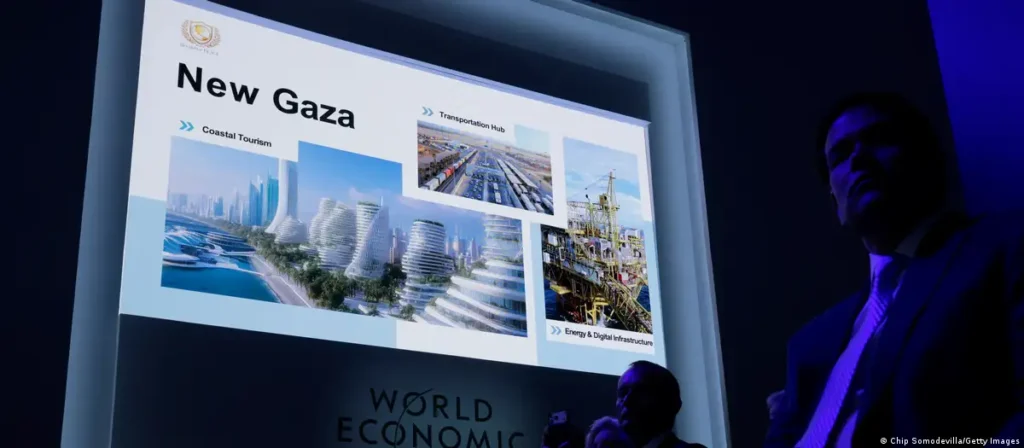
IMAGE: Jared Kushner presents the Board of Peace’s proposed “New Gaza” development at Davos in January 2026. Six months later, the reconstruction vision had contracted to a pilot portable-housing scheme near Rafah. (Source: DW)
Under the proposal, Palestinians driven from their homes by Israel’s military campaign would be offered portable housing inside the zone, but only after passing security screening. Israeli reporting said the screening would exclude people carrying weapons or deemed to have an affiliation with Hamas, but it did not explain how affiliation would be defined.
Israeli forces would pull back from the immediate area but remain positioned around it, while a multinational force deployed between them and the Palestinian population. As for the day-to-day administration, it would fall to the National Committee for the Administration of Gaza, or NCAG, an appointed Palestinian technocratic body created under Trump’s plan, with its police entrusted with enforcing the zone’s internal rules. The Board says it has identified areas capable of housing tens of thousands of people, although it has not published a capacity for the first pilot.
Six months after Trump promised rapid reconstruction, none of the Board’s programme has begun on the scale it advertised, and much of the pledged funding had still not been disbursed. Yet the Board has preserved the institutions through which it could exercise control over territory and population inside Gaza.
The Board finds territory
The NCAG was created to run public services under the Board’s postwar framework, but it currently has no territory to govern. A Board official described the pilot as a “starting point”, a way to establish the committee inside Gaza even without a broader political agreement. In practice, the Board is trying to create facts on the ground before Palestinians have any say over who governs them.
Rafah, in southern Gaza, is the location currently under consideration for that foothold. However, the Board has not disclosed the precise site, and officials have not presented the location as final. The proposed portable-cabin pilot would therefore depend on Israel withdrawing from whichever area is ultimately selected, a multinational force being ready to deploy, and the Board securing the necessary funding.

IMAGE: Extensive destruction in Rafah, where Trump’s Board of Peace has considered establishing a screened pilot zone administered by its appointed Palestinian committee. (Source: BBC)
Meanwhile, Hamas said it had dissolved the body overseeing its ministries and was prepared to transfer civil administration to the NCAG, although ministry staff remained and Hamas continued to exercise security and policing functions in areas under its control. The pilot’s immediate obstacles therefore extend beyond civil administration, as Israel must not only withdraw from the selected territory, but also agree on the role of the proposed foreign forces.
If the zone is established, the NCAG would handle housing and services while its police enforce internal rules. Palestinians seeking entry would face screening by the committee, backed by the international force. Israeli reporting said armed people and those deemed affiliated with Hamas would be excluded, but did not explain whether affiliation meant armed membership, political activity, civil employment or some broader association.
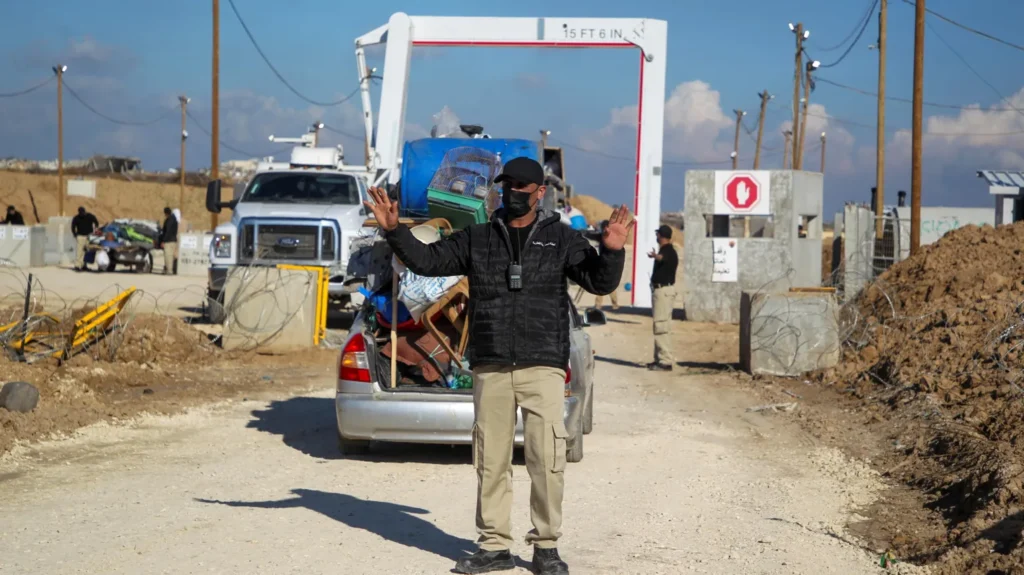
IMAGE: Foreign contractors screen vehicles at a Gaza checkpoint. The proposed Rafah pilot would introduce a separate screening system administered by the NCAG with support from an international force. (Source: BBC)
The international force itself is not yet operational, and its mandate and relationship with Israel are still being negotiated. Public accounts of the plan do not identify what information would be used for screening, who would provide it or whether rejected applicants could seek review. These decisions would determine who gained access to shelter and services inside the zone. Once more, Gaza’s population would have no direct democratic voice or influence over this process.
Israel holds the decisive power here. Its government would decide whether to withdraw troops from the selected area and what restrictions it imposed afterwards. It has become clear that the Board is in desperate need of territory inside Gaza to show progress after the failure of its larger plan. Meanwhile, Israel can withhold that territory whenever it chooses.
The Board and Israel do not share the same objectives. The Board wants enough Israeli withdrawal to install its institutions inside Gaza, while Israel benefits from keeping that withdrawal limited and conditional. Unsurprisingly, neither side is offering Palestinians control over the zone’s territory, external security or political future.
Board officials insist entry would be voluntary and that Israeli troops would not directly screen residents. They also say land-ownership rights will be taken into consideration. Calling participation voluntary does not resolve whether residents would have a meaningful choice if shelter, security and essential services were substantially more available inside the zone than elsewhere. These assurances mean little, especially if the business of destruction and restrictions continue as usual in the strip and outside of this pilot zone.
Governing displacement
The people the Board hopes to move into the zone did not end up near Rafah by choice. Repeated Israeli evacuation orders, bombardment and the destruction of homes and infrastructure forced Palestinians out of their communities. Israel then expanded its military control, squeezing much of Gaza’s population into an increasingly small and restricted area where many still live in tents or damaged buildings.

IMAGE: A Palestinian family leaves Rafah as Israeli military operations force civilians to seek shelter elsewhere in Gaza. The Board’s proposed pilot would offer displaced families portable housing subject to screening and externally imposed rules. (Source: Reuters)
The pilot offers some of these displaced families entry into a zone administered by the Board’s appointed institutions rather than an authority chosen by Palestinians. In exchange for portable cabin housing and greater separation from Israeli forces, they would have to submit to screening and accept rules set by an unelected body.
Once inside, residents would live under NCAG police and a foreign multinational force. No published plan sets a timetable for return or guarantees that residents will be able to reach their original communities. Nor is there an independent process for resolving property claims.
The Board’s vague assurance on land-ownership rights does nothing to address the reality on the ground. That assurance leaves unanswered how ownership would be verified when homes and records have been destroyed, how claims to property outside the pilot zone would be protected, or whether participants would retain an enforceable right to return to it.
Many homes have been destroyed. Others remain in areas under Israeli military control or behind lines their owners cannot cross. In this case, paper recognition of ownership is likely to mean nothing without actual access.
The immediate issue is whether Palestinians will be able to return to the areas inside Gaza from which Israel displaced them. The broader right of return claimed by Palestinian refugees remains unresolved. Nothing in the Board’s plan suggests that entering the zone would cancel those claims, and nothing protects them either.
Even residents permitted to leave the zone would still face Israeli restrictions on movement. A person might exit the pilot area only to find themselves unable to cross Israeli military lines, travel north or return without another security check. The “illusion of freedom” offered inside the zone would be tightly bounded by Israeli power.
Concentrating aid and services inside the zone would also create pressure to enter. Members of the Palestinian committee have reportedly warned that this approach could divide Gaza’s population and leave most people with inferior access to assistance. Humanitarian organisations have raised concerns that such zones risk enabling forced displacement under the cover of aid.
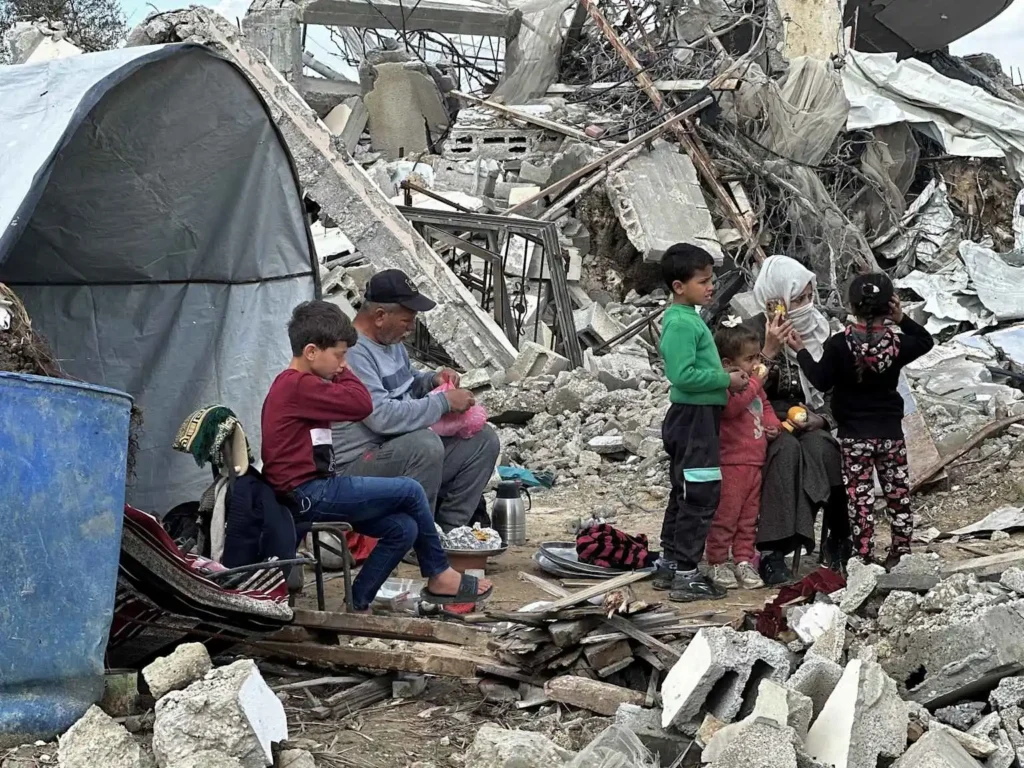
IMAGE: A displaced Palestinian family lives in a tent amid the ruins of Gaza. The proposed pilot would offer more substantial shelter, but only inside a screened zone governed by appointed institutions. (Source: Al Jazeera)
A family choosing between a serviced cabin and continued hunger or life in a tent is not making a free choice. Entry may be described as voluntary on paper, but the conditions created by Israeli destruction and restrictions make refusal extremely difficult.
The relief may be real for some. But the greater risk is that it becomes the administrative machinery of managed displacement.
The scheme would give Israel’s displacement of Palestinians an administrative structure. Screening would decide who gains access to shelter and services. By concentrating housing and aid inside the zone, the scheme would create powerful pressure for the selected population to remain. What is currently presented as emergency relief risks becoming a substitute for rebuilding destroyed communities or allowing return. Furthermore, running this system will require serious funding, and Washington has already explored using Palestinian funds to pay for it.
Palestinian money
Under the Oslo framework, Israel collects customs duties and taxes on behalf of the Palestinian Authority. These clearance revenues belong to the Palestinians, not to Israel. Israel has withheld billions of dollars from the PA, deepening its financial crisis and undermining its ability to pay salaries and deliver services.
In May, Reuters reported that the United States was considering asking Israel to release some of these withheld funds. Part of the money could be redirected to the US-backed administration in Gaza, while another portion might go to the PA in Ramallah if it carried out reforms. The PA estimated the withheld amount at around $5bn.
Israeli Finance Minister Bezalel Smotrich rejected the idea. Despite this, discussions reportedly continued between US and Palestinian officials over how to divide the funds.
Palestinian Prime Minister Mohammad Mustafa said Israel was blocking two distinct pools of Palestinian money. Approximately $6 billion in withheld clearance revenues and nearly $5 billion belonging to Palestinian banks that, he said, remained frozen because the Bank of Israel refused to receive the funds. He separately estimated that the broader restrictions caused annual losses of $11 billion to the Palestinian economy. The banking funds should not be conflated with the clearance revenues reportedly considered as a possible source of financing for Gaza. No transfer has been confirmed, and there is no public clarity over which component of the US-backed Gaza administration would receive any released money. The Board maintains an account at JPMorgan, and not at the World Bank as one would have thought, but there is no public evidence that any released Palestinian funds would flow into that account.
READ MORE: The Board That Wanted a Country
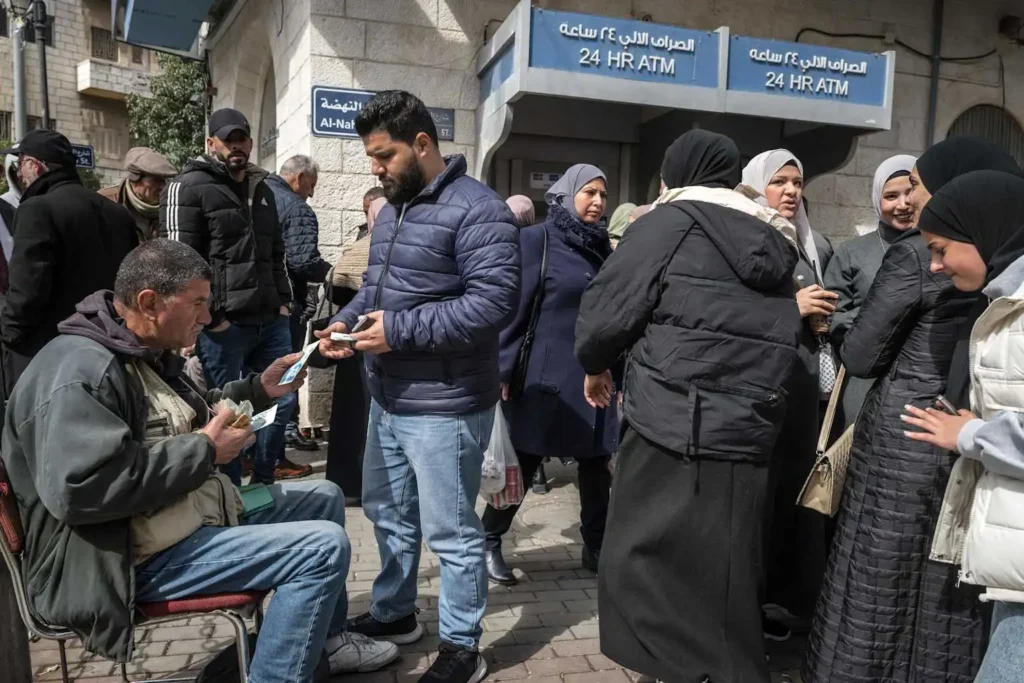
IMAGE: Palestinians gather outside a bank amid a shekel-cash crisis produced by Israeli banking restrictions. Palestinian Prime Minister Mohammad Mustafa says Israel is withholding approximately $6 billion in clearance revenues while nearly $5 billion belonging to Palestinian banks remains immobilised. (Source: YNET)
What is already clear is the structure of control. Israel would decide whether to release money belonging to the Palestinian Authority, while Washington would negotiate the terms of its division. The Trump-led Board would then be positioned to use some of those funds to sustain an administration that Palestinians never elected, inside a zone dependent on Israeli approval and foreign troops.
Palestinians displaced by Israel could end up living under an appointed authority partly financed by revenues that Israel withheld from Palestinian institutions. Ironically and sadly, their own money could be used to administer them without giving them any real power over the territory or the security system governing them.
The lack of funding alone does not explain why the original reconstruction plan was reduced to a small pilot near Rafah. However, it does reveal what the Board chose to preserve. Large-scale rebuilding was evidently abandoned, while the institutions’ need to police, screen and administer a population inside Gaza was kept.
The revised scheme was discussed in Cyprus by the NCAG and advisers from the Board, the Office of the High Representative for Gaza and the Tony Blair Institute. According to the NCAG, the meetings examined reconstruction, security and governance plans.
The pilot brings together territory, population, security and funding under one framework. If repeated, it could easily snowball and create a new political reality on the ground.
Partition without sovereignty
A second pilot would create another territory with its own administration and entry rules. Further expansion could leave Gaza fragmented between Board-run zones, areas under direct Israeli military control, buffer zones and territory outside the Board’s reach. No formal new border would be required. If replicated across Gaza, different governing and security systems would amount to partition in practice.
This division would also cut through the Palestinian population. Screening would separate those allowed into the Board’s zones from those denied entry or unable to reach them. If housing, services and relative safety were concentrated inside, a security classification decided by others could determine where Palestinians lived and which authority controlled their lives.
The West Bank offers the clearest precedent. The Oslo agreements created a system in which Palestinian institutions manage limited civilian affairs in disconnected enclaves while Israel retains overarching control over territory, movement and external security. What was presented as temporary has endured for more than three decades without delivering Palestinian sovereignty.
The Rafah plan would replicate this model with an international layer added on top. Multinational troops would stand between Palestinian residents and Israeli forces, while the Board oversaw Palestinian technocrats running day-to-day services. NCAG police would enforce the zone’s internal rules. Israel would still decide whether and how far it withdrew, and what power it kept around the zone.
This structure also explains the comparison with apartheid South Africa’s Bantustans. Those territories were presented as exercises in Black self-rule while real power remained in white hands. The histories and legal contexts differ, but the structural logic is comparable with local administration inside fragmented territory while control over land, movement security and resources remains elsewhere.
For Israel, this arrangement offers a way to avoid negotiating Palestinian statehood. Instead of discussing borders and self-determination, diplomacy could be reduced to managing separate zones, their security systems, entry rules and budgets. Israel could deal with Palestinian administrators without recognising a sovereign Palestinian government over Gaza and the West Bank as one territory.
The Board would finally gain territory and authority inside Gaza. Israel would reduce its direct contact with Palestinian civilians while retaining decisive leverage over the surrounding land. Palestinian technocrats would be left running a displaced population without controlling the system governing them.
The pilot might deliver immediate shelter and greater separation from Israeli troops. Palestinians cannot wait indefinitely for a political settlement before receiving basic services. But in this instance, the humanitarian need is clearly being used to justify a political project that Palestinians did not choose and over which they have no control.
The Board presents Rafah as a “starting point,” but has offered no indication of where the process leads. There is no published plan guaranteeing return to the communities Israel destroyed or emptied. There is no timetable for transferring power to a government chosen by Palestinians, and the Board has identified no safeguard preventing repeated pilots from permanently fragmenting Gaza.
What survived the collapse of Trump’s “Gaza Riviera” is not reconstruction, but a plan to administer Palestinians without transferring real power to them. The first people placed under this system would be those already displaced by Israel’s assault. They would be screened, placed within boundaries they did not choose and governed by institutions they did not elect—possibly using their own withheld revenues.
READ MORE PALESTINE NEWS AT: 21st CENTURY WIRE Palestine FILES
SUPPORT OUR INDEPENDENT MEDIA PLATFORM – BECOME A MEMBER @21WIRE.TV
VISIT OUR TELEGRAM CHANNEL
21st Century Wire is an alternative news agency designed to enlighten, inform and educate readers about world events which are not always covered in the mainstream media.
Source: https://21stcenturywire.com/2026/07/21/the-board-that-abandoned-gazas-reconstruction-now-wants-to-govern-it/
Anyone can join.
Anyone can contribute.
Anyone can become informed about their world.
"United We Stand" Click Here To Create Your Personal Citizen Journalist Account Today, Be Sure To Invite Your Friends.
Before It’s News® is a community of individuals who report on what’s going on around them, from all around the world. Anyone can join. Anyone can contribute. Anyone can become informed about their world. "United We Stand" Click Here To Create Your Personal Citizen Journalist Account Today, Be Sure To Invite Your Friends.
LION'S MANE PRODUCT
Try Our Lion’s Mane WHOLE MIND Nootropic Blend 60 Capsules
Mushrooms are having a moment. One fabulous fungus in particular, lion’s mane, may help improve memory, depression and anxiety symptoms. They are also an excellent source of nutrients that show promise as a therapy for dementia, and other neurodegenerative diseases. If you’re living with anxiety or depression, you may be curious about all the therapy options out there — including the natural ones.Our Lion’s Mane WHOLE MIND Nootropic Blend has been formulated to utilize the potency of Lion’s mane but also include the benefits of four other Highly Beneficial Mushrooms. Synergistically, they work together to Build your health through improving cognitive function and immunity regardless of your age. Our Nootropic not only improves your Cognitive Function and Activates your Immune System, but it benefits growth of Essential Gut Flora, further enhancing your Vitality.

Our Formula includes: Lion’s Mane Mushrooms which Increase Brain Power through nerve growth, lessen anxiety, reduce depression, and improve concentration. Its an excellent adaptogen, promotes sleep and improves immunity. Shiitake Mushrooms which Fight cancer cells and infectious disease, boost the immune system, promotes brain function, and serves as a source of B vitamins. Maitake Mushrooms which regulate blood sugar levels of diabetics, reduce hypertension and boosts the immune system. Reishi Mushrooms which Fight inflammation, liver disease, fatigue, tumor growth and cancer. They Improve skin disorders and soothes digestive problems, stomach ulcers and leaky gut syndrome. Chaga Mushrooms which have anti-aging effects, boost immune function, improve stamina and athletic performance, even act as a natural aphrodisiac, fighting diabetes and improving liver function. Try Our Lion’s Mane WHOLE MIND Nootropic Blend 60 Capsules Today. Be 100% Satisfied or Receive a Full Money Back Guarantee. Order Yours Today by Following This Link.


| Visits: | 1,823,973,049 |
| Stories: | 8,673,965 |
Whistler Blowers, Insiders

