

New Documents Blow Up the Miami Myth About Cuba’s ‘Murder in the Skies’

Freddie Ponton
21st Century Wire
Washington has revived one of the most combustible episodes in U.S.-Cuba relations just as Cuba buckles under blackouts, fuel shortages and intensified economic strangulation. On May 20, 2026, the Justice Department unsealed murder-related charges against 95-year-old former Cuban president Raúl Castro and five other Cuban officials over the 1996 Brothers to the Rescue shootdown, then chose to announce them at Miami’s Freedom Tower, before a room of hardline exile activists who greeted the case as political vindication rather than legal procedure.
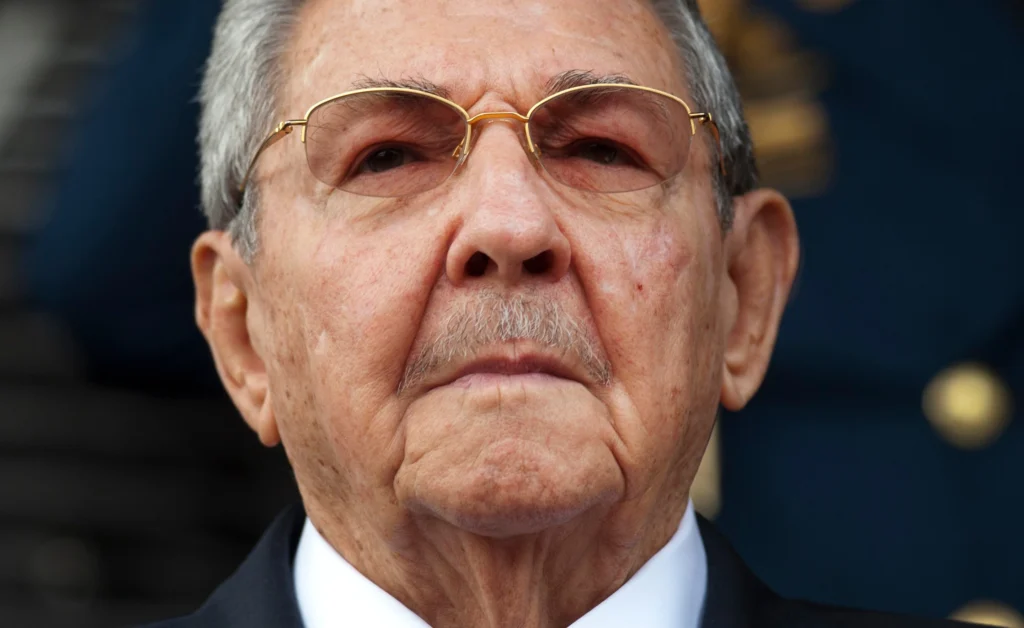
IMAGE: Cuba’s President Raúl Castro listens to the Cuban and Venezuelan national anthems during his welcome ceremony at the Miraflores presidential palace, March 17, 2015, in Caracas, Venezuela. (Source: AP Photo/Ariana Cubillos)
On February 24, 1996, three small planes flown by the Miami-based exile group Brothers to the Rescue took off from Opa-Locka airport on what the group presented as a mission near Cuban waters. Two of the aircraft were later destroyed by Cuban MiG fighters, killing four crew members, including three U.S. citizens. Cuba said it was defending its airspace, while U.S. officials and the victims’ families argued that the planes were in international airspace when they were hit. The International Civil Aviation Organization condemned the shootdown, and the episode became one of the defining flashpoints in the long standoff between Havana and Washington.
One day earlier, the National Security Archive, the independent research center at George Washington University that uses declassification and Freedom of Information requests to reconstruct buried state history, published a new batch of FAA records on the shootdown and its lead-up, explicitly noting that the release came on the eve of the indictment. Those records do not read like a simple murder file. They show U.S. officials warning, long before the MiGs took off, that Brothers to the Rescue’s flights had turned into “taunting” incursions and that Cuba might eventually shoot one of the planes down.
A 30-year-old tragedy is being repackaged as moral clarity just as Washington tightens the screws on an island already in profound distress. The same documents being cited to support the indictment also expose something far more awkward for the U.S. government. Officials in Washington saw the danger coming, understood that Brothers to the Rescue was provoking a violent confrontation, and failed to stop it.
Freedom Tower was the natural stage for that conversion of history into pressure politics. It is one of the symbolic temples of exile, Miami, the city where anti-Castro militancy, lobbying money and U.S.-Cuba policy have fed off one another for decades. By the time Todd Blanche read out the charges, the case had already been turned from a disputed historical tragedy into a live instrument of the current campaign to keep Cuba isolated, criminalized and under siege.
Warnings in Washington
The most revealing paper in the National Security Archive’s May 19 release of declassified FAA records is not dramatic in form. It is a short email sent on January 22, 1996 by Cecilia Capestany, an FAA International Affairs official. Writing after yet another unauthorized Brothers to the Rescue flight, and relaying a State Department alarm, Capestany described the incursion as “further taunting of the Cuban Government.” She then wrote the line that now sits at the center of the story:
“Worst case scenario is that one of these days the Cubans will shoot down one of these planes and the FAA better have all its ducks in a row.”
Capestany’s email also shows how far concern had spread inside the Clinton administration. Peter Tarnoff, Bill Clinton’s undersecretary of state for political affairs, had called Transportation Secretary Federico Peña to ask what was being done about José Basulto, the Brothers to the Rescue founder whose flights had been repeatedly challenging Cuban airspace. By January 1996, this had already reached the Cabinet. The government knew Basulto was escalating a dangerous confrontation. It knew Cuba was reacting with growing anger. It still failed to shut the operation down.
The same pattern runs through the rest of the record. Rick Nuccio, the White House official handling Cuba policy, had spent months trying to force Washington to take the problem seriously. A Miami FAA status report describes an August 9, 1995 interagency meeting chaired by Nuccio and co-chaired by John Schlosser from the State Department. The FBI, Customs, Coast Guard, Miami police and bomb-terrorism personnel were in the room. They were not discussing an unforeseeable calamity. They were discussing the possibility that a Brothers to the Rescue aircraft could be brought down if the group kept pushing Cuban airspace and Cuban patience.
Nuccio carried that warning to the eve of the disaster. In a message sent the night before the February 24 mission, he warned Sandy Berger, Clinton’s national security adviser, that the next Brothers to the Rescue flight could finally “tip the Cubans toward an attempt to shoot down or force down the plane.” The warning reached the top of the national security chain. The planes still took off.
Contrary to what for years was deemed the acceptable mainstream narrative, Washington was not blindsided by a sudden act of madness. The record now released by the National Security Archive shows officials describing the flights as provocations, predicting that Cuba might answer with force, and failing to stop a scenario they privately considered plausible.
After the shootdown, the public face of U.S. outrage was Madeleine Albright, then ambassador to the United Nations and soon to become secretary of state. Having released radio transcripts of Cuban pilots celebrating the attack, she told reporters, “Frankly, this is not cojones ( Spanish slang for testicles). This is cowardice.” Although the line worked because it offered a clean moral frame, the new documents make that frame harder to sustain. By the time Albright denounced Cuban brutality in public, people inside her own government had already described the flights as “taunting” and had already warned that one of them might be shot from the sky.
The men in the planes
Brothers to the Rescue (BTTR) built its reputation rescuing rafters in the Florida Straits, and that humanitarian image still shields the group in much of the U.S. press, while the FAA record shows a more dangerous evolution. By 1995, federal officials were documenting a pattern of airspace violations, publicity-driven overflights and overt political provocation directed at Havana.
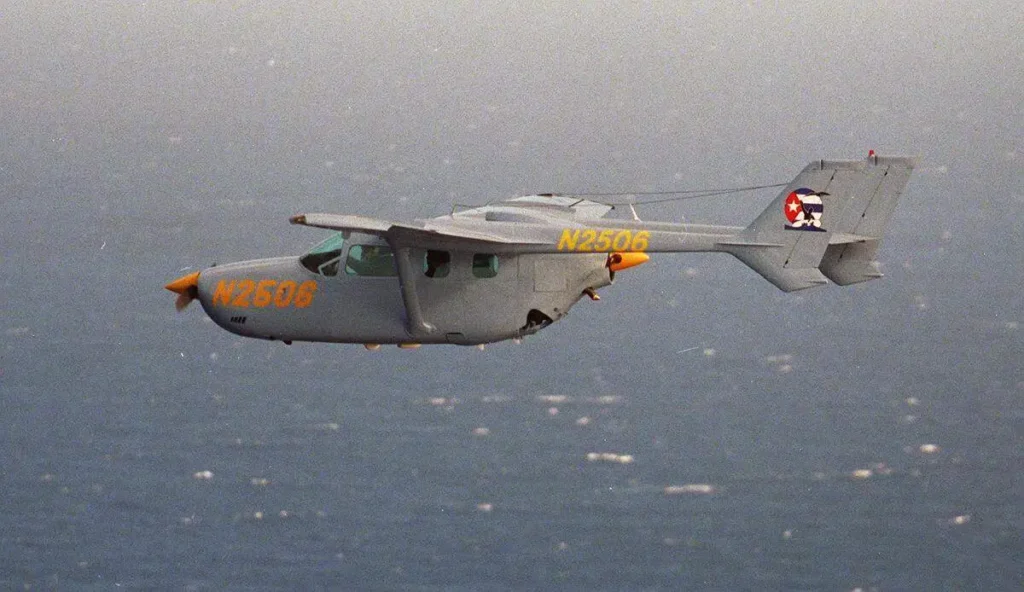
IMAGE: Brothers to the rescue plane flies during a one-year anniversary memorial service in 1997. (Source: Al Diaz, Miami Herald)
Former CIA-trained Cuban political dissident and BTTR funder, José Basulto, stood at the center of that shift. A Bay of Pigs veteran and long-time anti-Castro activist, Basulto was not simply a rescue pilot carried along by events. In later testimony, he openly discussed his earlier CIA-linked operations against Cuba, including a 1962 attack in which he fired a 20mm cannon at a Havana hotel used by Soviet personnel. That history places Basulto where he belonged all along, inside the long anti-Castro war, not outside it.
The FAA files show Basulto repeatedly pushing beyond what U.S. authorities considered defensible. On July 13, 1995, he flew into Cuban airspace over Havana while a television crew filmed from the plane. Brothers to the Rescue material was dropped over populated areas. Cuba protested through diplomatic channels. The FAA opened enforcement action 95SO190142, citing unauthorized entry into Cuban airspace and careless or reckless operation, and proposed suspending Basulto’s pilot certificate. He was warned in meetings, supplied with the relevant regulations, and told what the consequences of another violation could be. Yet, the flights continued.
Washington’s own paperwork shows that Cuba’s threats were not being dismissed as bluster. State Department notices relayed Havana’s declared determination to defend its territorial sovereignty and warned that unauthorized vessels could be sunk and aircraft downed. Basulto knew the warnings, and the FAA knew that he knew, but the flights still went ahead.
The February 24, 1996 chronology leaves little room for sentimental reconstruction. The Three Brothers to the Rescue aircraft departed Opa-Locka, Florida, that afternoon. At 14:56, they informed Havana air traffic control that they intended to operate south of the 24th parallel. Cuban controllers warned that the zone was active and dangerous. The Brothers to the Rescue pilots did not pretend to be unaware of the risk. When Havana warned that the zone was active and dangerous, they replied that they knew the danger and were willing to go ahead “as free Cubans.”
What followed remains the core legal dispute. U.S. Customs radar showed one aircraft entering Cuban territorial airspace at 15:19, while the two planes later destroyed were last tracked outside Cuban airspace when they vanished from radar. Cuba has long maintained that the aircraft were violating or threatening its airspace and that its response was defensive. The International Civil Aviation Organization condemned the attack and concluded that the two planes were destroyed in international airspace. That dispute is real, and the FAA papers do not erase it; However, they do strip away the fairy tale. The operation was provocative, the danger had been repeatedly flagged, and it is now clear that Washington knew it.
The FAA’s own draft emergency order says the rest in flat bureaucratic prose. Basulto, Brothers to the Rescue and the pilots involved had operated in a manner “careless or reckless so as to endanger the lives or property of others,” the draft order states, before directing them to cease and desist from unauthorized operations in Cuban airspace. Only after the dead were in the water did the U.S. government act with urgency.
The Miami machine
The current indictment depends on severing the 1996 shootdown from the political world that produced it. This is no longer possible, as these new revelations collapse the clean morality tale.
Luís Posada Carriles and Orlando Bosch sit at the heart of that history. Both men were deeply embedded in anti-Castro militant networks. Declassified CIA and FBI material tied both to the 1976 Cubana Flight 455 bombing, which killed all 73 people on board, including Cuba’s teenage fencers and their coaches. One intelligence source quoted Posada shortly before the bombing, saying, “We are going to hit a Cuban airplane” and “Orlando has the details.” After the explosion, the two Venezuelans who planted the bomb, former employees of Posada’s security firm, called his office.
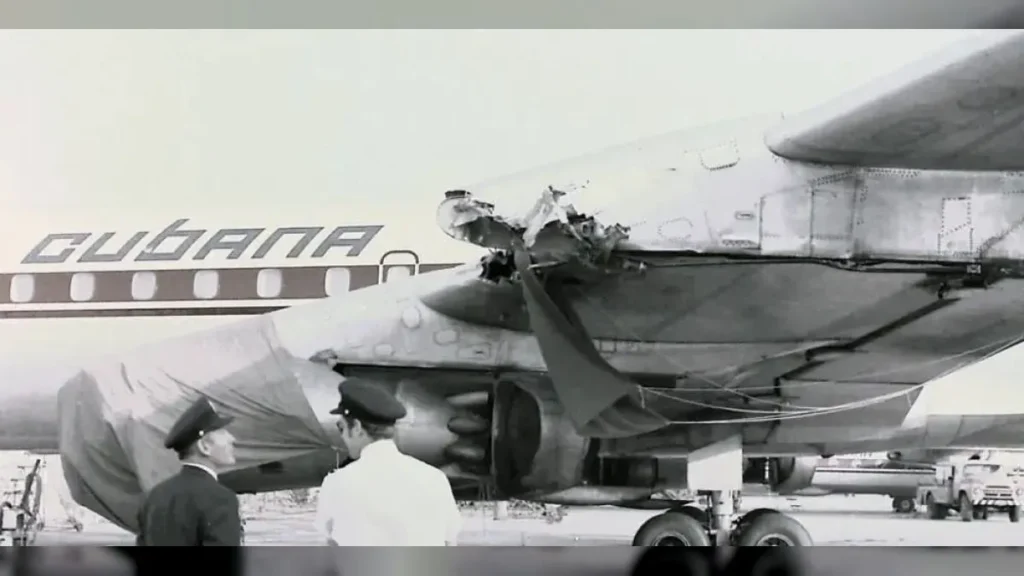
IMAGE: 49th anniversary of the attack on Cubana de Aviación flight 455: A crime against humanity (Source: Mazo4f)
These were far from being obscure figures. Posada spent years inside the United States despite public evidence tying him to terrorism against Cuba and despite later links to the 1997 Havana hotel bombings. Bosch died in Miami in 2011, sheltered by a political culture that treated anti-Castro violence as something other than terrorism when the targets were Cuban. That history sits in the background every time Washington now presents itself as the guardian of justice in the Brothers to the Rescue case.
The way the United States treated Gerardo Hernández underlines the double standard. Hernández was one of the Cuban Five, the intelligence officers sent by Havana to infiltrate exile groups in Florida and track operations directed against Cuba. He became the only person imprisoned in the United States in direct connection with the Brothers to the Rescue shootdown, convicted in Miami on conspiracy charges and sentenced to two life terms before his release in the 2014 prisoner exchange. In the political universe now demanding justice for 1996, the Cuban operative monitoring hostile exile networks drew life sentences. The men tied to bombing a Cuban civilian airliner spent their final years in Florida.
Jorge Mas Canosa gave that universe its most effective institutional form. A Bay of Pigs veteran and founder of the Cuban American National Foundation, Mas Canosa spent the 1980s and 1990s translating Miami’s hardline exile politics into federal policy. CANF backed Radio Martí and TV Martí, lobbied for ever-tighter sanctions, and helped drive the Torricelli Act and Helms-Burton, the legal architecture of the embargo that still shapes life on the island.
Jorge Mas Santos now carries that project forward in a cleaner register. He runs CANF, chairs MasTec and owns Inter Miami CF. He is not a celebrity businessman who happens to hold views on Cuba. He is the heir to the most powerful anti-Havana network ever built in the exile community, now sitting close to an administration openly discussing transition, privatization and political redesign on the island. In March 2026, after taking Inter Miami’s title-winning squad to the White House, Mas Santos emerged talking not about football but about Cuba. Donald Trump told him he would soon be able to “go back.” Mas Santos responded by calling 2026 “the year of freedom for our homeland” and saying he was working “in lockstep” with the White House and Marco Rubio.
Billionaire businessman Mas Santos sits at a junction his father never had. He runs the main exile lobby, controls a major U.S. construction and infrastructure empire, and now has direct access to a White House that thinks in real‑estate terms when it talks about “freedom” and “transition” in Cuba. For Trump’s circle, a collapsed socialist state on the doorstep of Florida is not only a geopolitical prize but a future landscape of beachfront hotels, marinas and privatized utilities waiting to be carved up. The fathers’ generation built the sanctions regime and defended the men of violence. The sons are positioned to manage the transition they have spent decades trying to force, and to help decide who gets to own the island once the dust settles.
A 1996 case for a 2026 siege
The revival of the Brothers to the Rescue case is landing in the middle of a live crisis, not in the calm of historical reflection. Cuba is enduring long blackouts, severe fuel shortages and deep shortages of medicines and basic goods, as Washington is tightening economic pressure through sanctions, shipping restrictions, and a policy mix widely described as an effective oil blockade.
Rubio stands at the center of that effort. Now secretary of state and still the most potent federal expression of Miami hardline politics, Rubio has pushed new sanctions against Cuba’s military-linked businesses and made clear that Washington sees the island’s suffering not as a reason to ease pressure but as leverage. His answer to a country in distress has been more punishment, more conditions and more talk of “new people in charge.”
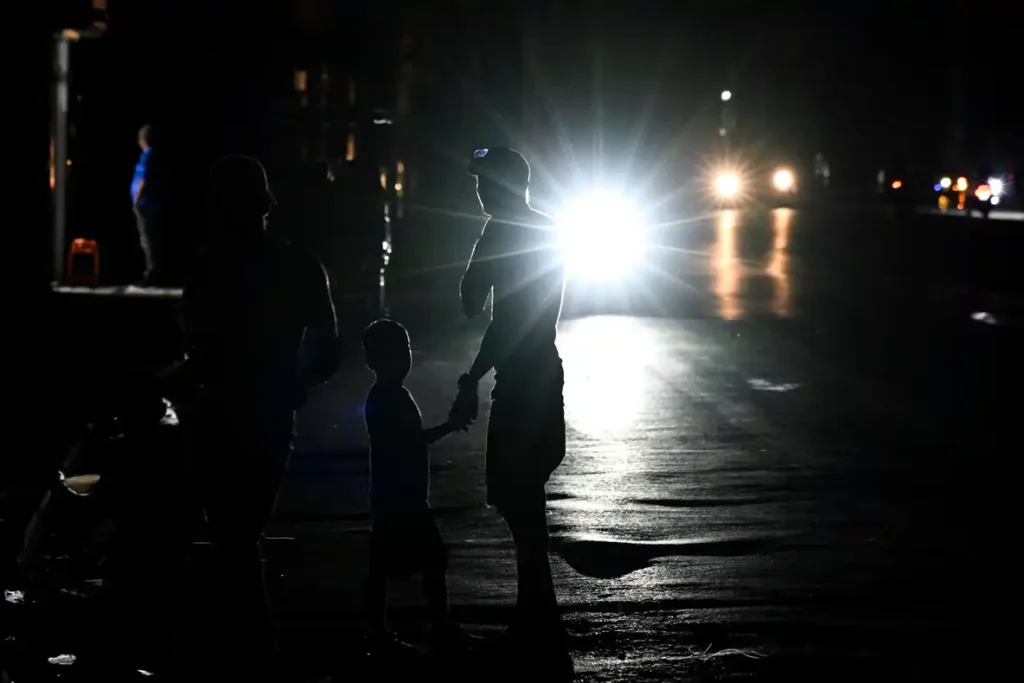
IMAGE: People stand on a street during a blackout in Havana on March 16, 2026 after Cuba suffered a widespread power cut according to the national electricity company, against the backdrop of a severe crisis on the island caused by the US energy blockade (USA Today)
The effects inside Cuba are concrete. Blackouts have wrecked refrigeration, disrupted transport, strained hospitals and turned daily life into a calculation around the arrival and disappearance of electricity. Medicines are harder to find. Families barter for fuel and queue for food. More people leave when they can. Rubio’s offer of $100 million in aid, but only through delivery mechanisms controlled by Washington, arrives in that context looking less like relief than like an attempt to build parallel channels of authority while the siege remains in place.
The indictment lands in the middle of this. It refreshes the image of Cuba as a criminal state at a moment when the humanitarian argument for easing sanctions has become harder to suppress. It gives Miami’s donors, exile media and Washington hawks a usable morality play. It helps turn any move toward diplomacy into alleged appeasement of murderers. And because the case is tied to a real tragedy with American dead, it supplies a more marketable justification for continued pressure than blunt talk of regime change ever could.
The National Security Archive’s new FAA documents are being folded directly into that effort. Their authority comes from the state itself. But once read in full, they tell a more compromising story than the one now being performed from Miami. They show a U.S. government that knew Brothers to the Rescue had become a provocation machine, knew Cuba might answer violently, watched the escalation continue, and then spent the next three decades stripping that context away in favor of a cleaner martyrdom narrative.
Blanche has left the next step deliberately vague. Asked how Raúl Castro would ever reach a U.S. courtroom, he said there was an arrest warrant and that Washington expected him to appear “by his own will or by another way.” That phrasing landed only months after the U.S. operation that flew Nicolás Maduro out of Caracas following his own indictment, and it has already led Reuters and the BBC to note that the Castro case could furnish similar legal cover if the White House chose to escalate beyond sanctions and spectacle.
The same political class that sheltered anti‑Castro bombers now claims to speak for international law. The same bureaucracy that watched this crisis unfold in 1996 is parading its own warnings as evidence that only Havana is guilty. And the same Miami network that once celebrated men who blew up a Cuban airliner is back in charge of the script, this time in suits, fronting for a Trump administration that treats international law with open contempt while deciding how hard Cuba is squeezed and who will cash in should the government fall.
The documents published this week do not settle the past. They clarify the present. They show how a fatal episode, long stripped of its full context, is being reopened and repackaged to harden the siege on Cuba in 2026. That is the story hiding behind the Freedom Tower applause.
READ MORE CUBA NEWS AT: 21st Century Wire Cuba Files
SUPPORT OUR INDEPENDENT MEDIA PLATFORM – BECOME A MEMBER @21WIRE.TV
VISIT OUR TELEGRAM CHANNEL
21st Century Wire is an alternative news agency designed to enlighten, inform and educate readers about world events which are not always covered in the mainstream media.
Source: https://21stcenturywire.com/2026/05/22/new-documents-blow-up-the-miami-myth-about-cubas-murder-in-the-skies/
Anyone can join.
Anyone can contribute.
Anyone can become informed about their world.
"United We Stand" Click Here To Create Your Personal Citizen Journalist Account Today, Be Sure To Invite Your Friends.
Before It’s News® is a community of individuals who report on what’s going on around them, from all around the world. Anyone can join. Anyone can contribute. Anyone can become informed about their world. "United We Stand" Click Here To Create Your Personal Citizen Journalist Account Today, Be Sure To Invite Your Friends.
LION'S MANE PRODUCT
Try Our Lion’s Mane WHOLE MIND Nootropic Blend 60 Capsules
Mushrooms are having a moment. One fabulous fungus in particular, lion’s mane, may help improve memory, depression and anxiety symptoms. They are also an excellent source of nutrients that show promise as a therapy for dementia, and other neurodegenerative diseases. If you’re living with anxiety or depression, you may be curious about all the therapy options out there — including the natural ones.Our Lion’s Mane WHOLE MIND Nootropic Blend has been formulated to utilize the potency of Lion’s mane but also include the benefits of four other Highly Beneficial Mushrooms. Synergistically, they work together to Build your health through improving cognitive function and immunity regardless of your age. Our Nootropic not only improves your Cognitive Function and Activates your Immune System, but it benefits growth of Essential Gut Flora, further enhancing your Vitality.

Our Formula includes: Lion’s Mane Mushrooms which Increase Brain Power through nerve growth, lessen anxiety, reduce depression, and improve concentration. Its an excellent adaptogen, promotes sleep and improves immunity. Shiitake Mushrooms which Fight cancer cells and infectious disease, boost the immune system, promotes brain function, and serves as a source of B vitamins. Maitake Mushrooms which regulate blood sugar levels of diabetics, reduce hypertension and boosts the immune system. Reishi Mushrooms which Fight inflammation, liver disease, fatigue, tumor growth and cancer. They Improve skin disorders and soothes digestive problems, stomach ulcers and leaky gut syndrome. Chaga Mushrooms which have anti-aging effects, boost immune function, improve stamina and athletic performance, even act as a natural aphrodisiac, fighting diabetes and improving liver function. Try Our Lion’s Mane WHOLE MIND Nootropic Blend 60 Capsules Today. Be 100% Satisfied or Receive a Full Money Back Guarantee. Order Yours Today by Following This Link.


| Visits: | 1,807,243,073 |
| Stories: | 8,644,480 |
Whistler Blowers, Insiders

