

Eurasia, Reimagined: Inside Valdai’s Ambitious Blueprint for a Post-Bloc Century

The Valdai Discussion Club’s conference on December 9 signalled a notable evolution in how Eurasia’s emerging powers are thinking about the continent’s security future. Participants from Russia, India, Iran, China, Pakistan and Central Asia gathered in Moscow not simply to exchange views, but to explore the contours of a new cooperative framework for one of the world’s most strategically consequential regions. The atmosphere was neither confrontational nor nostalgic; instead, it was forward-looking, driven by a recognition that Eurasia’s complexity demands a fresh approach to stability, dialogue and economic resilience.
Founded in 2004, the Valdai Discussion Club was created as a platform to bring together international scholars, policymakers and experts to analyse Russia’s role in global affairs and foster dialogue between Russia and the wider world. Over two decades, it has evolved from a forum centred on explaining Russian policy to foreign audiences into a broad intellectual hub examining geopolitical, economic and security dynamics across Eurasia. Today, its aim is increasingly forward-looking: to generate new strategic concepts, deepen cross-regional engagement and contribute to building a more inclusive and multipolar Eurasian order.
The central message emerging from this year’s event can be distilled into one line:
Russia is attempting to shape a Eurasian security model that transcends blocs, rejects Western dominance, and claims to offer equal, sovereign and indivisible security for every state from Lisbon to Shanghai.
This ambition framed the day’s discussions, inspiring participants to consider how a continent long defined by rivalry might instead be anchored by principles of shared security and mutual respect.
To understand the conceptual foundations behind this emerging vision, the Foundation for Development and Support of the Valdai Discussion Club introduced the newly released Valdai Club report “Eurasian Security Architecture: Origins, Core Principles, and Prospects for Evolution”. The report provides the intellectual scaffolding for the discussion, arguing that Eurasia requires a security approach that reflects contemporary realities: the rise of new powers, the interdependence of economies, the limits of Cold War-era alliances, and the necessity of balancing sovereignty with cooperation. Rather than prescribing a fixed architecture, it outlines a set of guiding principles designed to encourage more stable, predictable and inclusive relations across the continent.
DOCUMENT: Valdai Club Report on the Eurasian Security Architecture, titled “Eurasian Security Architecture: Origins, Core Principles, and Prospects for Evolution”, authored by Valdai Club Program Director, Ivan Timofeyev (Source: Valdai Club)
Report Eurasian Security Architecture ENG
This emphasis on inclusion and pluralism shaped the opening discussions of the conference, where participants examined how a region as vast and diverse as Eurasia might build trust without imposing rigid ideological frameworks. Many highlighted that the continent’s security challenges increasingly transcend national boundaries. From energy stability and critical infrastructure protection to digital vulnerabilities and cross-border economic shocks, the concept of security is expanding far beyond tanks and treaties. That shift has created a new political space in which countries can work together without requiring deep alignment on governance models or foreign-policy philosophies.
Speakers also stressed that Eurasia’s political landscape is evolving in ways that make cooperation increasingly necessary. Tensions persist along several geographic fault lines, between India and China, across the South Caucasus, in Afghanistan and, of course, between Russia and the West; yet many participants argued that these rivalries need not define the continent’s future. While no one undervalued the complexities involved, there was a shared conviction that even modest steps toward understanding, transparency and crisis management could help reduce the risks of accidental escalation. For several attending experts, the mere fact that leading thinkers from rival states were present at the same table was a modest but meaningful gesture toward dialogue.
Economic security emerged as a particularly important theme, and arguably the most promising pathway for building the trust needed to support a broader security framework. With global supply chains under pressure, transport corridors being reconfigured, and international finance increasingly entangled in geopolitical competition, Eurasian states have strong incentives to develop resilient, diversified and mutually beneficial economic ties. Conference participants pointed to the rapid expansion of transcontinental transport projects, alternative payment systems and cross-border energy initiatives as proof that Eurasia is already weaving together the infrastructure for a more interconnected future. These mechanisms, if further developed, could provide the practical foundation for the political vision articulated at Valdai.
SEE MORE: The Idea of ‘Eurasia’ is Much More Viable Than ‘Europe’ – Here’s Why
What stood out in the December discussions was not a rejection of the West, but rather an affirmation of the idea that Eurasia deserves additional platforms for cooperation that are shaped by regional priorities rather than external geopolitical pressures. This is one of the reasons the Valdai initiative was received positively by many attendees. It seeks to complement, not replace, existing structures by offering an alternative vocabulary for security, one centred on respect for sovereignty, cultural diversity and the belief that countries can coexist peacefully even when they pursue different political models. Several participants noted that this approach resonates strongly in an increasingly multipolar world, where the demand for flexible, non-hierarchical forms of cooperation is rising.
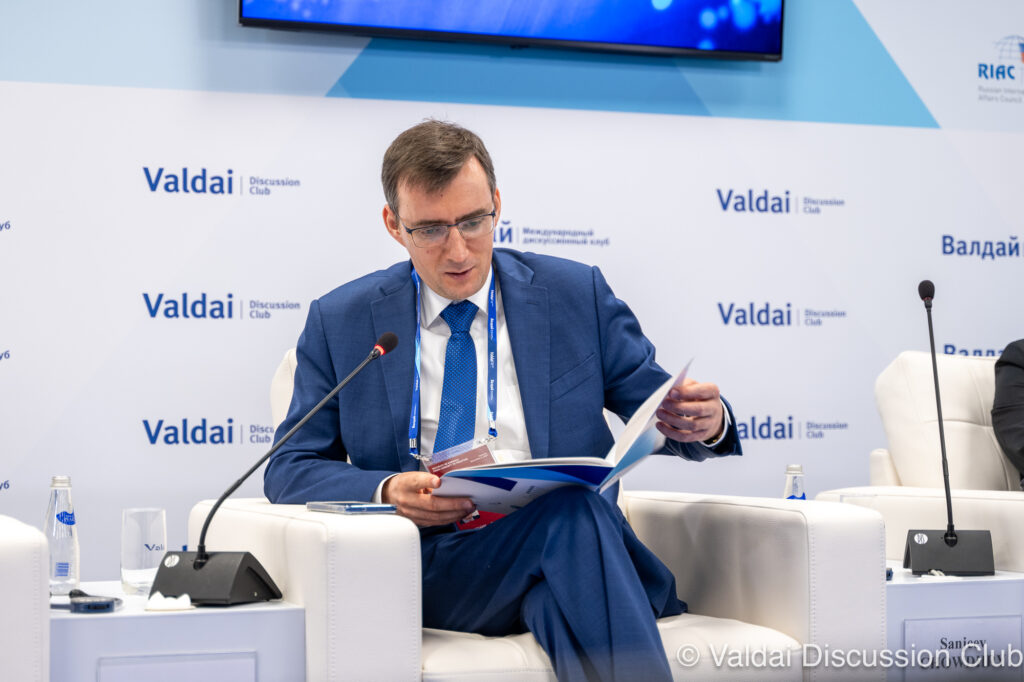
IMAGE: Ivan Timofeev, Valdai Club Program Director, and the Director General of the Russian International Affairs Council (RIAC) @ Valdai Discussion Club (Source: Valdai Club)
While the challenges should not be underestimated, differing threat perceptions, historical disputes and geopolitical competition are realities across the continent, the tone of the conference suggested a willingness to look beyond constraints and focus on emerging opportunities. For many attendees, the concept of a Eurasian security architecture is not a grandiose attempt to redraw global power structures, but a pragmatic response to new global conditions. They argued that the continent has reached a point where deeper dialogue and shared mechanisms are not only desirable but necessary.
Seen in this light, Russia’s role in convening the discussion was understood by many participants not as an attempt at geopolitical dominance, but as an effort to encourage a more stable and inclusive regional order at a time of significant global uncertainty. Several experts emphasised that countries across Eurasia are not seeking to join blocs; they want platforms that allow them to balance multiple interests, avoid confrontation and strengthen resilience. Russia’s initiative was interpreted as a step toward that broader aspiration, offering intellectual and diplomatic space for states to articulate their own security ideas rather than adopt frameworks designed elsewhere.
By the time the conference concluded, what emerged was less a fixed blueprint and more a shared understanding that Eurasia has entered a new phase, one where cooperation, even if incremental, is both possible and necessary. There was clear recognition that building a continent-wide architecture will take time, patience and trust, but also a sense that the first steps have been taken. The participants did not leave with illusions of instant transformation; they left with the conviction that dialogue itself is a strategic asset.
If the Valdai Club’s December gathering is indicative of a broader trend, then Eurasia may be on the cusp of moving beyond a narrative dominated by fragmentation and competition toward one that values stability, shared prosperity and respectful coexistence. The conference demonstrated that the region’s states, despite their differences, recognise the need to shape their own future rather than have it shaped for them. In that sense, the discussions represented not only an intellectual exercise but a meaningful gesture toward a more cooperative Eurasian century.
READ MORE RUSSIA NEWS AT: 21st Century Wire Russia Files
SUPPORT OUR INDEPENDENT MEDIA PLATFORM – BECOME A MEMBER @21WIRE.TV
VISIT OUR TELEGRAM CHANNEL
21st Century Wire is an alternative news agency designed to enlighten, inform and educate readers about world events which are not always covered in the mainstream media.
Source: https://21stcenturywire.com/2025/12/10/eurasia-reimagined-inside-valdais-ambitious-blueprint-for-a-post-bloc-century/
Anyone can join.
Anyone can contribute.
Anyone can become informed about their world.
"United We Stand" Click Here To Create Your Personal Citizen Journalist Account Today, Be Sure To Invite Your Friends.
Before It’s News® is a community of individuals who report on what’s going on around them, from all around the world. Anyone can join. Anyone can contribute. Anyone can become informed about their world. "United We Stand" Click Here To Create Your Personal Citizen Journalist Account Today, Be Sure To Invite Your Friends.
LION'S MANE PRODUCT
Try Our Lion’s Mane WHOLE MIND Nootropic Blend 60 Capsules
Mushrooms are having a moment. One fabulous fungus in particular, lion’s mane, may help improve memory, depression and anxiety symptoms. They are also an excellent source of nutrients that show promise as a therapy for dementia, and other neurodegenerative diseases. If you’re living with anxiety or depression, you may be curious about all the therapy options out there — including the natural ones.Our Lion’s Mane WHOLE MIND Nootropic Blend has been formulated to utilize the potency of Lion’s mane but also include the benefits of four other Highly Beneficial Mushrooms. Synergistically, they work together to Build your health through improving cognitive function and immunity regardless of your age. Our Nootropic not only improves your Cognitive Function and Activates your Immune System, but it benefits growth of Essential Gut Flora, further enhancing your Vitality.

Our Formula includes: Lion’s Mane Mushrooms which Increase Brain Power through nerve growth, lessen anxiety, reduce depression, and improve concentration. Its an excellent adaptogen, promotes sleep and improves immunity. Shiitake Mushrooms which Fight cancer cells and infectious disease, boost the immune system, promotes brain function, and serves as a source of B vitamins. Maitake Mushrooms which regulate blood sugar levels of diabetics, reduce hypertension and boosts the immune system. Reishi Mushrooms which Fight inflammation, liver disease, fatigue, tumor growth and cancer. They Improve skin disorders and soothes digestive problems, stomach ulcers and leaky gut syndrome. Chaga Mushrooms which have anti-aging effects, boost immune function, improve stamina and athletic performance, even act as a natural aphrodisiac, fighting diabetes and improving liver function. Try Our Lion’s Mane WHOLE MIND Nootropic Blend 60 Capsules Today. Be 100% Satisfied or Receive a Full Money Back Guarantee. Order Yours Today by Following This Link.


| Visits: | 1,756,308,462 |
| Stories: | 8,546,308 |
Whistler Blowers, Insiders

