

One Acre Against The Odds

Most families are about to get hit twice—and they don’t even see it coming.
First at the checkout line. Then again at the dinner table.
Food prices don’t have to explode for this to hurt. They just have to keep creeping—quietly, steadily—year after year. A little more for produce. A little more for meat. A little more for eating out when everyone’s tired and nobody wants to cook. And before long, the grocery bill becomes a fixed monthly anxiety you can’t negotiate with.
There’s Still One Lever You Control

But here’s the part almost nobody talks about.
There is still one move left that flips the script. One move that doesn’t depend on politicians, supply chains, or “market corrections.” One move that turns inflation into something you harvest instead of suffer through.
It doesn’t require a bunker or a bug-out bag.
It requires an acre of dirt, a stack of seed catalogs, and the decision—right now, while winter still lingers—that this spring, your family will stop renting its food… and start growing it.
Planting a one-acre heirloom vegetable garden this year may be one of the most powerful moves a family can make—for their wallet, their health, and their sense of independence. And that’s true even if spring still feels a long way off and the ground outside is hard as iron.
Right now, while winter hangs on, you’re standing at a quiet crossroads. You can drift into another growing season reacting to prices, shortages, and headlines—or you can turn one acre of soil into something that works for you, year after year.
Food Inflation and What an Acre Is Really Worth
First, let’s talk money—because ignoring it won’t make it behave.
Yes, food inflation has cooled from its worst spikes. But it hasn’t reversed. In 2025, overall food prices ran 3.1 percent higher than the year before. Food eaten at home—your grocery cart—rose another 2.4 percent, and USDA expects food prices to climb roughly 3.0 percent again in 2026. Eating out is getting hit even harder: restaurant food jumped 4.1 percent last year and is projected to rise another 4.6 percent this year.
In plain English, every pound of vegetables you don’t have to buy is quietly becoming more valuable with each passing season.
So what does a serious garden actually produce? One family in Maine decided to find out. They tracked every ounce harvested from a roughly 1,600-square-foot garden and priced it out at local organic retail rates. Over one season, they pulled in 834 pounds of food worth about $2,400—while spending only $282 on seeds, compost, water, and supplies.
That’s an 862 percent return.
Broken down further, it worked out to roughly $1.50 of food value per square foot. Scale that up, and you’re looking at a theoretical $60,000 worth of produce per acre under intensive management.
Now, let’s be realistic. Most first-year one-acre gardens won’t hit anything close to that. But even a fraction of it is enormous. Say you only manage $15,000 worth of produce value in 2026 and spend a generous $3,000 on seeds, tools, irrigation, and amendments. You’ve still created $12,000 of tax-free food for your family.
And when you consider that USDA expects beef, sugar, and beverages to rise even faster than vegetables this year, every pound of homegrown tomatoes, beans, squash, and greens helps you sidestep the worst of the inflation pressure.
Heirlooms, Chemicals, and Taking Back Control
Cost is only part of the story. Control is the other.
Over the last few decades, genetically engineered crops have become tightly linked to heavy herbicide use—especially glyphosate and newer chemicals like glufosinate. As herbicide-tolerant GMO crops spread, glyphosate use worldwide jumped nearly fifteen-fold between 1995 and 2014. Researchers now describe this as a “pesticide treadmill,” where rising chemical use breeds resistant weeds, which then demand even more spraying.
In North America, studies show the number of different herbicides applied to GMO corn fields has increased by more than 50 percent since the 1990s.
In some systems, crops are engineered specifically so herbicides can be sprayed directly over the plants during the growing season—something that would normally kill them. That convenience comes with higher chemical residues on staple foods, especially grains. While regulators and industry debate safety thresholds, many families have quietly reached their own conclusion: they don’t want to be the experiment.
They’d rather shorten the distance between soil and plate.
That’s where heirloom vegetables shine. Planting open-pollinated, non-GMO varieties means seeds you can save, flavors bred for eating—not shipping—and a garden where you decide what touches the soil and the leaves. Compost, mulch, rotation, and beneficial insects replace a chemical program designed for industrial monocultures.
In a world of rising pesticide use tied to GMO systems, a one-acre heirloom garden becomes your family’s calm, stubborn “no thanks.”
A Family Project, Not a Solo Chore
Another hidden strength of a one-acre garden is scale. It’s big enough to matter—but not so big it has to rest on one person’s shoulders.
An acre sounds intimidating until you break it into pieces: a quarter-acre for heavy feeders like corn and squash, another section for trellised tomatoes and beans, wide beds for salad greens and roots, and border areas for herbs and flowers. Suddenly, it’s manageable—and assignable.
Each section can become someone’s responsibility. Kids included.
Children can help flip through seed catalogs, build simple pallet trellises, label rows, pull weeds, and harvest. Younger kids love fast wins—radishes, peas, cherry tomatoes that go from seed to snack in no time. Older kids can track yields and run the math on how much the family saved compared to store prices.
In that Maine case study, the family’s three boys were part of the system that produced over six months of truly organic food. Yours can be too.
Spring is coming fast whether we’re prepared or not. If you use this winter wisely, by late summer you won’t just be reading about food inflation and chemical residues.
You’ll be walking your own rows, filling baskets instead of shopping carts—and showing your kids that real security starts with the soil under your feet.
Source: https://www.offthegridnews.com/survival-gardening/one-acre-against-the-odds/
Anyone can join.
Anyone can contribute.
Anyone can become informed about their world.
"United We Stand" Click Here To Create Your Personal Citizen Journalist Account Today, Be Sure To Invite Your Friends.
Before It’s News® is a community of individuals who report on what’s going on around them, from all around the world. Anyone can join. Anyone can contribute. Anyone can become informed about their world. "United We Stand" Click Here To Create Your Personal Citizen Journalist Account Today, Be Sure To Invite Your Friends.
LION'S MANE PRODUCT
Try Our Lion’s Mane WHOLE MIND Nootropic Blend 60 Capsules
Mushrooms are having a moment. One fabulous fungus in particular, lion’s mane, may help improve memory, depression and anxiety symptoms. They are also an excellent source of nutrients that show promise as a therapy for dementia, and other neurodegenerative diseases. If you’re living with anxiety or depression, you may be curious about all the therapy options out there — including the natural ones.Our Lion’s Mane WHOLE MIND Nootropic Blend has been formulated to utilize the potency of Lion’s mane but also include the benefits of four other Highly Beneficial Mushrooms. Synergistically, they work together to Build your health through improving cognitive function and immunity regardless of your age. Our Nootropic not only improves your Cognitive Function and Activates your Immune System, but it benefits growth of Essential Gut Flora, further enhancing your Vitality.
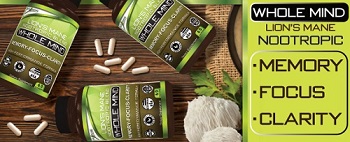
Our Formula includes: Lion’s Mane Mushrooms which Increase Brain Power through nerve growth, lessen anxiety, reduce depression, and improve concentration. Its an excellent adaptogen, promotes sleep and improves immunity. Shiitake Mushrooms which Fight cancer cells and infectious disease, boost the immune system, promotes brain function, and serves as a source of B vitamins. Maitake Mushrooms which regulate blood sugar levels of diabetics, reduce hypertension and boosts the immune system. Reishi Mushrooms which Fight inflammation, liver disease, fatigue, tumor growth and cancer. They Improve skin disorders and soothes digestive problems, stomach ulcers and leaky gut syndrome. Chaga Mushrooms which have anti-aging effects, boost immune function, improve stamina and athletic performance, even act as a natural aphrodisiac, fighting diabetes and improving liver function. Try Our Lion’s Mane WHOLE MIND Nootropic Blend 60 Capsules Today. Be 100% Satisfied or Receive a Full Money Back Guarantee. Order Yours Today by Following This Link.



| Visits: | 1,774,093,969 |
| Stories: | 8,578,240 |
Whistler Blowers, Insiders


Till somebody comes by and takes it.