

Prophecy News - 'Khamenei’s Final Warning: "We Will Sink the Ford" - Iran’s Secret Sea Weapon Exposed', presented by Global Strike Desk, February 22nd, 2026

Jesus has prophesied this for quite a long time.. Here, it’s being played out. I found this website just a few days ago, and ‘Money over History’. These two related youtube channels are very direct and without anger. The specifics are detailed, and as far as I can tell, because I’ve looked up names and terms, very accurate. Iran may be destroyed, Damascus Syria may be bombed, but America too will face its comeuppance.
Global Strike Desk
02/22/2026
The USS Gerald R. Ford, 13 billion dollars of nuclear-powered steel is steaming toward Iran. The message is unmistakable. America is ready. America is dominant. Iran should be afraid. That is the official narrative. A show of force so overwhelming that Tehran will blink, come to the table and sign a deal.
Now, here is what actually happened. The moment that carrier left port, Iran’s supreme leader Ayatollah Ali Khamenei went on X, the same platform where Trump posts his threats, and posted his reply directly to the world. He wrote, “The Americans constantly say that they’ve sent a warship toward Iran. Of course, a warship is a dangerous piece of military hardware. However, more dangerous than that warship is the weapon that can send that warship to the bottom of the sea.”
That post has been viewed 3.5 million times and counting. And then he posted again, “The U.S. president keeps saying they have the strongest military force in the world. The strongest military force may at times be struck so hard that it cannot get up again.” He didn’t say which weapon. He didn’t name a system. He didn’t need to, because for 47 years, Iran has been building exactly this arsenal. And this week, piece by piece, Washington is finally being forced to look at what they built. That is your reality check. And what Iran built will keep you up at night.
Before we get into the weapons, and we are going to go deep on the weapons. Let’s establish the physical context because geography is the most underrated variable in this entire crisis. The Strait of Hormuz is 39 km wide at its narrowest point. That is 24 miles. You cannot hide the USS Gerald R. Ford inside 24 miles of water. At over a thousand ft long, it takes up roughly a tenth of that corridor by itself. And Iran controls the entire northern coastline of that strait. Every meter of it.
The Hormuz Islands: Abu Musa, Greater Tunb and Lesser Tunb, sit directly in the Strait’s approaches. Iran has controlled them since 1971. They are fortified. They host missile batteries, radar installations, IRGC speedboat squadrons, and drone launch facilities. IRGC Navy Commander Rear Admiral Alireza Tangsiri called them “impregnable fortresses” and “unsinkable aircraft carriers”. He used that exact phrase, “unsinkable aircraft carriers.”
Iran’s islands cost nothing to maintain compared to a 13 billion dollar ship. They cannot sink. They cannot run out of fuel. They cannot be recalled for maintenance. And they are permanently positioned at the point where the USS Ford must pass. ..Let that sink in.
Now let’s talk about what Khamenei wasn’t naming, because the silence around the specific weapon is intentional and the list of candidates is terrifying. The most discussed candidate in the hours after Khamenei’s post, was a missile system Iran has been quietly perfecting for over a decade. The Fattah-1, Iran’s hypersonic glide vehicle. Range 1,400 km, that is 870 miles. The USS Abraham Lincoln is currently operating off the coast of Oman. According to analysts at ‘Defense Security Asia’, the Abraham Lincoln is already within potential engagement range of Iran’s longer range anti-ship systems. The ship doesn’t need to enter the Hormuz for Iran to threaten it. Let that sink in.
The carrier hasn’t entered the Persian Gulf. It hasn’t even approached the Strait, and Iran may already have weapons that can reach it. Iran claims the Fattah-2 can reach speeds of Mach 13 to Mach 15 during flight, roughly 15,000 kmh. It features a hypersonic glide vehicle design, meaning after its ballistic launch phase, the warhead detaches and glides along an unpredictable maneuvering trajectory.
Now, Western analysts at the International Institute for Strategic Studies have questioned whether Iran’s hypersonic claims fully hold up technically. Fabian Hinz of the IISS describes the Fattah as closer to a maneuverable re-entry vehicle than a true hypersonic glide vehicle, in the way Russia or China has developed. But here is the operative military reality. You don’t need a perfect hypersonic missile to defeat an aircraft carrier’s defenses. You need a missile that maneuvers unpredictably in its terminal phase, arrives faster than a standard ballistic, and comes in alongside 20 other threats simultaneously that Iran has. And the Fattah is just the beginning.
On February 4th, 2026, 3 weeks ago, Iran did something that almost nobody in the Western press reported on with the seriousness it deserved. Hours before nuclear talks in Oman, while Iranian negotiators were boarding planes to meet American officials, Iran’s state television broadcast footage of the IRGC aerospace force inaugurating a new underground missile city. And they unveiled a weapon that had been moved there, the Korramshahr 4.
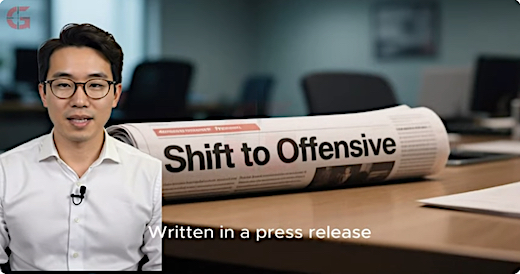
Iranian state media announced the deployment with language that was precise and deliberate. They said the operational deployment of the Khorramshahr 4 in missile cities, coincides with the announced shift in the armed forces doctrine from defensive to offensive. “defensive to offensive”, written in a press release published hours before peace talks. That is not accidental language. ..That is Iran telling Washington exactly what it is doing so that Washington understands exactly what a failed deal means.
Now let’s talk about what the Khorramshahr 4 actually is because the numbers are extraordinary. Range: 2,000 km. That covers all of Israel, all U.S. bases in the Gulf and reaches into NATO territory in southeastern Europe. Warhead: 1,500 kg. For context, that is 3,000 lb of explosive payload. The warhead alone weighs more than a fully loaded FA18 Super Hornet fighter jet. Speed: Mach 16 outside the atmosphere, Mach 8 on re-entry into the atmosphere. Flight time to target at maximum range: 10 to 12 minutes. Circular error:.. probable meaning, how close it hits to its aim point: 30 m. That is the length of a school bus, at 2,000 km. And it can be launched from a mobile platform in less than 15 minutes. Let that sink in.
Iran deployed a missile with a 2,000 km range, a 1500 kg warhead, 10-minute flight time, and 30 meter accuracy. And they did it on the same day their diplomats sat down with American negotiators, as a negotiating statement, not a military action. A statement. The math doesn’t work in America’s favor when Iran’s opening diplomatic move is rolling out a missile that can hit every American base in the region within 10 minutes. But the Khorramshahr-4 is still not what Khamenei was pointing at, when he said, “the weapon that can send a warship to the bottom of the sea.” Because ballistic missiles, even maneuvering ones, are primarily land attack weapons. They can hit fixed targets with extraordinary precision.
A moving carrier is a different problem. The weapon designed specifically to hunt and kill moving aircraft carriers is Iran’s anti-ship arsenal. And that arsenal has a structure that most Western commentary has never properly explained. Think of it as three concentric rings around the carrier. Each ring uses a different weapon. Each ring is designed to create a different problem for the carrier’s defense systems. The goal isn’t to punch through the defenses with one weapon. The goal is to saturate them with all three rings simultaneously.
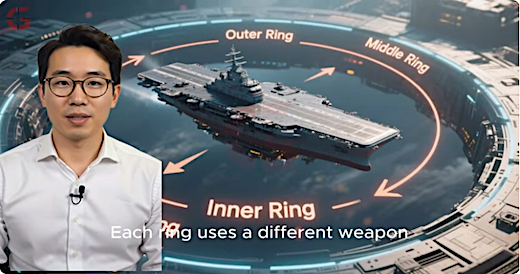
Ring one, the outer ring. Range: over 1,000 kilometers. The Abu Mahdi cruise missile. The Abu Mahdi was unveiled in 2020 as Iran’s longest range anti-ship cruise missile. Turbo jet powered. Weight 1,650 kg. Warhead 410 kg. A penetrating high explosive charge designed to punch through the armored hall of a warship. Reported range: over 1,000 km. Analysts at ‘Defense Security Asia’ confirmed this week that this range places vessels operating off Oman’s coast, such as the USS Abraham Lincoln, within potential engagement range. The missile flies at a sea skimming altitude of below 50 m. It is designed specifically to fly below the radar horizon of surface ships, emerging from the radar noise of ocean clutter only in the final seconds of its approach.
It uses artificial intelligence to adapt its flight path and resist electronic jamming. It has a Dual Seeker guidance system, both active and passive radar to resist countermeasures. It can be launched from deep inside Iranian territory. The launch platform never needs to come within range of American strike aircraft or naval guns.
Ring two, the middle ring. Range: 300 km, two weapons, the Khalij Fars anti-ship ballistic missile and the Zolfaghar Basir. The Khalij Fars, whose name translates as Persian Gulf, is a solid fuel anti-ship ballistic missile that arrives from above, not from the side. Range: 300 km. Warhead: 650 kg. Speed: Mach 3 to Mach 4. Impact angle nearly vertical. Here’s why a vertical impact missile is terrifying to a carrier’s defense system.
The SM2 and SM6 interceptors on American destroyers are optimized to intercept threats coming in from the horizon. A ballistic missile coming down from above requires the interceptor to achieve a very high elevation intercept, a harder shot geometrically and computationally than a horizontal interception. And the Khalij Fars, according to Iran, can impact within 8.5 m of its aim point during testing. 8.5 m on a ship that is 1,000 ft long. .. The Zolfaghar Basir has a 700 km range and the same electro-optical terminal seeker. It extends the ballistic threat ring to twice the distance of the Khalij Fars.
Ring three, the inner ring, the swarm. Hundreds of IRGC fast attack craft, some capable of over 100 knots, armed with shorter range missiles like the Nouir and Quadar-2 cruise missiles, torpedoes, and in some configurations, direct attack suicide profiles. The Nouir and Quadar are derived from China’s C802 missile family. Range 120 to 300 km. They seek, skim. They are radar guided. They can be launched simultaneously from dozens of small boats at once. And here is the Aegis radar’s mathematical problem with the swarm
The Aegis system on a Burke class destroyer can track hundreds of targets simultaneously. It can engage multiple threats at once, but its magazine, the VLS cells [vertical launch system] that hold its interceptor missiles, is finite. A single destroyer carries between 96 and 122 VLS cells. Not all of those are interceptors. Some are for tomahawk strike missiles. Some are for anti-submarine weapons. If Iran launches the outer ring, Abu Mahdi long-range cruise missiles from deep inside Iran, then immediately launches the middle ring, Khalij ballistic missiles from coastal launchers, and simultaneously sends the inner swarm - dozens of fast attack boats firing Nouir and Quadar missiles from multiple directions, the carrier strike group is now managing three simultaneous attack axis at three different ranges, arriving at overlapping time windows with three completely different flight profiles that require completely different intercept solutions. The math doesn’t work.
A finite magazine faces an infinite threat concept. This is not speculation. This is the doctrine Iran published. This is what the Iranian military calls “a multi-vector threat matrix”. They named it. They built it. And they’ve been practicing it in the Strait of Hormuz every year, including right now this week, alongside Russian and Chinese ships. And we haven’t even gotten to the mines. The U.S. Defense Intelligence Agency estimated in 2019 that Iran possessed over 5,000 naval mines. As of this month, Army Recognition’s [a daily news source] detailed analysis placed Iran’s stockpile between 5,000 and 6,000 mines. That figure includes everything from basic contact mines to bottom influence mines that detect magnetic signatures and fire-guided torpedoes upward into a ship’s hull.
Iran doesn’t need to build a perfect minefield. It needs to create doubt. Even the possibility of mines in the Strait of Hormuz, even a rumor of mining, would halt commercial traffic. Insurers would pull coverage. Tankers would divert. The price of oil would spike before a single mine detonated. And Iran has submarines specifically optimized to covertly seed mines at night in the narrow waters of the Hormuz. While IRGC coastal missile batteries suppress any mine counter-measure operation that attempts to clear the Strait. The math doesn’t work. The U.S. has limited mine countermeasure vessels in the region. Mine clearing is slow, dangerous, and requires the clearing force to operate within range of the same coastal missile batteries that would be engaging the carrier group.
Let’s now do the translations because the diplomatic language being used this week is extraordinary in how much it is being asked to hide. When Secretary of State Marco Rubio said: “The U.S. wanted talks to cover Iran’s ballistic missiles, its support for proxy groups and treatment of their own people.” What he actually meant was, “We are asking Iran to surrender the three things it considers existential to its national security, as preconditions for relief from the economic pressure that is strangling its population.” Iran’s missiles are its deterrent against the U.S. Its proxies are its forward defense against Israel. Its internal politics are its identity as a revolutionary state.
Washington is asking Iran to give up all three in exchange for sanctions relief. Iran said, “No” immediately. Iranian foreign minister Abbas Araghchi said directly that Tehran only discusses its nuclear issue. “We do not discuss any other issue with the U.S.” When Araghchi said, “I am in Geneva with real ideas to achieve a fair deal..” What is not on the table? Submission before threats. What he actually meant was, ‘We will negotiate the nuclear file. We will not negotiate away the weapons that make negotiation necessary. Remove the threat and we’ll discuss enrichment. Keep the threat and we keep the missiles.’ That is not an unreasonable position from Iran’s perspective. It is the position that makes a deal structurally impossible from Washington’s perspective.
When the White House announced the Ford’s deployment and Trump said, “In case we don’t make a deal, we’ll need it.” What he actually meant was, ‘I have now created a public deadline backed by a public military deployment and the entire world is watching to see whether the threat is real.’ ..That is not a negotiating strategy. That is a pressure campaign with no obvious release valve that doesn’t involve either a deal Washington can’t get, or [a] strike Washington can’t fully justify without a specific triggering event.
And here is the translation nobody is providing for: Khamenei’s posts on X. When the Supreme Leader, a man who has not posted casually in 47 years of leadership, takes to social media to personally threaten American aircraft carriers and describes a weapon that can sink them, what he actually meant was, ‘We know the Ford is coming. We see your satellite images. We read your deployments in real time, and we want you to read this message and think carefully before the order is given.’ ..It is deterrence by declaration.
It is the nuclear doctrine of ‘mutually assured destruction’ applied to conventional naval warfare in a 39 km wide strait. And it works the same way.. If the cost of using your weapon is too high, you don’t use it. The strategic catastrophe here is not that Iran might sink the Ford. The catastrophe is that Iran might not need to. Every day, the Ford steams toward the region, burning $6.5 million in operating costs. Every SM2 [intercepter] fired at a healthy drone costs $2.1 million to replace. Every day, the USS Abraham Lincoln sits in the Arabian Sea past its scheduled maintenance window. that is strategic erosion.
Iran spent 47 years building a threat system designed for exactly this theater at exactly this scale, against exactly this type of adversary. The Khalij Fars missile was designed specifically to kill American aircraft carriers in the Persian Gulf. The Abu Mahdi was designed specifically to extend that kill zone into the Arabian Sea. The Swarm Doctrine was designed specifically to saturate Aegis radar. This is not improvised. This is the result of a state level investment in asymmetric anti-access warfare that predates most of the sailors aboard the Ford by decades.
And the United States is sailing directly into it with a ship that its own navy flagged for maintenance with a crew approaching 300 consecutive days at sea, in a theater where the enemy has 20 plus years of intelligence on exactly how those ships operate, what their radar blind spots are, and what their magazine limits are. Let that sink in. The math doesn’t work. And the political dimension makes the math even worse.
Trump is facing an absolute no-win trap. He set a public deadline. He sent two carriers. He created a situation where every news outlet on Earth is counting down to March 6th, 2026. The world is watching. If he strikes Iran after the deadline expires with no deal, he initiates the most significant US military operation in 20 years, against a country that has had 20 years to prepare its defenses specifically for this scenario, in a waterway that 20% of the world’s oil flows through, with Russian and Chinese ships already in the theater.
If he backs down, extends the deadline, announces new talks, accepts a partial deal that doesn’t include missiles or proxies, he validates every adversary’s calculation that American deadlines are theater, not policy. And if, in the worst scenario, Iran launches and damages or sinks an escort ship, not even the carrier, just a destroyer, the political pressure for overwhelming retaliation would be immense. The American public would demand it. The military would be ready for it.
And then the straight of Hormuz closes. Oil goes to $150 a barrel. And the global economy enters a crisis that makes 2008 look mild. That is the catastrophe scenario. It doesn’t require the Ford to sink. It requires one successful hit on one ship, and one decision that cannot be taken back. There is no clean exit. The carriers created leverage, but also a commitment. The public deadline created urgency, but also a trap. And the Ford steaming through the Mediterranean right now is sailing into the most thoroughly prepared anti-access threat environment ever assembled against an American naval force.
One more number, just one more. And then the question. ..In 2024, Iran launched over 500 ballistic missiles at Israel across multiple exchanges of fire. According to the Economist, 6% of those 500 missiles hit builtup areas, meaning roughly 30 missiles penetrated all of Israel’s layered defenses. Arrow-2, Arrow-3, David’s Sling, Iron Dome, American THAAD, and Patriot batteries. 6% of 500 missiles is 30 hits on a country with the most advanced missile defense network in the world. Now, apply that math to a carrier strike group with a finite magazine in a 39 km strait, facing all three rings simultaneously. In a theater where Iran has had 47 years to prepare and knows every American procedure, every radar frequency, and every magazine limit, 6% is not zero. And zero is the only acceptable number when the target is the most expensive ship America has ever built.
So here is the question. The only question that matters as the countdown ends and the carriers arrive and the diplomats run out of time. Khamenei said, “The weapon that can sink an aircraft carrier is more dangerous than the carrier itself.” And he said it after studying American naval doctrine for 47 years. After building the Khalij Fars specifically to kill carriers. After deploying the Abu Mahdi to reach carriers before they reach the Strait. After putting the Khorramshahr-4 in an underground missile city on the same day his diplomats sat down with American negotiators, after conducting live-fire drills in the Hormuz, alongside Russian and Chinese ships, while the Ford transited Gibraltar.
The question isn’t whether Iran can sink the Ford. The question is, does Khamenei believe it? And if he does, what does that belief cost the world the moment someone tests it?
Links-
‘Khamenei’s Final Warning: “We Will Sink the Ford” — Iran’s Secret Sea Weapon Exposed’
https://www.youtube.com/watch?v=i8ej-DecIws
‘A Declaration of War’
/spirit/2026/02/prophecy-news-a-declaration-of-war-given-by-jesus-to-biblaridion-the-little-book-the-small-scroll-of-revelation-10-february-18-2026-2525676.html
‘SOON IT BEGINS!’ 💀
/spirit/2026/02/short-vision-1-soon-it-begins-%f0%9f%92-given-by-jesus-to-lynne-johnson-february-18th-2026-2525677.html
Mary’s Messages
/spirit/2020/05/marys-messages-to-help-us-during-tribulation-period-2517355.html
Anyone can join.
Anyone can contribute.
Anyone can become informed about their world.
"United We Stand" Click Here To Create Your Personal Citizen Journalist Account Today, Be Sure To Invite Your Friends.
Before It’s News® is a community of individuals who report on what’s going on around them, from all around the world. Anyone can join. Anyone can contribute. Anyone can become informed about their world. "United We Stand" Click Here To Create Your Personal Citizen Journalist Account Today, Be Sure To Invite Your Friends.
LION'S MANE PRODUCT
Try Our Lion’s Mane WHOLE MIND Nootropic Blend 60 Capsules
Mushrooms are having a moment. One fabulous fungus in particular, lion’s mane, may help improve memory, depression and anxiety symptoms. They are also an excellent source of nutrients that show promise as a therapy for dementia, and other neurodegenerative diseases. If you’re living with anxiety or depression, you may be curious about all the therapy options out there — including the natural ones.Our Lion’s Mane WHOLE MIND Nootropic Blend has been formulated to utilize the potency of Lion’s mane but also include the benefits of four other Highly Beneficial Mushrooms. Synergistically, they work together to Build your health through improving cognitive function and immunity regardless of your age. Our Nootropic not only improves your Cognitive Function and Activates your Immune System, but it benefits growth of Essential Gut Flora, further enhancing your Vitality.

Our Formula includes: Lion’s Mane Mushrooms which Increase Brain Power through nerve growth, lessen anxiety, reduce depression, and improve concentration. Its an excellent adaptogen, promotes sleep and improves immunity. Shiitake Mushrooms which Fight cancer cells and infectious disease, boost the immune system, promotes brain function, and serves as a source of B vitamins. Maitake Mushrooms which regulate blood sugar levels of diabetics, reduce hypertension and boosts the immune system. Reishi Mushrooms which Fight inflammation, liver disease, fatigue, tumor growth and cancer. They Improve skin disorders and soothes digestive problems, stomach ulcers and leaky gut syndrome. Chaga Mushrooms which have anti-aging effects, boost immune function, improve stamina and athletic performance, even act as a natural aphrodisiac, fighting diabetes and improving liver function. Try Our Lion’s Mane WHOLE MIND Nootropic Blend 60 Capsules Today. Be 100% Satisfied or Receive a Full Money Back Guarantee. Order Yours Today by Following This Link.


| Visits: | 1,781,436,937 |
| Stories: | 8,592,192 |
Whistler Blowers, Insiders

