
Porcupines: the most primitive rodents in the LRT

According to Google AI
the most primitive rodent is the burrowing mountain beaver, Aplodontia, Google AI supports this tradtional and wide-spread assertion by “Pulling a Larry Martin” = presenting a short list of traits that other rodents don’t have.
Someday Google AI should learn that the best and only way to determine phylogenetic placement and last common ancestor status is with a wide gamut phylogenetic analysis that includes all pertinent taxa, including a proximal outgroup taxon, in this case a long list of precursor arboreal taxa.
Here
in the large reptile tree (LRT, 2340 taxa) the extant porcupine (Coendou, Fig 1) represents the late-surviving last common ancestor of all rodents (including rabbits and manatees) because its next most primitive ancestor (see below) is not a rodent (by definition).

The proximal ancestor of the last common ancestor of rodents
is the aye-aye, Daubentonia, another extant taxon, this time from Madagascar. It has a gnawing, rodent-like dentition and is just as arboreal as the lemurs it is often mistakenly compared to, also restricted to Madagascar.

The aye-aye diet
consists of insects it finds under the bark of tree trunks and limbs.
The porcupine diet
has almost entirely transitioned over to almost every other part of the forest, including the tender inner bark of trees, with only a few insects on occasion.
So rodent teeth, like those of other diprotodonts (by convergence) were originally evolved in both clades for pulling bark off trees.
Figure 4. Daubentonia, the extant aye-aye, now nests in the LRT with Tupaia, the tree shrew.
” data-large-file=”https://pterosaurheresies.wordpress.com/wp-content/uploads/2023/06/daubentonia-tupaia588.jpg?w=584″ src=”https://pterosaurheresies.wordpress.com/wp-content/uploads/2023/06/daubentonia-tupaia588.jpg?w=584″ alt=”Figure 4. Daubentonia, the extant aye-aye, now nests in the LRT with Tupaia, the tree shrew.” class=”wp-image-78926″ style=”aspect-ratio:0.7859200538301406;width:584px;height:auto” srcset=”https://pterosaurheresies.wordpress.com/wp-content/uploads/2023/06/daubentonia-tupaia588.jpg?w=584 584w, https://pterosaurheresies.wordpress.com/wp-content/uploads/2023/06/daubentonia-tupaia588.jpg?w=117 117w, https://pterosaurheresies.wordpress.com/wp-content/uploads/2023/06/daubentonia-tupaia588.jpg?w=234 234w, https://pterosaurheresies.wordpress.com/wp-content/uploads/2023/06/daubentonia-tupaia588.jpg 588w” sizes=”auto, (max-width: 584px) 100vw, 584px” />
Although it is common knowledge
that the aye-aye is a primitive primate, and lives on the island of lemurs (Madagascar), after analysis it nests closer to the origin of rodents and the origin of multituberculates, derived from Ignacius and Carpolestes (both from the Paleocene of North America), both close to Plesiadapis (Paleocene of North America and Europe via the land bridge of Greenland).
The geographic range of these taxa was likely much wider than the present refugia given the Madagascar refugium of Daubentonia where it evolved those long, bark-tapping fingers, convergent with those found in the striped possum, a marsupial, Dactylopsila, today restricted to the islands surrounding Australia.
Porcupines are basal to
arboreal squirrels on one branch and increasingly burrowing mountain beavers leading to gophers and naked mole rats on another branch, and increasingly aquatic beavers, which led to marine beavers = Moeritherium, manatees and kin on yet another branch, and increasingly terrestrial rats, mice, rabbits, jerboas and capybaras on yet another branch.
This is why the outgroup taxa are SO important in phylogenetic analysis. Let your cladogram choose them for you. Don’t be like so many of today’s paleontologists who cherry-pick the outgroups they want to use by force of tradition or peer-group pressure = consensus.
This appears to be a novel hypothesis of interrelationships.
If not, please provide a citation so I can promote it here.
References
wiki/Porcupine
wiki/Rodent
Source: https://pterosaurheresies.wordpress.com/2026/11/15/porcupines-the-most-primitive-rodents-in-the-lrt/
Anyone can join.
Anyone can contribute.
Anyone can become informed about their world.
"United We Stand" Click Here To Create Your Personal Citizen Journalist Account Today, Be Sure To Invite Your Friends.
Before It’s News® is a community of individuals who report on what’s going on around them, from all around the world. Anyone can join. Anyone can contribute. Anyone can become informed about their world. "United We Stand" Click Here To Create Your Personal Citizen Journalist Account Today, Be Sure To Invite Your Friends.
LION'S MANE PRODUCT
Try Our Lion’s Mane WHOLE MIND Nootropic Blend 60 Capsules
Mushrooms are having a moment. One fabulous fungus in particular, lion’s mane, may help improve memory, depression and anxiety symptoms. They are also an excellent source of nutrients that show promise as a therapy for dementia, and other neurodegenerative diseases. If you’re living with anxiety or depression, you may be curious about all the therapy options out there — including the natural ones.Our Lion’s Mane WHOLE MIND Nootropic Blend has been formulated to utilize the potency of Lion’s mane but also include the benefits of four other Highly Beneficial Mushrooms. Synergistically, they work together to Build your health through improving cognitive function and immunity regardless of your age. Our Nootropic not only improves your Cognitive Function and Activates your Immune System, but it benefits growth of Essential Gut Flora, further enhancing your Vitality.
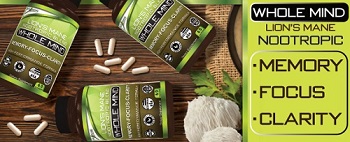
Our Formula includes: Lion’s Mane Mushrooms which Increase Brain Power through nerve growth, lessen anxiety, reduce depression, and improve concentration. Its an excellent adaptogen, promotes sleep and improves immunity. Shiitake Mushrooms which Fight cancer cells and infectious disease, boost the immune system, promotes brain function, and serves as a source of B vitamins. Maitake Mushrooms which regulate blood sugar levels of diabetics, reduce hypertension and boosts the immune system. Reishi Mushrooms which Fight inflammation, liver disease, fatigue, tumor growth and cancer. They Improve skin disorders and soothes digestive problems, stomach ulcers and leaky gut syndrome. Chaga Mushrooms which have anti-aging effects, boost immune function, improve stamina and athletic performance, even act as a natural aphrodisiac, fighting diabetes and improving liver function. Try Our Lion’s Mane WHOLE MIND Nootropic Blend 60 Capsules Today. Be 100% Satisfied or Receive a Full Money Back Guarantee. Order Yours Today by Following This Link.


| Visits: | 1,838,619,114 |
| Stories: | 8,737,692 |
Whistler Blowers, Insiders

