
Sapiens, page 4: The Most Important Thing to Know

One page at a time, I’m reviewing Sapiens: A Brief History of Humankind by Yuval Noah Harari.
Here we are. Just three posts into this journey and it’s already feeling like Bible study. (Some of us didn’t just to go church most Sundays of our formative years. We also went to religious school with religion class at the start of each day.)
Open up the book that starts with creation and ends in apocalypse. Think about what some of the words on one of the pages means. Too much. Think about the words, in just one passage, way too much.
Maybe relate those words to your life, or someone else’s, your neighbor’s, maybe relate what you’re reading to the news, to the wars somewhere.
Maybe assume there’s a lesson to be learned from someone who knows better. Maybe expect to find answers to the big questions we all ask and to questions we never even thought to ask.
Or, if you’re a skeptic and know that the Bible was written by ordinary people just like the rest of us, maybe read it with a sense of irony, instead. And wonder, as you go, if the author is in on the irony or not. But in Bible study, we keep skepticism and criticism to ourselves–at least we (mostly) did when I was a kid. Here, on the Mermaid’s Tale and with this other creation-to-apocalypse tale, we speak freely.
Page 4

We’re imagining we’re on a nature hike, taking in all the animals we might hope to see. It’s 2 million years ago and we only see (now dead) people who are a “familiar cast of human characters”: mothers concerned with babies, children getting dirty for fun, rebellious teens, wizened old farts just wanting to be left alone, ape-like men trying to impress “the local beauty” and (held separately from the aforementioned elders) “wise old matriarchs who had already seen it all.” He says that these (ancient imaginary people) are doing what many (2015) animals do and he says that many (2015) animals are doing all that these (ancient imaginary) people are doing and so, “there was nothing special about humans,” at this time in our collective evolutionary history. But c’mon… already in that “familiar cast of characters” there are roles that are not necessarily equivalent to other animals. How do we know that mother-child relations in 2-million-years-ago hominins were no different from those in any other animal now, let alone at the time? How do we know that 2-million-years-ago hominins were not impacting their surroundings in more intense or weirder ways than any other organism? We do not. We cannot.
This time-traveling safari is lovely and is presumably here to spark our imaginations so that we can travel right along with Harari’s. But what a way to start a science book, a history book.
These ancestral portraits aren’t beyond the bounds of reality, not even close. But to assert, based on these 100% figments that, “The most important thing to know about prehistoric humans is that they were insignificant animals with no more impact on their environment than gorillas, fireflies, or jellyfish,” is wild isn’t it?
Like, sure, at some point our direct ancestors were as insignificant/significant (potato/potahtoe) as all other organisms (which are all, literally, integral to the lives of all other organisms because everything is connected).
But why plant a stake in 2 million years ago that says they were still just like all the other animals? Why assert that this completely made-up condition for these ancient hominins is the most important thing about them?
I think it was the lovely Ian Tattersall who wrote somewhere that humans are “the pinnacle of nothing”. Now, that’s how you say we’re not special. Here, however, Harari is looking back and pointing out how unpinnacular our ancestors were to contrast them against their descendants, us.
The rest of the page instructs us on “species”–how those that we label separate species based on observable traits are often usually not having sex and sharing genetic material. And, if they were, then perhaps that would cause a scientist to decide to keep or lump them into one species.
I think the point is to confuse, not clarify, the concept of species so that readers know they are labels/boundaries we put on nature, not categories that we find out in nature. From an evolutionary perspective, species are so obviously human constructed categories. If we know that nothing comes from nothing and so everything came from something, and when change is constant which means everything came from something different, then we know that labels like species cut up a continuum, arbitrarily. I think that’s what he’s offering here.
Or he’s just trying to set up the fact that we are Homo sapiens so that the title of the book makes sense.
To be continued…
Source: http://ecodevoevo.blogspot.com/2026/04/sapiens-page-4-most-important-thing-to.html
Anyone can join.
Anyone can contribute.
Anyone can become informed about their world.
"United We Stand" Click Here To Create Your Personal Citizen Journalist Account Today, Be Sure To Invite Your Friends.
Before It’s News® is a community of individuals who report on what’s going on around them, from all around the world. Anyone can join. Anyone can contribute. Anyone can become informed about their world. "United We Stand" Click Here To Create Your Personal Citizen Journalist Account Today, Be Sure To Invite Your Friends.
LION'S MANE PRODUCT
Try Our Lion’s Mane WHOLE MIND Nootropic Blend 60 Capsules
Mushrooms are having a moment. One fabulous fungus in particular, lion’s mane, may help improve memory, depression and anxiety symptoms. They are also an excellent source of nutrients that show promise as a therapy for dementia, and other neurodegenerative diseases. If you’re living with anxiety or depression, you may be curious about all the therapy options out there — including the natural ones.Our Lion’s Mane WHOLE MIND Nootropic Blend has been formulated to utilize the potency of Lion’s mane but also include the benefits of four other Highly Beneficial Mushrooms. Synergistically, they work together to Build your health through improving cognitive function and immunity regardless of your age. Our Nootropic not only improves your Cognitive Function and Activates your Immune System, but it benefits growth of Essential Gut Flora, further enhancing your Vitality.
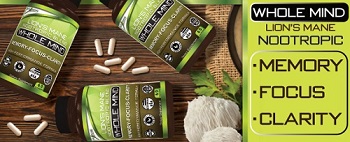
Our Formula includes: Lion’s Mane Mushrooms which Increase Brain Power through nerve growth, lessen anxiety, reduce depression, and improve concentration. Its an excellent adaptogen, promotes sleep and improves immunity. Shiitake Mushrooms which Fight cancer cells and infectious disease, boost the immune system, promotes brain function, and serves as a source of B vitamins. Maitake Mushrooms which regulate blood sugar levels of diabetics, reduce hypertension and boosts the immune system. Reishi Mushrooms which Fight inflammation, liver disease, fatigue, tumor growth and cancer. They Improve skin disorders and soothes digestive problems, stomach ulcers and leaky gut syndrome. Chaga Mushrooms which have anti-aging effects, boost immune function, improve stamina and athletic performance, even act as a natural aphrodisiac, fighting diabetes and improving liver function. Try Our Lion’s Mane WHOLE MIND Nootropic Blend 60 Capsules Today. Be 100% Satisfied or Receive a Full Money Back Guarantee. Order Yours Today by Following This Link.


| Visits: | 1,792,871,496 |
| Stories: | 8,614,594 |
Whistler Blowers, Insiders

