
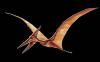
More answers to Stu Bonk queries and comments

“Stu Bonk indicates splayed hind limbs (which happens when the axes of the acetabulum and femoral head align) would have a limited range of motion in pterosaurs. Please see:”
Quoting Stu Bonk in blue italic
Few things:
-
- There are a few frames in the Sharovipteryx animation where the femoral head is almost entirely detached from the pelvis. >> I don’t see what you see and I am an amateur 2D animator. For other readers to judge, here is the animation:https://pterosaurheresies.wordpress.com/2021/12/10/sharovipteryx-running-animation/
- How do you know this was the actual range of motion of the femur? >> I don’t know the ‘actual’ range. What is your precision requirement? This is a crushed fossil. This was the first time on the planet that Sharovipteryx was animated as a biped. The range was set at a little above the prepubis and a little behind it. The prepubis and anterior ilium anchored femoral adductors developed after the reduction of the femoral abductors = caudofemoralis anchored on the anterior tail. Please note therapsids and mammals also did this by convergence. For videos of other bipepdal lepidosaurs (lacking a prepubis) on YouTube click here .
- You didn’t make the gifs in a 3-dimensional space/program nor did you simulate how musculature would actually work in those situations. Due to this, your reconstructions of them running in that motion cannot be considered as evidence because there were no biomechanical restraints put in place, meaning you could have accidentally extended the range of motion too far, put the femur in at the wrong angle making it either too short or too long, made the femoral head move too far out of/within the socket, etc. >> All semi-valid objections. However, your job is not to wonder if I did something wrong, nor to judge based on criteria I was not obligated to, but to repeat what I did and show I did something wrong. In other words: falsify what I did. That’s the scientific method. Be a player, not a spectator. “I’m not convinced” is not a scientific reply.
-
- In the video of the lizard running, while it is using its hindlimbs for propulsion, it is still very much using its forelimbs to push itself off the ground and forward. Considering that the animals you claim run in a similar fashion are all more heavily built and aren’t as elongated, does it not make sense that pterosaurs especially would have to use their forelimbs for locomotion considering that they all have forelimbs longer than their hindlimbs.” >> Here’s a giant pterosaur running in the manner of Sharovipteryx animated – but using its wings like a fat chicken for thrust and lift – though not enough to fly:http://www.reptileevolution.com/quetzalcoatlus.htm
It is worthwhile noting that – at speed– bipedal lizards (videos here) plant their feet far behind their center of balance. Humans do the same. Some call it a controlled fall.
“and pay attention to that YouTube video of a running lizard by the Bruce Jayne labs on that page. Note the wiggling of the hips during each stride AND the wide placement of the feet in dorsal view.”
“However, both the musculature and the general morphology of a zebra-tailed lizard and an Anhanguera are extremely different with the latter being much more heavily built than the former, leading to Anhanguera having much more restraint in regards to the movement of the femur.” – Anhanguera is much larger and different: it has huge wings that develop lift in a breeze or with thrust. Better to compare Anhanguera to a soaring sea bird. Also note the extremely small feet on Anhanguera (linked above). Those feet are not made for running. They are vestiges. Choose your comparisons wisely.
“Cosesaurus does have trailing membranes on the forelimbs. Also a pteroid.”
“From all of your skeletals and diagrams of Cosesaurus, the membranes you speak of look much more like filaments and I don’t really see how they are membranes.” >> Please remember that pterosaur wing membranes are embedded with fibers. Those on Cosesaurus are extremely short and rudimentary. We are lucky to have them. Baby steps.
“Sorry you’ve been misled by other workers that gliding came first in birds, bats and pterosaurs. The anatomy indicates flapping came first. You can flap with little wings before you can glide. And gliding is not a forelimb active mode. Thus, these animals needed to develop flapping first.”
“As a person who tries to keep up with the literature, I wouldn’t say I’ve been ‘misled’. I’ve known for a while that flapping obviously came before flight in birds and non-avian dinosaurs. But here’s the thing: how can you be sure that pterosaurs flapped like birds in order to take off when you haven’t really done anything to prove that its biomechanically possible? >> Please remember the elongate and locked down coracoid found only in flapping birds and pterosaurs AND their nonvolant ancestors. That translates left-right-left-right into up-down-up-down. Gliders don’t have that. Pterosaurs AND their ancestors also had a sternal complex and a strap-like scapula, as in birds. All reconstructions of mine show the feet placed beneath the center of balance = shoulder joint in pterosaurs, as in birds. That enables the wings to fold and unfold while bipedal. I note you did not mention that competing quad-launch hypothesis for pterosaurs. It was based on cheating the anatomy of pterosaurs, detailed here.
“You haven’t shown that their hindlimb muscles would be strong enough to push their entire body of [sic] the ground, >> those muscles did not need to be strong enough to push the entire body off the ground. Flapping wings producing thrust and lift helped, as in birds. And to your query, how high is needed? 1cm? 10cm? a meter? Please be precise.
“you haven’t shown that pterosaur forelimb muscles are capable of flapping to the same extent as birds without severe strain, you haven’t actually tested for where the center of mass would be in pterosaurs nor if it would be compatible with bird-like flight, and you haven’t shown that pterosaur wings, when flapping and in the air, can function nearly identical to bird wings.” >> At present you seem to be indicating that pterosaur could not fly in the manner of birds = flapping. Granted, birds have feathers while pterosaurs have a long digit 4 trailed by fibers and tissues. Otherwise, both fold up their wings similarly and have similar shoulder bones by convergence. Let’s be specific. Name the genus you are wondering about. Otherwise pterosaurs range in the size of birds from bee-hummiingbirds to moas. Be specific on genus and indicate your objections to bird-like flapping in pterosaurs with whatever evidence you deem necessary. If it gets lengthy, please direct us to a website that details your thoughts, rather than getting lengthy in the comments section.
Source: https://pterosaurheresies.wordpress.com/2025/12/15/more-answers-to-stu-bonk-queries-and-comments/
Anyone can join.
Anyone can contribute.
Anyone can become informed about their world.
"United We Stand" Click Here To Create Your Personal Citizen Journalist Account Today, Be Sure To Invite Your Friends.
Before It’s News® is a community of individuals who report on what’s going on around them, from all around the world. Anyone can join. Anyone can contribute. Anyone can become informed about their world. "United We Stand" Click Here To Create Your Personal Citizen Journalist Account Today, Be Sure To Invite Your Friends.
LION'S MANE PRODUCT
Try Our Lion’s Mane WHOLE MIND Nootropic Blend 60 Capsules
Mushrooms are having a moment. One fabulous fungus in particular, lion’s mane, may help improve memory, depression and anxiety symptoms. They are also an excellent source of nutrients that show promise as a therapy for dementia, and other neurodegenerative diseases. If you’re living with anxiety or depression, you may be curious about all the therapy options out there — including the natural ones.Our Lion’s Mane WHOLE MIND Nootropic Blend has been formulated to utilize the potency of Lion’s mane but also include the benefits of four other Highly Beneficial Mushrooms. Synergistically, they work together to Build your health through improving cognitive function and immunity regardless of your age. Our Nootropic not only improves your Cognitive Function and Activates your Immune System, but it benefits growth of Essential Gut Flora, further enhancing your Vitality.

Our Formula includes: Lion’s Mane Mushrooms which Increase Brain Power through nerve growth, lessen anxiety, reduce depression, and improve concentration. Its an excellent adaptogen, promotes sleep and improves immunity. Shiitake Mushrooms which Fight cancer cells and infectious disease, boost the immune system, promotes brain function, and serves as a source of B vitamins. Maitake Mushrooms which regulate blood sugar levels of diabetics, reduce hypertension and boosts the immune system. Reishi Mushrooms which Fight inflammation, liver disease, fatigue, tumor growth and cancer. They Improve skin disorders and soothes digestive problems, stomach ulcers and leaky gut syndrome. Chaga Mushrooms which have anti-aging effects, boost immune function, improve stamina and athletic performance, even act as a natural aphrodisiac, fighting diabetes and improving liver function. Try Our Lion’s Mane WHOLE MIND Nootropic Blend 60 Capsules Today. Be 100% Satisfied or Receive a Full Money Back Guarantee. Order Yours Today by Following This Link.


| Visits: | 1,759,395,063 |
| Stories: | 8,551,167 |
Whistler Blowers, Insiders

