

CNA explains: How does the Catholic Church create dioceses and archdioceses?

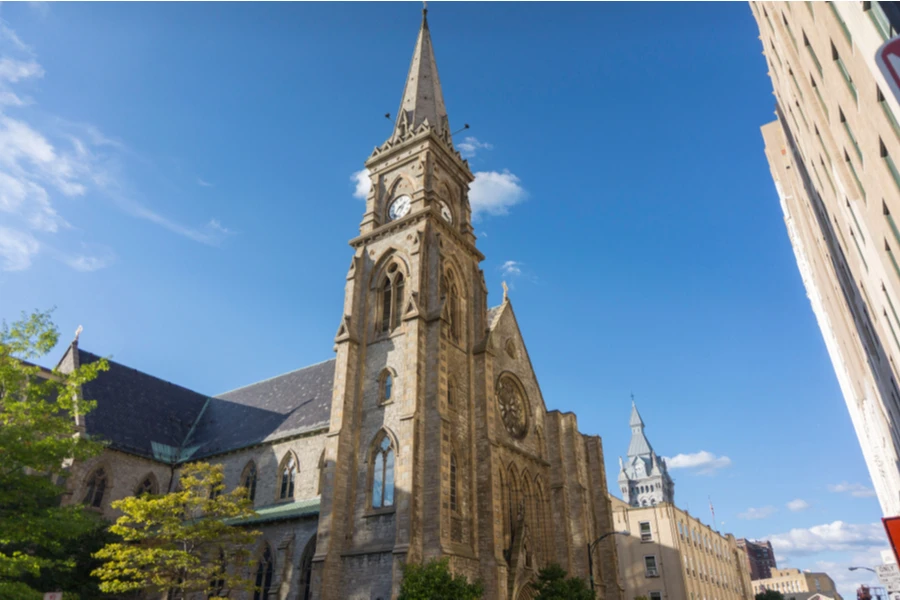 St. Joseph Cathedral, Buffalo. | Credit: CiEll/Shutterstock
 Jan 10, 2026 / 06:00 am (CNA).
Catholics in the U.S. were witness to a rare Church decision in 2023 when Pope Francis elevated the Diocese of Las Vegas to a metropolitan archdiocese. Las Vegas had previously been a suffragan diocese of San Francisco, having been created by Pope John Paul II in 1995.
A suffragan diocese operates within an ecclesiastical province subordinate to a larger archdiocese and is led by a suffragan bishop who has the authority to lead his own diocese but works under the metropolitan archbishop.
In September 2025, Pope Leo XIV created a new Catholic diocese in northern China; though it goes by the same name as one established decades ago by Beijing without Vatican approval — a product of ongoing tensions between China and the Holy See — the move demonstrated the Holy See’s authority in creating local Church jurisdictions.
Outside of one’s own parish, a diocese or archdiocese is arguably the average Catholic’s most common point of interaction with the Church. These jurisdictions manage local Church life and administration, with bishops and archbishops offering both spiritual and temporal guidance and authority to Catholics under their care.
But how does the Catholic Church decide what becomes a diocese or an archdiocese? What are the roots of this ancient practice, and how does it function today?
Exclusively a papal right
Monsignor William King, JCD, KCHS, an assistant professor at the school of canon law at The Catholic University of America, told CNA that the right to erect (or suppress) a diocese “belongs exclusively to the successor of Peter, the bishop of Rome,” that is, the pope.
“Historically, secular rulers have intruded into the process and the autonomy of the Church in this action has been hard-won,” he said, pointing out that “even today in certain parts of the world, secular or civil rulers wish to have input into matters such as this.”
The pope never makes decisions regarding dioceses and archdioceses “without considerable study and consultation,” King said.
The history of diocesan administration stretches back to the earliest years of the Church, he said. In those days a diocese consisted of “a city larger than the surrounding cities and towns,” often a place of commerce or a center of government.
Throughout the centuries, including after the imperial legalization of the Church by Constantine, Church leaders refined the diocesan structure of “pastoral ministry and governance” in order to facilitate “communication and decision-making” throughout Christendom.
“This became increasingly important as the Church grew and encountered different systems of law, philosophy, and religious practice,” King said. Roman models of government structure proved useful and sufficient for Church governance; King noted that the Church structure even today more closely resembles a government than a corporation.
The process by determining which jurisdictions counted as archdioceses likely arose in earlier centuries organically, King said, with Church leaders identifying major centers of “culture, education, commerce, government, and transportation” as particularly significant jurisdictions.
The procedure for elevating a diocese to an archdiocese, meanwhile — as Pope Francis did to Las Vegas in 2023 — requires “significant study, discussion, and decision-making,” King said.
The Holy See conducts such reviews in part through a diocese’s “quinquennial report,” a detailed rundown of the diocese’s activities and administration. Such a report may indicate to the Holy See that a particular region is growing and could benefit from elevation to an archdiocese.
Local suffragan bishops will participate in discussions to that effect, King said, and the Roman Curia will work with bishops’ conferences as well as the local apostolic nuncio.
“The ultimate decision is that of the Roman pontiff, the bishop of Rome,” King said, “but is always done with his awareness of the conversations and consultations already conducted at every level.”
The priest pointed out that not every local jurisdiction of the Church is a diocese or archdiocese. At times, he said, the pope may establish a less common ecclesiastical administration “for a variety of reasons that relate to culture, legal acceptance or opposition, small numbers, and the like.”
Such jurisdictions include apostolic prefectures, apostolic vicariates, ordinariates, and other designations. Such areas may be governed by a bishop or a priest named by the pope, King said.
Source: https://www.catholicnewsagency.com/news/268985/cna-explains-how-does-the-catholic-church-create-dioceses-and-archdioceses
Anyone can join.
Anyone can contribute.
Anyone can become informed about their world.
"United We Stand" Click Here To Create Your Personal Citizen Journalist Account Today, Be Sure To Invite Your Friends.
Before It’s News® is a community of individuals who report on what’s going on around them, from all around the world. Anyone can join. Anyone can contribute. Anyone can become informed about their world. "United We Stand" Click Here To Create Your Personal Citizen Journalist Account Today, Be Sure To Invite Your Friends.
LION'S MANE PRODUCT
Try Our Lion’s Mane WHOLE MIND Nootropic Blend 60 Capsules
Mushrooms are having a moment. One fabulous fungus in particular, lion’s mane, may help improve memory, depression and anxiety symptoms. They are also an excellent source of nutrients that show promise as a therapy for dementia, and other neurodegenerative diseases. If you’re living with anxiety or depression, you may be curious about all the therapy options out there — including the natural ones.Our Lion’s Mane WHOLE MIND Nootropic Blend has been formulated to utilize the potency of Lion’s mane but also include the benefits of four other Highly Beneficial Mushrooms. Synergistically, they work together to Build your health through improving cognitive function and immunity regardless of your age. Our Nootropic not only improves your Cognitive Function and Activates your Immune System, but it benefits growth of Essential Gut Flora, further enhancing your Vitality.

Our Formula includes: Lion’s Mane Mushrooms which Increase Brain Power through nerve growth, lessen anxiety, reduce depression, and improve concentration. Its an excellent adaptogen, promotes sleep and improves immunity. Shiitake Mushrooms which Fight cancer cells and infectious disease, boost the immune system, promotes brain function, and serves as a source of B vitamins. Maitake Mushrooms which regulate blood sugar levels of diabetics, reduce hypertension and boosts the immune system. Reishi Mushrooms which Fight inflammation, liver disease, fatigue, tumor growth and cancer. They Improve skin disorders and soothes digestive problems, stomach ulcers and leaky gut syndrome. Chaga Mushrooms which have anti-aging effects, boost immune function, improve stamina and athletic performance, even act as a natural aphrodisiac, fighting diabetes and improving liver function. Try Our Lion’s Mane WHOLE MIND Nootropic Blend 60 Capsules Today. Be 100% Satisfied or Receive a Full Money Back Guarantee. Order Yours Today by Following This Link.


| Visits: | 1,774,145,913 |
| Stories: | 8,578,581 |
Whistler Blowers, Insiders

