

A conversation with Williams College’s Darel E. Paul (Part 2 of 2)

Editorial note: this essay originally appeared at The Giving Review.
***
As the Willmott Family Third Century Professor of Political Science at Williams College in Williamstown, Mass., Darel E. Paul‘s academic research generally focuses on elite ideologies in Western countries and their manifestation in public policies. Paul has authored three books, and he writes popular commentary and analysis, including regularly for Compact and First Things, among other outlets.
Two incisive Compact pieces of Paul’s in particular have caught our Giving Review eye. Earlier this month, in “The End of ‘Minnesota Nice,’” he writes that the massive welfare-fraud scandal engulfing the state “highlights the central role that private nonprofits play in delivering public goods and services in America. The inability of the state government to prevent the fraud highlights the power that the NGO sector exercises in the contemporary Democratic Party.” The scandal “was made possible by a system of interlocking government agencies and non-governmental organizations sometimes dubbed the ‘NGO-industrial complex.’”
And in 2024, in “Why NGOs Run Your World,” Paul writes, “In today’s liberal societies, the dividing line between government and nongovernment is a thin one.” He notes that “[n]onprofits are legally required to act in a nonpartisan manner. But the relationship between the state and NGOs is inherently political” and that “[i]n the United States, the Democratic Party has found voter education, registration, and mobilization nonprofits particularly useful.
“Right-wing parties are well aware of the significant contributions NGOs make in carrying out left-wing policies. They seem to have little ability in either stopping them or in fostering their own NGOs, however,” according to Paul in the piece, and “[t]he professional class is peculiarly suited to the nonprofit sector, because it is unusually dependent on nonmarket and state-mandated market forms of revenue.”
Paul was, well, nice enough to join me for a recorded conversation last week. In the first part of our discussion, which is here, we talk about the role of nonprofits in the Minnesota scandal, in the Democratic Party, and in other progressive states and Washington, D.C. The 15-and-a-half-minute video below is the second part, during which we discuss the professional class in the nonprofit sector and what the right should consider doing in response to its activities and their effects.
Asked about the “managerial class” in the nonprofit sector, Paul modifies the term to the “professional managerial class.” “I think adding the professional part is really important because there’s a lot of people who are produced by American higher education and sent out into the workforce who are professionals,” he tells me. “They have a kind of a definition, in a sociological sense, of being professionals—highly educated, they have a lot of autonomy in their work, they tend to do a lot of kind of creative activities that they need some autonomy” and “have a career ladder that they tend to ascend.
“I think these professionals are a big part of the story,” he continues. “The professional class is large in America. It’s gotten much larger over the last generation and a lot of these people, especially as jobs tend to dry up in places like academia,” are among what is a surplus that nonprofits absorb.
“The professional class is not particularly representative” of America, according to Paul. “In fact, the data that I have accumulated and I have published in other outlets suggest that the professional class is probably the least representative class in America, certainly when we’re talking about things like race and ethnicity. It tends to be a very left-leaning class.”
Compared with the managerial class, he says,
the professional class tends to be defined much more by level of education. You find a lot more people who have master’s degrees and Ph.D.s being in the professional class. They’re often struggling against managers, who mostly are going to have B.A.s, maybe some master’s degrees, very rarely have Ph.D.s, but they’re going to be making a lot more money right on the managerial side.
There is thus a “kind of built-in tension between managers and professionals. I think there is often a lot of antagonism between those two groups,” he adds.
“Professionals are exercising power through the institutions that they control,” according to Paul. “That tends to be things like academia, tends to be things like the NGO sector, nonprofits in general, and the cultural sector, cultural industries.” There’s a “lot of professional-class power in those” institutions. “[W]hen people on the right are concerned about the power of the left in American society, they’re really thinking about institutions that the left controls, and those institutions are things like the NGO sector, academia, and the culture industries.”
Asked whether there’s a conservative professional class, including in the nonprofit sector, Paul answers in the affirmative, saying “I think that it’s been getting smaller over time, as I think the class has gotten larger,” however. He thinks “a more-positive project for the right to take on is exactly trying to expand, to try to nurture, cultivate its own professional class and to build institutions that those people can find work in.” Building “new institutions or maybe building autonomous institutions inside of pre-existing institutions, that might be a path that has some real good prospects going forward.”
Writ large, “I think that’s important right to remember that the left has been doing this for ages, right? This is nothing new. It’s not like, Oh, you know, if we play ball, they play ball, and we’ll all get along,” Paul says. “The story is probably much more about balance of power, and I think it’s probably much more about institutional autonomy, creating autonomous organizations that can survive a change of power, because the change of power will come, right?
“Certainly, there’s something important about building norms,” he concludes. “There’s been a lot of erosion of norms in America. … I think building up of some norms would be good going forward. But I think also building some autonomous centers of power is probably better.”
Source: https://capitalresearch.org/article/a-conversation-with-williams-colleges-darel-e-paul-part-2-of-2/
Anyone can join.
Anyone can contribute.
Anyone can become informed about their world.
"United We Stand" Click Here To Create Your Personal Citizen Journalist Account Today, Be Sure To Invite Your Friends.
Before It’s News® is a community of individuals who report on what’s going on around them, from all around the world. Anyone can join. Anyone can contribute. Anyone can become informed about their world. "United We Stand" Click Here To Create Your Personal Citizen Journalist Account Today, Be Sure To Invite Your Friends.
LION'S MANE PRODUCT
Try Our Lion’s Mane WHOLE MIND Nootropic Blend 60 Capsules
Mushrooms are having a moment. One fabulous fungus in particular, lion’s mane, may help improve memory, depression and anxiety symptoms. They are also an excellent source of nutrients that show promise as a therapy for dementia, and other neurodegenerative diseases. If you’re living with anxiety or depression, you may be curious about all the therapy options out there — including the natural ones.Our Lion’s Mane WHOLE MIND Nootropic Blend has been formulated to utilize the potency of Lion’s mane but also include the benefits of four other Highly Beneficial Mushrooms. Synergistically, they work together to Build your health through improving cognitive function and immunity regardless of your age. Our Nootropic not only improves your Cognitive Function and Activates your Immune System, but it benefits growth of Essential Gut Flora, further enhancing your Vitality.
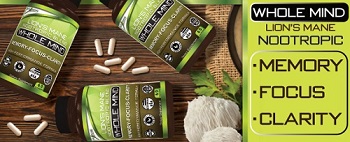
Our Formula includes: Lion’s Mane Mushrooms which Increase Brain Power through nerve growth, lessen anxiety, reduce depression, and improve concentration. Its an excellent adaptogen, promotes sleep and improves immunity. Shiitake Mushrooms which Fight cancer cells and infectious disease, boost the immune system, promotes brain function, and serves as a source of B vitamins. Maitake Mushrooms which regulate blood sugar levels of diabetics, reduce hypertension and boosts the immune system. Reishi Mushrooms which Fight inflammation, liver disease, fatigue, tumor growth and cancer. They Improve skin disorders and soothes digestive problems, stomach ulcers and leaky gut syndrome. Chaga Mushrooms which have anti-aging effects, boost immune function, improve stamina and athletic performance, even act as a natural aphrodisiac, fighting diabetes and improving liver function. Try Our Lion’s Mane WHOLE MIND Nootropic Blend 60 Capsules Today. Be 100% Satisfied or Receive a Full Money Back Guarantee. Order Yours Today by Following This Link.


| Visits: | 1,776,359,349 |
| Stories: | 8,582,924 |
Whistler Blowers, Insiders