

After New START: Indo-Pacific Alliance Modernization Is Urgent—and It Starts on the Ground in Japan and South Korea


A U.S. THAAD battery deployed in Seongju, South Korea. Credibly deterring Chinese coercion would require additional THAAD batteries integrated into a regional missile defense network. (Source: BBC)
On February 5, 2026, the New Strategic Arms Reduction (New START) Treaty will expire, ending the last legally binding limits on U.S. and Russian strategic nuclear forces. With it goes a framework that capped deployed warheads at 1,550 and delivery vehicles at 700—and, more importantly, the verification regime that anchored strategic stability for over a decade. Russia’s 2022 suspension, followed by repeated violations ranging from INF-style prohibited systems to novel delivery vehicles like the nuclear-powered Burevestnik missile, made renewal politically and strategically untenable. China, never a party to New START, has exploited this vacuum, accelerating a nuclear buildup from roughly 500 warheads in 2025 toward an estimated 1,500 by 2035.
The United States now confronts, for the first time, two near-peer nuclear competitors simultaneously; thus Washington’s response—preparing for nuclear “uploads” and reinforcing the credibility of the strategic triad—is necessary yet insufficient. Without ceilings on strategic arsenals, stability will increasingly hinge on whether escalation can be managed below the nuclear threshold, thereby making conventional deterrence in the Indo-Pacific—especially land-based missile defense and forward-deployed resilience—decisive. Yet this task cannot be carried by the United States alone. Allied burden‑sharing—particularly through alliance modernization that builds interoperable Command, Control, Communications, Computers, Intelligence, Surveillance, and Reconnaissance (C4ISR) networks atop ground‑based air and missile defense systems—is no longer optional; it is a prerequisite for credible integrated deterrence in the post–New START era, and a pathway toward a Pacific architecture deliberately designed to blunt Chinese coercion—modular, mobile, and resilient enough to deny Beijing the ability to localize risk or exploit allied hesitation, while pairing denial with calibrated punishment across cyber, space, and information domains to impose costs for grey‑zone aggression without crossing nuclear thresholds.
Strategic Unraveling: A Triangular Arms Race Begins
With New START gone, an unconstrained triangular arms race is already underway. Russia has modernized roughly 90 percent of its nuclear triad and can sustain a deployed arsenal near former treaty limits while diversifying delivery systems. China, meanwhile, represents the more destabilizing variable. It is constructing hundreds of new missile silos, deploying DF-41 intercontinental ballistic missiles, expanding dual-capable DF-26 systems, and fielding hypersonic glide vehicles designed to compress U.S. decision time and overwhelm regional defenses.
According to an Atlantic Council expert, U.S. strategy must adapt to this new reality: in the short term, Washington should upload additional warheads onto Ohio-class SSBNs, reintroduce multiple independently targetable reentry vehicles (MIRVs) on portions of the Minuteman III force, and deploy the Long-Range Stand-Off (LRSO) weapon aboard B-52 bombers to restore counterforce leverage against two near-peer competitors simultaneously; in the medium term, rely on the Columbia-class SSBN, B-21 Raider bomber, and nuclear-armed sea-launched cruise missile (SLCM-N) to ensure the strategic triad’s survivability and credibility through the 2040s; and diplomatically, keep trilateral arms-control talks viable while investing in NC3 resilience and missile-defense architectures, including exploratory concepts like a continental “Golden Dome.”
The costs of adapting to the post–New START environment, however, are staggering. Congressional Budget Office estimates place U.S. nuclear modernization at roughly $946 billion by the mid‑2030s. Yet nuclear spending alone cannot manage escalation. INDOPACOM still faces an estimated $27 billion shortfall in conventional capabilities—especially missile defense, strike, and sustainment—leaving U.S. forces exposed in the opening phases of a crisis. Without resilient conventional forces, nuclear investments risk becoming instruments of last resort rather than tools of stability.
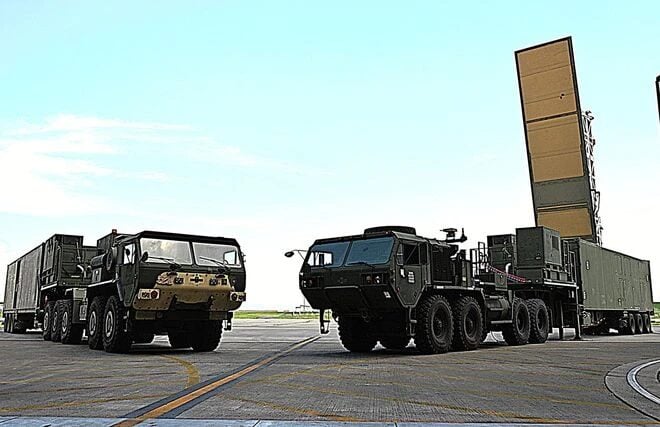
U.S. Typhon MRC (ground-launched SM-6/Tomahawk system for 1,500km precision strikes) launcher and C2 vehicle at Marine Corps Air Station (MCAS) Iwakuni, Sept. 15, 2025 (Source: Asahi Shimbun).
The Indo-Pacific Front: Why Alliance Modernization—Especially Conventional Forces—Anchors Stability
Indo-Pacific allies routinely affirm their commitment to a “free and open Indo-Pacific,” yet capability gaps remain stark. Japan’s planned increase to 2 percent of GDP by 2027 masks persistent delays in force integration and C4ISR interoperability—revealing structural gaps that hardware spending alone cannot bridge. South Korea spends roughly 2.7 percent of GDP on defense, but much of that investment remains concentrated on peninsula-specific contingencies rather than scalable regional stabilization.
In the post–New START environment, burden-sharing defined merely as cost-sharing is no longer sufficient. What deterrence now requires is shared risk and shared resolve: allied decisions that visibly place national territory, forces, and political capital inside the same escalation ladder faced by the United States. Ground-based deployments, forward rotations, and interoperable data fabrics that turn disparate sensors into unified battle management matter precisely—converting alliances from siloed hardware buyers into networked deterrence partners.
This logic aligns with a growing body of strategic scholarship, most notably the work of James Fearon and Andrew Lim. They argue that the erosion of U.S. conventional superiority—driven by China’s A2/AD architectures and Russia’s precision-strike capabilities—has produced a destabilizing overreliance on nuclear deterrence. Their core claim, however, is not that nuclear forces have become obsolete, but rather that strategic stability increasingly depends on restoring a software-orchestrated conventional triad in which penetrating strike platforms, precision fires, and mobile retaliation function as intelligent nodes within JADC2-enabled data ecosystems. Within this framework, missile defense should not be understood as a standalone pillar of deterrence but as a survivability enabler—a means of preserving offensive forces long enough to execute credible second-strike conventional operations.
Building on this strategic imperative to reinforce the conventional triad, alliance modernization in Northeast Asia could acquire tangible form. Enhanced trilateral coordination among the United States, South Korea, and Japan would allow THAAD and SPY-7 sensors to feed advanced data-fusion layers into Typhon and HIMARS effectors, thereby transforming missile defense from a purely protective measure into the foundation of software-defined second-strike precision.
In December 2025, U.S. M270A2 MLRS units stationed at Camp Casey demonstrated rapid counterfire against DPRK artillery, while HIMARS rotations from Okinawa maintained continuous availability. Yet such precision fires are credible only insofar as their survivability is assured by layered defenses, since DPRK missiles or Chinese DF-26 strikes could saturate critical hubs—such as Pyeongtaek—thereby degrading the very conventional triad Fearon and Lim prescribe. To function as a true survivability enabler against high-altitude threats, therefore, South Korea’s single THAAD battery—deployed in 2017—must be augmented through PAC-3 integration, ensuring that HIMARS forces remain preserved for follow-on strikes.
Such augmentation, however, cannot occur in isolation. Effective trilateral cooperation requires orchestration through federated C4ISR networks, complemented by Japanese contributions. In this regard, Typhon basing on Japanese territory completes the Fearon–Lim precision‑strike leg. Despite the withdrawal from Iwakuni and persistent political opposition in Okinawa, the system remains central to the trilateral alliance’s mid‑range strike capability, particularly when reinforced by Tokyo’s mobile SPY‑7 radars paired with SM‑3 Block IIA interceptors—introduced after Japan’s 2020 pivot from the canceled Aegis Ashore program—which add agile command‑and‑control enablers to the overall architecture.
The resulting theater sequence is coherent and continuous: SPY-7 tracks Chinese launches, Korean THAAD defends critical bases, HIMARS suppresses transporter-erector-launchers, Type-12 missiles secure the littorals, and Typhon targets Shanghai–Beijing command-and-control nodes—all unified through software-defined battle management.
Source: https://foreignpolicyblogs.com/2026/01/26/after-new-start-indo-pacific-alliance-modernization-is-urgent-and-it-starts-on-the-ground-in-japan-and-south-korea/
Anyone can join.
Anyone can contribute.
Anyone can become informed about their world.
"United We Stand" Click Here To Create Your Personal Citizen Journalist Account Today, Be Sure To Invite Your Friends.
Before It’s News® is a community of individuals who report on what’s going on around them, from all around the world. Anyone can join. Anyone can contribute. Anyone can become informed about their world. "United We Stand" Click Here To Create Your Personal Citizen Journalist Account Today, Be Sure To Invite Your Friends.
LION'S MANE PRODUCT
Try Our Lion’s Mane WHOLE MIND Nootropic Blend 60 Capsules
Mushrooms are having a moment. One fabulous fungus in particular, lion’s mane, may help improve memory, depression and anxiety symptoms. They are also an excellent source of nutrients that show promise as a therapy for dementia, and other neurodegenerative diseases. If you’re living with anxiety or depression, you may be curious about all the therapy options out there — including the natural ones.Our Lion’s Mane WHOLE MIND Nootropic Blend has been formulated to utilize the potency of Lion’s mane but also include the benefits of four other Highly Beneficial Mushrooms. Synergistically, they work together to Build your health through improving cognitive function and immunity regardless of your age. Our Nootropic not only improves your Cognitive Function and Activates your Immune System, but it benefits growth of Essential Gut Flora, further enhancing your Vitality.

Our Formula includes: Lion’s Mane Mushrooms which Increase Brain Power through nerve growth, lessen anxiety, reduce depression, and improve concentration. Its an excellent adaptogen, promotes sleep and improves immunity. Shiitake Mushrooms which Fight cancer cells and infectious disease, boost the immune system, promotes brain function, and serves as a source of B vitamins. Maitake Mushrooms which regulate blood sugar levels of diabetics, reduce hypertension and boosts the immune system. Reishi Mushrooms which Fight inflammation, liver disease, fatigue, tumor growth and cancer. They Improve skin disorders and soothes digestive problems, stomach ulcers and leaky gut syndrome. Chaga Mushrooms which have anti-aging effects, boost immune function, improve stamina and athletic performance, even act as a natural aphrodisiac, fighting diabetes and improving liver function. Try Our Lion’s Mane WHOLE MIND Nootropic Blend 60 Capsules Today. Be 100% Satisfied or Receive a Full Money Back Guarantee. Order Yours Today by Following This Link.


| Visits: | 1,781,389,730 |
| Stories: | 8,592,082 |
Whistler Blowers, Insiders

