

A New Supreme Court Case Tests the Limits of Judicial Deference to Federal Agencies


The U.S. Supreme Court is scheduled to hear oral arguments today in an important case that asks how much judicial deference is owed to the U.S. Sentencing Commission’s commentary on the federal sentencing guidelines when a judge is applying those guidelines during the sentencing of a federal criminal defendant. That may sound like a somewhat dry legal dispute, but the ramifications are big not only in the realm of criminal law, but also for the broader legal battle over statutory interpretation, the role of the courts, and the authority of those federal agencies that some critics have called “the administrative state.”
The case is Beaird v. United States. Kendrick Jarrell Beaird was arrested for pointing a gun at someone and, because he had a prior felony record, was convicted as a felon in possession of a firearm. Under the federal sentencing guidelines, Beaird faced an even higher sentence if the firearm “involved…is capable of accepting a large capacity magazine.” His gun’s magazine was capable of holding 17 rounds. Did that count as large capacity and thus trigger a higher sentence? The federal sentencing guidelines did not directly say, but the U.S. Sentencing Commission’s commentary on the guidelines did: According to the commentary, a magazine capable of accepting “more than 15 rounds of ammunition” counts as large capacity.
Are the federal courts bound to follow the Sentencing Commission’s commentary in a case like this and dutifully impose a steeper sentence? Or may the courts impose a lower sentence based on their own alternate view of the best reading of the text of the sentencing guidelines?
In Stinson v. United States (1993), the Supreme Court held that the commentary to the federal sentencing guidelines is entitled to major deference from the courts. “We decide that commentary in the Guidelines Manual that interprets or explains a guideline is authoritative,” the Court said, “unless it violates the Constitution or a federal statute, or is inconsistent with, or a plainly erroneous reading of, that guideline.”
Among the questions at issue in today’s oral arguments in Beaird is “whether Stinson v. United States still accurately state[s] the level of deference due to the Commentary of the Federal Sentencing Guidelines.” In other words, should there be cases in which a judge’s alternate reading may trump the interpretation favored by the commission’s commentary?
Those questions alone make this a notable case. But this particular dispute also arrives in the midst of a broader, ongoing battle over judicial deference to the authority of federal regulatory agencies. For instance, in Kisor v. Wilkie (2019), the Supreme Court narrowly upheld a precedent which said that a federal agency’s interpretation of its own “ambiguous” rule is entitled to broad judicial deference unless the agency’s interpretation is “plainly erroneous or inconsistent with the regulations being interpreted.”
Justice Elena Kagan’s 5–4 majority opinion in Kisor v. Wilkie justified this holding on the grounds that the Court’s deferential doctrine “enables the agency to fill out the regulatory scheme Congress has placed under its supervision.”
Writing in dissent, Justice Neil Gorsuch faulted this approach for requiring judges “to accept an executive agency’s interpretation of its own regulations even when that interpretation doesn’t represent the best and fairest reading.” That sort of deference, Gorsuch argued, “creates a ‘systematic judicial bias in favor of the federal government, the most powerful of parties, and against everyone else.’”
This Kagan-Gorsuch clash of legal visions is likely to arise again in the Beaird case. Whether or not Kagan’s pro-deference view will still command the majority, however, remains to be seen.
The post A New Supreme Court Case Tests the Limits of Judicial Deference to Federal Agencies appeared first on Reason Magazine.
Source: https://reason.com/2026/10/13/a-new-supreme-court-case-tests-the-limits-of-judicial-deference-to-federal-agencies/
Anyone can join.
Anyone can contribute.
Anyone can become informed about their world.
"United We Stand" Click Here To Create Your Personal Citizen Journalist Account Today, Be Sure To Invite Your Friends.
Before It’s News® is a community of individuals who report on what’s going on around them, from all around the world. Anyone can join. Anyone can contribute. Anyone can become informed about their world. "United We Stand" Click Here To Create Your Personal Citizen Journalist Account Today, Be Sure To Invite Your Friends.
LION'S MANE PRODUCT
Try Our Lion’s Mane WHOLE MIND Nootropic Blend 60 Capsules
Mushrooms are having a moment. One fabulous fungus in particular, lion’s mane, may help improve memory, depression and anxiety symptoms. They are also an excellent source of nutrients that show promise as a therapy for dementia, and other neurodegenerative diseases. If you’re living with anxiety or depression, you may be curious about all the therapy options out there — including the natural ones.Our Lion’s Mane WHOLE MIND Nootropic Blend has been formulated to utilize the potency of Lion’s mane but also include the benefits of four other Highly Beneficial Mushrooms. Synergistically, they work together to Build your health through improving cognitive function and immunity regardless of your age. Our Nootropic not only improves your Cognitive Function and Activates your Immune System, but it benefits growth of Essential Gut Flora, further enhancing your Vitality.
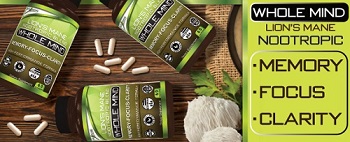
Our Formula includes: Lion’s Mane Mushrooms which Increase Brain Power through nerve growth, lessen anxiety, reduce depression, and improve concentration. Its an excellent adaptogen, promotes sleep and improves immunity. Shiitake Mushrooms which Fight cancer cells and infectious disease, boost the immune system, promotes brain function, and serves as a source of B vitamins. Maitake Mushrooms which regulate blood sugar levels of diabetics, reduce hypertension and boosts the immune system. Reishi Mushrooms which Fight inflammation, liver disease, fatigue, tumor growth and cancer. They Improve skin disorders and soothes digestive problems, stomach ulcers and leaky gut syndrome. Chaga Mushrooms which have anti-aging effects, boost immune function, improve stamina and athletic performance, even act as a natural aphrodisiac, fighting diabetes and improving liver function. Try Our Lion’s Mane WHOLE MIND Nootropic Blend 60 Capsules Today. Be 100% Satisfied or Receive a Full Money Back Guarantee. Order Yours Today by Following This Link.


| Visits: | 1,834,774,905 |
| Stories: | 8,720,034 |
Whistler Blowers, Insiders

