

While losing 34% of its students, LAUSD’s spending on compensation increased by $1.7 billion

Los Angeles Unified School District’s recent labor agreements with United Teachers Los Angeles and other unions were hailed as a win for teachers, administrators, and service employees. But the district, which spends more money than it gets each year and is losing students, doesn’t have the funds to pay for it.
This isn’t for lack of funding: from 2002 to 2023, California led the nation in K-12 spending growth. The most recent federal data shows LAUSD spent nearly $27,000 per student in 2023. So why does the nation’s second-largest public school district have a billion-dollar structural budget deficit?
Analysis of data from California’s State Controller’s Office, which publishes employee-level payroll data for public school districts, counties, cities, and other government entities, shines a light on the causes of LAUSD’s structural deficit and how to fix it.
This analysis starts with an overview of our methodology, presents key findings, and discusses implications for LAUSD and state policymakers.
Methodology
We obtained all 11 years of LAUSD compensation data available from the California State Controller’s Office website, sorted job titles into 19 categories, and calculated inflation-adjusted spending on each category.
While LAUSD spending figures are available elsewhere, this data allows for greater nuance in evaluating compensation trends. However, it also has limitations. Because the dataset doesn’t distinguish between part-time and full-time employees, we do not report employee counts. And, because some job titles are vague and their categories can’t be confirmed, all figures presented are estimates.
This analysis evaluates trends from the district’s 2013 fiscal year to fiscal year 2023, the first and most recent year for which data are available. For context, LAUSD enrollment fell by 34.7% during this time, going from 655,455 students to 427,795 according to the National Center for Education Statistics.
Key findings
The data provide insights into LAUSD’s compensation spending, employee wages, and employee benefits spending.
Compensation spending growth by job category
Despite falling enrollment, LAUSD’s inflation-adjusted expenditure on employee compensation—including salaries, benefits, and other wages— grew by about $1.7 billion or 27% as shown in Figure 1. In comparison, total dollars going to teachers rose by only $85.4 million, as their share of employee compensation fell from 51.8% to 41.8%. LAUSD spent more on employees, but the new dollars went disproportionately to non-teaching staff.
Figure 1: Estimated Compensation Growth by Job Category
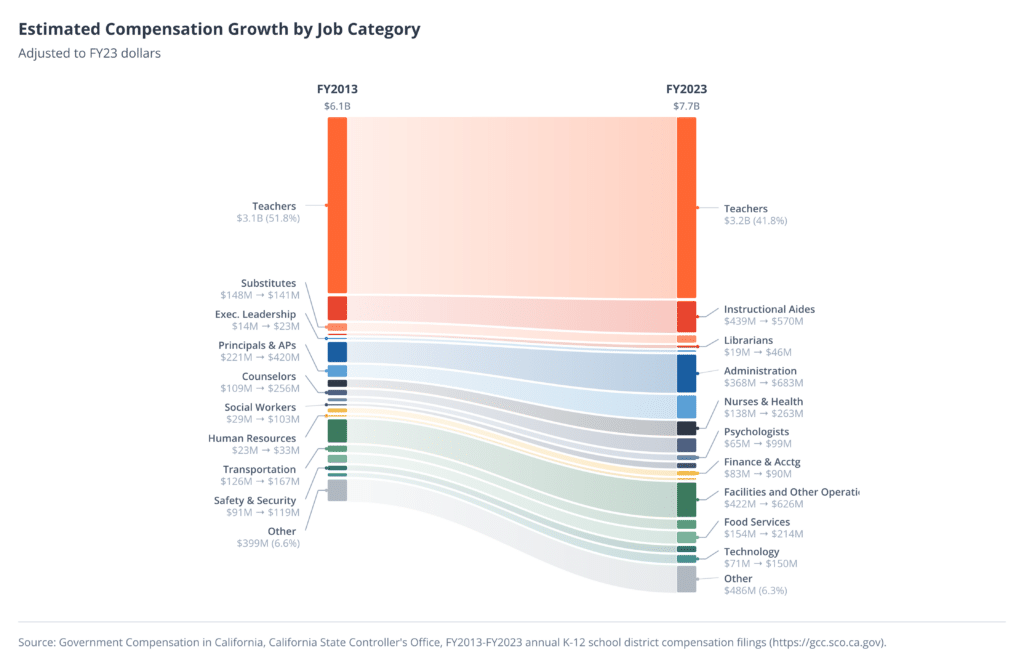
The largest increase in compensation spending, about $315 million, went to administrative positions. Inflation-adjusted spending on administration grew from $368.2 million in fiscal year 2013 (FY13) to $683.4 million in fiscal year 2023 (FY23). This includes both central office and school staff with a broad range of responsibilities, including state accountability, special education, compliance, grants, instructional oversight, and other duties. Overall, 1,568 administrative positions earned wages exceeding $100,000, while 541 had wages exceeding $150,000.
Compensation for facilities staff, which includes job titles such as maintenance manager, landscape architect, facilities project manager, and building engineer, had the next-highest growth from FY13 to FY23, rising by about $203 million in total. Spending on principals and assistant principals rose by a similar amount, about $199 million.
The fourth-highest growth category was counselors, which increased by $148 million. When combined with other student support roles such as nurses ($124 million), social workers ($74 million), and psychologists ($34 million), these four categories accounted for $380 million in spending growth or more than one-fifth of all growth during this period. Also notable was the rise of about $131 million in spending on instructional aides, who often have duties related to special education.
Highest wages by job category
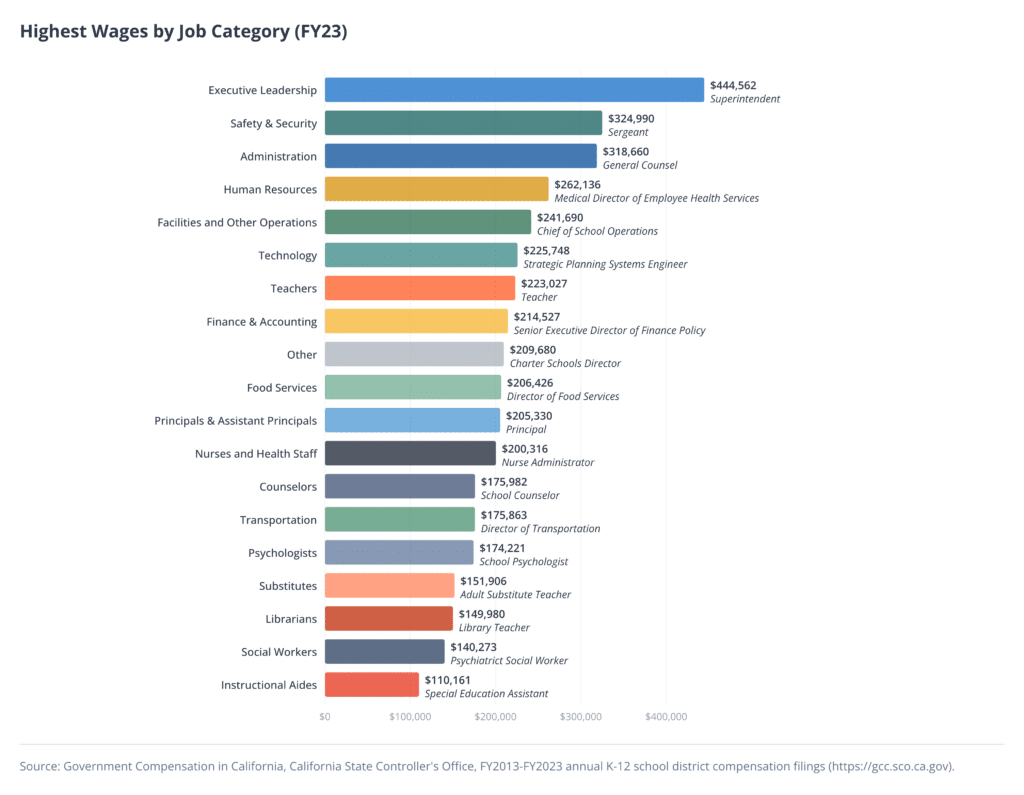
The data published by California’s State Controller’s Office includes salary, benefits, and other wages for all LAUSD employees. Due to data constraints, it’s not possible to accurately report average salaries. However, Figure 2 shows the highest reported wage for each job category in FY23. These figures, which include salaries and other pay but not benefits, provide insight into the earnings of key LAUSD employees.
LAUSD’s superintendent tops the wages list at $444,562 per year in 2023, with a sergeant making $324,990 in 2023, general counsel receiving $318,660, and the medical director of employee health services being paid $262,136 a year and also standing out as the highest earners in their respective job categories.
The top-paid teacher in LAUSD earned $223,027 in total wages in 2023, and the highest-paid principal earned $205,330. Other key positions include the highest-paid counselor, paid $175,982 in 2023, a psychologist paid $174,221, and a social worker taking home $140,273.
In total, over 23,500 LAUSD employees made at least $100,000 in 2023, and more than 2,000 earned at least $150,000.
Figure 2: Highest Wages by Job Category (FY23)
Spending on employee benefits
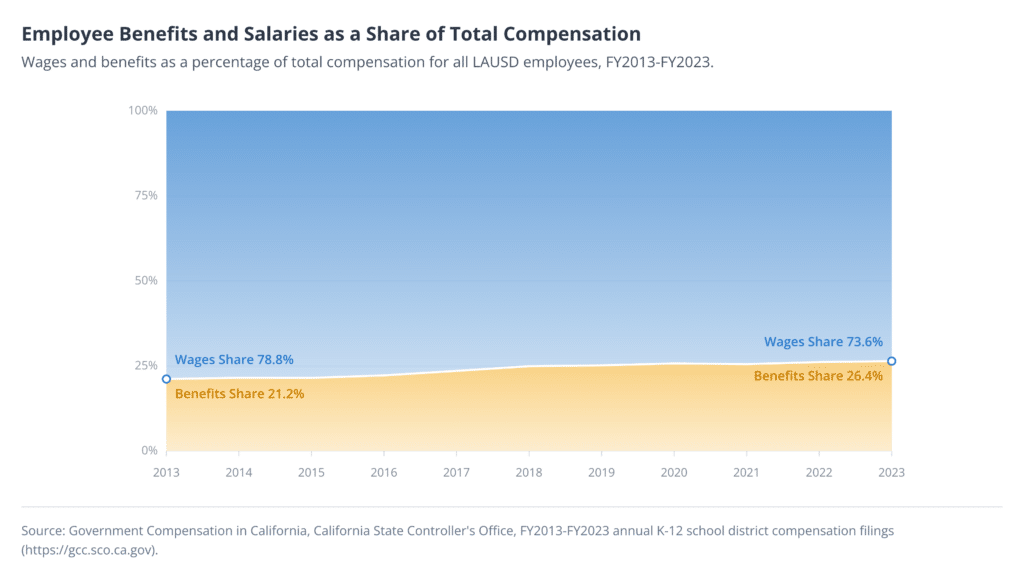
Employee benefit costs—which include pension contributions and health insurance—are becoming increasingly expensive for LAUSD. Between 2013 and 2023, the district’s inflation-adjusted annual benefit spending increased by $756 million—or 59%—as benefits consumed a larger share of total compensation, rising from 21.2% to 26.4% as shown in Figure 3.
Figure 3: Employee Benefits and Salaries as a Share of Total Compensation (FY13-FY23)
Shifts in the compensation structure can affect employees’ take-home pay and school district costs. To illustrate, consider two actual LAUSD employees who earned similar inflation-adjusted wages in FY13 and FY23, as shown in Table 1. While the employee in 2013 cost $132,987 in total compensation, the employee in 2023 cost $153,802—about 16% more in additional compensation. Paying an employee the same inflation-adjusted salary costs more money than it used to due to rising benefit costs.
Table 1: Comparing LAUSD employees with similar wages over time
| Year | Wages | Benefits | Total Compensation |
| 2013 | $109,999 | $22,988 | $132,987 |
| 2023 | $109,526 | $44,276 | $153,802 |
Discussion
There are a few key takeaways from the data. First, LAUSD’s compensation spending grew dramatically in relation to student enrollment. Between FY13 and FY23, enrollment fell by 227,660 students, a 34.7% decline, but total spending on school district employees rose by $1.7 billion after adjusting for inflation.
With its high costs and declining enrollment, LAUSD has too many employees. The district is projecting budget deficits of $1.3 billion in FY26 and $1.5 billion in FY27.
In recent years, an influx of federal and state funds has helped plug its budget holes, but with federal pandemic relief funding having expired—and California’s fiscal outlook on shaky ground—it’s likely LAUSD will have to make substantial workforce reductions in the coming years.
LAUSD’s recent labor agreements with United Teachers Los Angeles (UTLA) and other unions will make its fiscal situation even worse. The deals, which include a 12% average salary bump for teachers and administrators, a 24% wage increase for service employees, plus hundreds of new support staff, are estimated to cost the district an extra $1.2 billion each year—money the district is hoping will come from the state.
Next, LAUSD has chosen to prioritize large investments in non-teaching staff over boosting teacher pay. Only 5% of the $1.7 billion rise in compensation spending since 2013 went to teachers.
To be sure, some staffing decisions are driven by external policies rather than internal priorities. For instance, a rise in special education diagnoses or services—which are influenced by federal laws—might have contributed to spending increases on administration, instructional aides, and other positions.
But it’s also clear that LAUSD shifted its spending priorities.
One example is LAUSD’s growing investments in its “whole child” strategy. Rather than focusing on core academics such as math, science, and reading, the district has expanded its responsibilities to include things like mental health, medical care, and other social services.
This is why spending on student support staff, such as counselors (up 135%), social workers (256%), and nurses and other health staff (90%), has grown dramatically, while spending growth on teachers was modest. These employees typically don’t earn nearly as much as executive leadership or other district leaders, but the top wages shown in Figure 2 indicate they can earn more than many of the district’s teachers.
The effectiveness of LAUSD’s whole child strategy can be debated, but it’s clearly at odds with boosting teacher salaries if that’s a primary policy goal for the district.
Finally, benefit spending, driven largely by unfunded pension liabilities, is consuming an increasingly large share of employee compensation. For years, California has underfunded its pension promises to teachers, and now the bill is coming due.
In FY23, LAUSD’s net pension liability was over $6.7 billion—or $15,733 per student—according to Reason Foundation’s State and Local Government Finance Report. As a result, portions of district and employee retirement contributions are being used to cover past obligations rather than funding benefits for current teachers.
This means that, even though benefit spending is up, teachers aren’t necessarily getting better retirement benefits. Pension debt will continue to drain resources from LAUSD’s budget and teacher paychecks unless the state takes steps toward greater solvency.
Conclusion
Publicly reported data from California’s State Controller’s Office and the National Center for Education Statistics indicate that LAUSD’s billion-dollar budget deficit is caused by a combination of rising payroll spending, declining student enrollment, mission drift, and teacher pension debt.
With the district expected to continue losing students and pension costs rising, LAUSD’s new collective bargaining commitments worsen its financial position, and the district will likely have to make significant reductions in staff size and payroll in the coming years.
The post While losing 34% of its students, LAUSD’s spending on compensation increased by $1.7 billion appeared first on Reason Foundation.
Source: https://reason.org/commentary/losing-students-lausd-spending-compensation-increase/
Anyone can join.
Anyone can contribute.
Anyone can become informed about their world.
"United We Stand" Click Here To Create Your Personal Citizen Journalist Account Today, Be Sure To Invite Your Friends.
Before It’s News® is a community of individuals who report on what’s going on around them, from all around the world. Anyone can join. Anyone can contribute. Anyone can become informed about their world. "United We Stand" Click Here To Create Your Personal Citizen Journalist Account Today, Be Sure To Invite Your Friends.
LION'S MANE PRODUCT
Try Our Lion’s Mane WHOLE MIND Nootropic Blend 60 Capsules
Mushrooms are having a moment. One fabulous fungus in particular, lion’s mane, may help improve memory, depression and anxiety symptoms. They are also an excellent source of nutrients that show promise as a therapy for dementia, and other neurodegenerative diseases. If you’re living with anxiety or depression, you may be curious about all the therapy options out there — including the natural ones.Our Lion’s Mane WHOLE MIND Nootropic Blend has been formulated to utilize the potency of Lion’s mane but also include the benefits of four other Highly Beneficial Mushrooms. Synergistically, they work together to Build your health through improving cognitive function and immunity regardless of your age. Our Nootropic not only improves your Cognitive Function and Activates your Immune System, but it benefits growth of Essential Gut Flora, further enhancing your Vitality.

Our Formula includes: Lion’s Mane Mushrooms which Increase Brain Power through nerve growth, lessen anxiety, reduce depression, and improve concentration. Its an excellent adaptogen, promotes sleep and improves immunity. Shiitake Mushrooms which Fight cancer cells and infectious disease, boost the immune system, promotes brain function, and serves as a source of B vitamins. Maitake Mushrooms which regulate blood sugar levels of diabetics, reduce hypertension and boosts the immune system. Reishi Mushrooms which Fight inflammation, liver disease, fatigue, tumor growth and cancer. They Improve skin disorders and soothes digestive problems, stomach ulcers and leaky gut syndrome. Chaga Mushrooms which have anti-aging effects, boost immune function, improve stamina and athletic performance, even act as a natural aphrodisiac, fighting diabetes and improving liver function. Try Our Lion’s Mane WHOLE MIND Nootropic Blend 60 Capsules Today. Be 100% Satisfied or Receive a Full Money Back Guarantee. Order Yours Today by Following This Link.


| Visits: | 1,814,546,916 |
| Stories: | 8,659,285 |
Whistler Blowers, Insiders

