

The Trump Administration Wants More Tariffs To Combat 'Structural Excess Capacity.' Here's What That Means.


Every year, there are many more airplanes manufactured in the United States than the country’s domestic airlines can use.
This is a rather straightforward fact, but it has some important ramifications for the Trump administration’s trade policies, so bear with me for a moment. During 2025, for example, Boeing churned out 600 commercial airliners from its assembly facilities in Washington state and South Carolina. Many of those planes were sold to foreign airlines and exported.
Last year was no outlier: The U.S. routinely exports billions of dollars worth of commercial aircraft and airplane equipment. We make more than we can consume, and we sell the rest to businesses in other countries. This excess manufacturing is not a problem. On the contrary, this is tremendous news for the workers at Boeing and for the company’s shareholders. It’s also great for those foreign buyers—airlines can purchase Boeing planes without first needing to develop a local airliner-production industry.
On the other hand, if America were limited to producing only as many airplanes as it could consume domestically, Boeing’s workers would have less to do, make fewer sales, and probably earn lower pay. Boeing’s shareholders and those foreign airlines would be worse off too. Everyone involved would be poorer.
But the same excess manufacturing capacity that makes Boeing a global leader in airplane production is now becoming a boogeyman for the Trump administration—at least when it is businesses in other countries that are doing it.
“Across numerous sectors, many U.S. trading partners are producing more goods than they can consume domestically,” said U.S. Trade Representative Jamieson Greer in March as the Trump administration launched its latest effort to slap new tariffs on trading partners. “This overproduction displaces existing U.S. domestic production or prevents investment and expansion in U.S. manufacturing production that otherwise would have been brought online.”
As Greer’s office draws up a formal report outlining that supposed threat, he continues highlighting it. In an interview with CNBC earlier this month, Greer listed “structural excess capacity” as one of the supposedly “unfair trading practices” that the Trump administration plans to target with a new wave of tariffs later this year.
This is not merely some rhetorical point—it is one of the two main avenues by which the Trump administration is aiming to rebuild the tariff regime that was largely struck down by the Supreme Court in February. (The other is an investigation into countries that use slave labor or trade with countries that do.)
Unlike the earlier tariffs, which relied on a breathtaking (and illegal) expansion of executive emergency powers, the new approach seems to be on questionable but slightly more solid legal footing. Under Section 301 of the Trade Act of 1974, the president is allowed to authorize tariffs targeting specific products in response to “unjustifiable, unreasonable, or discriminatory foreign government practices.”
But does “excess industrial capacity” count as an unfair trading practice? Despite Greer’s attempt to make it sound like a serious threat, Americans should be skeptical. The fact that Boeing produces more planes than American airlines can use doesn’t mean it is unfairly taking advantage of the rest of the world. The same is true when the trade flows are reversed.
There are numerous other examples. The U.S. is one of the world’s leading producers and exporters of cotton. We grow much more cotton than our domestic industries can use. Should American farmers have to grow less cotton so they aren’t unfairly displacing cotton production in the rest of the world? Of course not.
Likewise, U.S. exports of telecommunications, computer, and information services exceeded imports by 25 percent last year, notes Debbie Jennings, a senior policy manager at the National Taxpayers Union Foundation. “Policymakers in Washington, DC, should not inadvertently encourage foreign governments to adopt the view that trade surpluses justify harsh restrictions on U.S. services providers,” she writes.
Part of the argument here is that other governments—most significantly, China—are subsidizing industries in ways that encourage the excess production in the first place.
And, yeah, that’s probably true. So that means the U.S. government will stop subsidizing Boeing, right?
This whole effort seems like little more than an attempt to translate worries about trade deficits into policy. It is impossible for every country on the planet to produce exactly as much cotton or consumer electronics or steel as it will consume in its domestic industries—but that’s what Greer and the Trump administration seem to want.
“If trade surpluses become evidence of unfair trade, the U.S. will be attempting something unprecedented: using tariffs to punish other countries simply for selling goods the rest of the world wants to buy,” argued a trio of Georgetown professors in a March op-ed in The Hill, shortly after Greer announced the Section 301 investigations.
“The new investigation treats large or persistent trade surpluses as evidence of ‘structural excess capacity,’” they noted. “Worse, the notice uses such vague language and loose economic reasoning that almost any country could be found guilty of ‘structural overcapacity.’”
We’ll have more information once Greer’s office completes its investigations and makes a formal report outlining plans for tariffs. But the fact that this process is playing out in a procedural, bureaucratic way—as opposed to the haphazard tariffs that Trump had previously deployed—should not obscure the fundamentally unserious argument at the heart of it.
When businesses based in foreign countries sell their excess production to businesses and consumers in the United States, that’s not proof of a dark conspiracy to undermine American manufacturing. It is no different than what Boeing is doing when it builds more planes than Americans can use, or when cotton farmers export their supply.
Once again, the Trump administration seems to be demonstrating how little it understands about the global trading system it wants to control.
The post The Trump Administration Wants More Tariffs To Combat ‘Structural Excess Capacity.’ Here’s What That Means. appeared first on Reason.com.
Source: https://reason.com/2026/06/16/the-trump-administration-wants-more-tariffs-to-combat-structural-excess-capacity-heres-what-that-means/
Anyone can join.
Anyone can contribute.
Anyone can become informed about their world.
"United We Stand" Click Here To Create Your Personal Citizen Journalist Account Today, Be Sure To Invite Your Friends.
Before It’s News® is a community of individuals who report on what’s going on around them, from all around the world. Anyone can join. Anyone can contribute. Anyone can become informed about their world. "United We Stand" Click Here To Create Your Personal Citizen Journalist Account Today, Be Sure To Invite Your Friends.
LION'S MANE PRODUCT
Try Our Lion’s Mane WHOLE MIND Nootropic Blend 60 Capsules
Mushrooms are having a moment. One fabulous fungus in particular, lion’s mane, may help improve memory, depression and anxiety symptoms. They are also an excellent source of nutrients that show promise as a therapy for dementia, and other neurodegenerative diseases. If you’re living with anxiety or depression, you may be curious about all the therapy options out there — including the natural ones.Our Lion’s Mane WHOLE MIND Nootropic Blend has been formulated to utilize the potency of Lion’s mane but also include the benefits of four other Highly Beneficial Mushrooms. Synergistically, they work together to Build your health through improving cognitive function and immunity regardless of your age. Our Nootropic not only improves your Cognitive Function and Activates your Immune System, but it benefits growth of Essential Gut Flora, further enhancing your Vitality.
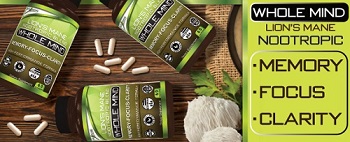
Our Formula includes: Lion’s Mane Mushrooms which Increase Brain Power through nerve growth, lessen anxiety, reduce depression, and improve concentration. Its an excellent adaptogen, promotes sleep and improves immunity. Shiitake Mushrooms which Fight cancer cells and infectious disease, boost the immune system, promotes brain function, and serves as a source of B vitamins. Maitake Mushrooms which regulate blood sugar levels of diabetics, reduce hypertension and boosts the immune system. Reishi Mushrooms which Fight inflammation, liver disease, fatigue, tumor growth and cancer. They Improve skin disorders and soothes digestive problems, stomach ulcers and leaky gut syndrome. Chaga Mushrooms which have anti-aging effects, boost immune function, improve stamina and athletic performance, even act as a natural aphrodisiac, fighting diabetes and improving liver function. Try Our Lion’s Mane WHOLE MIND Nootropic Blend 60 Capsules Today. Be 100% Satisfied or Receive a Full Money Back Guarantee. Order Yours Today by Following This Link.


| Visits: | 1,814,546,916 |
| Stories: | 8,659,285 |
Whistler Blowers, Insiders

