

Fifth Circuit Strikes Down Federal Law Banning Home Alcohol Distilleries

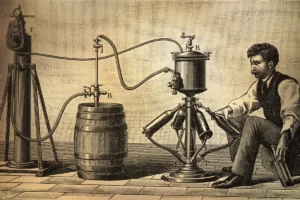
Yesterday, in McNutt v. US Department of Justice, the US Court of Appeals for the Fifth Circuit struck down an 1868 federal law banning home alcohol distilleries. The court ruled that the law exceeded Congress’ authority under the taxing power, and also under the Necessary and Proper Clause. It’s an important win for constitutional federalism – as well as for home alcohol distillers! But it’s significance is limited by the fact that the court did not consider the possibility that the law is authorized by Congress’ power to regulate interstate commerce.
The decision was written by prominent conservative Judge Edith Jones. But the unanimous ruling was joined by liberal Obama appointee Judge James Graves. It’s an impressive, and somewhat unusual, cross-ideological agreement on the type of federalism issue that often splits jurists along ideological lines.
Judge Jones is, I think, undeniably right to argue that the tax power cannot justify this law:
[T]he power to “lay and collect Taxes” means Congress can charge or demand money from taxpayers. It is also obvious that the purpose of a tax is to raise revenue for the
government. Indeed, “the essential feature of any tax” is that “[i]t producesat least some revenue for the Government.”NFIB v. Sebelius, 567 U.S. 519, 564 (2012)… (emphasis added)….Section 5178(a)(1)(B) and Section 5601(a)(6) exceed these constitutional limits. Primarily, neither provision raises revenue. Not only do they prohibit at-home distilleries, but in so doing, they amount to an anti-revenue provision that prevents distilled spirits from coming into existence. Cf. 26 U.S.C. § 5001(b) (taxation begins “as soon as [the spirit] is in existence”). The provisions operate to reduce revenue instead of raising it. This violates the Supreme Court’s explanation of how the federal power of taxation works: “[I]mposition of a tax nonetheless leaves an individual with a lawful choice to do or not do a certain act, so long as he is willing to pay a tax levied on that choice.” NFIB, 567 U.S. at 574, 132 S. Ct. at 2600 (emphasis added). These plaintiffs have only the choice not to do as they wish or risk fines and imprisonment.
Exactly so.
The Fifth Circuit also concludes that the law in question exceeds Congress’ authority under the Necessary and Proper Clause, which grants the power to makes laws “necessary and proper” for carrying into execution other federal powers. I think the court is right that the law in question is not “proper.” The Supreme Court, in NFIB v. Sebelius (2012), ruled that a “proper” power permissible under the Clause is one that is “ancillary” to the implementation of an enumerated power. It cannot be a “great, substantive and independent” power. See my analysis in this article. The power claimed here is clearly “great and independent.” As Judge Jones notes, “[u]nder the government’s logic, Congress may criminalize nearly any at-home conduct only because it has the possibility of concealing taxable activity.”
I am much less persuaded by the court’s conclusion that the law here is not “necessary.” In McCulloch v. Maryland (1819), Chief Justice John Marshall famously ruled that “necessary” includes any measures that may be “useful” or “convenient” for implementing an enumerated power. I am no fan of this formulation, and tend to believe Thomas Jefferson and James Madison were right to argue that “necessary” means something like “essential.” But Marshall’s approach is longstanding precedent, unlikely to be overturned. This formulation is so permissive that I cannot think of any other modern precedent that struck down a federal law on the grounds that it isn’t “necessary.”
Judge Jones instead relies on another passage from McCulloch, which defines “necessary” as “plainly adapted,” and thus is potentially more restrictive. But “useful” and “convenient” are the standard formulations embodied in in numerous precedents. And, on that approach, the home distillery ban probably does qualify as “necessary.” For example, it might be “useful” or “convenient” to advancing the government’s goal of increasing tax revenue, by incentivizing people to engage in activities subject to taxation, rather than home distilling.
Even if the home distillery ban is “necessary,” it still isn’t “proper.” The Fifth Circuit therefore got the bottom line right.
But I would not celebrate too much, just yet. Though this law is not authorized under the tax power or the Necessary and Proper Clause, it could pass muster under Congress’ power to regulate interstate commerce, which the Fifth Circuit did not consider, because the government chose not to argue this issue on appeal.
In Gonzales v. Raich (2005), the Supreme Court held that Congress’ power to “regulate commerce… among the several states” gives it the authority to forbid the possession and distribution of medical marijuana that had never crossed state lines or even been sold in any market within a state. I believe Raich is one of the Supreme Court’s worst-ever federalism decisions. I laid out the reasons why in a 2006 article written soon after the ruling came down. But the Supreme Court doesn’t seem inclined to overrule Raich, and indeed refused to hear a case that offered a good opportunity to reconsider it, just a few months ago.
Raich held that the Commerce Clause gives Congress almost unlimited power to regulate any “economic activity” defined as any activity involving the “production, distribution, and consumption of commodities.” Alcoholic beverages are pretty obviously commodities, and home distilling involves their production and distribution.
Thus, if the federal government is so inclined, it could potentially try to continue to enforce this law and – if challenged again – defend it under the Commerce Clause. When and if that happens, I hope the Supreme Court will take the opportunity to overrule or at least limit Raich. But I am not optimistic it will happen, at least not in the near future.
As the Fifth Circuit notes, there is at least one other case challenging this law, currently before the Sixth Circuit (the district court in that case had dismissed it on procedural grounds). We shall see what happens with it.
The post Fifth Circuit Strikes Down Federal Law Banning Home Alcohol Distilleries appeared first on Reason.com.
Source: https://reason.com/volokh/2026/04/11/fifth-circuit-strikes-down-federal-law-banning-home-alcohol-distilleries/
Anyone can join.
Anyone can contribute.
Anyone can become informed about their world.
"United We Stand" Click Here To Create Your Personal Citizen Journalist Account Today, Be Sure To Invite Your Friends.
Before It’s News® is a community of individuals who report on what’s going on around them, from all around the world. Anyone can join. Anyone can contribute. Anyone can become informed about their world. "United We Stand" Click Here To Create Your Personal Citizen Journalist Account Today, Be Sure To Invite Your Friends.
LION'S MANE PRODUCT
Try Our Lion’s Mane WHOLE MIND Nootropic Blend 60 Capsules
Mushrooms are having a moment. One fabulous fungus in particular, lion’s mane, may help improve memory, depression and anxiety symptoms. They are also an excellent source of nutrients that show promise as a therapy for dementia, and other neurodegenerative diseases. If you’re living with anxiety or depression, you may be curious about all the therapy options out there — including the natural ones.Our Lion’s Mane WHOLE MIND Nootropic Blend has been formulated to utilize the potency of Lion’s mane but also include the benefits of four other Highly Beneficial Mushrooms. Synergistically, they work together to Build your health through improving cognitive function and immunity regardless of your age. Our Nootropic not only improves your Cognitive Function and Activates your Immune System, but it benefits growth of Essential Gut Flora, further enhancing your Vitality.
Our Formula includes: Lion’s Mane Mushrooms which Increase Brain Power through nerve growth, lessen anxiety, reduce depression, and improve concentration. Its an excellent adaptogen, promotes sleep and improves immunity. Shiitake Mushrooms which Fight cancer cells and infectious disease, boost the immune system, promotes brain function, and serves as a source of B vitamins. Maitake Mushrooms which regulate blood sugar levels of diabetics, reduce hypertension and boosts the immune system. Reishi Mushrooms which Fight inflammation, liver disease, fatigue, tumor growth and cancer. They Improve skin disorders and soothes digestive problems, stomach ulcers and leaky gut syndrome. Chaga Mushrooms which have anti-aging effects, boost immune function, improve stamina and athletic performance, even act as a natural aphrodisiac, fighting diabetes and improving liver function. Try Our Lion’s Mane WHOLE MIND Nootropic Blend 60 Capsules Today. Be 100% Satisfied or Receive a Full Money Back Guarantee. Order Yours Today by Following This Link.


| Visits: | 1,795,622,984 |
| Stories: | 8,619,805 |
Whistler Blowers, Insiders

