

The Saving Construction in NFIB and the Anti-Saving Construction in Learning Resources

In NFIB v. Sebelius, the votes were unusual. Five justices held that the ACA’s mandate could not be supported by Congress’s commerce powers. Five justices also held that under the best reading of the statute, the penalty enforcing the ACA’s mandate cannot be construed as a valid exercise of the taxing power. Chief Justice Roberts, however, used these findings of unconstitutionality as a necessary predicate to applying the saving construction.
This part of the opinion is not well-understood. Some critics charged that Roberts’s analysis of the commerce clause was unnecessary since he ultimately upheld the law as a valid exercise of the taxing power. The speculation was that Roberts wanted to gift conservative some jurisprudential victory on the Commerce Clause while upholding Obamacare. The Chief Justice could only get to the saving construction after fully considering whether the law was otherwise unconstitutional. Under the saving construction, the Chief Justice was able to construe the penalty as a tax. To be sure, Roberts acknowledged the saving construction wasn’t the best reading of the statute, but it was a reasonable reading for purposes of constitutional avoidance. Justices Ginsburg, Breyer, Sotomayor, and Kagan joined that portion of the saving construction, giving it five votes, and making that a majority opinion.
Learning Resources operates in something of a mirror fashion. Chief Justice Roberts, as well as Justices Gorsuch and Barrett, found that under the major questions doctrine, the plaintiffs would prevail. While constitutional avoidance in NFIB compelled a saving construction, constitutional avoidance in Learning Resources compelled an anti-saving construction. For a duly-enacted statute, the Court reads the statute to uphold Congress’s handiwork. But for a novel executive branch interpretation of an old statute, the Court reads the statute to cut against the President’s handiwork. To use Justice Gorsuch’s phrasing, “When Congress failed to speak clearly, courts put a thumb on the scale in favor of delegated power. ” In other words, Congress puts a thumb on the scale against the executive branch.
The only way that Roberts, Gorsuch, and Barrett could have reached the Major Questions Doctrine is by finding the plaintiffs do not prevail under the best reading of the statute. I’ll admit this point is not stated expressly in the opinion. Part II-A-2 of the Chief’s opinion sort of just jumps into MQD without explaining why. And Justice Kagan does not join II-A-2. But why apply this canon (whatever the basis) if the plaintiffs plainly win under the statute? Justices Kagan, joined by Justices Sotomayor and Jackson, found that the plaintiffs had the best “straight-up” reading of the statute. But these three refused to join the Court’s application of the Major Questions Doctrine. Kagan wrote, “For all those reasons, straight-up statutory construction resolves this case for me; I need no major-questions thumb on the interpretive scales.”
I think Kagan is right that there is a big difference between “straight-up” statutory interpretation, and MQD statutory interpretation. Whether you approach this from the perspective of substantive canons (like Justice Gorsuch) or “common sense” (like Justice Barrett), the MQD is doing something different than the traditional tools of statutory interpretation. When I went to law school two decades ago, and studied statutory interpretation, the MQD wasn’t really a thing. Sure we read Brown & Williamson and a few other cases, but no one thought this was a revolutionary doctrine. But it is a thing now. If the MQD is simply another name for statutory interpretation, then why call it something else?
I think the Roberts opinion has to be seen as expressly rejecting this “straight-up” reading of the statute. Otherwise, there would be no need to go down the Major Questions Doctrine route. In NFIB, the Chief Justice made clear why he was applying the saving construction. But in Learning Resources, the Chief Justice did not explain why he was applying the anti-saving construction. Indeed, Roberts could have joined Kagan’s opinion, which endorsed the plaintiffs’ statutory reading. But that didn’t happen.
Justices Kavanaugh, joined by Justices Thomas and Alito, found that the plaintiffs do not prevail under the “straight-up” reading of the statute, nor do they prevail under the Major Questions Doctrine. Justice Kavanaugh found that “In the foreign affairs context, including tariffs, the longstanding rule is simple: Interpret the statute as written, not with a thumb on the scale against the President.” Here, “as written” means “straight-up.” I think Kagan and Kavanaugh are on the same page here.
Let’s count the votes.
Three justices clearly found that the “straight-up” reading of the statute, without the major questions doctrine, supports the government: Kavanaugh, Thomas, Alito. Three justices would have necessarily needed to find that the “straight-up” reading of the statute, without the major questions doctrine, supports the government: Roberts, Gorsuch, Kavanaugh. I count six votes for this position. Three justices found that the statute can be read, under the major questions doctrine, to support the plaintiffs: Roberts, Gorsuch, and Barrett.
Six should beat three. So why was this case a reversal? The simple answer is that Justice Kagan, Sotomayor, and Jackson stated that they concurred in the judgment. But concurring in a judgment does not create a judgment. The judgment should be determined based on which interpretative position garners the most votes. Here, there are six votes to reject the lower court’s reasoning on the statute. This is not a case like Marks where no single interpretive position garners a majority. There is a majority, but the Justices do not wish to acknowledge it. You cannot turn a dissent into a concurrence by labelling it as concurring in judgment. Here, a majority of the Court squarely rejected the plaintiffs’ statutory argument, and only three members adopted the plaintiffs’ backup argument under the MQD. Why did the government lose?
All of the above analysis would be wrong if the major questions doctrine is not viewed as some sort of avoidance canon. But if it’s not an avoidance canon, what is it? I realize there is an ongoing debate in the literature, and on the Court, about what triggers the MQD. But I think everyone would agree that it is always the first step, where possible, to apply a “straight-up” method of statutory interpretation. The sort of statutory interpretation we all learned in law school decades ago. In other words, if Justice Kagan is right, then there is no need to ever consider the major questions doctrine. And unlike NFIB, Justice Kagan did not join the anti-saving construction.
I realize this issue is largely academic, as the judgment says “affirm,” but I don’t think the answer is so clear.
The post The Saving Construction in NFIB and the Anti-Saving Construction in Learning Resources appeared first on Reason.com.
Source: https://reason.com/volokh/2026/02/24/the-saving-construction-in-nfib-and-the-anti-saving-construction-in-learning-resources/
Anyone can join.
Anyone can contribute.
Anyone can become informed about their world.
"United We Stand" Click Here To Create Your Personal Citizen Journalist Account Today, Be Sure To Invite Your Friends.
Before It’s News® is a community of individuals who report on what’s going on around them, from all around the world. Anyone can join. Anyone can contribute. Anyone can become informed about their world. "United We Stand" Click Here To Create Your Personal Citizen Journalist Account Today, Be Sure To Invite Your Friends.
LION'S MANE PRODUCT
Try Our Lion’s Mane WHOLE MIND Nootropic Blend 60 Capsules
Mushrooms are having a moment. One fabulous fungus in particular, lion’s mane, may help improve memory, depression and anxiety symptoms. They are also an excellent source of nutrients that show promise as a therapy for dementia, and other neurodegenerative diseases. If you’re living with anxiety or depression, you may be curious about all the therapy options out there — including the natural ones.Our Lion’s Mane WHOLE MIND Nootropic Blend has been formulated to utilize the potency of Lion’s mane but also include the benefits of four other Highly Beneficial Mushrooms. Synergistically, they work together to Build your health through improving cognitive function and immunity regardless of your age. Our Nootropic not only improves your Cognitive Function and Activates your Immune System, but it benefits growth of Essential Gut Flora, further enhancing your Vitality.
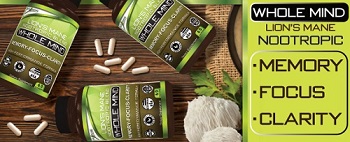
Our Formula includes: Lion’s Mane Mushrooms which Increase Brain Power through nerve growth, lessen anxiety, reduce depression, and improve concentration. Its an excellent adaptogen, promotes sleep and improves immunity. Shiitake Mushrooms which Fight cancer cells and infectious disease, boost the immune system, promotes brain function, and serves as a source of B vitamins. Maitake Mushrooms which regulate blood sugar levels of diabetics, reduce hypertension and boosts the immune system. Reishi Mushrooms which Fight inflammation, liver disease, fatigue, tumor growth and cancer. They Improve skin disorders and soothes digestive problems, stomach ulcers and leaky gut syndrome. Chaga Mushrooms which have anti-aging effects, boost immune function, improve stamina and athletic performance, even act as a natural aphrodisiac, fighting diabetes and improving liver function. Try Our Lion’s Mane WHOLE MIND Nootropic Blend 60 Capsules Today. Be 100% Satisfied or Receive a Full Money Back Guarantee. Order Yours Today by Following This Link.


| Visits: | 1,781,484,625 |
| Stories: | 8,592,333 |
Whistler Blowers, Insiders

