

The Minnesota Fraud Scandal Is Just the Tip of the Iceberg


Growing national outrage over Minnesota’s welfare fraud is justified, but not because of where it took place or because it implicates members of any immigrant community. It’s much more than a “Minnesota” story.
The outrage is justified because Americans are finally getting a concrete look at what happens when pushing public money out the door matters more than verifying the eligibility of the recipients, confirming services were delivered, or, ultimately, being a good steward of taxpayers’ money.
Since 2022, investigators have uncovered a staggering amount of fraud, including $250 million siphoned from pandemic-era child nutrition programs to a network of individuals and shell companies, and have secured dozens of indictments with more prosecutions underway. But it goes beyond that.
Federal prosecutors now suggest that up to half of the $18 billion spent on 14 Medicaid-funded Minnesota programs since 2018 may have been tied to fraud. The scandal touches programs covering housing assistance, autism therapy, and other welfare services. Even if those estimates are ultimately revised downward, the pattern is unmistakable. Fraud did not merely slip through the cracks. It became routine.
Minnesota is not the exception but rather the example Americans finally noticed. Medicaid fraud has been endemic at the state and federal levels for decades. Politicians haven’t done much, even with scholars and journalists raising the alarm.
Medicaid reports $543 billion in “improper payments” over the past decade, though that figure omits one of the largest sources of error: whether states correctly determined the eligibility of the individuals they enrolled and paid providers on behalf of. According to Paragon Institute calculations, this brings improper payments to $1.1 trillion over those 10 years.
Improper payments are not identical to fraud; many involve missing documentation or administrative errors. But that distinction offers little comfort considering how little money is recovered. They are also an open invitation for more abuse.
Actual fraud, meanwhile, is widespread and persistent. In 2024 alone, state Medicaid Fraud Control Units reported more than 1,151 convictions and more than $1.4 billion in civil and criminal recoveries. Federal enforcement recovers a tiny share of what is stolen. Fraud that goes undetected never appears in the data.
That’s only the tip of the iceberg. Medicare, the Supplemental Nutrition Assistance Program (SNAP), and many other welfare programs also suffer from massive fraud. The Affordable Care Act’s (ACA) exchange subsidies provide another cautionary example.
A recent Government Accountability Office report shows that the fraud risks in the ACA’s advanced premium tax credit remain severe a decade after they were first identified. The ability to gain subsidized coverage for fictitious applicants without providing required documentation, tens of thousands of Social Security numbers used for overlapping coverage, and more than $21 billion in subsidies never reconciled with tax filings are among the findings. Nonetheless, the Centers for Medicare and Medicaid Services has not updated its fraud risk assessment since 2018 and still lacks a comprehensive anti-fraud strategy.
It’s tempting to treat the Minnesota scandal as a morality play about managerial incompetence. And yes, Gov. Tim Walz deserves some blame. When red flags persist for years across multiple programs, failure of leadership is part of the story. But focusing on a single official or state misses the deeper lesson.
The problem is not administrative capacity; it’s incentives. Spending other people’s money with little personal consequence for failure leads to a collapse of accountability, regardless of who’s in charge. In addition, voters have limited incentives to monitor complex programs. Interest groups, by contrast, have strong incentives to organize around government spending.
None of this requires bad intentions—it’s predictable human behavior flowing from predictable incentives—but it creates an environment for waste and fraud to take root.
What would a serious anti-fraud agenda look like?
First, simplify the structure of the programs that produce improper payments and fraud. Federal matching grants, which Medicaid is largely built around, push states to build systems far larger than they would ever fund themselves, diluting accountability and encouraging growth for its own sake.
Second, do away with automatic enrollment and the “pay now, scrutinize later” style of oversight, which lets temporary errors turn into recurring bills. Any beneficiary’s eligibility must be regularly affirmed. If this can’t be done at scale, the honest response is to scale back on unsustainable promises, not to add more bureaucracy.
Third, ultimately, no oversight regime can police a government so large and complex. Some programs must be split up or entrusted with fewer responsibilities. Those that can’t account for where their dollars go should operate with tighter budgets.
The public is right to be angry. In fact, it should be angrier, and in a more bipartisan way. But we should not demand tougher rhetoric, more task forces, or another round of enforcement layered onto the same broken structure. If we want less fraud, we need less government. Minnesota is not the whole story, but it’s a fraud alert that’s hard to ignore.
COPYRIGHT 2026 CREATORS.COM
The post The Minnesota Fraud Scandal Is Just the Tip of the Iceberg appeared first on Reason.com.
Source: https://reason.com/2026/01/08/the-minnesota-fraud-scandal-is-just-the-tip-of-the-iceberg/
Anyone can join.
Anyone can contribute.
Anyone can become informed about their world.
"United We Stand" Click Here To Create Your Personal Citizen Journalist Account Today, Be Sure To Invite Your Friends.
Before It’s News® is a community of individuals who report on what’s going on around them, from all around the world. Anyone can join. Anyone can contribute. Anyone can become informed about their world. "United We Stand" Click Here To Create Your Personal Citizen Journalist Account Today, Be Sure To Invite Your Friends.
LION'S MANE PRODUCT
Try Our Lion’s Mane WHOLE MIND Nootropic Blend 60 Capsules
Mushrooms are having a moment. One fabulous fungus in particular, lion’s mane, may help improve memory, depression and anxiety symptoms. They are also an excellent source of nutrients that show promise as a therapy for dementia, and other neurodegenerative diseases. If you’re living with anxiety or depression, you may be curious about all the therapy options out there — including the natural ones.Our Lion’s Mane WHOLE MIND Nootropic Blend has been formulated to utilize the potency of Lion’s mane but also include the benefits of four other Highly Beneficial Mushrooms. Synergistically, they work together to Build your health through improving cognitive function and immunity regardless of your age. Our Nootropic not only improves your Cognitive Function and Activates your Immune System, but it benefits growth of Essential Gut Flora, further enhancing your Vitality.
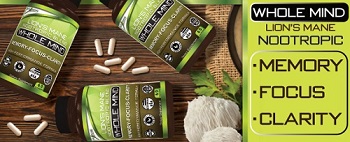
Our Formula includes: Lion’s Mane Mushrooms which Increase Brain Power through nerve growth, lessen anxiety, reduce depression, and improve concentration. Its an excellent adaptogen, promotes sleep and improves immunity. Shiitake Mushrooms which Fight cancer cells and infectious disease, boost the immune system, promotes brain function, and serves as a source of B vitamins. Maitake Mushrooms which regulate blood sugar levels of diabetics, reduce hypertension and boosts the immune system. Reishi Mushrooms which Fight inflammation, liver disease, fatigue, tumor growth and cancer. They Improve skin disorders and soothes digestive problems, stomach ulcers and leaky gut syndrome. Chaga Mushrooms which have anti-aging effects, boost immune function, improve stamina and athletic performance, even act as a natural aphrodisiac, fighting diabetes and improving liver function. Try Our Lion’s Mane WHOLE MIND Nootropic Blend 60 Capsules Today. Be 100% Satisfied or Receive a Full Money Back Guarantee. Order Yours Today by Following This Link.


| Visits: | 1,774,267,652 |
| Stories: | 8,578,734 |
Whistler Blowers, Insiders

