

U.S. law shouldn’t copy Europe’s app store regulation

Lawmakers in the United States are considering a major intervention in the way big mobile platforms like Apple and Google sell apps to hundreds of millions of smartphone owners. Taking a page from Europe’s Digital Markets Act (DMA), the App Store Freedom Act would require Apple and Google to host rival app stores and give app developers equal technical access to those using official channels. Rather than greater freedom, the act would undermine security features and complicate the user experiences of hundreds of millions of consumers.
The App Store Freedom Act attempts to break up so-called “mobile walled gardens,” mandating that large mobile platforms let users replace and delete apps and services that come pre-installed on their devices in favor of third-party apps downloaded from unofficial app stores. Users would also be given the ability to choose alternative in-app payments and payment systems that are not operated or controlled by the covered company’s app store. On top of that, platforms would have to give third-party app developers the same kind of system-level access that official apps get—the same tools, interfaces, and technical permissions.
The core of the bill is a U.S. version of what the European Union has already done through similar provisions in the DMA. In theory, both laws aim to make digital app markets more competitive. But in practice, as critics of the DMA have noted, breaking down the walls leads to emerging security risks, clunkier user journeys, and still-uncertain gains for competition. None of that should appeal to U.S. policymakers.
Why the walls exist
There are plenty of reasons why an app store would want to limit which apps are available for download, what data an app developer can access, and which methods app developers can use to interact with and advertise to consumers. Devices and app stores carry the burden of preventing the spread of malware, blocking deceptive apps, and setting clear user consent requirements when apps access onboard systems like a device’s camera and location.
Early app stores were flooded with scams and services using questionable data practices, especially around subscriptions. These so-called “fleeceware” apps advertised themselves as free, then quietly converted users into expensive recurring subscriptions that are difficult to cancel. In 2018, for instance, TechCrunch highlighted a QR code reader that advertised itself as free but quietly enrolled users in a $156‑per‑year subscription, briefly landing it among the App Store’s top‑grossing apps.
Over time, Apple and Google responded by tightening their rules, stepping up human review, and adding automated scanning. Apple now reports that its App Store has prevented billions of dollars in fraudulent transactions in recent years and blocked millions of risky app submissions. Google’s Play Protect scans hundreds of billions of apps per day, including app submissions to the Play Store, and blocks millions of apps and developer accounts that violate policies. These protections work because platforms have the ability to set strict app store rules, but by forcing platforms to treat unofficial apps and app stores on equal terms, the App Store Freedom Act would make that job harder and more complex.
Upending the U.S. app store security model
Much of the App Store Freedom Act is ripped from the interoperability section of Europe’s DMA. Under this section, the European Commission decides which big tech companies count as “gatekeepers” by looking at their turnover inside the EU, market capitalization, and user thresholds, then imposes a set of rules on their “core platform services.” Those obligations include allowing users to uninstall pre‑loaded apps, permitting installation of third‑party app stores, banning self‑preferential rankings, and requiring fair, reasonable, and non‑discriminatory terms for access to app stores and key technical interfaces. The App Store Freedom Act is narrower in scope, but the regulatory logic is the same.
Europe’s experience under the DMA already shows how quickly a well-intentioned regulation can produce a messy, hard-to-manage safety environment. Earlier this year, EU iPhone users found that minors could install Hot Tub, a porn app, through a third-party app store called AltStore PAL. Because the app was installed via a third-party store, it bypassed Apple’s parental controls.
The controversy highlighted the importance of user trust. Most users have come to understand that apps on an iPhone have gone through the same App Store screening, age-rating, and parental-control regime they’ve relied on for years. But the DMA undermined this assumption. Third-party apps pass only minimal checks on iPhones to ensure they are compatible with the device, bypassing the App Store’s curated review. That gap between what users think an iPhone app means and what the platform can actually guarantee is an inevitable side effect of treating third-party app stores as interchangeable with the official store despite obvious differences in oversight and risk.
This serves as just one of the core reasons why these interoperability mandates risk undoing many of the hard-won improvements to the app-store ecosystem over the last decade. They don’t abolish platform review entirely, but they do make it easier for riskier app stores, sideloaded apps, and third‑party payment systems to reach consumers without going through the same curated, tightly controlled channels that exist today. A platform can’t offer the same level of privacy or safety when it’s legally required to allow apps, app stores, and payment systems it can’t fully vet.
The changes mandated by the App Store Freedom Act are not simply a matter of facilitating consumer choice. The bill’s supporters suppose that individual smartphone users can choose to deactivate specific security features, but this is not how complex smartphone ecosystems work. Allowing this functionality at the user level forces mobile platforms to undermine ease of use and security features for all users. The sets of features sometimes called “walled gardens” have evolved from decades of mobile platforms responding in the market to what their consumers demand. Forcing down such walls would do nothing to enhance the “freedom” of app store customers.
The post U.S. law shouldn’t copy Europe’s app store regulation appeared first on Reason Foundation.
Source: https://reason.org/commentary/u-s-law-shouldnt-copy-europes-app-store-regulation/
Anyone can join.
Anyone can contribute.
Anyone can become informed about their world.
"United We Stand" Click Here To Create Your Personal Citizen Journalist Account Today, Be Sure To Invite Your Friends.
Before It’s News® is a community of individuals who report on what’s going on around them, from all around the world. Anyone can join. Anyone can contribute. Anyone can become informed about their world. "United We Stand" Click Here To Create Your Personal Citizen Journalist Account Today, Be Sure To Invite Your Friends.
LION'S MANE PRODUCT
Try Our Lion’s Mane WHOLE MIND Nootropic Blend 60 Capsules
Mushrooms are having a moment. One fabulous fungus in particular, lion’s mane, may help improve memory, depression and anxiety symptoms. They are also an excellent source of nutrients that show promise as a therapy for dementia, and other neurodegenerative diseases. If you’re living with anxiety or depression, you may be curious about all the therapy options out there — including the natural ones.Our Lion’s Mane WHOLE MIND Nootropic Blend has been formulated to utilize the potency of Lion’s mane but also include the benefits of four other Highly Beneficial Mushrooms. Synergistically, they work together to Build your health through improving cognitive function and immunity regardless of your age. Our Nootropic not only improves your Cognitive Function and Activates your Immune System, but it benefits growth of Essential Gut Flora, further enhancing your Vitality.
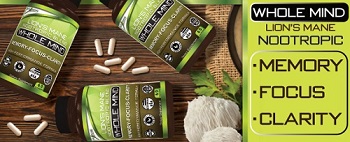
Our Formula includes: Lion’s Mane Mushrooms which Increase Brain Power through nerve growth, lessen anxiety, reduce depression, and improve concentration. Its an excellent adaptogen, promotes sleep and improves immunity. Shiitake Mushrooms which Fight cancer cells and infectious disease, boost the immune system, promotes brain function, and serves as a source of B vitamins. Maitake Mushrooms which regulate blood sugar levels of diabetics, reduce hypertension and boosts the immune system. Reishi Mushrooms which Fight inflammation, liver disease, fatigue, tumor growth and cancer. They Improve skin disorders and soothes digestive problems, stomach ulcers and leaky gut syndrome. Chaga Mushrooms which have anti-aging effects, boost immune function, improve stamina and athletic performance, even act as a natural aphrodisiac, fighting diabetes and improving liver function. Try Our Lion’s Mane WHOLE MIND Nootropic Blend 60 Capsules Today. Be 100% Satisfied or Receive a Full Money Back Guarantee. Order Yours Today by Following This Link.


| Visits: | 1,760,596,176 |
| Stories: | 8,553,172 |
Whistler Blowers, Insiders

