

The Digital Stock Plumbing TradeBitgo—BTGO-NYSE

I think the crypto world changed forever on Sept 17 with new SEC rules that make it easier for institutions to buy store and trade stocks—on the blockchain. These rules will allow instant settlement (not 2 days) and the ability to trade 24/7/365. (The SEC is bypassing Congress here; I explain that in this report.)
I bought a bunch of different crypto assets (all small amounts, but totalling over $100K) Thursday and Friday—mostly Bitcoin (IBIT-NYSE) and Coinbase (COIN-NASD), Ethereum (ETHA) and Solana (SOLA-TSX). I also own covered call ETFs on these as I think they are about to rip. And 1000 shares of BitGo
BitGo is a unique story– BitGo is the first publicly traded, federally chartered digital asset infrastructure company in the United States. It holds an OCC national trust bank charter — the same class of licence a real bank holds. It is NOT a digital treasury company. It is right now the only company that can buy a real stock, tokenize it and hold it and lend it out—for a $500M EV, that’s interesting!
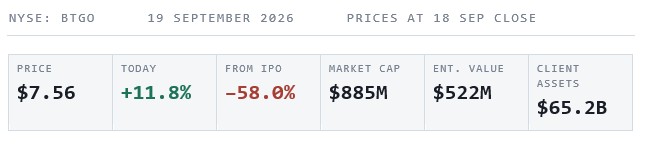
The stock has been a disaster after–it went public in January at $18, touched $24.50, and now trades at $7.56. The business underneath grew the whole way down. ClaudeAI and I discuss here is what the market is actually pricing — and what it appears to be missing.
Why this company, and why this week
1. What BitGo does
BitGo can take a real share of a real listed company, lock it in a federally regulated bank vault, and hand you a blockchain token of that share. The token trades around the clock. You hold it in your own wallet. You can borrow against it in seconds. And you keep the dividends and the votes, because you still own the share.
BitGo proved this in August. CEO Mike Belshe went on stage, bought 100 shares of SpaceX (SPCX) on the open market, took them as tokens into his own wallet, and borrowed $20,000 against them — without selling. Three financial systems, one screen, about ninety seconds. By the company’s account, nobody in America had done that before with a real listed stock.
No other US company can do all of that. It takes a national bank charter to hold the share, and crypto engineering to issue the token. Almost nobody has both.
The Business That Pays The Bills Today
That is the future prize. The day job now is older and simpler: BitGo holds other people’s crypto. It guards $65.2 billion of digital assets for 5,833 institutional clients in more than 100 countries — exchanges, banks, ETF issuers, hedge funds, asset managers, corporate treasuries.
Belshe founded the company in 2013 and has run it through four crypto cycles without ever losing a client’s assets. Custody is the front door.
Once the assets sit on the platform, BitGo also charges to trade them, stake them, lend against them, settle them, and to run stablecoin programs on top of them. Roughly three-quarters of clients buy two or more products.
It earns fees on other people’s money. It does not own the crypto. It does not take credit risk. When the market falls, BitGo earns less — but it keeps earning.
What Tokenized Stock Could Be Worth
Here is the part investors are actually buying. BitGo earns about 26 cents a year per $100 it holds — that is its whole business divided by its assets.
Stocks will pay less than crypto, because BitGo never touches the trade.
Call it 10 cents per $100 from holding the shares and lending against them.
Now run it against the US stock market, which is worth $69 trillion.
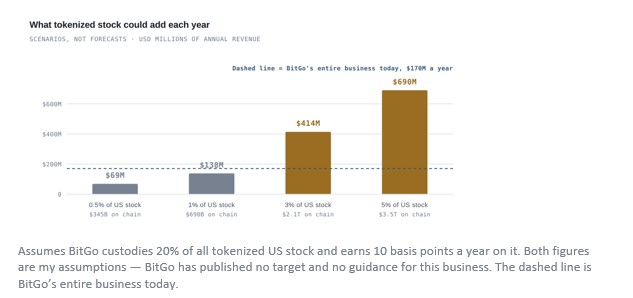
Read the middle bar. If just 1% of US stock moves on chain and BitGo holds a fifth of it, that one line earns about $138 million a year — close to doubling the whole company. At 3% it earns $414 million, roughly two and a half times everything BitGo makes now.
Now the cold water
Every real-world asset tokenized so far — bonds, funds, property, all of it — adds up to about $35 billion. The 1% case above needs $690 billion of US stock on chain. That is twenty times everything tokenized to date, in one asset class. It may take years. It may never happen. Tokenized stock earns BitGo nothing today.
So this is the shape of the bet: a real, working crypto custody business that pays the bills, plus a free option on stocks moving onto blockchains. The SEC just made that option legal. Whether it pays is the open question.
2. Why it is hard to copy
Two things, and the second matters more than most investors realise.
First, BitGo is the first publicly traded, federally chartered digital asset infrastructure company in the United States. It holds an OCC national trust bank charter — the same class of licence a real bank holds. Belshe believes BitGo may be the first bank in OCC history to convert in a single day. Most applicants wait 9 to 18 months, and several are waiting now.
Second, and this is the actual moat: Wall Street is building four or five competing ways to put company shares onto blockchains, and BitGo is the custodian for all of them. It is the sole qualified custodian on the Canton Network, the sole custodian for Figure (FIGR)’s tokenized equities platform, and the wallet infrastructure behind the DTCC’s own tokenization initiative — the DTCC being the institution that settles essentially every US stock trade.
The moat, in one line
BitGo does not have to pick the winning standard. It gets paid whichever one wins. It is not competing in the format war — it is the referee who gets paid by all sides.
3. Why it matters this week
On 17 September 2026 the SEC published a five-year “innovation exemption” that, for the first time, creates a legal path for real US company shares to trade on public blockchains. It is strict: tokens must carry identical rights to the underlying stock, smart contracts must be public and auditable, and purely synthetic price-tracking tokens are explicitly excluded.
Again, BitGo demonstrated very publicly on stage earlier this summer — a real listed share, bought on the open market, held in qualified custody at a federally regulated trust bank, issued as a self-custody token the owner could immediately borrow against. BitGo did not have to change anything to fit the new rule. It had already built to it.
The market noticed the SEC news immediately. On 18 September, bitcoin ran $78K to $81K, Coinbase (COIN) jumped 12%, and the tokenization infrastructure tokens led everything — Near +32%, Starknet +27%, Arbitrum +26%, Uniswap +20%. Of the 125 largest non-stablecoin tokens, 111 rose. BitGo closed up 11.8% at $7.56 on nearly seven times its average volume.
What is actually being claimed here
A regulatory door opened, and the sector repriced immediately — that is history, not forecast. Whether this becomes a durable re-rating depends on execution, and there is a specific test: management has guided to positive adjusted EBITDA in Q3, reported in November. BitGo is an unprofitable small-cap that has fallen 58% since its January IPO. This is a high-risk situation whichever way it resolves.
The rest of this report explains what BitGo really earns, why the headline revenue figure is misleading, how it compares with Figure (FIGR), and what could go wrong.
The Catalyst
What the SEC did on 17 September
The Securities and Exchange Commission published an “innovation exemption” for tokenized US stocks. It runs five years. In plain terms, it lets approved venues trade tokenized National Market System shares on public blockchains — using automated market makers and liquidity pools — without being regulated as stock exchanges.
The conditions are strict, and they are the interesting part:
• Tokenized shares must carry identical rights to the real stock.
• Smart contracts must be public, auditable, and on public ledgers.
• Venues must notify the underlying issuer before trading third-party tokens.
• Trading halts when the real stock halts.
• Symbol and volume caps apply, with public disclosure of operations.
Read that list against what BitGo demonstrated six weeks earlier. Identical rights — that is the Article 8 entitlement. A regulated party in the chain — that is the OCC trust bank. Public on-chain settlement — that is the goSPCX wallet. BitGo did not have to change anything to fit the rule. It had already built to it.
There is a second, sharper point. On the August earnings call, a Goldman Sachs analyst asked Belshe what happens if the CLARITY Act stalls in Congress and the SEC’s exemption arrives instead. His answer was that BitGo would be fine either way — “selfishly better off without CLARITY” — because it already knows how to operate under regulators, while less experienced competitors would stay on the sidelines waiting for legislation. That is precisely the scenario that just landed.
What it is worth, concretely
Nothing, yet. The exemption creates a legal path; it does not create revenue. BitGo is not a broker-dealer for this purpose and will not earn trading fees. Belshe has said the money he is chasing is lending against tokenized shares — letting someone with $20,000 of stock borrow against it the way a private-wealth client can. The loan book today is roughly $200 million and the constraint is dollars to lend, not demand. That is the line to watch in Q3 and Q4.
The market voted anyway. BitGo closed up 11.8% at $7.56 on nearly seven times its average volume, while bitcoin ran to $81,000 and the tokenization infrastructure tokens — Near +32%, Starknet +27%, Arbitrum +26%, Uniswap +20% — led the whole market. That dispersion tells you this was a regulatory repricing, not a liquidity rally.
Plain English
What A Tokenized Stock Actually Is
Before going further, this term needs clearing up, because it gets used for two completely different things — and the SEC has just drawn a hard line between them.
A tokenized stock does not create a new share. Nothing is duplicated, and nothing replaces the ordinary stock. It is a new record of ownership of a share that already exists. The share itself sits still in a vault the whole time. What changes is where the ledger entry lives.
The part that makes it click
Here is what most investors never realise: you already don’t own your stock directly.
When you buy 100 shares of Apple through your broker, no certificate with your name on it exists anywhere. The share is registered to a nominee company called Cede & Co, the holding entity for the Depository Trust Company. Your broker holds a claim against the DTC. You hold a claim against your broker.
What you own is a security entitlement — a legally enforceable claim, defined under Article 8 of the Uniform Commercial Code, sitting at the bottom of a chain of book entries. It has worked this way since the 1970s. Your shares are already just a database row at your broker.
Tokenizing swaps that bottom database row for a blockchain entry. Same chain, same share at the top, different technology at the bottom.
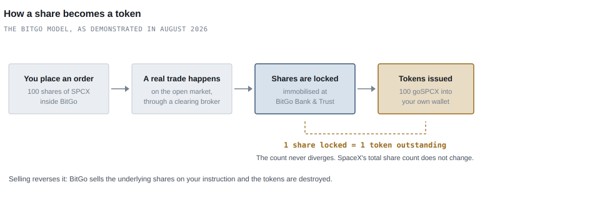
No phantom shares are created. Guaranteeing that one-to-one match is the custodian’s entire job — which is precisely why this requires a regulated trust bank and cannot simply be done by an app.
The two kinds — and the line the SEC just drew
This is where the confusion comes from, and it is the most important thing in the 17 September ruling.
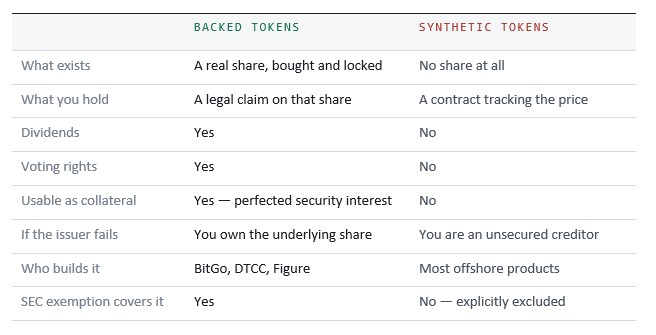
SEC Chairman Atkins said approved tokens must give holders “the same rights and privileges as the traditional securities, including rights to receive dividends and exercise voting rights.” The Commission specifically ruled out “synthetic security tokens that are derivatives and don’t provide ownership of the shares.”
That one distinction is why the ruling matters so much for BitGo. Synthetics were easy to build — anyone can write a contract that tracks a price. The backed version needs a federally chartered custodian holding real shares and a legal structure that makes the token a perfected claim. BitGo already had both. Most offshore competitors built the kind the SEC just excluded.
So why bother at all?
If it is the same share with a different record, what is gained? Four things:
• It trades around the clock. The stock market closes at 4pm. A blockchain does not.
• Settlement is instant rather than two days later.
• It can be pledged automatically. That is the loan in BitGo’s demo — borrow against your shares in ninety seconds, no bank, no paperwork. This is the part BitGo actually plans to monetise.
• You can hold it yourself, in your own wallet, rather than only on a broker’s books.
One honest caution
None of this removes risk — it relocates it. Your claim is only as good as the custodian holding the real shares and the smart contract tracking the tokens. If a custodian ever issues more tokens than it holds shares, holders find out too late. That is exactly why the SEC’s conditions demand public, auditable smart contracts and a regulated entity in the chain, and why the five-year exemption is a trial rather than a permanent rule.
What You Are Buying
BitGo is not a treasury company. It is the vault they all rent.
This distinction does all the work, so let’s be precise about it.
A digital asset treasury company buys crypto and holds it. Its shares are a wrapper around a pile of tokens, usually with leverage attached. When bitcoin goes up, the stock goes up more. When bitcoin goes down, the stock goes down more, and if the leverage is wrong the company dies. You are buying a bet on a price.
BitGo sells the safe. It holds other people’s crypto — $65.2 billion of it — for 5,833 institutional clients across more than 100 countries: exchanges, banks, ETF issuers, hedge funds, asset managers. It charges them to store it, to trade it, to stake it, to lend against it, and to move it. Mike Belshe founded the company in 2013 and has run it through four full crypto cycles. It has never lost client assets.
The economics are completely different. A treasury company makes money when the price rises. BitGo makes money when assets move and when balances sit — and it keeps making money in a bear market, just less of it. In the worst quarter crypto has had in two years, BitGo’s adjusted EBITDA loss was $4.2 million. Not a blow-up. A rounding error against $423 million of book equity and zero corporate debt.
The one sentence version
BitGo does not own the assets. It owns the relationship with everyone who does — and that relationship survives a 50% drawdown in a way a leveraged token balance does not.
Two Markets
How BitGo gets paid in crypto, and how it will get paid in stocks
In crypto: BitGo gets paid five ways
A client opens an account to store coins. That is the front door. Then BitGo sells them more.
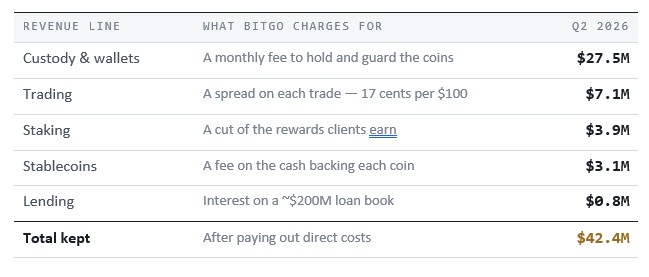
Settlement is the sixth thing BitGo does, and it earns almost nothing today.
Belshe keeps it cheap on purpose. Every new client on the network gives every other client someone new to trade with, so the network sells itself.
In Stocks: BitGo Gets Paid Two Ways, Not Five
This is the part most people get wrong, so here it is plainly.
BitGo does not get paid for the stock trade. It is not the broker. When Belshe bought those SpaceX shares on stage, a clearing partner did the trade. Belshe said it himself: “it’s not trading fees that we’ll be looking for there.”
What BitGo does get paid for:
• Holding the shares. Every tokenized share needs a real share locked at a qualified custodian. BitGo charges to hold it, the same way it charges to hold bitcoin.
• Lending against the shares. This is the one Belshe is chasing. A person with $20,000 of stock cannot normally borrow against it — only rich clients can. BitGo wants to change that, and it runs 24 hours a day.
There is a third, quieter one: the venues themselves pay. Figure (FIGR), the DTCC and anyone else building a tokenized-stock market needs an independent custodian, and BitGo is already that for three of them.
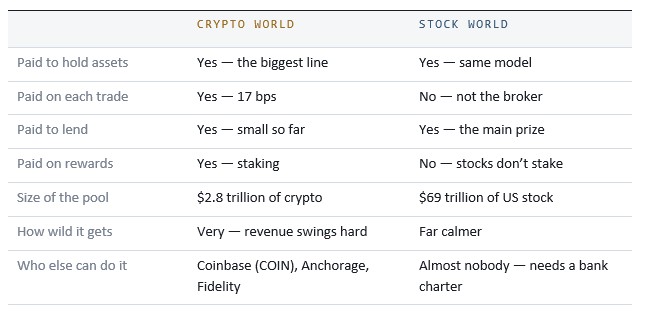
Why this matters
BitGo earns less per dollar in stocks, because it never touches the trade. But the pool is 25 times bigger and far steadier. A thin fee on $69 trillion of calm money beats a fat fee on $2.8 trillion of wild money — if the shares ever move on chain in size. That is the whole bet.
Be clear about the timing. Stocks earn BitGo nothing today. The SEC opened the door two days ago. The first dollar of real revenue is quarters away, not weeks.
The Differentiator
Every road to tokenized stocks runs through the same custodian
Wall Street is currently building four or five competing versions of the same idea: putting real company shares onto blockchains. The DTCC — the institution that settles essentially every US stock trade — has its model.
Figure (FIGR) has another. Robinhood (HOOD) has a third. A cluster of offshore exchanges have a fourth. Nobody knows which wins.
BitGo does not need to know. It is the custodian for all of them.
It is the sole qualified custodian on the Canton Network, the permissioned privacy chain the DTCC chose for its tokenized equity work. It is the sole custodian for Figure (FIGR)’s open-network tokenized equities platform. It provides the wallet infrastructure for the DTCC’s own tokenization initiative, which processed its first live US transactions in July. And any token from any of the other models can simply be held in a BitGo wallet.
This is the thing that separates BitGo from everything else in digital assets, and it is worth saying slowly: BitGo makes money on tokenized equities no matter which standard wins. It is not competing in the format war. It is the referee who gets paid by all sides.
“No one can predict precisely which networks, protocols or business models will ultimately emerge as leaders. We have deliberately built BitGo so our success does not depend on making that prediction.”
Mike Belshe, CEO — Q2 2026 earnings call, 12 August
The part nobody else can copy quickly
Underneath the neutrality sits a licence. In 2026 BitGo became the first publicly traded, federally chartered digital asset infrastructure company in the United States — it holds an OCC national trust bank charter. Belshe says BitGo may be the first bank in OCC history to convert in a single day: conditionally approved, wrote the regulatory capital cheque, operating the next morning. Most applicants wait 9 to 18 months.
That charter is what let BitGo do something on stage in August that, by the company’s account, had never been done in America. Belshe logged in, bought 100 shares of SpaceX on the open market through a clearing partner, received them as goSPCX tokens in his own self-custody wallet, and then borrowed $20,000 against them in SoFi (SOFI)’s stablecoin — without selling the position. Three financial systems, one screen, about ninety seconds.
The technical detail that matters is deeply unglamorous: those tokens are UCC Article 8 entitlements. Decades-old, boring, tested securities law. That means the token is a perfected security interest — a bank will lend against it, and the holder keeps dividends, voting rights and corporate actions.
Every offshore tokenized-stock product launched before this was a synthetic wrapper you could not pledge as collateral, because you could not perfect the security.
Why this is a moat and not a feature
A competitor can copy the interface in a quarter. To copy the structure it needs a federal trust bank charter, a broker-dealer relationship, thirteen years of custody operations, and the legal work to make on-chain entitlements perfectible. Belshe: “there’s a lot that goes into it… I think we have a long lead ahead of new entrants.”
One more differentiator worth a line, because it is the kind of thing that wins institutional due diligence: BitGo supports 186 of the top 250 digital assets and claims broader chain coverage than Coinbase (COIN) or Anchorage. When a new token launches, BitGo is usually the first regulated venue that can hold it — and custody is where every client relationship starts.
The setup
On 21 January 2026, BitGo rang the bell at the New York Stock Exchange. The company sold shares at $18, raised $213 million, and watched the stock jump nearly 25% on day one. Within weeks it hit $24.50. Then crypto rolled over, and BitGo rolled with it. Ten sessions after the IPO the stock had given back 45%. By August it traded under $5.
That is a brutal first eight months for any new listing. But here is the part that should stop you: while the share price fell 70%, the business did not shrink. Clients grew 26% year over year. Assets on the platform grew 31% on a like-for-like basis. The company added a federal bank charter, won the custody mandate for three separate tokenized-equity networks, and built something in July that nobody else in America had built.
The stock fell because bitcoin fell. That is the whole explanation, and it is also the opportunity — or the trap, depending on what you think BitGo actually is.
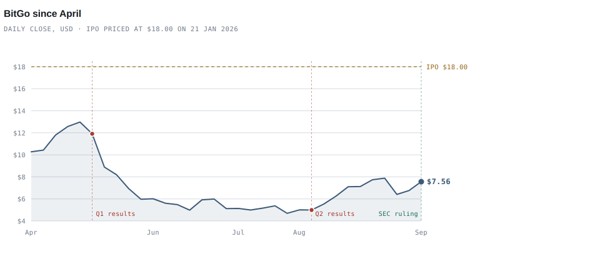
Two earnings dates did most of the damage. The stock lost 25% in the three sessions after Q1 on 13 May, then bottomed at $4.65 on 13 August, the morning after Q2. It has climbed 63% off that low — including today’s move on the SEC’s tokenized-stock ruling.
The Accounting Trap
The $4.3 billion that is really $42 million
Open any screener and BitGo shows quarterly revenue of $4.33 billion against an $885 million market cap. That looks absurd — 0.05 times sales. It is absurd, because the number is not revenue in any sense a retail investor would recognize.
When a client asks BitGo to buy $100 million of bitcoin, BitGo books $100 million of revenue and roughly $99.97 million of cost. The company keeps the spread. In the second quarter that spread ran 17 basis points — seventeen hundredths of one percent. The staking business works the same way: BitGo collected $64.7 million and paid out $60.8 million to validators. Stablecoins, the same: $38.8 million in, $35.7 million out.
Strip out the pass-through and the real number appears. BitGo’s economic revenue in Q2 was about $42 million. That is 1.1% of the headline.
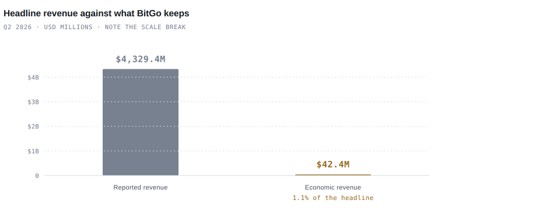
The bar on the left is what gets reported. The sliver on the right is what the company actually earns. Any valuation multiple built on the left-hand number is meaningless — and any investor who bought on “0.05x sales” bought a mirage.
Once you look at economic revenue, the shape of the business changes completely. Trading — 97% of the headline — contributes less than a fifth of the real money. The quiet subscription line, custody and wallet fees that clients pay every month whatever the market does, is the single largest contributor and the only one that grew in both quarters.
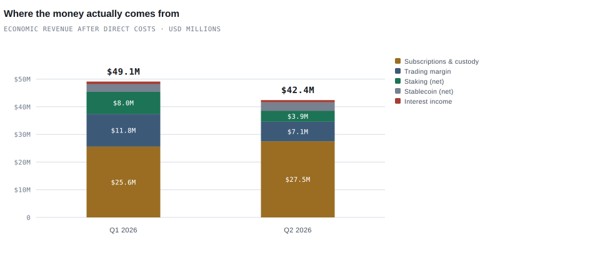
Recurring subscription and custody revenue — the most durable line — is now 65% of what BitGo keeps, up from 52% in Q1. That shift happened because trading and staking economics deteriorated, not because subscriptions boomed. Both readings are true.
And here is the honest problem with this business, stated plainly: the take rates are wild. Staking economics ran 12.5% a year ago, jumped to 16.1% in Q1, then collapsed to 6% in Q2 when one large Ethereum client negotiated a volume discount. Trading margin went 19 basis points, 32, then 17. Only the stablecoin line has moved in a straight line, from 2.6% to 8%.
A business whose unit economics swing 60% on the mix of two or three clients is not yet a predictable business. That is a real mark against the stock, and it is why the shares fell 21% the day after Q2.
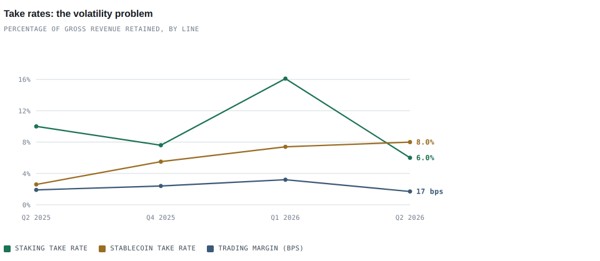
Stablecoin-as-a-Service is the one line compounding cleanly — take rate tripled in a year as launch discounts rolled off. Staking is the one causing damage. Management guides trading margin back to 20–25 bps and says July already recovered.
Break-Even
When does BitGo start making money?
Start with a fact that gets lost: BitGo made money last year. Adjusted EBITDA came in at +$32.4 million for 2025, including +$12.1 million in the fourth quarter alone. Then crypto fell, and the profit went with it.
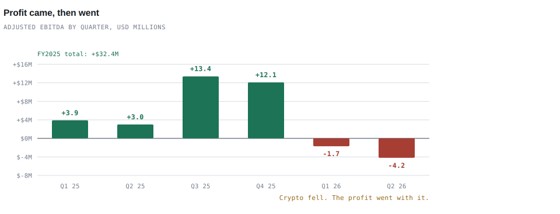
This is a cycle, not a broken business. Q3 2025 is derived from the full-year figure of $32.4M less the three reported quarters; the rest are as reported.
What management says
CFO Ed Reginelli, asked on the Q2 call what gets BitGo back to profit:
“The goal would be, yes, to get the business to closer to break even, slightly profitable in Q3.”
Ed Reginelli, CFO — 12 August 2026
His plan: grow revenue, then bank $15 million a year of cost cuts — about $9 million from the 15% job cut in June, another $6 million from moving servers off public cloud and other savings. They start hitting in Q3.
That is the only number management has put on the table. There is no formal guidance and no long-term margin target.
Where the break-even line actually sits
Management never published it, so here is the math from the reported figures.
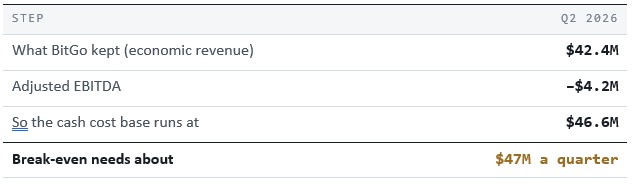
That is $186 million a year. BitGo kept $42.4 million in Q2. The hole is $4.2 million a quarter.
Watch how fast it closes:
• The $15 million of cost cuts equals $3.75 million a quarter. That covers almost 90% of the gap on its own.
• Trading spreads going back to normal — Reginelli called 20 to 25 basis points the historical range, against 17 in Q2. On the same volume that adds about $2.4 million. He said July had already recovered.
Add them and you get roughly $6 million against a $4 million hole — about +$2 million of adjusted EBITDA in Q3. Management’s promise needs no miracle. It needs the cuts to land and spreads to behave.
What the Street thinks
Analysts model net revenue of $202 million this year, $266 million next year, $342 million in 2028. On earnings per share they have −$0.78 in 2026, then +$0.12 in 2027 and +$0.38 in 2028.
So the Street sees adjusted EBITDA turning now and real accounting profit arriving in 2027. The gap between those two is stock pay and depreciation — real costs that adjusted EBITDA leaves out. Mizuho said flatly in August that it does not expect profit in 2026. Rosenblatt prices the stock at 13 times its 2027 EBITDA estimate.
Where scale helps
Some costs never grow. Those are where the money is.
• The licences cost the same at any size. The bank charter, the European licences across 30 countries, the audits, the insurance — all of it costs the same whether BitGo holds $65 billion or $200 billion. Every new client after that is nearly free money. This is the moat and the profit engine in one.
• Custody is almost all fixed cost. Same vaults, same staff, same audits. The next dollar of custody fees drops almost straight to profit.
• Each new blockchain gets built once. BitGo supports 186 of the top 250 coins. That work serves one client or five thousand at the same cost.
• Selling more to the same client costs nothing. About three-quarters of clients already buy two or more products, over half buy three or more.
• Staking flips at size. Reginelli: once volume on a coin gets big enough, BitGo runs its own machines instead of paying someone else, “where we appreciate a much higher margin.”
• The settlement network feeds itself. Each client added gives every other client a new partner to trade with.
• AI is cutting costs now. Over 40% of code is AI-written or AI-assisted, with output up 220% in one quarter. AI handles 20% of engineering tickets and answers 17% of support requests first.
Where scale hurts
A bull case usually stops there. Q2 showed the other half.
Big clients pay less, not more
Trading gets no benefit from size. A bigger trade does not earn a wider spread — large clients push it narrower. Q2 proved it: volume rose and the margin fell from 32 basis points to 17. And staking gets worse with size: the take rate dropped from 16.1% to 6.0% in one quarter because a big Ethereum client brought huge volume at a discount rate. Winning a whale lifts revenue and wrecks the margin.
So BitGo has real operating leverage in custody, licences and cross-selling, and negative leverage in trading and staking pricing. The business only inflects if the mix shifts toward the steady lines. In Q2 it did — custody and subscriptions went from 52% to 65% of what BitGo kept — but only because the other lines shrank.
The two numbers to watch in November
Did BitGo keep $47 million or more in Q3? And did the trading spread get back to 20–25 basis points? Those two answers decide whether the break-even story is real or slipping.
The Numbers
Fact sheet
BitGo Holdings, Inc. · as at 19 September 2026 · balance-sheet figures from the Q2 10-Q, 30 June 2026
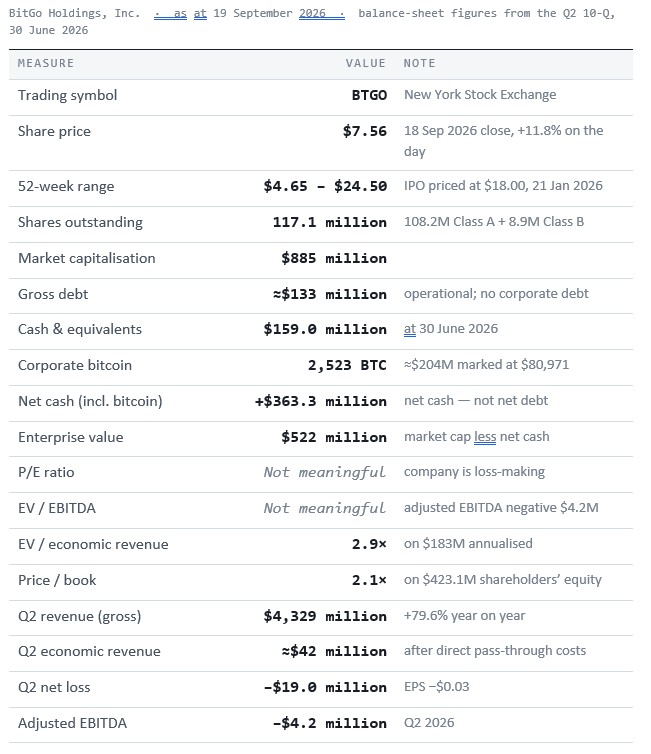
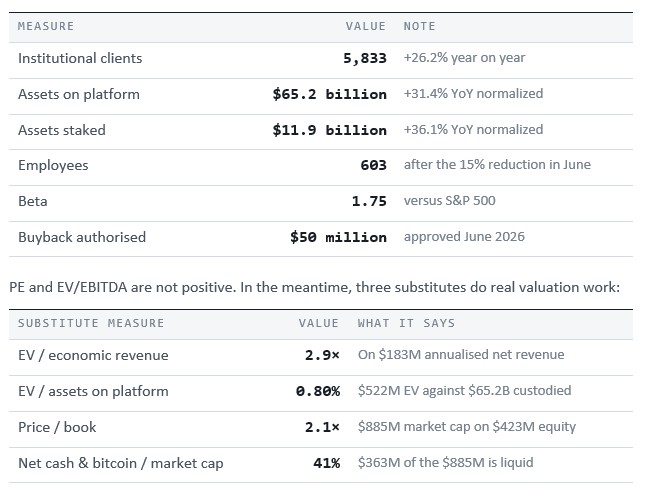
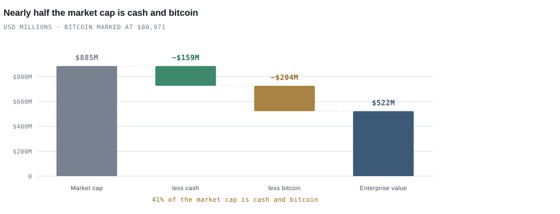
Strip out $159M of cash and 2,523 bitcoin worth $204M, and the market values the entire operating business — the charter, the custody platform, 5,833 clients, $65 billion of assets — at about $522 million. A $50 million buyback is authorised against that.
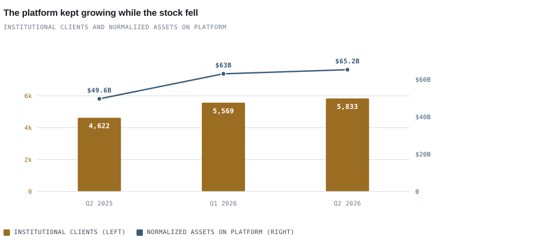
“Normalized” restates prior periods at current token prices, so it strips out the effect of crypto falling and shows underlying flows. Reported assets on platform dropped 30% year over year; normalized assets rose 31%. That gap is the entire bull case in one line.
The Comparison
Figure and BitGo: two opposite ways to earn
The most useful company to hold BitGo up against is Figure Technology Solutions (Nasdaq: FIGR), the blockchain lending and capital-markets company founded by Mike Cagney. The two are partners at one point of contact and structurally opposite everywhere else.
The one-line version: Figure takes credit risk to earn a fat margin. BitGo takes no credit risk and earns a thin one. Everything else follows from that.
The coincidence that makes it obvious
Both companies pushed roughly $4.3 billion of volume through their platforms in the second quarter of 2026. Look at what each one kept.
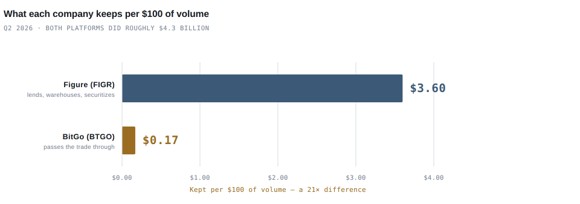
Figure keeps about twenty times more of every dollar crossing its platform. Not because it is cleverer — because it underwrites the loan, warehouses it, hedges it, securitizes it and keeps a residual slice. BitGo passes the trade through and touches none of it.
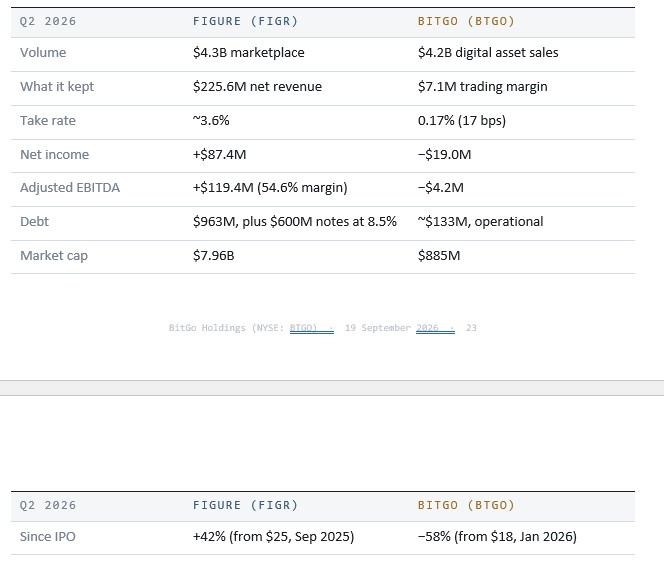
How each actually earns
Figure gets paid on the same loan four or five times. A home equity line gets originated (origination fee, $26.3M), sits on a warehouse line earning interest ($22.8M), gets sold or securitized (gain on sale, $57.6M), leaves behind a servicing asset ($29.1M gain plus $11.3M of fees on $17.3 billion of loans), and the partner bank that originated it pays a technology fee ($72.9M — the fastest-growing line, from 489 partner originators). Figure also runs an SEC-registered exchange, issues its own yield-bearing stablecoin (YLDS), owns roughly 25% of the HASH token behind Provenance Blockchain, and operates DART, a blockchain lien registry competing with MERS.
BitGo earns on other people’s assets sitting still and moving. Custody and wallet subscriptions ($27.5M), trading spread (17 bps), staking take rate (6%), and stablecoin sponsor fees (8% on $4.6 billion of segregated reserves). No underwriting, no loan book beyond roughly $200 million of client lending, no duration risk.
Where they touch
On 20 February 2026 the two completed what they billed as the first fully on-chain public equity trades, on Figure’s alternative trading system through its OPEN network — with BitGo Bank & Trust as the independent qualified custodian, separated on purpose from Figure’s execution function so clients are not taking counterparty risk against the venue they trade on. BitGo also provides qualified custody for YLDS.
That separation is the whole point, and it captures the difference between them: Figure wants to be the market. BitGo wants to be the vault the market keeps its assets in.
Where they collide
• Prime brokerage. Figure’s “Democratized Prime” lets retail borrow against collateral. BitGo’s stated growth direction is institutional prime. Same product, different customer — for now.
• Stablecoins. BitGo issues for clients and takes a sponsor fee. Figure issues its own and keeps the yield.
• Tokenized equities. Figure runs one of the four or five competing models. BitGo custodies for all of them — including the DTCC, Figure’s largest rival. BitGo’s neutrality is its strategy and Figure’s problem.
The risk each one carries
Figure — read the short report before you form a view
Morpheus Research published a short report on 16 April 2026 alleging that Figure’s own SEC filings state the loan origination system “does not rely on blockchain technology”; that delinquencies on held-for-sale loans rose from 3.91% to 5.46% between 2024 and 2025 against Bank of America (BAC)’s 1.78%; that Figure is itself a large buyer of its own marketplace volume, undercutting the capital-light story; that roughly 65% of HASH governance tokens sit with Figure, affiliates and Cagney; and that Cagney sold $64 million of stock at around $28.50 with no purchases. Figure rebuts the blockchain claim by saying the chain applies post-funding. The stock is down roughly 55% from its January high of $78 even while up 42% from its IPO.
Figure also carries real leverage. Debt went from $557 million to $963 million in six months, plus $600 million of 8.5% senior notes issued after quarter-end to term out the bridge for the $717 million Kiavi acquisition that closed on 1 September.
BitGo’s risk is different in kind: no credit risk, but a securities class action filed in July 2026, an unstable take rate, and a balance sheet holding 2,523 bitcoin — which produced the $18.8 million unrealized loss that drove the quarter into the red.
What the comparison means for BitGo
The market pays roughly 12 times net revenue for Figure and about 2.9 times economic revenue for BitGo. Some of that gap is deserved — Figure is profitable and BitGo is not. But some of it is that Figure books a credit business at a technology multiple, while BitGo’s genuinely capital-light model gets valued as a broken crypto IPO.
The asymmetry
If tokenization is real, BitGo gets paid whichever model wins. Figure only gets paid if its own does. That asymmetry is worth more than 2.9 times economic revenue — and it is the single clearest argument for owning the custodian rather than the platform.
Both Sides
The BITGO scorecard
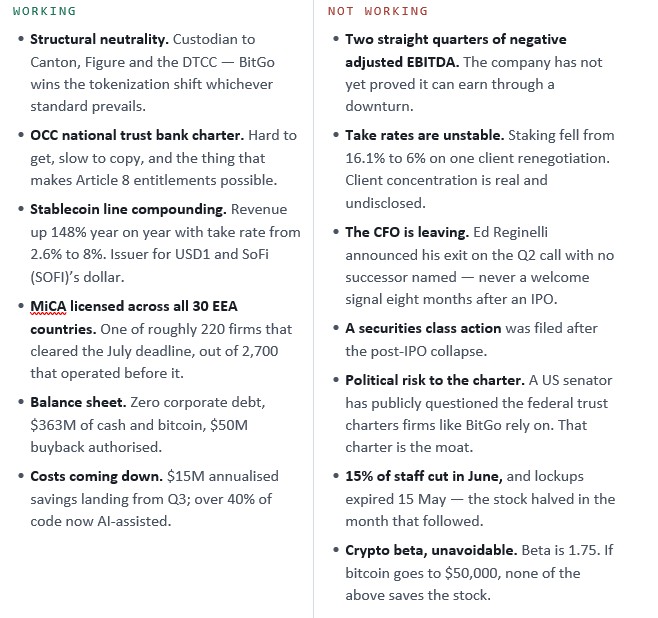
How to think about it
BitGo is a leveraged bet on crypto becoming boring — on digital assets turning into regulated financial plumbing that banks, ETF issuers and eventually the DTCC run their operations through. If that happens, the company that holds the charter and sits under every competing standard is worth a great deal more than $522 million.
If instead crypto stays a speculative asset class that trades in violent cycles, BitGo is a thin-margin broker with unstable take rates, no profits, and a stock that will keep tracking bitcoin down as well as up.
The tell will not be the bitcoin price. It will be whether Q3, reported in November, delivers the positive adjusted EBITDA management has guided to — and whether the lending-against-tokenized-equities business that the SEC just legalised starts showing up as revenue.
Sources. Figure Technology Solutions Q2 2026 results (13 Aug 2026) and Q2 10-Q; Morpheus Research report on Figure, 16 Apr 2026; BitGo and Figure joint release, 20 Feb 2026. BitGo Q1 2026 and Q2 2026 earnings call transcripts (Seeking Alpha, 13 May and 12 August 2026); BitGo Q2 2026 results press release, investors.bitgo.com; Seeking Alpha coverage by Mike Fay (7 Feb 2026), Tyler Wiedwald (18 May 2026) and Dorine Cherop (6 Jul 2026); SEC press release 2026-90, “SEC Issues Innovation Exemption to Facilitate the Trading of Tokenized NMS Stock”, 17 September 2026; share price and company data via Financial Modeling Prep and Alpha Vantage, 18 September 2026.
Economic revenue is calculated as: digital asset sales margin + staking revenue × take rate + subscriptions and services + stablecoin revenue × take rate + interest income. Q2 2026 = $42.4M; Q1 2026 = $49.1M. Enterprise value uses 117.1M shares (108.2M Class A + 8.9M Class B) at $7.56, less $159.0M cash and 2,523 BTC marked at $80,971.
This is not investment advice. It is a research note prepared from public filings and market data for general information. I am not a licensed financial adviser. BitGo is an unprofitable small-cap whose share price has fallen 70% this year and whose business is directly exposed to cryptocurrency prices. Do your own work and consider speaking with a licensed adviser before acting.
Source: https://oilandgas-investments.com/2026/latest-reports/the-digital-stock-plumbing-tradebitgo-btgo-nyse/
Anyone can join.
Anyone can contribute.
Anyone can become informed about their world.
"United We Stand" Click Here To Create Your Personal Citizen Journalist Account Today, Be Sure To Invite Your Friends.
Before It’s News® is a community of individuals who report on what’s going on around them, from all around the world. Anyone can join. Anyone can contribute. Anyone can become informed about their world. "United We Stand" Click Here To Create Your Personal Citizen Journalist Account Today, Be Sure To Invite Your Friends.
LION'S MANE PRODUCT
Try Our Lion’s Mane WHOLE MIND Nootropic Blend 60 Capsules
Mushrooms are having a moment. One fabulous fungus in particular, lion’s mane, may help improve memory, depression and anxiety symptoms. They are also an excellent source of nutrients that show promise as a therapy for dementia, and other neurodegenerative diseases. If you’re living with anxiety or depression, you may be curious about all the therapy options out there — including the natural ones.Our Lion’s Mane WHOLE MIND Nootropic Blend has been formulated to utilize the potency of Lion’s mane but also include the benefits of four other Highly Beneficial Mushrooms. Synergistically, they work together to Build your health through improving cognitive function and immunity regardless of your age. Our Nootropic not only improves your Cognitive Function and Activates your Immune System, but it benefits growth of Essential Gut Flora, further enhancing your Vitality.

Our Formula includes: Lion’s Mane Mushrooms which Increase Brain Power through nerve growth, lessen anxiety, reduce depression, and improve concentration. Its an excellent adaptogen, promotes sleep and improves immunity. Shiitake Mushrooms which Fight cancer cells and infectious disease, boost the immune system, promotes brain function, and serves as a source of B vitamins. Maitake Mushrooms which regulate blood sugar levels of diabetics, reduce hypertension and boosts the immune system. Reishi Mushrooms which Fight inflammation, liver disease, fatigue, tumor growth and cancer. They Improve skin disorders and soothes digestive problems, stomach ulcers and leaky gut syndrome. Chaga Mushrooms which have anti-aging effects, boost immune function, improve stamina and athletic performance, even act as a natural aphrodisiac, fighting diabetes and improving liver function. Try Our Lion’s Mane WHOLE MIND Nootropic Blend 60 Capsules Today. Be 100% Satisfied or Receive a Full Money Back Guarantee. Order Yours Today by Following This Link.


| Visits: | 1,832,866,022 |
| Stories: | 8,709,730 |
Whistler Blowers, Insiders

