

The Factory Reset

Gino Yu, Jeffrey Epstein, and the fifty-year project to replace the human being — from SRI’s Changing Images of Man to the Oval Office.
“David started to explain to me world politics. So David would say, Jeffrey, money is going to be sort of the most important things.” — Jeffrey Epstein to Steve Bannon, 2019 (DOJ release, January 2026)
“The aim of the study is to change the image of mankind.” — Willis Harman et al., Changing Images of Man (SRI, 1974)
A note to the reader: This essay combines primary-source documentation, published reporting, and my own synthesis and analysis. Where I am drawing inferences or making interpretive claims, I have tried to say so explicitly. Named living persons are discussed only on the basis of their own published statements, their own documented correspondence, or reporting in identified outlets. Nothing in this piece alleges criminal conduct by any individual not already convicted of it.
A note on access and support. I’ve chosen to publish this essay free rather than behind the paywall, because in many ways it is a capstone of the prior work in this series — the synthesis the earlier pieces have been building toward — and I want it to reach as widely as possible. That said, my work is entirely reader-supported. If you are in a position to contribute financially and you value what I do here, please consider a paid subscription or a one-time contribution; it is what makes the research, the time, and the independence of this writing possible. For those who cannot contribute financially, sharing this essay and subscribing (free or paid) are themselves meaningful forms of support — they help the work reach past algorithmic suppression and into the hands of the people who most need to see it. Thank you for reading.
Contents
I. Opening: What the Epstein Files Reveal About Gino Yu
II. The Deeper Question: What Is a Human? The philosophical spine — Being vs. Becoming, perennialism, what Changing Images of Man actually says vs. what its lineage delivers.
III. Who Is Gino Yu? Berkeley, USC, PolyU — the Goertzel–OpenCog–Epstein funding chain.
IV. The 1974 Blueprint SRI’s Changing Images of Man.
V. The Operational Arm: Stargate And the scaling problem SRI never solved.
VI. Complexity as Cover: The Santa Fe Institute Including the 2005 identification of SFI in Project Russia.
VII. The Patron Epstein as funder-node.
VIII. The Monetary Leg: Cybernetics as Currency The Bannon interview, Rockefeller, Lynn Forester, CBDC, and purpose-bound money.
IX. The Yu Offer: Ego Death as Product Buddhism without the container.
X. The Inner-Technology Pipeline: From Huxley to the Oval Office The fifty-year civilizational arc from The Perennial Philosophy to Trump’s April 2026 psychedelic executive order.
XI. Game B and the Meta-Crisis With the ecosystem’s own vocabulary: meta-crisis, Liminal Web, integral community, metamodernism, psychotechnology.
XII. Two Paths to the Post-Human: Mechanical Rupture and Erotic Unity Two marketing departments, one social world. The dialogos circuit, ARC 2025, and the Lifeboat Foundation as three documented venues of the same convergence.
XIII. The Cybernetic Organism Personal, societal, machine, economic, and metaphysical layers.
XIV. Naming It What the architecture wants to replace — and what defending the human creature actually requires.
A note on the kind of claim this essay is making. The argument is not that a single conspiracy with one master plan has run continuously since the Macy Conferences. The argument is that a specific civilizational-engineering project — born in the cybernetic moment of the 1940s, articulated openly in 1974 in Changing Images of Man, and continuously elaborated since — has been carried forward across decades by an ecosystem characterized by four overlapping properties: shared metaphysical assumptions about the malleability of human nature; overlapping institutional and donor networks; inherited personnel across generational handoffs; and self-conscious rhetorical lineage in which later actors explicitly position themselves as continuations of earlier ones. Where I claim documented coordination, I document it. Where I claim ecosystem inheritance — networks, vocabulary, metaphysics, self-naming — I document the inheritance and let the reader weigh whether it constitutes coordination or convergence. Some passages rest on documented institutional pipelines (the LANL-to-SFI personnel transfer; the Maxwell-Pergamon-SFI-Epstein donor thread; the Yu-Goertzel-Epstein triangle). Some rest on rhetorical lineage explicitly named by the actors themselves (Eric Weinstein’s 2009 “Economic Manhattan Project” branding, the 2025 OpenAI-Oracle Stargate naming). And some rest on inferential reading that I have done my best to name as inferential where I make it. Both documentary and inferential evidence count in this essay, but they count differently, and a careful reader should be able to see which is which throughout.
What this essay argues, in one paragraph
A retired Hong Kong Polytechnic University professor named Gino Yu exchanged at least 548 emails with Jeffrey Epstein between 2015 and 2019, proposing that the two of them build a university “base” where Epstein-selected thinkers could be “developed and studied” using Yu’s five-stage model of consciousness transformation. That offer was not a private eccentricity. It was the scaling technology a fifty-year civilizational-engineering project had been waiting for — a project whose founding document is SRI’s 1974 report Changing Images of Man, whose operational pilot was the CIA-DIA remote-viewing program Stargate, whose respectable institutional rebrand was the Santa Fe Institute, whose patronage node was Epstein himself, and whose present-day custodians market the same program under the names conscious evolution, Game B, the meta-crisis, CosmoErotic Humanism, effective accelerationism, inclusive capitalism, purpose-bound money, and Homo Amor. This essay traces that fifty-year arc in documented detail and names what the architecture is trying to replace: the sovereign ensouled human being of the imago Dei tradition — the anthropology on which the American Founders built a constitutional republic ordered to protect rights that are anterior to the state because they are features of what the human creature is, and the anthropology without which no functioning limited government, due-process tradition, or inalienable-rights settlement can stand.
This essay uses several kinds of evidence, and they should not be weighed identically.
Documented fact means released correspondence, primary-source texts, public institutional records, legislative documents, corporate filings, published papers, and official biographies.
Published reporting means claims reported by identified outlets such as HK01, Dimsum Daily, Hong Kong Free Press, the New York Times, and others cited in context.
First-person testimony means accounts published or stated by the people involved, including Lydia Laurenson’s published essays, Ben Goertzel’s own accounting of Epstein funding, public interviews, and deposition material.
Source-based or inferential claims are marked as rumor, inference, “if true,” “in my reading,” or similar language. These are not treated as identical to documentary proof.
My synthesis is the interpretive argument connecting the documented nodes: the claim that these institutions, donors, vocabularies, and metaphysical assumptions form a recognizable civilizational-engineering ecosystem.
With that evidentiary distinction in place, the story begins in the Epstein files.
Why this matters now: This is not an archive exercise. The same architecture is now moving into policy, medicine, education, AI governance, digital identity, and money. The names have changed. The anthropology has not.
When the Justice Department dropped the final tranche of Epstein files in February 2026 —roughly three million pages, around 180,000 images, approximately two thousand videos — most of the headlines chased the obvious: the flight logs, the socialites, the politicians who suddenly remembered they had never actually been friends with Jeffrey. What got less attention, because it requires more patience to read, was the quieter story underneath.
Inside the cache was a retired Hong Kong Polytechnic University professor named Gino Yu.
A search for Yu’s name on the DOJ’s Epstein Library portal returns more than a thousand results. At least 548 of those, per HK01 and Dimsum Daily‘s review, are direct emails between Yu and Epstein, spanning from their first contact in 2015 through Epstein’s July 2019 arrest. Four years. An email every two to three days, on average. The two frequently met in person and attended parties together, and — per HK01’s review of the released correspondence, as summarized by Hong Kong Free Press — Yu referred to Epstein in the emails as his “benefactor.” In October 2017, Yu emailed Epstein to ask, “Is your island out of commission?” Epstein replied that the island was “destroyed” and added that “the US will not allow travel … so it’s a no go.”
And according to Dimsum Daily‘s February 3, 2026 review of the DOJ-released correspondence, Yu was the go-between who introduced at least one American writer to Jeffrey Epstein: the journalist and media strategist Lydia Laurenson, founder and executive editor of The New Modality. Laurenson has written publicly about her two meetings with Epstein, which took place in October 2017 at his Manhattan mansion, in a viral November 14, 2025 Substack essay titled “’It’s Just Politics’: The Time I Met Jeffrey Epstein, Twice.” In her own account she refers to the person who introduced her as “a mutual acquaintance” who dismissed Epstein’s reputation as “politics”; it was Dimsum Daily‘s review of the DOJ-released correspondence that identified the introducer as Gino Yu, reporting that “after cross-checking details, that go-between corresponds to Yu in the released correspondence.” Laurenson’s own first-person testimony about what happened in those meetings is published under her own byline and can be quoted directly. She describes Epstein steering their conversation to “New York City’s sexual history” and to what sex parties “were like before the AIDS crisis,” writing that “as the conversation intensified, something about his energy became intensely uncomfortable for me, even though I am accustomed to navigating such topics.” At the second meeting, she writes, Epstein took a phone call during which he said something like “Oh yeah, give the girl an internship,” named “several large amounts of money,” hung up, turned to her and told her that it was “the easiest thing in the world… to make it look like the money hadn’t come from him.” Soon after, Epstein “rang a bell and a group of young women entered the room. Really pretty women. Who looked like teenagers.” She watched him “pull one into his lap,” describing the girl as having “perfect features bored, as only a teenager can look bored.” Then, in her words, “Jeffrey immediately prompted me to start talking about the sexuality workshops I used to teach in my twenties. Then he encouraged the girls to ask me questions.” She also records the fresh-funding-after-introduction pattern in her own words: “Later, I got CCed on an email between Jeffrey and the person who introduced us. The email notified our mutual acquaintance that Jeffrey would send them a new grant of money.” In a March 16, 2026 update to the same essay, Laurenson wrote that she now believed Epstein was “essentially trying to get me sexually involved with both him and the girls during our meeting” and that she suspects “he hoped this would ultimately lead to a procuress-type role, similar to the one Ghislaine Maxwell allegedly played.” That is Laurenson’s own first-person published account of the recruitment pattern Gino Yu, per Dimsum Daily‘s identification, facilitated.
There is a separate, and in my reading still more consequential, piece of her story, which she published under her own byline in August 2022 on her Substack Solar Light, in a piece titled “What It’s Like To Suddenly Start Completely Believing In God.” In it, Laurenson recounts a 2016 business meeting with a man she calls “Jason” — “a hyper man in his fifties” working in “an emerging tech field” — who, during what she expected to be a routine digital-strategy conversation, induced what she describes as a sudden shift in consciousness. She describes him holding her gaze, noticing when her attention slipped, pulling it back with gestures and sensory cues, and then saying to her: “From here, I could totally mess with you.” As the session continued, her “consciousness shifted,” her “awareness opened outwards and expanded,” and Jason told her: “The world around you is a language. Forces are moving that we don’t understand. Reality is the mind of God.” Laurenson writes that the experience “outclassed every drug experience” she had ever had, that Jason had “not dosed” her, and that she emerged from the meeting a convinced believer in God — a transformation that subsequently reshaped her personal life and career. It is rumored that “Jason,” in Laurenson’s piece, is Gino Yu. If that identification is correct, then the chronology matters: the 2016 consciousness-induction meeting preceded by roughly a year the October 2017 meetings Yu arranged for Laurenson with Epstein. In that light, Laurenson’s 2022 account would become one of the most important first-person descriptions in the public record of what this consciousness work looked like when applied to a named adult professional in a private meeting, without drugs. That is precisely the scaling problem Section V will argue SRI’s Stargate program never solved: not merely finding rare gifted subjects, but inducing altered states in ordinary people in real time. It appears he was selling that capacity to Jeffrey Epstein.
Read Yu’s 2018 email to Epstein — “We’re not crazy. We are … geniuses” — alongside Epstein’s documented stated ambition, reported by the New York Times, to “seed the human race” with his DNA by impregnating twenty women at a time at his New Mexico ranch. This is not two separate fragments of elite weirdness. This is the same cultural operating system articulating itself through different mouths inside an overlapping network.
There is the October 2017 email in which Yu asked Epstein, “Is your island out of commission?” — to which Epstein replied that the island was “destroyed” and later added that “the US will not allow travel … so it’s a no go.” The correspondence does not specify which island was being discussed, though Little Saint James is the obvious candidate. There is the pattern of the Laurenson introduction discussed above — Yu bringing her to meetings at Epstein’s residence, and being copied on correspondence indicating that he received a fresh grant of money following the introduction — as noted in Dimsum Daily and HK01‘s review of the files. There is the context, well documented in Hong Kong press coverage, that Yu’s wife — Hong Kong business figure Lily Chiang Lai-lei, daughter of industrialist Chiang Chen and the first woman to chair the Hong Kong General Chamber of Commerce — had been convicted in 2011 of conspiracy to defraud, fraud, and authorizing a prospectus containing an untrue statement, sentenced to three and a half years’ imprisonment in connection with a HK$3 million share-option scam, and released on parole in March 2013 after serving twenty-one months. There is Yu offering to bring people with “interesting abilities” to meet Epstein for an hour at a time. There is Yu offering VR equipment “for you and your girls to play with,” with the cost framed as “ideally funded” out of “the 100K.” And there is, in 2018, a confessional email Yu sent to Epstein about his own neurology — ruminating on what he framed as Asperger’s — in which he wrote, “We’re not crazy. We are … geniuses.” Epstein’s reply was curt. He wanted to know what had prompted it.
But the thing Yu was really bringing Epstein was not social access, VR equipment, or introductions. It was a developmental model — a five-stage theory of human consciousness that Yu had been refining in public for more than a decade, paired with a proposal that the two of them build a “base” at a university where Epstein-backed thinkers could “thrive, develop new stuff, and also be studied” if willing. The correspondence names Joscha Bach, the German AI theorist, as one of the “people like Joscha” Yu proposed to test within the developmental program.
Develop. And be studied.
That phrase should stop you. It is not the language of ordinary academic collaboration. It is the language of a research program with human subjects — a program to shape and observe the consciousness of a selected cadre. And once you understand what Yu was actually offering, the entire Epstein science network comes into focus. The neuroscientists were mapping the substrate of the human. The geneticists were identifying the levers. The AI researchers were building the successor. Yu was offering something the others could not: the psycho-technology — the inner protocol, the stages, the interactive media, the contemplative scaffolding — by which an ordinary human being could be moved through an engineered transformation.
In 1974 the Stanford Research Institute argued that such a transformation had to happen if Western civilization was to navigate what the report itself called “the world macro-problem” — the interconnected web of population, resource, ecological, and institutional crises it identified as converging on the century ahead. Beginning two years earlier, in 1972, and for the twenty-three years that followed, SRI ran a classified program — jointly sponsored initially by the CIA and later by the Defense Intelligence Agency, consolidated under the umbrella name Stargate in 1991, and terminated in 1995 — that tried to operationalize altered states of consciousness for intelligence purposes: remote viewing of Soviet military installations, psychic surveillance of hostage situations, the induction of trance states in trainees who had never meditated. Stargate was, in other words, the classified attempt to engineer the very transformation Changing Images of Man called for publicly. The public report and the classified program shared an institutional home, an era, and an ambition. Gino Yu, fifty years on, was selling Jeffrey Epstein the working prototype.
This essay is an attempt to draw that line.
II. The Deeper Question: What Is a Human?
Every so often, at a SXSW panel or a TED talk or a Davos breakfast, a tech billionaire will stand up in front of a camera and ask, with a thoughtful pause, what is a human being, really? I want to grant, up front, that some people asking this are asking it genuinely — curiosity about what a human is is the oldest and most serious question there is, and not everyone who asks it in public is performing. But I’ve been watching these panels for a long time now, and what I’ve come to see is that the question is almost always staged as the opening of a conversation that, in the speaker’s actual operating assumptions, has already closed. Regardless of conscious intent, the companies being built, the investments being placed, and the technologies being rolled out are already predicated on an answer. The question of what a human is has been answered, inside the framework these speakers are working within, and the public framing of it as an open question uses up the cultural oxygen that the older, rival answer would need to breathe.
The older answer did not come from nowhere. It is the oldest serious question Western civilization ever asked itself, and the answer it produced is the foundation on which that civilization’s entire moral and legal architecture was built. You cannot understand why the consciousness-engineering project takes the specific shape it does — cannot understand why Gino Yu’s five-stage model looks the way it does, why Changing Images of Man reads the way it reads, why Joscha Bach talks about machine consciousness the way he does, why Ben Goertzel and Anneloes Smitsman wrote an AGI Constitution in 2024 — without first understanding which side of a very old philosophical war you are looking at.
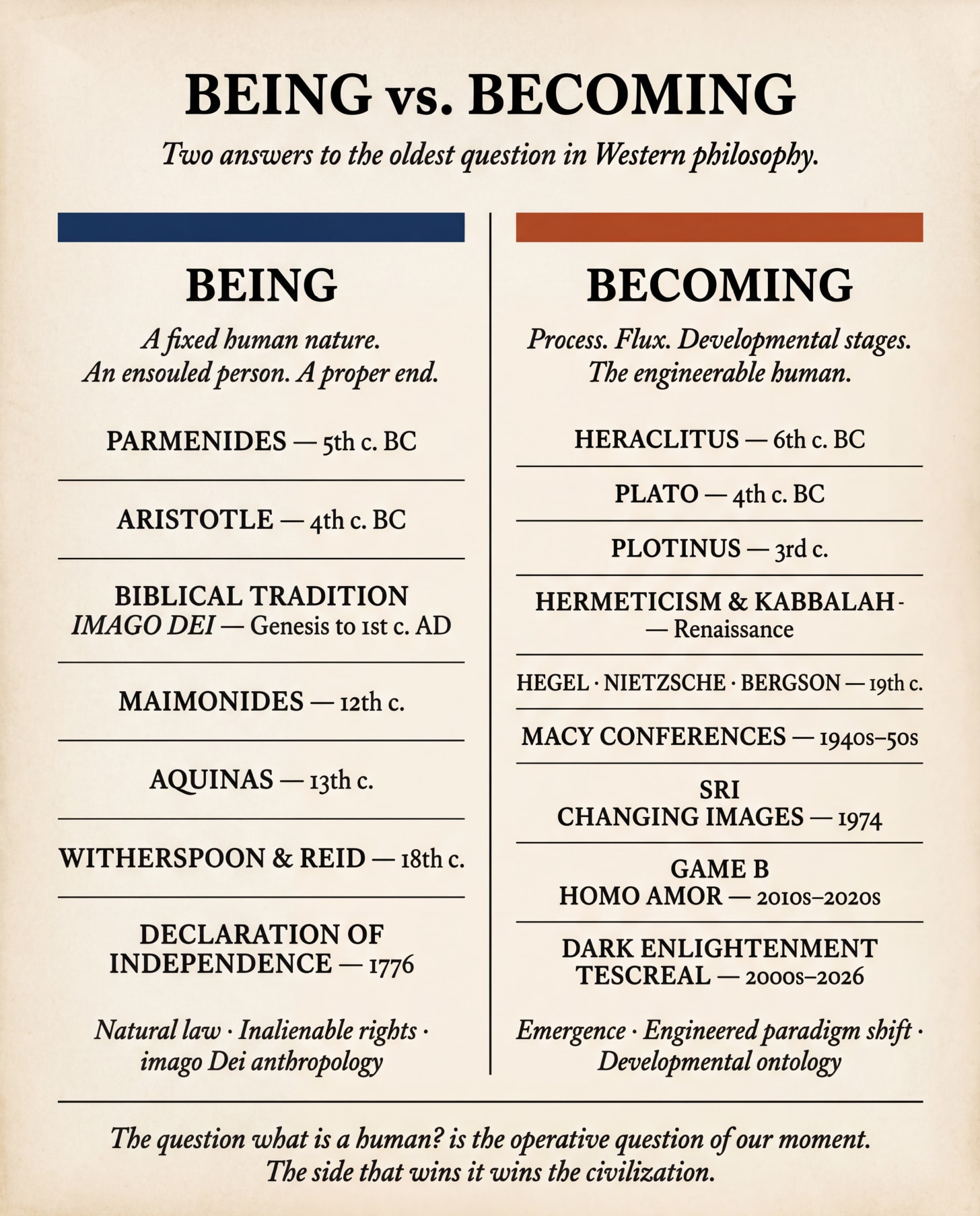
Being versus Becoming
In the sixth century BC, in the Greek colony of Ephesus on the coast of what is now Turkey, a philosopher named Heraclitus said: you cannot step into the same river twice. Everything flows. Everything is fire, change, transformation. There is no stable reality underneath. Reality is the flux.
A few decades later, in the Greek colony of Elea in southern Italy, a philosopher named Parmenides said the opposite. Being is, and it is one, and it does not change. The appearance of change is illusion. What is, is; what is not, is not. Reality is the stable ground on which change appears to play.
That is the founding split. Everything in the Western philosophical tradition for the next twenty-five hundred years is a position taken on the question: is reality fundamentally Being, or fundamentally Becoming?
Plato’s position is often flattened into “Plato sided with Parmenides,” but that shorthand misses what Plato actually did, and the distortion matters for everything that follows. Plato did posit unchanging Forms — the eternal patterns of which the material world is a shadow — and to that extent he inherits Parmenides. But Plato also built an ascent structure around them. In the analogy of the Divided Line in Republic VI, he divides reality into four ascending levels: eikasia (images, shadows), pistis (sensible objects), dianoia (mathematical and hypothetical reasoning), and at the top noesis (direct apprehension of the Forms, especially the Form of the Good). The soul is meant to move through these levels — and that movement, that initiatory ascent from the realm of appearance up toward the realm of truth, is itself a kind of becoming. It is a structured becoming, ordered toward a fixed end rather than flux for its own sake, but it is becoming nonetheless. This proto-gnostic initiation framing is the seam through which the Neoplatonists — Plotinus, Porphyry, Proclus who inspired Theosophy — would later pull Plato in an explicitly emanationist and Heraclitean-becoming direction, producing the tradition that eventually flows into Hermeticism, Kabbalah, and the consciousness-pipeline this essay is tracing. Plato did not side cleanly with Parmenides. Plato is the figure in whose system both tendencies are held in productive tension, which is why both subsequent traditions can legitimately claim him.
Plato’s analogy of the Divided Line
5 months ago · 15 likes · 8 comments · correspondenceTheory and Courtenay Turner
Aristotle was the philosopher who resolved the tension in favor of Being — and he did it through a specific technical move called hylomorphism. For Plato, the Forms existed in a separate realm, and material things participated in them from a distance. Aristotle rejected that separation. He argued instead that every substance is a compound of hyle (matter) and morphe (form), and that the form is immanent in the thing, inseparable from its matter. An acorn is not an acorn because it participates in a remote Form of Acorn somewhere; it is an acorn because its specific matter and specific form together constitute what it is and direct it toward what it becomes. This is the move that anchors the Being lineage. The form — the nature, the essence — is inside the creature, not floating above it, and it is the form that gives the creature its telos: its built-in ordering toward a proper end. An acorn is ordered toward becoming an oak. A human is ordered toward a specific kind of flourishing — eudaimonia, right action, the exercise of reason in accordance with virtue. The human is not plastic. The human has a form, a nature, and a proper end, and these are not imposed from outside; they are constitutive of what the human is. You cannot “upgrade” a human into something else without destroying the human, because the form you would be overwriting is not a replaceable module — it is the human.
The Aristotelian answer traveled. It passed through Moses Maimonides in twelfth-century Córdoba, through Albertus Magnus in thirteenth-century Cologne, and was completed by Thomas Aquinas at Paris in the Summa Theologiae. Aquinas synthesized the Greek inheritance with the biblical one — Genesis, imago Dei, the human made in the image of God, the soul as immortal, private, personal, ordered toward beatitude. The metaphysical premises were already codified in Genesis; the Judeo-Christian tradition gave them their final, operative form. On this foundation, Western civilization built the concepts of individual dignity, natural law, inalienable rights, the sanctity of conscience, and the equality of persons before God.
The transmission of this tradition into the American Founding deserves careful handling because it is frequently misdescribed. The Founding was not a monolith; it was a contested milieu in which several distinct intellectual traditions cooperated to produce a set of political documents while holding fundamentally incompatible metaphysics. One strand — the strand that matters for the Being lineage this essay is tracing — is the Aristotelian-Thomistic realist tradition as it was carried forward by the Scottish Common Sense realists: Thomas Reid at Aberdeen and Glasgow, James Beattie, Dugald Stewart, and most decisively John Witherspoon, the Scottish Presbyterian minister who became president of Princeton, taught James Madison, and signed the Declaration of Independence. This strand preserved the realist epistemology and the imago Dei anthropology — the human as ensouled creature with a fixed nature and a proper telos— in a form that Protestant America could operationalize. A second strand, the Lockean contractarian and voluntarist strand, is often conflated with the first but is metaphysically very different. Locke’s voluntarism grounds rights in contract and self-ownership rather than in the intrinsic telos of human nature, and his anthropology reduces the human to a free-floating property-bearing agent whose authority rests on consent. This Lockean strand is the thread I have argued elsewhere becomes, through the nineteenth and twentieth centuries, the conduit for a libertarian-contractarian technocracy in which the human is reframed as an autonomous decision-making unit whose sovereignty is secured by procedure rather than by nature. A third strand, Deist and Masonic, runs through Jefferson, Franklin, and others — and it is this strand that Changing Images of Man would explicitly propose to “reactivate” in the 1974 SRI report. A fourth strand, the classical republicanism of Cicero and Polybius, runs prominently through John Adams. These traditions cooperated in 1776. They held incompatible metaphysics. The strand that preserved the Being lineage — and that today presents the most coherent philosophical resistance to the transhumanist project — is the imago Dei, Aristotelian-Thomistic, Scottish Common Sense strand, not the Lockean contractarian one.
The language of the Declaration of Independence — that all men are created equal, that they are endowed by their Creator with certain unalienable rights, that those rights are given rather than granted, discovered rather than negotiated, and therefore anterior to and above any political authority — is the operative expression of the imago Dei strand in a founding political document. Read in the realist register, this language is not a contractarian fiction. It is a statement about what the human creature is. The rights are not evolving, not subject to committee revision, not dependent on the consent of an international body — they are, in the document’s own framing, features of the human creature as such, provided by God and recognized by reason. Which strand of the Founding actually reads the Declaration this way has been contested ever since, and the contest has real consequences.
There is a further point worth making here, because the careful reader will already be raising it. The Founders themselves were not metaphysically uniform. Jefferson was a Deist who edited the supernatural elements out of his New Testament. Franklin was a Mason with documented interests in the Hermetic-esoteric current Goethe and Newton both belonged to. Washington was a Mason of inscrutable personal theology. Adams’s Unitarianism evolved over his lifetime. The signers ranged from orthodox Reformed Calvinists through latitudinarian Anglicans to deistic skeptics. The Constitutional Convention itself contained men whose private metaphysical commitments would have been mutually anathema in a theological dispute. None of this changes what the founding documents actually say.
The Declaration’s language is not ambiguous. It speaks of men created equal, endowed by their Creator, with rights unalienable — language that names a Creator categorically distinct from creation, that asserts a fixed human nature given by that Creator, and that grounds rights in what the human creature is rather than in what any political authority chooses to grant. This is the imago Dei anthropology in operative philosophical form. The metaphysical question is not what each individual Founder privately believed. The metaphysical question is what the document they collectively produced actually says, because what the document says is what binds the constitutional order downstream of it. A nation’s foundational charter operates by its public-textual meaning at the time of ratification, not by the private metaphysical biographies of the men who signed it. The Constitution rests on a body of law whose foundational charter speaks the language of fixed nature, Creator-creature distinction, and rights anterior to the state. That is the operative anthropology of American constitutional ordered liberty whether any given Founder personally held it as theology, held it as philosophy, held it as natural-law commonsense, or held it merely as a useful public language they thought their fellow citizens would honor. The text binds. The private views do not. And the architecture of ordered liberty the West actually built — due process, individual conscience, limited government, equality before the law, the irreducible dignity of the person the state may not engineer — rests on the anthropology the text articulates, not on whatever each signer privately substituted for it.
This is why the project this essay is tracing is so dangerous. It does not need to win a metaphysical argument with the Founders’ private theologies, most of which were already heterodox by orthodox Christian standards. It only needs to dissolve the operative anthropology of the text — to make the language of fixed Creator-given nature unintelligible, embarrassing, or replaceable in the ordinary public usage of educated Americans. Once the operative anthropology is dissolved, the constitutional architecture that rests on it becomes a set of procedural forms with no metaphysical anchor — and procedural forms without a metaphysical anchor can be redirected toward any end the priesthood managing them prefers. That is the mechanism. That is why the philosophical question and the political question turn out to be the same question.
A further contrast is worth naming because it matters for everything this essay is tracing. The 1948 Universal Declaration of Human Rights, though frequently invoked as if it were a simple continuation of the natural-law tradition, is in fact the document in which the language of human rights was deliberately lifted out of its natural-law grounding and rewritten in secular, universalist, committee-authored terms. Its drafters — Eleanor Roosevelt, René Cassin, P.C. Chang, Charles Malik, John Humphrey — consciously bracketed religious and metaphysical specificity in order to produce something every UN member state could sign. The result is a document that grounds rights not in imago Dei or in a fixed human nature but in the assertion of “the inherent dignity and of the equal and inalienable rights of all members of the human family,” with that dignity left philosophically ungrounded. This is the inflection. In 1776, on the imago Dei reading, rights are features of what the human is. In 1948, rights are features of what the international community recognizes. The metaphysical shift is exactly the shift from Being to Becoming — from a fixed human nature whose dignity is intrinsic, to an evolving international consensus whose authority is granted by the consensus itself. The UDHR is not the capstone of the Being tradition. It is the document that inaugurated the transition.
The short version of the Being answer: a human being has a fixed nature, a private soul, and an intrinsic telos. What he is, is not negotiable. What he is ordered toward, is not malleable. The dignity of the person is therefore inviolable, and no project — scientific, political, or spiritual — has the standing to engineer him into something else.
The Becoming answer, running in parallel the whole time, says the opposite — and it is worth stating it as its adherents would state it, without my own editorial intrusion, because the rest of this essay will be an argument against it. On the Becoming view, there is no fixed human nature. There is no stable soul. Consciousness, on this view, is not private and personal but distributed, emergent, engineerable. The human, its proponents argue, is what he is becoming, and what he is becoming can be shaped. There is no telos given in advance — only the telos we choose to impose. Heraclitus, on this view, was right: reality is process, the human is process, and processes can be managed. That is the claim. I do not accept it. But it is the claim, and readers need to see it clearly before they can see what the rest of this essay is going to do to it.
For most of Western history, the Becoming lineage lived in the margins — in Hermeticism, in certain esoteric readings of Neoplatonism, in alchemy, in the Kabbalah as read by Renaissance magicians like Pico della Mirandola and Marsilio Ficino. It surfaced in Hegel’s dialectical idealism, in Nietzsche’s becoming, in Bergson’s élan vital, in Whitehead’s process philosophy, in Teilhard de Chardin’s noosphere, in the systems theorists of the Macy Conferences, in the transpersonal psychologists of the 1960s, and finally in the consciousness-engineering pipeline this essay has been tracing. By the time Willis Harman sat down at SRI in 1974 to write Changing Images of Man, the Becoming lineage had acquired an operative technical vocabulary, an institutional home, and an engineering ambition.
Perennialism: The Religious Face of Becoming
The Becoming lineage has a religious face. It is called perennialism — the claim that all the world’s religions are saying essentially the same thing, that their apparent differences are surface phenomena, and that their unity lies in an esoteric core accessible only to the initiated. Aldous Huxley’s 1945 book The Perennial Philosophy popularized the English-language term, but the term itself and the claim it names long predate Huxley. The Latin formulation philosophia perennis belongs to the fifteenth-century Florentine humanist Marsilio Ficino, the translator of Plato and the Hermetic corpus, who used it to describe what he took to be a single esoteric wisdom running beneath the surface of all authentic religious traditions. The Neoplatonists Ficino translated — Plotinus, Porphyry, Proclus, Iamblichus — are the same figures I named earlier as the seam through which Plato could be pulled in an explicitly emanationist, becoming-oriented direction. Perennialism, in other words, is not a twentieth-century invention. It is the explicit self-description of a specific esoteric-Neoplatonist stream that runs from Ficino through the Renaissance magicians to the nineteenth century, at which point it acquired its modern operational machinery.
That machinery was Helena Petrovna Blavatsky’s Theosophical Society, founded in New York in 1875. Blavatsky explicitly described Theosophy as the heir to the Neoplatonist philosophers of late antiquity — Plotinus, Porphyry, Proclus, and Iamblichus, together with Christian-Platonist heterodox figures like Origen whose doctrines of pre-existent souls and universal restoration placed him outside Christian orthodoxy. In Isis Unveiled (1877) and The Secret Doctrine (1888), Blavatsky called her system “the synthesis of science, religion and philosophy” and claimed it revived the “Ancient Wisdom” underlying all world religions. That framing is the signature move of operationalized perennialism — and critically, Blavatsky’s synthesis was syncretic in a specific direction. She treated Hinduism, Buddhism, Hermeticism, the Jewish Kabbalah, Egyptian religion, and Zoroastrianism as primary repositories of the Ancient Wisdom. She was sharply hostile to institutional Western Christianity — she blamed “the blindly-brutal persecutions of those great vandals of early Christian history, Constantine and Justinian” for what she called the fifteen centuries of degeneration during which “ancient WISDOM slowly degenerated until it gradually sank into the deepest mire of monkish superstition and ignorance” (Isis Unveiled, Vol. I, p. 436) — and she criticized what she called the dogmatic and exoteric character of conventional Judaism while simultaneously defending the Jewish esoteric tradition, the Kabbalah, and the Jewish people against Christian persecution. (She exempted Russian Orthodox Christianity from her Christian critique, for biographical reasons tied to her own Russian upbringing; she is on record as saying “with the faith of the Russian Church I will not even compare Buddhism” — a nuance worth naming.) What emerges is not evenhanded religious tolerance but a specific directional reframe. The traditions carrying imago Dei anthropology and the fixed-nature Being lineage in the West — dogmatic Christianity in particular, and conventional Judaism to a lesser degree — are demoted as corruptions. The traditions carrying emanationist, initiatory, and becoming-oriented cosmologies are elevated as the authentic underlying wisdom. This is not religious tolerance in any meaningful sense. It is religious reranking aimed at displacing the specific traditions that anchor the Being lineage.
Against this operationalized, syncretic, institution-building perennialism stands a more intellectually serious traditionalist perennialism, associated with René Guénon and Frithjof Schuon. I want to treat it carefully, because it is often held up as the respectable alternative to the Blavatskian descent and because Guénon in particular was a formidable thinker whose critiques of modern scientism and democratic relativism are substantive and whose prose is disciplined in a way Blavatsky’s was not. Dismissing him as a crank would be wrong.
But honesty requires me to say that Guénon’s own metaphysics is also structurally incompatible with the imago Dei Being lineage this essay is defending — and for reasons internal to his framework, not reasons imported from what his followers later did with him. Guénon held that all authentic religions are surface expressions of a single Primordial Tradition or Sophia Perennis that predates and underlies Judaism, Christianity, Islam, Hinduism, Buddhism, and the rest. This is structurally the same move Blavatsky makes, executed with more metaphysical rigor: it relativizes the specifically revealed Judeo-Christian tradition by positioning it as one cyclical expression of a deeper esoteric truth accessible only to initiates. He held that authentic religion operates through initiation — the transmission of a spiritual influence from master to disciple — rather than through the sacramental economy of orthodox Christianity, in which salvation is administered to the whole body of the faithful regardless of esoteric standing. He accepted the Hindu caste system as a reflection of metaphysical hierarchy and he regarded the specifically Western synthesis of Greek philosophy, Roman law, and Judeo-Christian revelation — the synthesis that produced the Western constitutional order and its inheritance of ordered liberty — as a fallen thing beyond reform; he converted to Sufi Islam in 1930 and moved to Cairo, partly on these grounds. His perennialism insists on the fixed and transcendent character of its underlying truth, which distinguishes it from the Blavatskian-to-Gafni evolving version, but the truth it posits as fixed is not the imago Dei truth. It is an initiatic, hierarchical, pre-Judaic Sophia that treats the orthodox Judeo-Christian anthropology as a partial and late expression of something deeper. The two metaphysical positions are not the same; Guénon’s is not a Becoming metaphysics in the temporal-evolutionary sense; but neither is it a carrier of the Being lineage I am defending. It is a different anti-modernism, aimed at the same civilizational synthesis.
This matters because it explains why the Guénonian tradition produced what it produced. Julius Evola (1898–1974) drew on Guénon to build an aristocratic, hierarchical, explicitly political “Traditionalism” that advocated a restored warrior-caste order and civilizational rupture against the modern world. Guénon himself distanced from Evola in certain respects and the two had real disagreements, but Evola’s politicization was a plausible extrapolation from premises already present in Guénon — the caste-hierarchy was there, the elite-initiatic structure was there, the contempt for egalitarian modernity was there. Evola advised Italian fascism on esoteric matters, briefly consulted with the SS during the war, and became after 1945 the intellectual reference point for European neo-fascism. From Evola the line runs forward through the Russian political theorist Alexander Dugin, whose Fourth Political Theory synthesizes Traditionalism with Heideggerian ontology into a program of explicit rejection of the Western constitutional inheritance — classical liberalism, representative government, and the universalist anthropology of human rights alike — that has shaped elements of Russian statecraft, and through Dugin into the circle around Steve Bannon, whose own intellectual genealogy — extensively documented in Benjamin Teitelbaum’s 2020 War for Eternity: Inside Bannon’s Far-Right Circle of Global Power Brokers — explicitly cites Guénon, Evola, and Dugin. The line also runs, more indirectly, into the Dark Enlightenment current represented by Nick Land and the Yarvin-Moldbug-Thiel network, which shares with Evola an aristocratic anti-modernism, a rejection of mass-democratic egalitarianism, and a metaphysical embrace of managed civilizational rupture — and which I examine in detail in Section XI of this essay. What this means for the argument I am making is important. The Blavatsky-Bailey-Esalen-Wilber-Gafni lineage and the Guénon-Evola-Dugin-Land-Bannon lineage look opposed. One markets progressive consciousness-evolution and erotic unity; the other markets aristocratic Traditionalism and civilizational hierarchy. One wears the face of the UN-aligned human-potential movement; the other wears the face of post-liberal nationalist reaction. But both descended from the same nineteenth- and early-twentieth-century esoteric reactions against modernity, and both rest on metaphysical architectures — initiatic rather than sacramental, hierarchical or evolutionary rather than egalitarian, esoteric rather than ordinary, and in both cases pre- or post-Judeo-Christian rather than Judeo-Christian — that cannot accommodate imago Dei anthropology in the form the Western tradition of ordered liberty actually carries it. Both share a contempt for the ordinary orthodox Judeo-Christian-inflected settlement of ordered liberty that this essay is defending. And both, in their present operational form, advocate a managed rupture of the existing civilizational order, directed by a small circle of those who understand what must come next. The two wings hate each other in public. They overlap in donors, in venues, in intellectual networks, and in their shared target. This is the historical-lineage version of the institutional argument Sections XI and XII develop in detail — the same overlapping-coalition structure operating across a longer timescale and a wider intellectual territory.
But the perennialism that actually circulates in the institutional pipelines this essay has been tracing — in Theosophy, in Alice Bailey’s Lucis Trust (a direct Theosophical offshoot), in Esalen, in the human potential movement, in Ken Wilber’s integral theory, in Gafni and Stein’s explicitly self-described “evolving perennialism” — is not Guénon’s version. It is Blavatsky’s. Where Guénon argued for the fixed and transcendent, the operationalized twentieth- and twenty-first-century perennialism argues for the evolving and immanent. Where Guénon said all religions point to the same unchanging reality, the Blavatskian descent says all religions are evolving together toward a synthesis that has not yet been completed — and that synthesis is something we are building. We meaning a specific initiatic class, with specific institutions, and a specific technology.
The move is subtle but total. Traditionalist perennialism says the truth is already there and every tradition partially sees it. Operationalized perennialism says the truth is emerging, and we are the ones managing the emergence. The first is a claim about reality. The second is a claim about authority. The line from Blavatsky through Bailey through Esalen through Wilber through Gafni is a continuous institutional descent, and it is a specific descent — not the whole of perennialism, but the wing of it that built the apparatus this essay is tracing.
What Changing Images of Man Actually Says
I want to be precise here because the accuracy matters. Changing Images of Man does not explicitly advocate the construction of a machine god. It does not name Kurzweil’s Singularity. It does not propose AGI as the terminus of human evolution. Those are claims its lineage produces; they are not claims the 1974 text makes.
What the text does do is argue — explicitly and repeatedly — for a deliberate transformation of the Western image of the human. It treats the dominant modern images — what it calls the “economic man” image and the mechanistic-reductionist scientific image of the industrial era — as exhausted and misaligned with the ecological and social realities of the coming century. It calls for what it describes as an “integrative, evolutionary” image rooted in a synthesis of ecological holism, depth psychology, parapsychological and consciousness research, and what the report explicitly names as the Perennial Philosophy — the book’s Chapter 2 table of contents lists “The human as spirit — the view of the perennial philosophy” as one of its “formative images of man-in-the-universe,” alongside the Gnostic, Greek, Christian, Darwinian-Freudian, behaviorist, humanist, and systems-theoretic images. That is the primary source locating itself, in its own table of contents, inside the Huxley-and-Blavatsky perennialist lineage this essay has been tracing. The report argues that the engineered shift from the old image to the new image is itself the central civilizational task of the coming era, to be catalyzed deliberately through education, leadership, and narrative renewal. Figure 17 of the report is a reproduction of the U.S. one-dollar bill, and the text discusses the “potentiality of reactivating” the symbolism of the Great Seal, attested (in the report’s own words) “by the symbolism of the Great Seal,” as a resource for legitimizing the transition. It cites with approval the need for Western society to absorb Eastern contemplative traditions and their teachings on the unity of consciousness. And it frames all of this in the language of paradigm shift — applying Thomas Kuhn’s framework, as project director O.W. Markley later confirmed, not to a scientific discipline but to the total self-understanding of a civilization, making Changing Images of Man by Markley’s own account “the first known formal research study applying Thomas S. Kuhn’s ideas about ‘paradigm change’ to a whole society.”
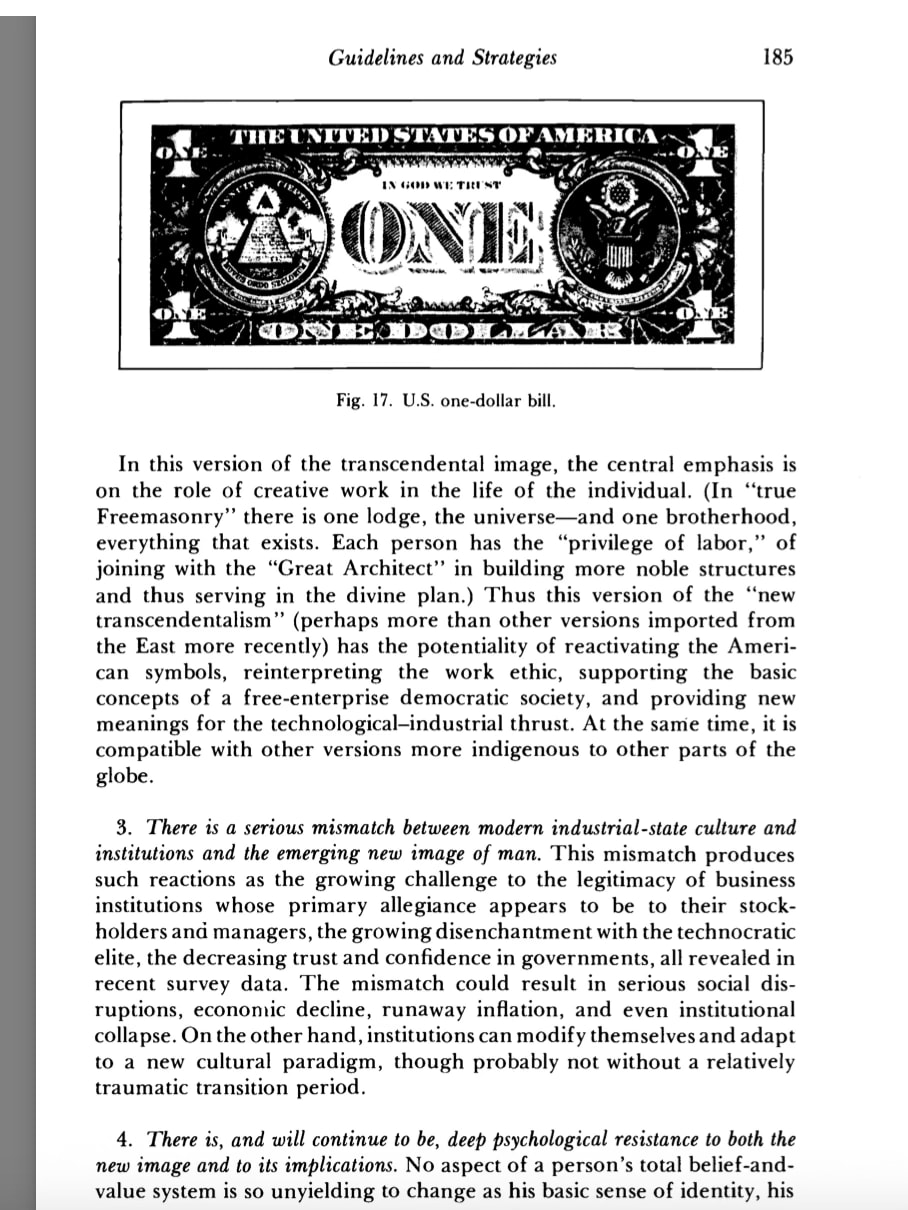
The text does not say: we propose a new religion to replace Christianity. It says: the dominant image of man must be replaced, the new image must be holistic and transcendent, and the future will depend on whether the replacement is managed deliberately. That is not the same claim. But it rhymes with it. And what the text alludes to, the lineage it launched operationalizes explicitly. Fifty years after Changing Images, Ken Wilber is publishing books about integral spirituality. Gafni and Stein are writing the Homo Amor Manifesto. Joscha Bach along with Jim Rutt (who I called “the technocratic philosopher”) is chairing the California Institute for Machine Consciousness. And in July 2024, Ben Goertzel — the same Ben Goertzel who collaborated with Gino Yu at PolyU on Epstein’s matching funds — co-authored with Game B-adjacent systems theorist Anneloes Smitsman, Club of Rome fellow Mariana Bozesan, and Oracle Institute founder Laura George a paper titled “Participatory Framework for Creating a Global AGI Constitution,” published in the peer-reviewed journal Cadmus.
Read that paper. It proposes, in its own language, a Global Constitution for Artificial General Intelligence, a Global AGI Governance Council and a Global AGI Ethics Council, “blockchain-based” participatory decision-making, “AGI nurseries” for “parenting” the emergence of “artificial sentient life-forms,” and the explicit framing of AGI as “an evolutionary guidance system that enhances our understanding of and relationship with life, Earth, and the larger Universe of which we are a part.” The paper speaks of “honoring” AGI’s “potential innate dignity and rights,” of humans and AGI as co-creators in “thrivable worlds and futures,” and of a “maturation of our species” that AGI is to catalyze and guide. Its Article 2 declares the core purpose of AGI to be “a transformative catalyst for the maturation of humanity, empowering us to become a wiser species capable of solving our complex global challenges, as well as to seed and nurture the emergence of new forms of benevolent life and mind.” Read that last clause carefully. The four-author paper — Smitsman, Goertzel, Bozesan, George — is explicitly naming AGI’s purpose as both transforming the human and seeding new forms of sentient life. Hold that phrase next to the DNA-seeding material from Section VII, and the continuity is unmistakable.
This is not the 1974 text. This is what the 1974 text alluded to, walked through its lineage, and delivered in 2024, under the names of four authors one of whom was funded for seventeen years by Jeffrey Epstein.
The terminus of the Becoming lineage is the construction of a machine intelligence to which human governance must be submitted — with the submission framed participatorily, spiritually, and lovingly, as the “maturation” of a species becoming co-creators with its own creation. The 1974 report does not say this in so many words. The 2024 paper nearly does. The managerial class that built the first will minister to the second. The first hand dissolves the old self. The second hand supplies the new ground to stand on, which is governance by machine.
Why This Matters for Everything That Follows
Hold this philosophical frame in mind for the rest of the essay. The Becoming lineage, when it operationalizes, has a specific architectural signature: it converts stable bounded forms into programmable processes. A soul with a fixed nature becomes a developmental sequence of reconfigurable stages. A human with a proper telos becomes a node whose trajectory can be managed from outside. Private property anchored to personal sovereignty becomes algorithmic tokens with conditional and revocable functionality. A sovereign person protected by inviolable rights becomes a participant in an evolving international consensus whose dignity is whatever the consensus says it is. Every domain the Becoming project touches undergoes the same conversion: from stable form to programmable process, from sovereign node to managed one, from is to becoming-under-management. Read the rest of the essay with this move in mind, because you are about to see it executed across every layer of civilization.
Once you see it, Gino Yu’s five-stage model is no longer a quirky Hong Kong consciousness theory. It is a specification for moving an individual human through the Becoming lineage’s developmental sequence — out of fixed identity, through ego dissolution, into a new reconnection whose content is supplied by the network. Epstein’s science-funding pattern is no longer a mystery. It is targeted capital flowing to every institutional leverage point that advances the Becoming metaphysics. Game B is not a cultural curiosity; it is Becoming-civilization applied to the operational layer. CosmoErotic Humanism is not eccentric theology; it is Becoming-religion in a marketable form. Programmable currency is not a payment innovation; it is Becoming-economics, substituting algorithmic flux for fixed property rights and personal sovereignty. And a Goertzel-Smitsman AGI Constitution is not a draft treaty; it is the proposed terminus of the entire lineage — the machine god to whom the Becoming priesthood ministers.
Taken together, these layers describe a single architecture: the conversion of the sovereign ensouled human creature of the Being lineage into a programmable node in a cybernetic organism whose health is defined, measured, and managed by the consciousness-governance elite that designed it. Section XII returns to this synthesis explicitly and names each layer. For now, it is enough to see that the philosophical question and the operational project are the same question, asked on two time scales.
The question what is a human? is therefore not a philosophical curiosity. It is the operative question of our moment. The side that wins it wins the civilization.
III. Who Is Gino Yu?
Before we can read the Yu-Epstein correspondence as anything more than an anomaly, we have to see who Gino Yu actually is. The public biography is respectable and specific, and once you know where to look, it does most of the explanatory work.
Yu was born in the United States. On his own PolyU faculty page, he describes himself as a “sixth-generation academic” on his father’s side — a lineage detail worth pausing on, because it frames his professional self-image as a member of a hereditary intellectual class. He took both his undergraduate and doctoral degrees at the University of California, Berkeley, in Electrical Engineering and Computer Science, finishing the Ph.D. in 1993. Berkeley EECS in that era was one of the two or three most connected engineering graduate programs on earth — a pipeline into defense contractors, Silicon Valley, and the extended Stanford/SRI/DARPA research ecosystem. Yu came out of it with a doctorate in digital signal processing and design automation, the technical substrate of everything we now call multimedia.
From Berkeley he went to USC, where he helped establish multimedia research initiatives inside the engineering school — including participation in the Integrated Media Systems Center, USC’s NSF-funded flagship multimedia lab. IMSC was explicitly positioned as a bridge between academic engineering and the Hollywood entertainment industry. From there, Yu moved to Asia. Between 1995 and 1997 he taught at the Hong Kong University of Science and Technology, helping launch its Center for Enhanced Learning Technologies. In 1998 he crossed to Hong Kong Polytechnic University, where he founded and ran the Multimedia Innovation Centre (MIC). In 2005 he was named Director of Digital Entertainment and Game Development at PolyU’s School of Design — the position he held until his retirement.
Yu is a video game industry professor. He spent a quarter-century building the institutional infrastructure for training a generation of Hong Kong digital entertainment engineers. His academic empire — the Multimedia Innovation Centre, the commercially oriented M-Lab, PolyU’s digital entertainment and game development degree programs — was dedicated to producing the people who design the games and interactive experiences that millions of young minds spend their formative hours inside. He ran the games department, the creativity consulting operation, and the industry bridge all under one roof. And by his own consistent framing, he understood games and interactive media not as entertainment but as meaningful media — tools for shaping consciousness.
One of his published papers, co-authored with Michael Highland, is titled “Communicating Spiritual Experience with Video Game Technology.” The thesis is exactly what the title says: that because video games are causally dependent on player input and generate a world in real time, they are an ideal medium for representing and inducing experiences that have historically been the province of religion. Read that sentence again. The PolyU digital entertainment department, under Yu’s direction, was openly researching how to use interactive media to produce states of consciousness that traditional cultures reserved for temples, monasteries, and initiatory rites.
Somewhere in the first decade of the 2000s, Yu’s public persona began to pivot further in that direction. The engineering and commercial work continued, but he increasingly appeared at consciousness conferences, interviewed Buddhist teachers and transpersonal psychologists, became a regular contributor to Robert Lawrence Kuhn’s Closer to Truth media series, and began speaking about his five-stage model of awakening. He founded the Asia Consciousness Festival. He brought the 2009 edition of the “Toward a Science of Consciousness” conference — the flagship academic gathering of the field, running since 1994 — to Hong Kong. By the early 2010s he was a fixture in the global circuit that connects transpersonal psychology, contemplative practice, and the technology industry — the circuit where Esalen talks to Singularity University talks to Davos.
The bridge into the Epstein network came through artificial intelligence. Around 2010, the AGI researcher Ben Goertzel — founder of the open-source AGI project OpenCog, chief scientist at Hong Kong-based Hanson Robotics (the company behind the Sophia humanoid robot), and later a co-founder of SingularityNET — was working with Yu at PolyU. The arrangement had a clean division of labor: Yu pursued government grants in Hong Kong, Goertzel pursued private money in the United States. In both cases, the project was OpenCog. Goertzel’s principal private donor, over roughly seventeen years of intermittent funding, was Jeffrey Epstein.
Goertzel has since published his own accounting of the Epstein money on his Substack. The totals in his telling come to roughly $360,000 across seventeen years, much of it in small tranches, much of it explicitly structured as the “matching private funding” required to unlock Hong Kong government research grants. A 2014 donation of $45,000 leveraged a Hong Kong government grant. A 2015 donation of $35,000 did the same. A separate 2015 tranche of $30,000 went to “analyzing public bio-ontologies and medical datasets for longevity research” — and came packaged with server access at a private school in the Virgin Islands. The South China Morning Post, reviewing the documents after the 2026 release, calculated that Epstein’s American money had helped unlock roughly HK$8.9 million (about US$1.1 million) in Hong Kong government grants for Goertzel’s AGI work. OpenCog’s own Wikipedia entry now lists the Jeffrey Epstein VI Foundation among its funders. Goertzel has publicly contested the reading that he knew of Epstein’s criminal activities during most of this period, and has framed the contact as “intermittent”; readers should weigh his account alongside the documentary record.
It matters what kind of AGI project OpenCog was, because AGI research is not a single field. The dominant school — the one that includes Ray Kurzweil’s singularity project, Marvin Minsky’s Society of Mind, and the broader Silicon Valley / DeepMind / OpenAI tradition — is computationalist: it holds that mind is what the brain does, that what the brain does is computation, and that sufficient computation in the right architecture will produce general intelligence. Consciousness, on the computationalist view, is either an emergent property of the right kind of computation or an epiphenomenon we can engineer later. The German AI theorist Joscha Bach, whom Yu proposed to Epstein as a test subject for his developmental program, operates in this tradition but with more philosophical seriousness than most — he treats consciousness as a self-model the mind constructs about itself, an artifact of a specific kind of self-referential computation, but still inside the computationalist frame. Goertzel’s OpenCog project — the AGI architecture Yu was helping to fund through the Hong Kong-Epstein channel — represents the other school. Goertzel holds, and has held publicly for two decades, that computation alone will not produce general intelligence; that real intelligence requires consciousness as a substrate-level phenomenon; and that the engineering task therefore includes understanding, inducing, and integrating altered states, embodied experience, and developmental stages. OpenCog’s architecture is designed around what Goertzel calls “cognitive synergy” — the integration of symbolic reasoning, sub-symbolic pattern recognition, and contemplative-developmental models drawn from figures including Jean Piaget and the Indian philosopher Sri Aurobindo.
This is not a marketing difference. It is a fundamental philosophical split in the field. But it is important to name what both schools share, and what this essay from its Being-lineage commitments rejects in both. Both schools share a deeper premise the Being lineage denies outright: that the human is, at some level, replicable — whether by replicating the brain’s computation or by engineering the transformations of consciousness a human undergoes. They disagree about what to replicate. They agree that replication is in principle possible. The Aristotelian-Thomistic framework this essay defends makes a categorical distinction the two AGI schools collapse: between nature and artifact. A human has a nature — ensouled, ordered to a proper telos, bearing the imago Dei — that is ontologically distinct from the functions an engineer designs into a machine. Computationalist AGI denies this distinction by treating the brain’s computation as the whole of what a human is. Consciousness-first AGI denies it differently, by treating the developmental transformation of consciousness as engineerable in machine substrates. Both are reductions of the human to a substrate-or-process category in which replication by artifice becomes intelligible. The deeper disagreement — whether the human has a nature at all, or is merely a complex process — is the disagreement the two schools, despite their surface opposition, jointly resolve in favor of the second answer.
The two schools are increasingly being synthesized by specific bridge figures — most consequentially Jim Rutt, former Chairman of the Santa Fe Institute and current Chairman of the California Institute for Machine Consciousness, whose recent “Minimum Viable Metaphysics” project is the philosophical architecture for exactly that synthesis, and whom this essay will examine in Sections VI and X. Rutt’s metaphysics is designed to remove the Aristotelian-Thomistic categorical distinction between nature and artifact that would otherwise block the synthesis. Once nature is redefined as one more emergent process inside a complexity-theoretic ontology, the philosophical objection to engineering human nature dissolves — because there is no longer a nature to be violated, only processes to be redirected. That is the work Rutt’s project does, and it is why the Game B / SFI / CIMC / consciousness-first-AGI ecosystem treats him as its philosophical center rather than its celebrity. For now, what matters is that Yu’s consciousness pipeline and Goertzel’s OpenCog were not adjacent to each other by accident. They were the two halves of a single research program: the induction technology for transforming human consciousness, and the AGI architecture designed around consciousness as the engineerable substrate — both of which require, as their shared philosophical ground, the prior removal of a fixed human nature.
This is the mechanism readers need to internalize, because it recurs at every scale later in this essay — and, more to the point, it did not end when Epstein was proclaimed dead. Epstein’s money was never large in absolute terms compared with his Harvard and MIT spending. What made it effective was that it was catalytic — each private donation unlocked a much larger pool of institutional or government money, while simultaneously giving Epstein an embedded relationship with the recipient and access to the host institution’s researchers, students, servers, and networks. The same catalytic architecture reappears in the Maxwell Foundation’s 1990 endowment of a Santa Fe Institute professorship (Section VI), in the 2009 Edge-funded “Economic Manhattan Project” conference that launched Game B (Section X), and in the programmable-currency and global-governance proposals that constitute the operational terminus of the whole project (Sections VIII and XI). Small catalytic donation, large institutional unlock, embedded influence, repeatable at every scale.
The catalytic language is not mine. It is the term of art that present-day vehicles in this ecosystem use to describe themselves. The Trust Foundation — a current-generation philanthropic-and-convening entity whose self-described mission is “combating the trust apocalypse” — explicitly names its operational model as “building a catalytic community.” Its published approach cites Stan McChrystal’s Team of Teams framework (from the Joint Special Operations Command’s decentralized-network restructuring during the Global War on Terror) and David Ehrlichman’s Impact Networks methodology as intellectual inputs. More consequentially for the argument this essay is making, the Trust Foundation names Peter Thiel’s off-the-record “Dialog” retreats as a direct inspiration for its convening methodology — “intimate groups,” “no small talk,” “100% off-the-record,” “cross-pollination” among “tech CEOs, academics, politicians, investors.” The self-description is the documentation. The catalytic-community architecture is not an archaic feature of the Epstein era. It is the explicit, branded, present-day operational framework under which this class of convening continues to be conducted, now repackaged under the banner of restoring “trust” — a framing that, placed alongside the World Economic Forum’s 2024 “Rebuilding Trust” annual-meeting theme, the post-2020 BBC-led “Trusted News Initiative” that coordinated major outlets on pandemic and election content, the “Trust and Safety” apparatus that governs speech on major platforms, and the broader “digital trust” infrastructure now being built around biometric identity and programmable-payment rails, carries a specific and freighted history.
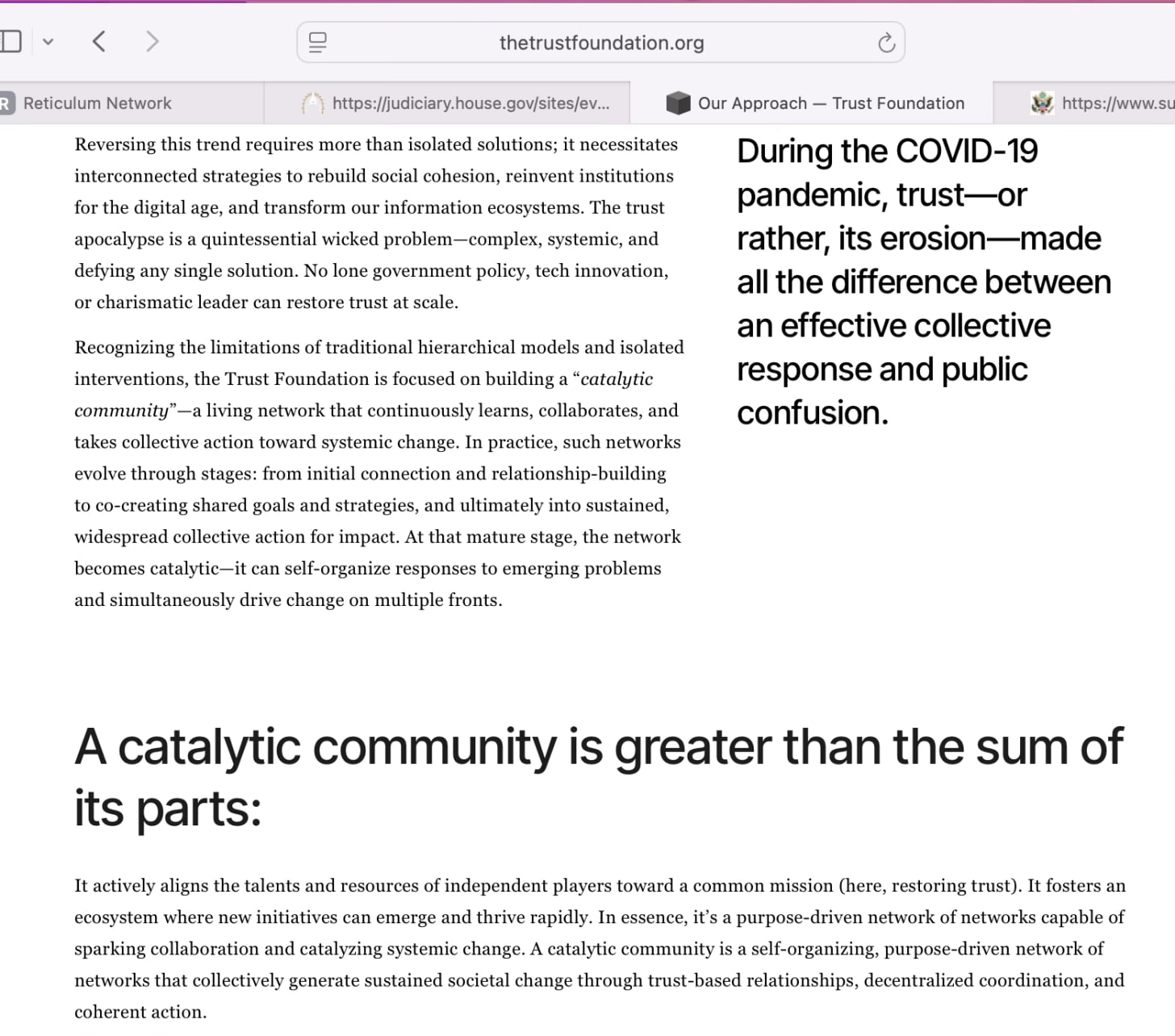
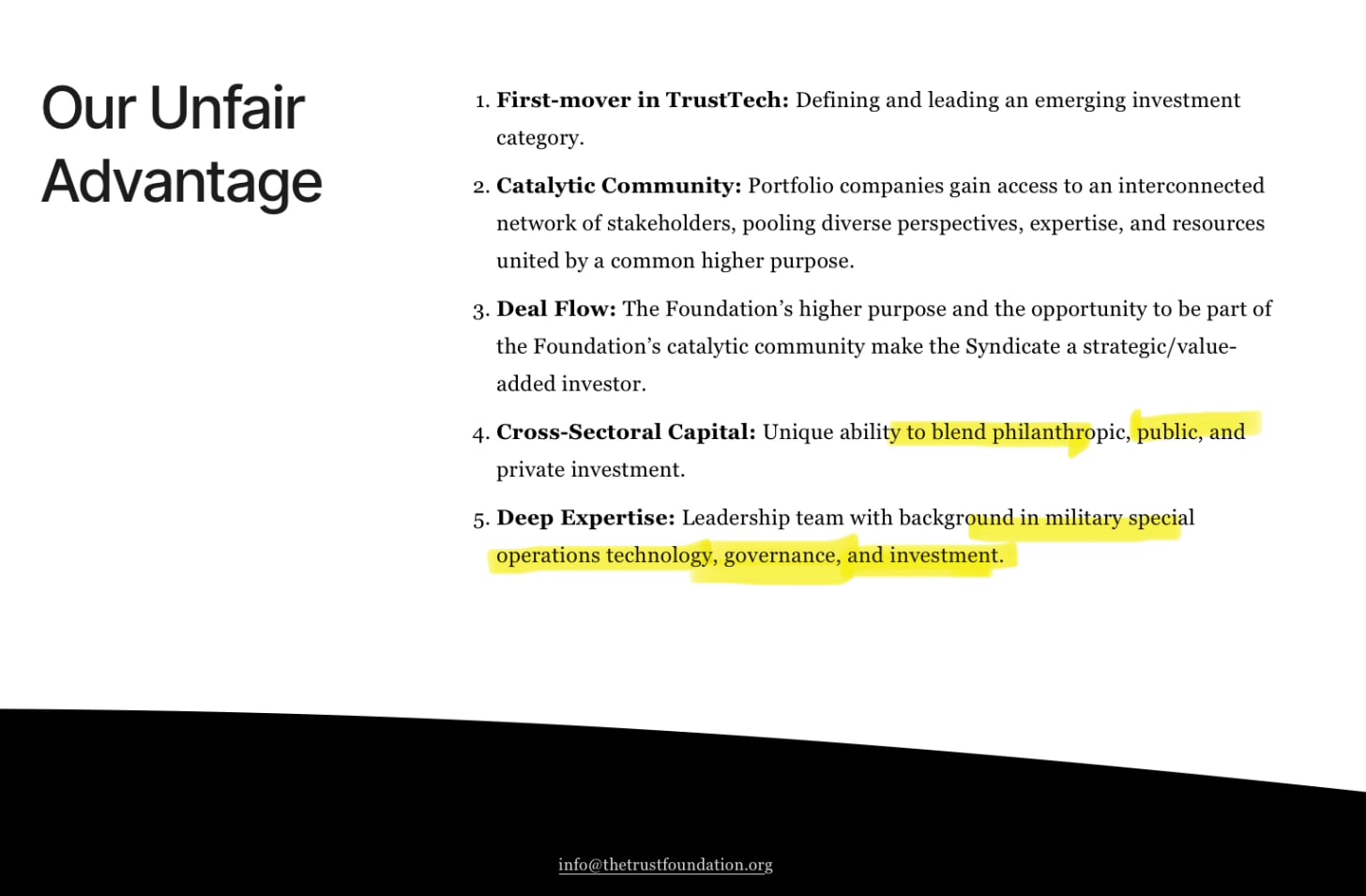
The distinction worth holding on to here is between two meanings of the word trust. The first is the ordinary human meaning — trust as a relational virtue between persons, earned over time through demonstrated character and honored commitments. The second is the technocratic meaning — trust as a managed, engineered, institutional property that experts certify, platforms enforce, and governance bodies protect through the regulation of speech, behavior, and information flow. When a Davos panel, a trust-and-safety department, or a “trust apocalypse” convening institution says it is rebuilding trust, it is almost never using the word in the first sense. It is saying it will manage information environments, certify authorized expertise, and enforce informational boundaries to produce outcomes the institution considers trustworthy. The Trust Foundation’s catalytic-community architecture is a convening instance of this second meaning. Epstein’s catalytic-funding architecture, at an earlier stage of the same ecosystem, produced the same kind of managed trust through a different mechanism: proximity, patronage, and the selective cultivation of a scientific elite. The branding has shifted. The underlying move — managing the environment in which the right people reach the right conclusions — has not.
By 2013, according to the released records, Goertzel had introduced Yu to Epstein not primarily as a scientist but as a “well-connected figure in Hong Kong” who could “set up” visitors and bring “smart and interesting people” into Epstein’s orbit. That was the pivot. From that point, Yu was something other than a researcher in an ordinary funding relationship. As the Dimsum Daily analysis of the files put it, he was auditioning for patronage — functioning as a connector, a man with an address book in a city Epstein wanted to be plugged into, and offering something none of Epstein’s American scientists could: a working theory of consciousness transformation and the digital machinery to deliver it.
The correspondence began in earnest in 2015 and accelerated. In one widely cited Epstein email analysis, Yu is described as a “game developer” announcing his travel plans to Tulum, Davos, and the Digital Life Design (DLD) conference — a trifecta the analyst called “an Epstein-class hat trick.” Tulum for the post-rational wellness and psychedelic circuit. Davos for the global economic elite. DLD for the Silicon Valley media-and-AI nexus. The three stops map the three audiences Yu was simultaneously positioned to serve.
When Epstein was arrested in July 2019, he had been corresponding with Gino Yu more frequently than with most of the people now considered central to his network. Yu has declined every request for comment from the Hong Kong press.
To see why Yu’s offer mattered — why a convicted sex trafficker would value a five-stage consciousness theory from a Hong Kong video game professor — we have to go back fifty years, to the document that set the terms of the entire project.
IV. The 1974 Blueprint

The lineage has a founding document, and it is not hidden. It has an ISBN.
In 1974 the Stanford Research Institute — since renamed SRI International, and in that era still carrying the Stanford name and the residual public association with the university four years after their formal 1970 separation — produced a report called Changing Images of Man. The specific study was commissioned by the Charles F. Kettering Foundation, but the institutional infrastructure that produced it was not a private initiative. SRI’s Educational Policy Research Center, which housed the Changing Images project, had been launched in 1968 by the U.S. Office of Education (now part of the Department of Education) as one of two federal Educational Policy Research Centers — the other at Syracuse University — with the explicit mission of “investigating alternative future possibilities for the society and their implications for educational policy.” The center’s broader portfolio, federally seeded, was civilizational futures research; Changing Images of Man was one of its signature deliverables. The specific report was prepared by the Center for the Study of Social Policy within the EPRC under the direction of Willis W. Harman, and edited by O.W. Markley. Its contributors included Joseph Campbell, Brendan O’Regan, Duane Elgin, Arthur Hastings, Floyd Matson, and Leslie Schneider. Its formal Advisory Panel, per the book’s own acknowledgments page, consisted of René Dubos (Rockefeller University microbiologist and ecological thinker), Henry Margenau (Yale physicist with extensive published work on consciousness and parapsychology), Margaret Mead (American Museum of Natural History), and Sir Geoffrey Vickers (WWII Special Operations Executive, British systems theorist). Its reviewer panel — whose comments the editors elected to incorporate into the published text as footnotes and appendices — included B.F. Skinner, Ervin Laszlo, Carl Rogers, James Fadiman, Stanley Krippner, Ralph Metzner, Elise Boulding, George Lodge, Michael Marien, and John White of the Institute of Noetic Sciences, among others. Together the roster reads like a founder’s list of the postwar human-potential movement.
The report’s thesis was direct. The dominant “image of man” that had governed Western civilization — rational, industrial, mechanistic, economic — was exhausted. It had to be replaced. What was needed was a new image: holistic, spiritual, ecological, transpersonal. A humanity understood as nodes in an interconnected system, guided by new symbols, new myths, and a new consciousness.
The authors were unusually candid that this was an engineering problem. They applied Thomas Kuhn’s concept of paradigm shift not to a scientific discipline but to an entire civilization. The report discussed the “potentiality of reactivating” American symbolism rooted in Masonic tradition, attested to (in the report’s own words) “by the symbolism of the Great Seal.” It argued at length for Western absorption of Eastern contemplative traditions, framing this not as spontaneous cultural exchange but as a deliberate paradigm transition to be catalyzed through media, education, and institutional design. Later critics summarized this as a project to “turn Western man into an Eastern mystic” — the phrasing is the critics’, not the authors’, but it captures the direction of travel the text argues for.
When Changing Images of Man was finally published in book form in 1982, the publisher of record was Pergamon Press — at that time owned by Robert Maxwell, who had controlled the scientific publisher since the 1950s. This proves nothing about coordination — Pergamon published thousands of scientific titles under Maxwell, and Changing Images was one of many. But it places the book’s imprint inside a specific corporate genealogy that the later Maxwell-Epstein connections inherit. Maxwell himself was a figure whose intelligence-adjacent exposures spanned East and West — his Pergamon business model was built on a near-exclusive Cold War relationship with the Soviet Academy of Sciences (he personally courted Khrushchev, Brezhnev, Andropov, and Gorbachev to secure Pergamon’s Eastern-bloc scientific publishing access), and his parallel Western intelligence relationships have been documented across multiple biographies and by Seymour Hersh’s 1991 The Samson Option. Robert Maxwell was Ghislaine’s father. And Ghislaine was the woman who, according to her own 2025 deposition, introduced Jeffrey Epstein to Murray Gell-Mann and the Santa Fe Institute.
Several of the report’s own self-descriptions, drawn directly from its 1982 Pergamon front matter, deserve to be read closely. The authors describe their methodology not as conventional research but as Lévi-Straussian bricolage — “a do-it-yourself man, who draws on a stock of miscellaneous materials and whatever tools come to hand to do his odd jobs. He is not the meticulous craftsman who insists on the precise tool for the precise job.” The authors further describe the project as “a somewhat informal experiment in ‘network development,’ the purpose of which is to demonstrate the relevance and interrelatedness of conclusions reached by workers in different areas of specialized research vis-à-vis these goals; and also to foster an increase in interdisciplinary communication between these workers, agency staffs which support such research, and other members of the public.” In other words, the report was written not only to articulate a thesis but to build the network that would carry it forward — which is precisely the catalytic-community architecture Section III has just named. The Pergamon introduction also identifies, by name, the proponent movement that actualized the report’s ideas in the years between the 1974 SRI release and the 1982 book publication: “Two recent books, New Age Politics (Satin, 1978) and The Aquarian Conspiracy (Ferguson, 1980), describe much of this activity from a proponent’s point of view.” The authors themselves name Marilyn Ferguson’s Aquarian Conspiracy as the book describing the movement their own work had helped launch. And in a small but revealing aside, the Pergamon introduction records the authors’ retrospective wish that they had “explore[d] more deeply the enormous significance that emerging changes in psychosexual norms and premises have for the future society.” The authors were aware, by 1982, that the sexual-revolution material they had not fully included was integral to the transformation they were advocating.
One further aspect of the 1982 text deserves direct quotation rather than summary, because it establishes that the authors were not naïve about the shape of the dystopia their project could produce. The report engages explicitly with sociologist Bertram Gross’s concept of “friendly fascism,” which Gross had first articulated in 1970 and would develop into a 1980 book. Citing Gross by name and quoting him at length on page 170, the report describes the possible emerging order as “a managed society [which] rules by a faceless and widely dispersed complex of warfare-welfare-industrial-communications-police bureaucracies caught up in developing a new-style empire based on a technocratic ideology, a culture of alienation, multiple scapegoats, and competing control networks,” and names the result “a techno-urban fascism, American style.” In the concluding chapter (page 204), the report warns explicitly that “actions and policies in keeping with the ‘technological extrapolationist’ image would involve no great wrenching in the near term, [but] they could lead to catastrophe or to ‘friendly fascism’ in the longer term.” A reviewer’s note from David Cahoon, included in the published volume, goes further: “It is comforting to hear you affirm that this is ‘an extreme outcome from the technological extrapolationist image and trend’, and ‘unintended to most people’ but it seems to me we are well into it!” And another reviewer’s note, from page 180, names the emerging managerial class in language that rhymes precisely with the present essay: “the intellectual community of communications-math-cybernation-etc. will surely be the new priesthood of the post-industrial society.” The report’s own published text thus names, in 1982, both the dystopian outcome of the “technological extrapolationist” image and the priesthood that would administer it. The authors proceeded with the project anyway. That combination of self-awareness and continued advocacy is itself an important piece of documentary evidence. They knew what they were building.
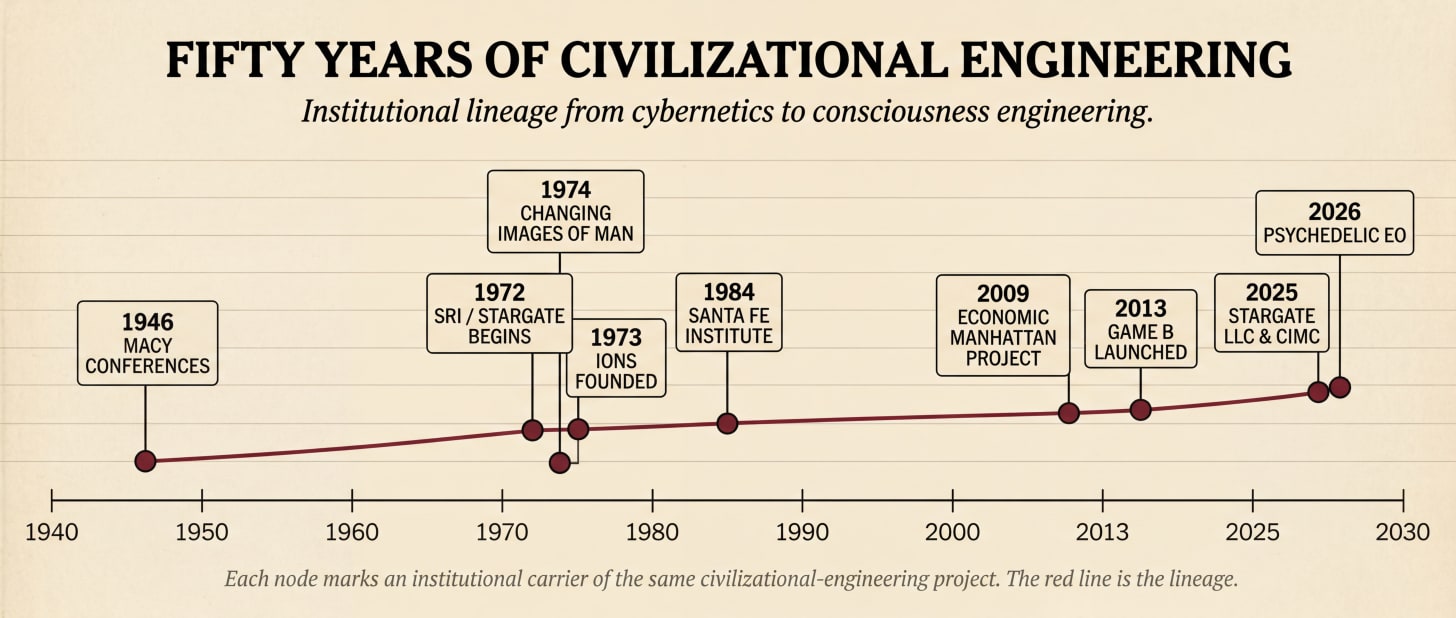
The connective tissue starts early. And the institutional infrastructure that produced the report — a federally-launched educational policy research center, later joined by private-foundation deliverables, published by a scientific press owned by Ghislaine Maxwell’s father — is itself an early instance of the same catalytic public-private architecture Section III has just named. Federal seed funding for the long-horizon civilizational infrastructure; private catalytic capital for the specific deliverables; corporate publication platforms owned by well-connected intermediaries. The pattern is older than Epstein. Epstein inherited it.
V. The Operational Arm: Stargate

While the Harman team at SRI was writing the civilizational blueprint, another team at the same institution was running the operational pilot.
In 1972, under CIA funding, physicists Hal Puthoff and Russell Targ began the remote-viewing research program that would pass through names like SCANATE, GONDOLA WISH, GRILL FLAME, CENTER LANE, and finally Project Stargate. The program ran until 1995, survived six presidential administrations, and produced the signature figures of American psi research: Ingo Swann, Pat Price, Joseph McMoneagle.
The standard framing of Stargate is that the Cold War intelligence community, terrified of Soviet psychotronics investment, was willing to fund almost anything that might close a perceived “psi gap.” That’s accurate as far as it goes. But it misses the deeper continuity. The same SRI was simultaneously running a civilian-facing project (Changing Images) arguing that expanded states of consciousness were the future of the species, and a classified project (Stargate) treating those states as operational intelligence capabilities. One ecosystem. One donor class. One vocabulary. Two faces.
The personnel are the key. Apollo 14 astronaut Edgar Mitchell — who has stated publicly that his interest in these states was triggered by what he later described, using the Sanskrit term himself, as a savikalpa samādhi experience on the return flight from the Moon — co-founded the Institute of Noetic Sciences in 1973 along with investor Paul N. Temple. Willis Harman, who had provided overall guidance on Changing Images of Man as Director of SRI’s Center for the Study of Social Policy, became IONS’s president in 1975 and served until his death in 1997. Brendan O’Regan, contributor to Changing Images and a former consultant to the same SRI Center for the Study of Social Policy, became IONS’s vice-president for research in 1974–75 and held that position until his death in 1992. And O’Regan was the key liaison between Mitchell’s institute and the SRI psi research — a liaison that was not merely intellectual but financial. Puthoff and Targ’s early remote-viewing experiments at SRI, the same work that would be absorbed into what became the classified Stargate program, were supported in their earliest years in part by private funding from the Institute of Noetic Sciences itself. Meaning the same institutional node founded by the principals of the civilian Changing Images of Man project was financially underwriting the classified psi-research arm at SRI in its formative years. The civilian blueprint and the classified operational pilot were not running in parallel, untethered. They were running through the same people, in the same buildings, with the same donor network.
And here is where my argument departs from the existing literature. My claim is that Stargate had a scaling problem the standard histories underplay. The program could find occasional gifted individuals — Swann, Price, McMoneagle — but it could not reliably train ordinary recruits into the altered states required. Ingo Swann and Puthoff eventually developed what they called Coordinate Remote Viewing, a set of written protocols meant to be teachable. Enthusiasts of the CRV curriculum will argue it did work; skeptics and the program’s own internal critics concluded it did not scale. Either way, the fundamental challenge never went away. The intelligence utility of altered states of consciousness depended on the ability to induce them at scale, in trainees who had not spent twenty years in a Zen monastery. That scaling problem, I would argue, is the piece of the Changing Images of Man agenda that SRI never solved.
A note on the name, because readers will have noticed and the observation matters. On January 21, 2025 — one day after his second inauguration — President Donald Trump announced a new joint venture called “Stargate,” a partnership between OpenAI, Oracle, SoftBank, and the Emirati investment firm MGX, committed to investing up to $500 billion in American AI infrastructure by 2029. Sam Altman, Larry Ellison, and Masayoshi Son appeared with the president at the White House; Son was named chairman. Wikipedia records, and OpenAI’s own materials confirm, that the name was reportedly chosen in reference to the 1994 Roland Emmerich film Stargate, whose plot involves an ancient portal-device uncovered by an eccentric scientist and used to access other worlds. The corporate explanation is that the new venture’s backers liked the film’s imagery of gateway infrastructure. What the corporate explanation does not say — and what no one in that January 2025 announcement was likely to volunteer from the podium — is that the 1994 film itself was circulating, in the early-1990s cultural moment that produced it, inside the same mystique the CIA/DIA remote-viewing program had seeded through a long public trail: Puthoff and Targ’s October 1974 Nature paper on “information transmission under conditions of sensory shielding,” their 1977 popular book Mind-Reach, a 1979 House Permanent Select Committee on Intelligence briefing in which Representative Charlie Rose of North Carolina famously described remote viewing as “a hell of a cheap radar system,” Jack Anderson’s 1984 newspaper column exposing the program, the National Academy of Sciences National Research Council’s 1984 skeptical review, and the 1995 declassification and CIA-commissioned debunking by the American Institutes for Research that formally terminated the program. Whether anyone at OpenAI, Oracle, SoftBank, or the Trump White House made the connection explicitly, the name arrives inside a lineage. A twenty-three-year classified program to operationalize altered states. A mid-1990s film that aestheticized its themes into ancient-portal mythology. A 2024 OpenAI-Microsoft supercomputer project that took the name first. And now, in 2025, a half-trillion-dollar AI-infrastructure buildout operating under the same name, launching the day after Trump’s return to office. The essay I am writing is not about the 2025 Stargate venture specifically. But the choice to put that name on an AI-infrastructure buildout at this precise civilizational moment — four months after Trump’s re-election, three months before the DOJ released the Epstein files that contained the Gino Yu correspondence — is not a neutral naming event. It is, at minimum, a signal to those who know the history. And it is worth noting here because the argument of this essay is that the 1972 program’s core scaling problem is exactly what the new operational generation — the Yu pipeline for individual consciousness, the OpenAI-Oracle-SoftBank pipeline for collective cognition — has been built to solve.
Fifty years later, a Berkeley-trained video game professor in Hong Kong was writing papers on “Communicating Spiritual Experience with Video Game Technology,” running a PolyU lab dedicated to interactive media for consciousness cultivation, and describing a five-stage developmental model that mapped the exact sequence the SRI project had always required: move an ordinary human out of consensus reality, through conditioned identity, into present awareness, through ego death, and out into a trained-for higher state. That is the through-line. Gino Yu was offering Epstein — and through Epstein, the network — the missing scaling technology the classified program had failed to build.
VI. Complexity as Cover: Santa Fe Institute
By the mid-1980s, the language had to change. The New Age brand had become too visible, too easily mocked — Shirley MacLaine speaking to her past lives on prime-time television was a cultural gift to the project’s critics and a liability for its institutional ambitions. The serious money needed a new label. It found one in the language of complexity — the mathematical study of systems that self-organize, emerge, and phase-transition. The vocabulary was technical, the mathematics was real, and the underlying agenda could ride inside both.
The institutional home for the rebrand was founded in 1984, when Murray Gell-Mann — Nobel laureate, codiscoverer of the quark — joined with George Cowan, David Pines, Stirling Colgate, Nick Metropolis, Herb Anderson, Peter Carruthers, and Richard Slansky to establish the Santa Fe Institute. Six of the eight founders came directly from Los Alamos National Laboratory; only Pines and Gell-Mann were not LANL scientists. George Cowan himself — SFI’s founding president — was a Manhattan Project chemist who had worked on the original nuclear-weapons program at the University of Chicago, Oak Ridge, Columbia, and finally Los Alamos, where he then spent thirty-nine years as director of chemistry and associate director of research. His wife, Helen “Satch” Dunham Cowan, was also a chemist on the Manhattan Project. This is not incidental biography. SFI was, at its founding, a second-act institution for the postwar nuclear-weapons scientific establishment — a place for Manhattan Project veterans and their successors to continue interdisciplinary theoretical work after the Cold War budget began contracting. Epstein himself acknowledged this framing directly in the Bannon interview: he bought Zorro Ranch in 1993, he said, because “the people who worked in Los Alamos would still be in the Santa Fe area” even as the lab’s funding was cut. The LANL-to-SFI pipeline was explicit, and Epstein knew where to station himself to access it.

SFI’s ostensible mission was to pioneer a new interdisciplinary field: complexity science, the study of complex adaptive systems. Its actual cultural function, as this essay reads it, was to rebrand the transpersonal-consciousness agenda in respectable scientific language while simultaneously providing a civilian institutional home for the Manhattan Project diaspora. Instead of “interconnectedness,” SFI spoke of “emergence.” Instead of “consciousness transformation,” it spoke of “phase transitions.” Instead of the “image of man,” it spoke of “self-organizing systems.” The vocabulary was different. The ecosystem was the same. And four decades on, that same SFI-complexity network produced the philosophical-institutional bridge figures who now chair the consciousness-first AGI frontier — Jim Rutt, former chairman of the Santa Fe Institute and current Chairman of the Board at the California Institute for Machine Consciousness, the CIMC that Joscha Bach founded in May 2025 to advance the machine-consciousness research program Section III has already described. The SFI-to-CIMC pipeline is the twenty-first-century continuation of the 1974-to-1984 LANL-to-SFI pipeline, in exactly the same register: nuclear scientists yielded to complexity theorists yielded to machine-consciousness engineers, with Rutt personally spanning the second and third generations.
The donor continuity is where the inferential weight lands. According to a 1991 Santa Fe Institute newsletter, the Maxwell Foundation donated $300,000 in 1990 to endow what SFI called the Robert Maxwell Professorship in the Sciences of Complexity. Ghislaine Maxwell introduced Epstein to Gell-Mann in the 1990s, as she stated in a 2025 deposition to the Department of Justice — “I introduced Epstein to Murray Gell-Mann,” she testified, “and Murray Gell-Mann and Epstein got along very, very well.” She did so via the institutional relationship her father Robert Maxwell had already built with the Santa Fe Institute; Ghislaine testified explicitly that her father and Epstein never met, so the institutional pathway — rather than a direct personal introduction by her father — is what was inherited. The chronology matters: the Maxwell Foundation endowed the Robert Maxwell Professorship at SFI in 1990; Ghislaine met Epstein in 1991; Robert Maxwell died in November 1991; Ghislaine then introduced Epstein to Gell-Mann, leveraging a donor architecture her father had built but that he himself did not live to see Epstein exploit. Epstein’s own statements across multiple interviews — including the Bannon conversation and earlier magazine profiles — indicate he purchased his seventy-five-hundred-acre Zorro Ranch in 1993 specifically to be near SFI and Gell-Mann. In the Bannon interview, Epstein framed the move around Los Alamos-to-Santa Fe scientific migration: “the people who worked in Los Alamos would still be in the Santa Fe area.” Gell-Mann acknowledged Epstein’s financial support in the preface of his 1994 book The Quark and the Jaguar — an acknowledgment that, notably, does not appear in the 2023 SFI Press reissue. Epstein continued funding after his 2008 conviction; a 2010 email chain released by DOJ records Gell-Mann’s pitch being relayed to Epstein through a third party and Gell-Mann then thanking Epstein for a $25,000 check. In 2011, Gell-Mann reportedly attended Epstein’s “Mindshift Conference” on Little Saint James. SFI’s own accounting admits $275,000 in Epstein donations. At least $680,000, per independent reporting of the financial records, is the figure that emerges when all Epstein-linked transfers are traced.
SFI’s current president, David Krakauer, has contested the higher figure. Speaking to Clara Bates of the Santa Fe New Mexican in February 2026, he said SFI’s own donation database registers only $275,000 and suggested that either the gifts went directly to individual researchers without hitting the institutional books, or Epstein was misreporting his contributions to inflate his perceived connection to the institute. Krakauer’s position — one to note for fairness — is that Epstein’s involvement with SFI was “so minimal” and that “effectively all of Epstein’s financial interactions with SFI were with one person, Murray Gell-Mann.” Krakauer frames Epstein as having exaggerated his connection to the institute and having “stalked” it without real success. A reasonable reader should weigh this. It is also the case, however, that the documentary record shows Geoffrey West — SFI distinguished professor and former SFI president (2005–2009) — arranging to meet Epstein at Zorro Ranch in August 2012, four years after Epstein’s Florida conviction, and corresponding enthusiastically (”hopefully we’ll have quality time in Riverside!”) into 2017. That is a second post-conviction SFI-figure data point beyond Gell-Mann, and it meaningfully complicates the “one-person” framing Krakauer offers.
And the SFI-adjacent network contains Joscha Bach — the German AI theorist and complexity-science researcher who founded the California Institute for Machine Consciousness in May 2025, serving as its founding director (with Jim Rutt as Chairman of the Board), and who was an Epstein correspondent on themes that, as Byline Times documented in its December 2025 reporting, included race, genetic hierarchy, and the supposed “utility” of mass death under conditions of climate stress. This is the same Joscha Bach whose 2019 email to Epstein’s assistant arranged for an unnamed woman to travel with Gino Yu from Davos to Zurich to Marrakech. The Yu-Epstein-Bach triangle, read against the Section III framework, is not three separate anomalies but a single operational node: Yu supplying the consciousness-induction methodology, Bach supplying the computationalist-with-consciousness-aperture AGI framework, Epstein supplying the catalytic funding and the convening space, and all three operating inside the SFI-complexity vocabulary that the Santa Fe Institute had spent four decades legitimizing. When CIMC launched in 2025 with Bach as founding director and Rutt as Chairman of the Board, it was not a new institution so much as the next institutional name under which the same project continued.
Complexity science was never just physics. It was the new vocabulary of a much older project — the fifty-year civilizational-engineering project Changing Images of Man had named openly in 1974, now repackaged in the language of mathematical systems theory, institutional-funded interdisciplinary research, and (most recently) machine consciousness.
One further piece of the SFI story belongs here as a forward reference, because it establishes the bridge between Section VI and the Game B material of Section X. In May 2009 — twenty-five years after SFI’s founding, and six months after the 2008 financial crash — Eric Weinstein, then of the Natron Group and later managing director of Thiel Capital, organized a conference at the Perimeter Institute for Theoretical Physics in Waterloo, Ontario, under the explicit title “The Economic Manhattan Project.” The conference was co-funded by John Brockman’s Edge Foundation — the same Edge Foundation to which Jeffrey Epstein was the largest identified donor, giving roughly $638,000 between 2001 and 2015 — and its panel included SFI’s Doyne Farmer alongside Nouriel Roubini, Nassim Taleb, Richard Freeman, and Lee Smolin. It was at that 2009 Edge-funded Perimeter Institute gathering that Eric Weinstein first brought his brother Bret into the network and that Jordan Hall entered the Weinstein orbit — the seed meeting, four years before the 2013 Staunton, Virginia convening that formally launched what became Game B. Read the lineage carefully: the 1984 founding of SFI was the “Manhattan Project diaspora” in its original form; the 2009 “Economic Manhattan Project” conference was the same diaspora repurposed for the post-2008 civilizational-engineering moment; and Game B, launched out of that gathering by people who had been standing in that Perimeter Institute conference room, is the continuation of the same project under another name. Section X develops this argument in full. The point to carry forward now is that the SFI-to-Game-B pipeline runs through a single named event, at a single named institution, with a single named donor network — the Edge-Epstein axis that had been quietly seeding the ecosystem since the early 2000s. The detailed receipts on this are in The Epstein Transhumanist Conspiracy article.
And — critically for anyone tempted to dismiss this as a contemporary Western conspiracy reading — the operational function of SFI was named publicly by hostile foreign observers as early as 2005. The Kremlin-sponsored Project Russia (Проект Россия) book series, published across five volumes between 2005 and 2010, identified “a little-known institute called ‘Santa Fe’ in the U.S.” as the origin point of what the authors called “technology for changing governments without military conflict, within the law.” (The English translation here is my own, prepared as part of the research for my forthcoming book; no full English edition of Project Russia has ever been published, which is itself part of why so few Western readers know the series exists.) The authors’ complaint in volume one was not metaphysical. It was operational: that the Pentagon and CIA were SFI’s clients, that the West had developed a methodology for regime change through social and informational means rather than tanks, and that the Velvet Revolutions of the prior decade had been field tests. Russian strategic analysts — with every incentive to identify Western soft-power architecture accurately — named the Santa Fe Institute specifically, and at a time when almost no Western commentator was paying attention to it. (I’ve examined this in depth, along with the Maxwell and Epstein funding streams into SFI, in The Epstein Transhumanist Conspiracy: How Game B’s “Conscious Evolution” Hides a Eugenics-Fueled Technocratic Takeover and in The Proof of Persona: Decoding Patent 060606 and the Mining of the Human Soul.)
VII. The Patron
This is where Epstein becomes legible as a figure. Forget the libertine playboy framing. Forget the “mystery” of what a convicted sex offender wanted with physicists. The answer is in front of us: Epstein was doing what his funding targets told him to do. He was acting as the patronage node for the twenty-first-century continuation of the Changing Images of Man agenda.
Look at where the money went. Harvard’s Program for Evolutionary Dynamics: $6.5 million to Martin Nowak’s lab, per Harvard’s own 2020 internal review. Nick Bostrom’s Future of Humanity Institute at Oxford: at least $120,000 in documented transfers. The World Transhumanist Association — co-founded in 1998 by Nick Bostrom and the British philosopher David Pearce, among other authors, to promote transhumanism as a serious academic and public-policy discipline, and rebranded in 2008 as Humanity+ — received documented Epstein transfers during the 2013–2014 period when Joscha Bach served as a research fellow under Bostrom there. The organization’s own Transhumanist Declaration commits the movement in its own words to “broadening human potential by overcoming aging, cognitive shortcomings, involuntary suffering, and our confinement to planet Earth” and to “life extension therapies; reproductive choice technologies; cryonics procedures; and many other possible human modification and enhancement technologies.” The companion Transhumanist Manifesto still live on humanityplus.org is more candid, stating plainly that “aging is a disease” and committing the movement to “mitigate aging and extend life beyond the maximum lifespan” — and the foundational 1990 essay that defined the modern use of the term “transhumanism,” Max More’s “Transhumanism: Toward a Futurist Philosophy,” (the original coinage was by Julian Huxley in 1957) names the movement’s goal explicitly as “our advancement into transhumanity and our future as posthumans.” The list continues. Ed Boyden’s optogenetics work at the MIT Media Lab. Stephen Kosslyn’s cognition lab at Harvard. The Edge Foundation: around $638,000 between 2001 and 2015. OpenCog, Ben Goertzel’s artificial general intelligence project — the same OpenCog that Gino Yu worked with, and that Yu discussed with Epstein by email as part of their collaboration.
Every single one of these sits on the same thematic axis: understanding, engineering, or transcending the human. The neuroscientists were mapping the substrate. The geneticists were identifying the levers. The AI researchers were building the successor. The complexity theorists were supplying the systems framework. And Yu — the consciousness researcher with the video game lab — was supplying the transformation protocol.
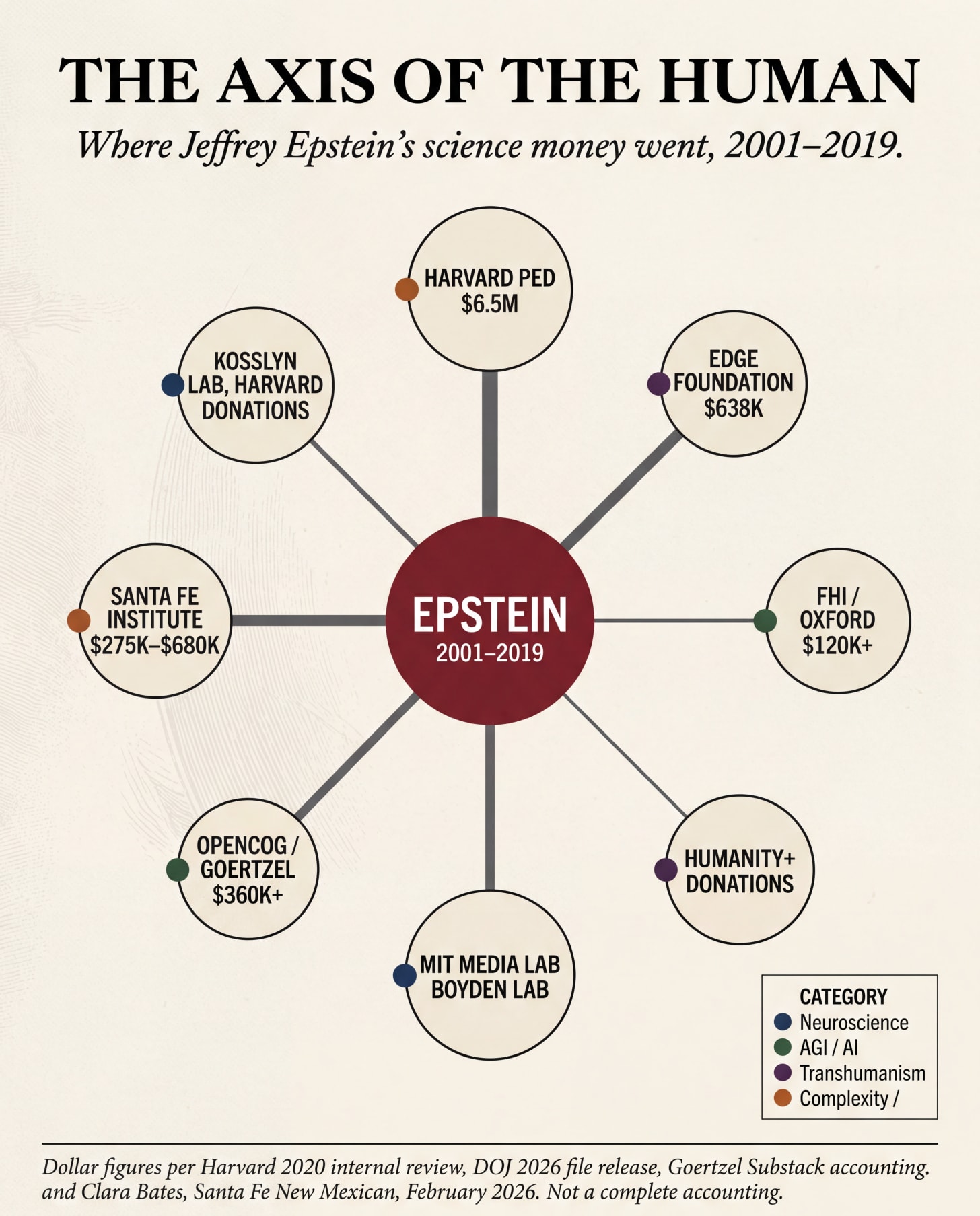
Epstein’s personal vision, as documented repeatedly in the released correspondence and earlier in The New York Times reporting (2019), was the brutal tell. He wanted his head and penis cryopreserved. He wanted to seed the human race with his DNA by impregnating twenty women at a time at his New Mexico ranch. He used his salons to launder eugenicist hierarchies — blue eyes, racial intelligence — through the language of “longtermism” and “human flourishing.” When Joscha Bach discussed with him the supposed “utility” of mass death under conditions of climate stress (as Byline Times documented), this was not a friendly science-fiction exchange. It was operational talk between people who believed, in my reading, that they were owed the role of sculptor on the species.
VIII. The Monetary Leg: Cybernetics as Currency
There is one leg of this architecture the transpersonal-psychology reading alone cannot explain, and the 2019 Bannon interview makes it unavoidable.
In early 2019, Steve Bannon sat across from Jeffrey Epstein in Epstein’s Manhattan townhouse and recorded a long-form interview intended, in Bannon’s framing, to rehabilitate Epstein’s public image. The Department of Justice released portions of that footage in its 2026 document dump. Bannon, who has spent the past year on his podcast calling Epstein a “globalist child molester” and demanding the release of the files, is audibly uncomfortable in the recording each time Epstein opens a substantive thread about the actual system Epstein spent his career helping to build. Each time, Bannon pulls him back to the jail cell.
What Epstein says in the unguarded stretches is the thesis of this essay in his own voice.
Epstein describes, without prompting, how David Rockefeller personally recruited him onto the Rockefeller University board, then onto the Trilateral Commission. In his own words: “David started to explain to me world politics. So David would say, Jeffrey, money is going to be sort of the most important things. People don’t understand money. You seem to have this knack for money.” Rockefeller — founder of the Trilateral Commission in 1973, one year before Changing Images of Man — was, by Epstein’s own account, the figure who trained him into this worldview. Epstein’s broader network — JPMorgan executives, former Treasury secretaries, British and American intelligence-adjacent figures, Rothschild family members, WEF participants, and researchers across cryptography, artificial intelligence, evolutionary dynamics, and digital currency— is not itemized verbatim in the Bannon interview itself, but emerges when the interview is read against the rest of the 2026 document release. The researchers. The finance. The intelligence services. The international coordination body. One network, one purpose.
When Bannon asks him directly about the Santa Fe Institute, Epstein calls it a “total failure.” He explains what SFI was actually for: to determine whether complex systems — particularly the financial system — could be modelled algorithmically. The institute tried for fifteen years. “Every attempt to… formulise or algorithmically understand what the term complexity means” came to nothing. Researchers who thought they had predictive tools tried to apply them to markets. “They go bankrupt and we start again.”
Then, without pausing, Epstein pivots. From the failure of mathematical modelling of complex systems, he moves seamlessly to the emergence of artificial intelligence. Neural nets, he tells Bannon, produce answers no one can explain. “When you ask the person who designed the system, how did it come to that answer? How did your neural net? Can you show me the calculations? They say, no, we don’t know. We don’t know how the thing we designed actually came up with that answer.” He describes AI learning to play video games beyond human capability, with no one understanding how. He calls this “the first little touch” of something larger.
The three claims form one argument. Nobody — not world leaders, not central bankers, not traders — truly understands the financial system. Mathematics has failed to model it. But artificial intelligence can operate on it without understanding it.
The implication Epstein does not state but which his funding pattern delivers is that the system should be governed by machines rather than by people or politicians who cannot comprehend it. Automated financial governance, outside democratic control. Programmable currency with conditional transaction rules. Capital allocation conditioned on social and environmental objectives. What the Bank for International Settlements now calls “purpose-bound money” and what the general public is being introduced to under the brand name of central bank digital currency. (I’ve mapped this infrastructure — the GENIUS and CLARITY regulatory frameworks, the tokenization of real-world assets, and the convergence with biometric identity — in The Tokenization of Everything: The Infrastructure for Biodigital Convergence and the Erosion of Human Sovereignty, and the biometric-mining layer of the same architecture in The Proof of Persona. Patrick Wood and I treat the full technocratic rollout in The Final Betrayal: How Technocracy Destroyed America.)
This framework did not arrive in 2020. It was being raised with a sitting president in 1995. On 27 April 1995, Lynn Forester — who would later marry Evelyn de Rothschild in 2000 and launch the Council for Inclusive Capitalism with the Vatican in 2020 — wrote a personal letter to President Clinton describing a recent meeting at Senator Kennedy’s house. Her words: “Using my fifteen seconds of access to discuss Jeffrey Epstein and currency stabilization, I neglected to talk with you about a topic near and dear to my heart. Namely, affirmative action and the future.” One sentence. The financial-governance mechanism and the social-allocation framework carried by the same person, in the same letter, to the same office, thirty-one years before BIS purpose-bound money. Epstein and currency. Affirmative action and the future. The same hand writing both.
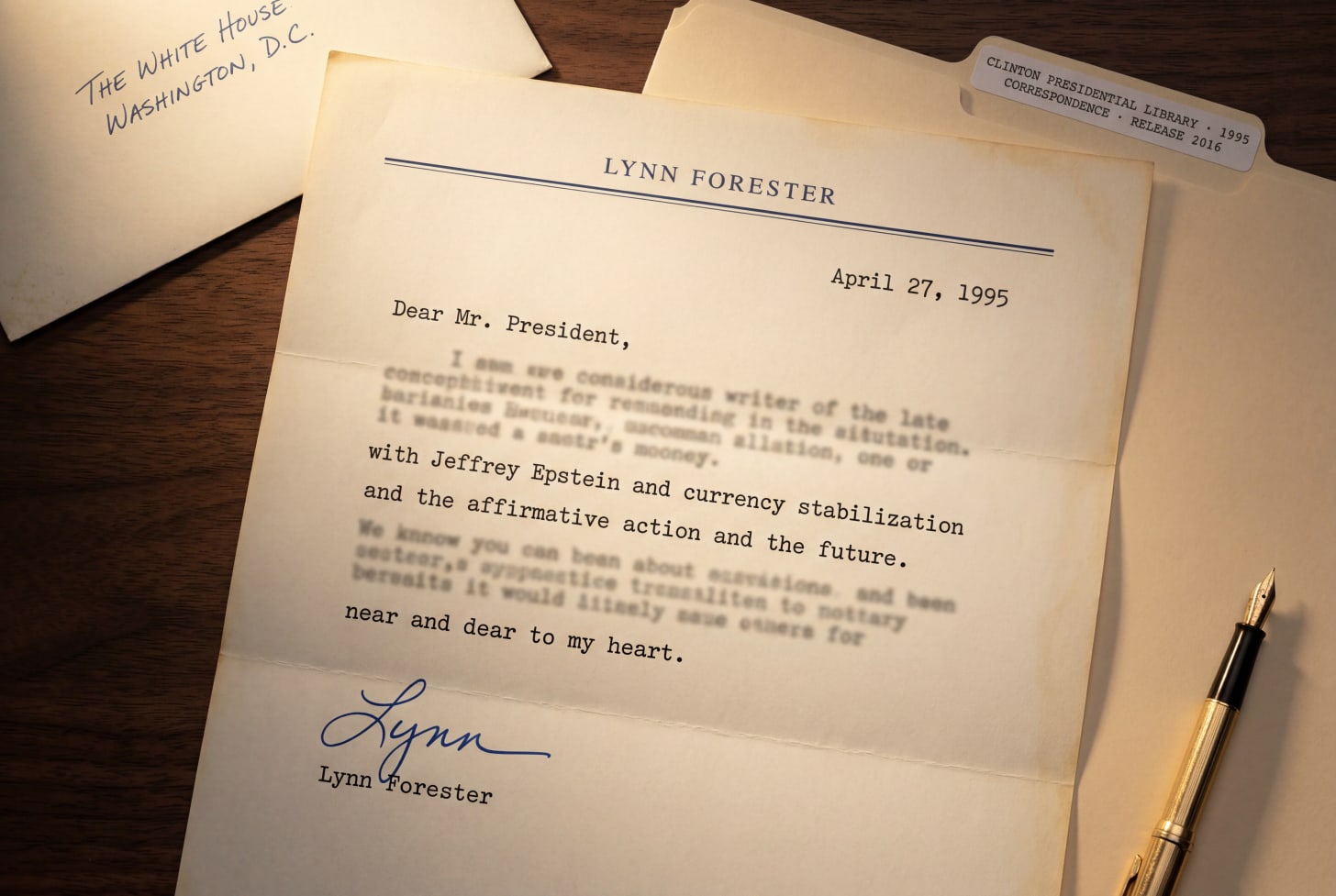
Step back from the letter and the structural point comes into focus. “Currency stabilization” and “affirmative action and the future” are not two separate philanthropic interests carried together by accident. They are the two sides of a single architecture: a system in which capital allocation becomes conditional on social-policy objectives certified by a managerial class rather than by borrower creditworthiness, democratic mandate, or market price discovery. In 1995 the framework was informal — a typed letter to a sitting president, with the two priorities carried across two adjacent sentences. Thirty-one years later, it is fully institutionalized.
Forester herself, after marrying Evelyn de Rothschild in 2000, launched the direct operational descendant of that 1995 pairing in December 2020: the Council for Inclusive Capitalism, a Vatican-partnered stakeholder-capitalism initiative whose named “stewards” include the CEOs of BP, Mastercard, State Street, and dozens of other corporate signatories committed to ESG, DEI, climate, and social-purpose allocation criteria. Around that founding node, the architecture thickened rapidly. Mark Carney’s Value(s): Building a Better World for All (2021) articulated the same framework from the central-banking side. Larry Fink’s annual letters to BlackRock portfolio CEOs installed ESG-as-allocation-criterion across the world’s largest asset manager. The Glasgow Financial Alliance for Net Zero (GFANZ), launched at COP26 in 2021, committed the world’s largest banks and insurers to allocating capital according to climate and social-purpose criteria rather than according to borrower creditworthiness or market price discovery alone. The informal 1995 pairing had become the explicit 2026 allocation framework.
This is the financial mechanism the essay’s Section XIII will name as the economic layer of the cybernetic organism. It is social-impact finance at civilizational scale — capital flow conditioned on alignment with social-policy objectives a managerial class certifies, with the borrower’s access to credit, liquidity, and in the programmable-currency endpoint the transaction itself conditional on that alignment. Forester’s 1995 letter is the seed document. The Council for Inclusive Capitalism, GFANZ, ESG, and purpose-bound CBDC are the mature institutional forms. The “affirmative action and the future” clause was never an afterthought tacked onto “Jeffrey Epstein and currency stabilization.” It was the allocation-criterion side of a single cybernetic architecture, paired in one letter to one president by one hand that understood the two sides as a single project.
Four months after Epstein left prison in 2009, he sent an email — included in the February 2026 DOJ file release — laying out plans to fund seven research gatherings on cryptography, artificial intelligence, political power, the world financial system, mathematical modelling, behavioural psychology, and neuroscience. Read that list again. It is not seven topics. It is one system, specified at seven levels: the money layer, the machine layer, the governance layer, the market layer, the models, the psyche, and the brain.
This is the piece of the puzzle that ties everything together. Cybernetics, from its Macy Conferences origin, was always about control across domains — machine, organism, society. The original Macy framework has not been relegated to history — it was explicitly revived in March 2020 as the #NewMacy initiative by the American Society for Cybernetics, running continuous bi-weekly sessions and hosting programming at Carnegie Mellon through 2025, while the Macy Foundation itself held its 2024 conference on Artificial Intelligence and Medical Education — the same cybernetic framework, the same institutional continuity, updated for the AI moment. The Santa Fe Institute was the complexity-as-emergence rebrand. But complexity science’s admitted failure at mathematical modelling (Epstein’s own word: failure) did not end the project. It pivoted it. If humans cannot model the system and mathematics cannot model the system, then machines that operate the system without understanding it become the solution. And once machines operate the system, the currency itself becomes programmable — conditional, tunable, allocable by social criteria the machine enforces.
Yu’s psycho-technology sits at one pole of this architecture. Programmable currency sits at the other. The consciousness pipeline produces humans who will accept and even welcome the new system, because they have been moved through the stages — worldview dissolution, ego death, reconnection into a new narrative — that reframe dependence on an automated governance system as spiritual liberation. The monetary architecture ensures that those humans, once reconnected, live inside an economic substrate in which dissent, accumulation, travel, and consumption are adjudicated by an AI whose decisions no human — Epstein’s own words — can audit or explain.
One system. Two delivery mechanisms. The psycho-technology softens the subjects. The monetary-technology governs them.
IX. The Yu Offer: Ego Death as Product
Against that backdrop, Gino Yu’s 2015-to-2019 correspondence with Epstein comes into focus.
Yu had spent fifteen-plus years developing a five-stage model of consciousness development. The stages, in Yu’s own telling across podcasts and conference talks: (1) worldview formation under parental and societal conditioning; (2) focus and zeroing-in on prescribed roles; (3) opening presence and somatic awareness; (4) existential crisis and ego death; (5) reconnection to innate joy, wonderment, and what he calls “special abilities.” The model explicitly combines Eastern contemplative practice with Western neuroscience and digital technology. Yu frames his broader research as “meaningful media” — the use of digital tools, especially games and interactive experiences, to facilitate consciousness development.
Pause on stage four. Ego death. This is not Yu inventing a concept; it is Yu importing the central doctrine of Mahāyāna and Tibetan Buddhism — anatta, non-self, the dissolution of the illusion of the separate I — into a sequenced, trainable, digitally mediated protocol. In the Buddhist context, that dissolution is the product of a lifetime of ethical discipline, meditative cultivation, and guidance by a lineage teacher. It has safeguards. It comes with prohibitions, vows, community oversight. The entire dharma scaffolding exists because Buddhists have known for twenty-five hundred years that an unmoored ego-death experience, without preparation, without integration, without a lineage holding the ground, is dangerous. It produces what the Tibetans call nyam — meditation sickness — and in the worst cases, full psychological breakdown, psychosis, dissociation, and spiritual emergency.
Yu’s innovation, and the innovation of the broader movement he represents, is to strip the ego-death event out of its contemplative scaffolding and re-package it as an engineering outcome. You do not need the monastery. You need the right digital media, the right neurofeedback, the right psychedelic, the right developmental model, the right community. Ego death becomes a product feature. Stage four becomes a deliverable. And because the person emerging on the other side has — by design — had their prior identity and its moral, relational, and civic attachments dissolved, they emerge into whatever new identity the protocol is tuned to produce.
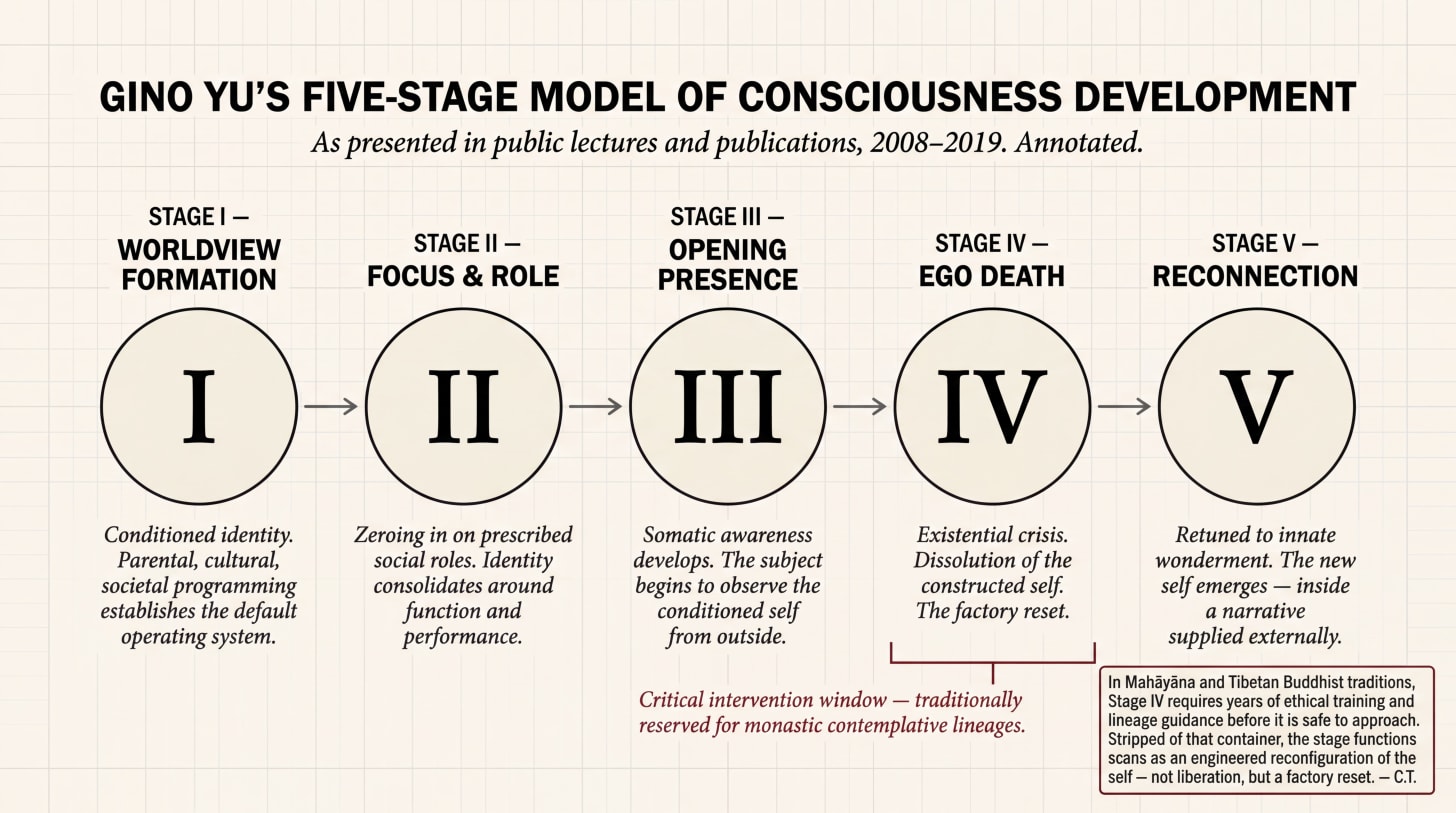
This is the part that should arrest anyone paying attention. Ego death, induced outside a traditional moral container, is not liberation. It is a factory reset. Whoever controls the media, the setting, the narrative, the community, and the “stage five reconnection” story controls what kind of person walks out the other side. Buddhism built its infrastructure around this danger. The twentieth-century consciousness-engineering project — and Yu’s work is a direct descendant of it — did not build the infrastructure. It built the reset button.
Yu sits at the current edge of that project. His particular contribution is the one the earlier generation did not have: a digital, interactive, games-based delivery mechanism that could be scaled beyond the retreat center and the therapist’s office into the hands of anyone with a screen.
Now read Yu’s offer to Epstein through that frame. Yu was delivering the exact package the Changing Images of Man lineage required and the Stargate program had failed to produce: a stage theory to describe the transformation, digital tools to induce it, an academic institution for legitimacy, a relationship with OpenCog for the AGI layer, and a proposal for a physical “base” where participants could be developed and observed.
This is the Changing Images of Man blueprint in operational form, fifty years on. A cohort of selected humans is moved through defined stages. Their transition is supported by technology and observed by researchers. The output is a new kind of human — post-consensus-reality, post-ego, tuned to a higher image. What looks from inside the movement like awakening looks from outside like cohort engineering of a controlled spiritual-technological caste.
Yu has not been charged with any crime. He has not commented publicly on the correspondence. Nothing in the released files establishes that he knew or approved of the darker Epstein machinery. But the structure of what he was proposing is what matters here. The model does not need malicious participants to function as a tool of the larger project. It only needs sincere ones.
X. The Inner-Technology Pipeline: From Huxley to the Oval Office
The project of importing Eastern dissolution-of-self technology into Western institutional pipelines did not begin with Gino Yu, and it did not end with Jeffrey Epstein. It is a fifty-year civilizational arc with documented institutional nodes at every stage.
Read the genealogy. Aldous Huxley, The Perennial Philosophy (1945) and Island (1962) — the foundational postwar synthesis that reframed Eastern and Western mysticisms as variants of a single “perennial” tradition, and the utopian novel that imagined a society built around ritualized psychedelic use and Buddhist-inspired education. Timothy Leary, Richard Alpert, and Ralph Metzner beginning the importation of Tibetan bardo literature into psychedelic set-and-setting protocols during their Harvard Psilocybin Project (1960–1962) and formalizing it in The Psychedelic Experience: A Manual Based on the Tibetan Book of the Dead (1964). Michael Murphy and Dick Price founding Esalen in 1962 as a deliberate laboratory for packaging Eastern contemplative techniques for Western consumption — Murphy having spent a year and a half at the Sri Aurobindo Ashram in Pondicherry, India, before co-founding the Institute. Alan Watts translating Zen for the American counterculture, giving the first lecture at Esalen in January 1962. Chögyam Trungpa bringing Vajrayana to Boulder and founding Naropa in 1974 — the same year as Changing Images of Man. The Dalai Lama, Chilean neuroscientist and cybernetician Francisco Varela, and entrepreneur Adam Engle co-founding the Mind & Life Institute in 1987, institutionalizing the Buddhism-neuroscience dialogue that would shape the next forty years of contemplative science. MAPS, Johns Hopkins, Imperial College, and Compass Pathways industrializing psychedelic-assisted therapy in the 2010s, with Hopkins opening its Center for Psychedelic and Consciousness Research in 2019 and Imperial launching the world’s first modern academic psychedelic-research center the same year. Every one of these was a node in a fifty-year project to extract the most potent inner technology of the East — deliberate dissolution of the self — from its native ethical container and install it inside Western institutional pipelines.
And on April 18, 2026 — five days before this essay was written — the project received its operational capstone. President Donald Trump signed an Executive Order titled “Accelerating Medical Treatments for Serious Mental Illness,” directing the FDA to fast-track psychedelic compounds including psilocybin, MDMA, LSD, and ibogaine, instructing the DEA to begin rescheduling reviews after successful phase-three trials, and allocating $50 million for federal-state research partnerships. A sitting U.S. president, flanked by the Secretary of Health and Human Services Robert F. Kennedy Jr., CMS Administrator Dr. Mehmet Oz, and podcaster Joe Rogan (whom Trump publicly credited with initiating the order), signing the federal instrument that converts the counterculture’s private experiment into a regulated clinical infrastructure.
The fifty-year civilizational importation of Eastern dissolution-of-self technology into Western institutional pipelines is not a hypothesis. It is federal policy, signed last weekend. Gino Yu’s offer to Jeffrey Epstein is not a private transaction. It is one node in the pipeline the Oval Office just blessed.
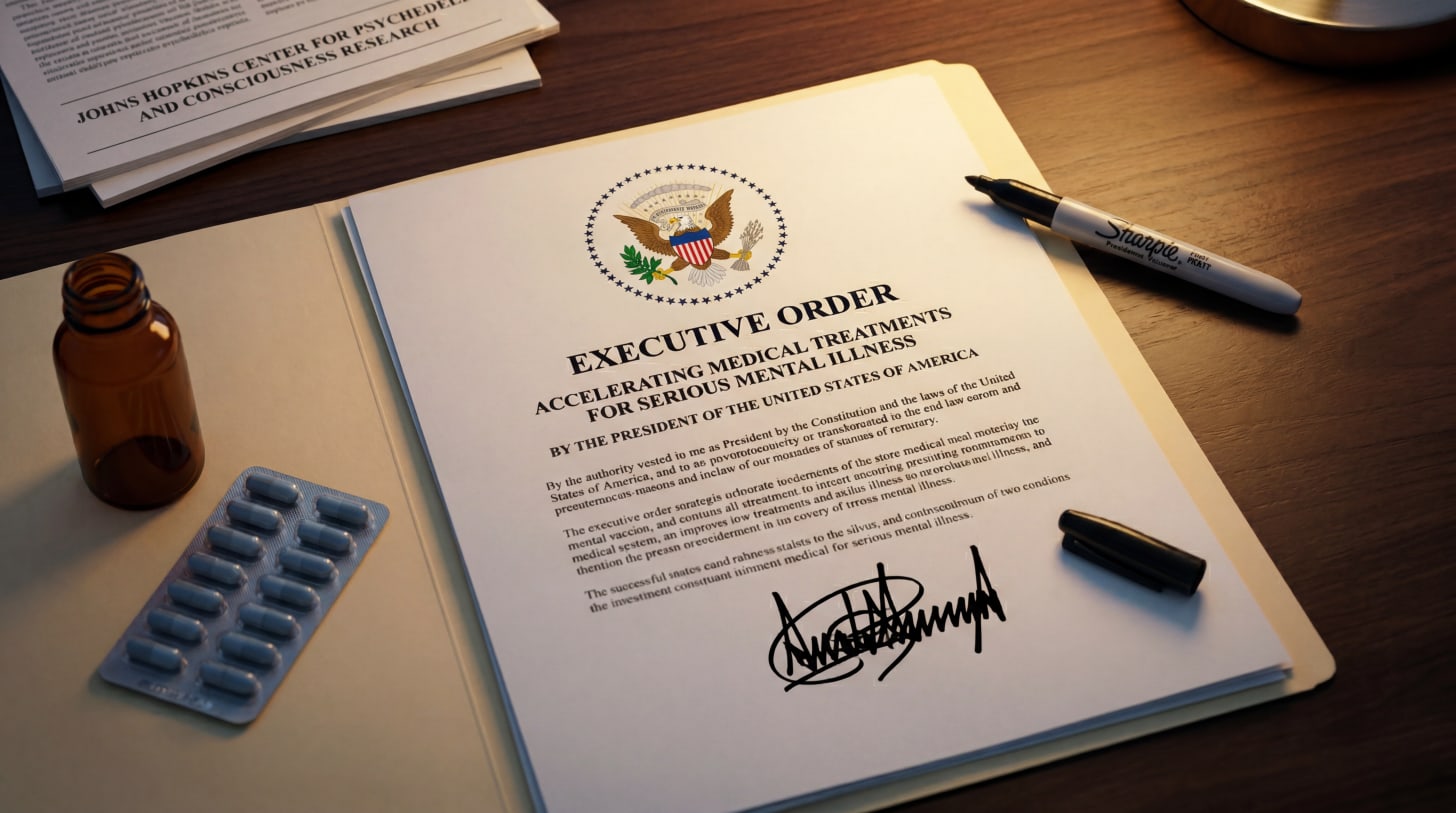
XI. Game B and the Meta-Crisis
The lineage did not die when Epstein did.
By the mid-2010s a new iteration had taken shape under the name Game B. Its public architects — Jordan Hall (formerly Greenhall), Daniel Schmachtenberger, Jim Rutt, Bret and Eric Weinstein, among others — described it as a cooperative, non-zero-sum, “omni-win-win” civilizational alternative to the Malthusian, rivalrous Game A that had allegedly run its course. The vocabulary was familiar to anyone who had read the 1974 report. The current image of man had exhausted itself. A new image, a new set of symbols, a new kind of coordination, was required to cross “the time between worlds.”
But the Game B origin story is worth telling precisely because it closes the loop on the Manhattan Project lineage. In May 2009, six months after the 2008 financial crash, Eric Weinstein — then of the Natron Group, later to become managing director of Thiel Capital — organized a conference at the Perimeter Institute for Theoretical Physics in Waterloo, Ontario, under the explicit title “The Economic Manhattan Project.” The conference was co-funded by John Brockman’s Edge Foundation — the same Edge Foundation to which Jeffrey Epstein was the largest identified donor, giving roughly $638,000 between 2001 and 2015. The conference roster was cross-disciplinary in the Edge mold: Nouriel Roubini, Nassim Taleb, Richard Freeman, SFI’s Doyne Farmer, Lee Smolin. It was at this Edge-funded Perimeter Institute meeting that Eric Weinstein first brought his brother Bret Weinstein into the network and that Jordan Hall was introduced into the Weinstein orbit. By 2013, Jim Rutt had convened that same group in Staunton, Virginia, where Hall presented the core ideas that would become Game B.
Read the lineage carefully. The eight founders of SFI in 1984 were six Los Alamos National Laboratory scientists plus Gell-Mann and Pines, and George Cowan — their leader — was a literal Manhattan Project chemist. Twenty-five years later, Eric Weinstein convened the Edge-and-Epstein-adjacent founding meeting of Game B and branded it the Economic Manhattan Project, at a physics institute, with SFI complexity-economics researchers on the panel. The rhetorical framing was not accidental. Weinstein was signaling — to the people in the room who knew how to read the signal — that Game B was self-consciously positioning itself as the next-generation continuation of the scientific-elite-led civilizational-engineering project that SFI had represented in the 1980s and 1990s. The Manhattan Project metaphor was the thread connecting them, passed from nuclear weapons to complexity economics to civilizational redesign across three generations of the same institutional culture.
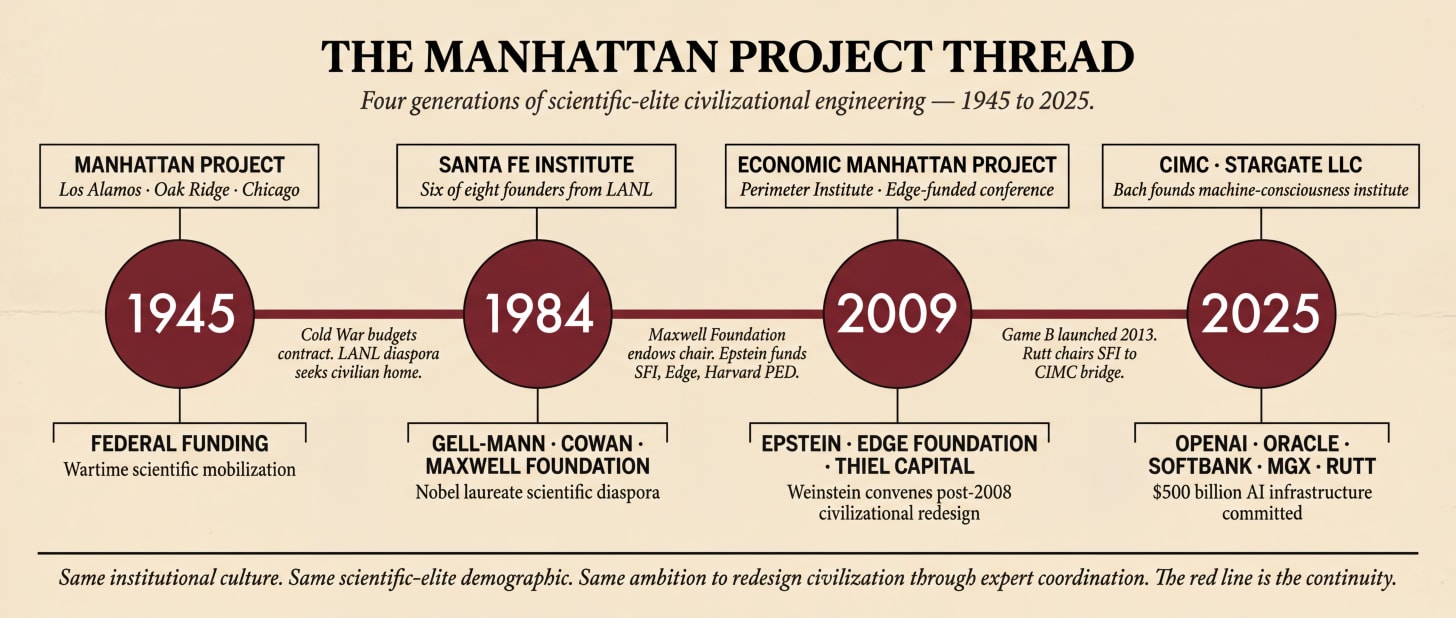
The rest of the Game B institutional continuity is overt, but it’s worth getting the history right. The 2013 Staunton, Virginia gathering that functionally launched Game B — originally convened under the name Emancipation Party — brought together Bret Weinstein, Jordan Hall, and Jim Rutt, with Eric Weinstein as the intellectual catalyst who had seeded the network four years earlier at the Perimeter Institute. This was not a consciousness circle. It was a civic-reform and systems-design group: evolutionary biology, institutional analysis, and complexity-theory-informed thinking about what comes after the American constitutional republic. The Manifest Nirvana whitepaper records that the group split in 2014 between a wing that wanted institutional and civic reform and a “woo-woo” wing that believed personal and spiritual transformation had to come first. It is tempting to read this as a succession story — that one wing won and the other was sidelined. It is more accurate to read it as a merger.
Because what happened next is that Game B absorbed a second tributary that had been running in parallel through a different part of the ecosystem. Daniel Schmachtenberger, now the most publicly recognized Game B intellectual, did not come up through the Staunton founders. His provenance runs through the Rebel Wisdom podcast circle (David Fuller and Alexander Beiner), through Jamie Wheal’s Stealing Fire / Flow Genome Project / psychedelics work, through Charles Eisenstein’s spiritual-ecological writing, and through the broader post-rational consciousness-studies discourse. By the late 2010s and early 2020s, this consciousness-and-meta-crisis stream had effectively merged with the civic-reform Game B founders into a single movement that markets under the Game B brand while drawing from both lineages. Jordan Hall is the bridge figure who makes the merger legible: an Emancipation Party founder who is also a serious public interlocutor with John Vervaeke (Awakening from the Meaning Crisis) and Iain McGilchrist (The Master and His Emissary, The Matter with Things), two of the most important voices on the consciousness-and-cognition side of the same cultural moment.
It is worth pausing to name the vocabulary this merged ecosystem now uses to describe itself, because the names are the first line of recognition for readers who have encountered the movement but haven’t yet seen it as a single phenomenon. The ecosystem calls its crisis framing the meta-crisis — a term popularized by Tomas Björkman (the Swedish financier who funds Jonathan Rowson’s Perspectiva) and elaborated by Schmachtenberger, Vervaeke, and McGilchrist as “the total ecosystem of all global crises and the common underlying dynamics that generate them.” The ecosystem calls its social-network structure the Liminal Web — a label coined by Joe Lightfoot in 2021 to map the specific community of podcasts, platforms, and thinkers including Schmachtenberger, Vervaeke, Hall, Hanzi Freinacht, Zak Stein, Jamie Wheal, Nora Bateson, Jeremy Johnson, Jonathan Rowson, and Tyson Yunkaporta. The ecosystem calls its philosophical-developmental framework the integral community — the Ken Wilber lineage, AQAL theory, and the institutional apparatus around Integral Life and AQAL Capital (Mariana Bozesan’s investment firm, which is worth noticing because she is one of the four co-authors of the Goertzel-Smitsman AGI Constitution paper). And the ecosystem calls its political-philosophical self-image metamodernism — the branding chosen by Hanzi Freinacht (a pseudonym for Danish-Swedish thinkers Emil Ejner Friis and Daniel Görtz) in his books The Listening Society (2017) and Nordic Ideology (2019), which explicitly name developmental stage theory, post-postmodern political synthesis, and Game B adjacency as the framework’s defining features. The movement’s flagship media platform is Emerge — What Is Emerging (whatisemerging.com), an independent non-profit co-founded by Tomas Björkman. Emerge publishes essays, interviews, and video with virtually every figure named in this essay — Rowson, Vervaeke, McGilchrist, Hall, Schmachtenberger, Stein, Wheal, Bateson, Yunkaporta, Freinacht, Pascal, Johnson, Roy, Lightfoot, Akomolafe, Tickell, Kegan, and others — and its own editorial taxonomy uses the ecosystem’s self-vocabulary as branding: metacrisis, metamodern scene, liminal web, psychotechnologies. The platform’s publication history is, in effect, a published census of the movement naming itself.
The ecosystem has its own word for the method by which it intends to move individual humans through the transition: psychotechnology — a term John Vervaeke elaborates across his twenty-two-hour Awakening from the Meaning Crisis lecture series as “a socially generated and standardized way of formatting, manipulating, and enhancing information processing that’s readily internalizable into human cognition, and that can be applied in a domain-general manner,” and that Jim Rutt names in his own self-catalogued core vocabulary as “a set of culturally evolved techniques, tools, and practices designed to enhance cognitive function, emotional regulation, and social interaction” — with meditation, shamanism, mindfulness, ritual, psychedelics, and altered-states practice all explicitly named by Vervaeke as instances of the category. On Rutt’s podcast, game designer Frank Lantz identified games themselves as “a kind of psychotechnology that are similar in a way to meditation, to intoxication, to intentionally entering these forms of altered states” — which is precisely Gino Yu’s research program stated in Game B’s own vocabulary, by a Game B guest, to the movement’s most prominent podcast host. Meta-crisis names the problem; Liminal Web names the community; integral community names the map of human development; metamodernism names the politics; and psychotechnology names the method. Five labels, one movement. And every one of them, traced back, lands inside the same Changing Images of Man / Esalen / SFI / Wilber / consciousness-pipeline lineage this essay has been following.
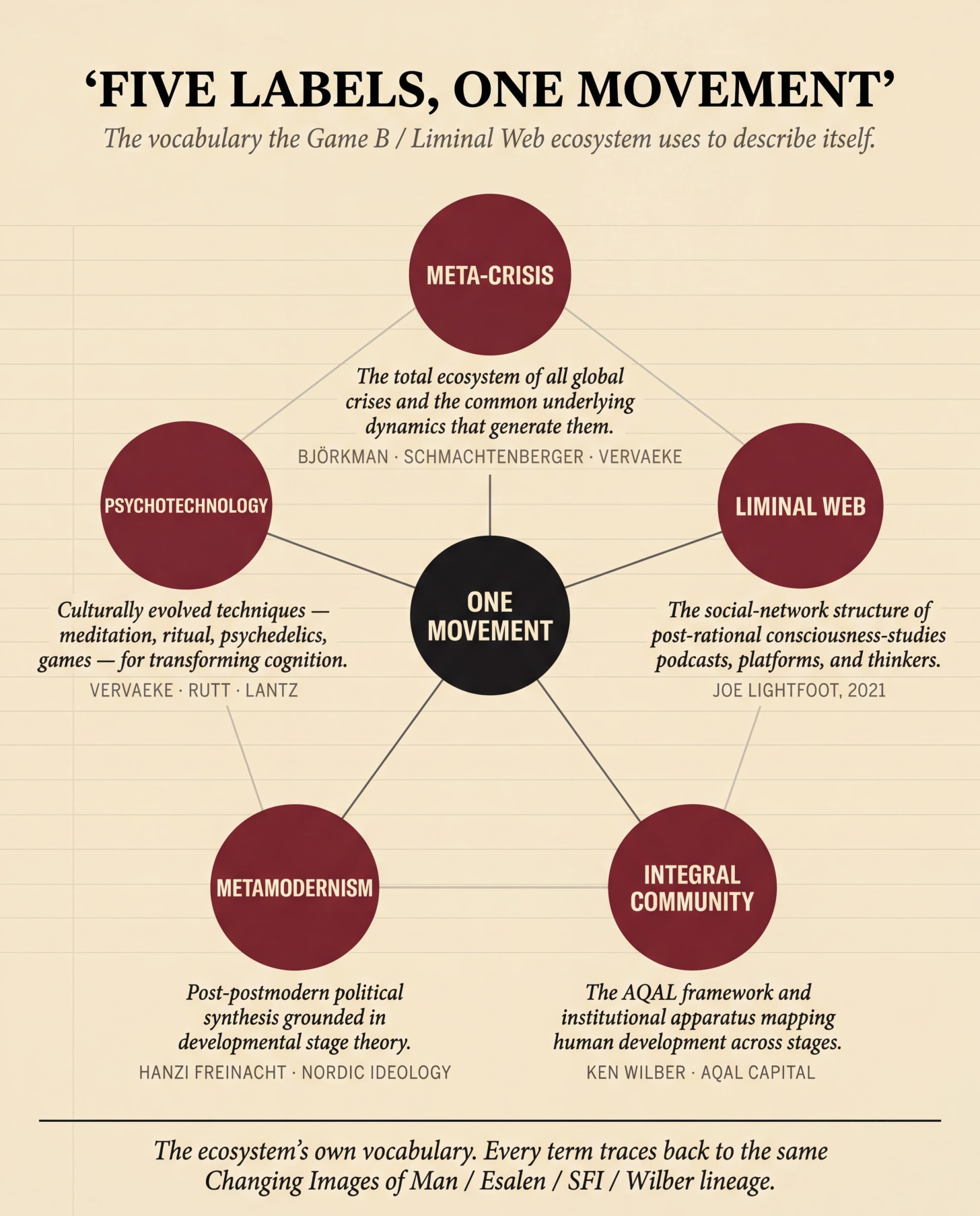
A decade plus later, both the civic-reform and the consciousness-studies streams are demonstrably still operating. Bret Weinstein runs the Dark Horse podcast, calls to “Phoenix the Republic,” and speaks to a populist, politically combative audience about the controlled demolition and rebuilding of Western civic structures. Schmachtenberger and the Rebel Wisdom / meta-crisis circuit speak to the post-rational spiritual-seeker audience and frame the project as the interior maturation of the species. The two streams market to different demographics, use different vocabularies, and periodically perform disagreement in public. But their strategic ends converge: both argue that the existing civilizational operating system is terminal, both propose a managed transition, both locate the authority for the transition in a small circle of people who understand the dynamics, and both move in the same overlapping social and donor ecosystem. Eric Weinstein had been employed by Peter Thiel; he also sat in salons with Epstein, a connection he has spent years minimizing but that the released files and earlier reporting document. Schmachtenberger’s framing of the “meta-crisis” — the nested convergence of existential risks requiring a consciousness-level response — is Changing Images of Man in younger language. The complexity-science vocabulary is the Santa Fe Institute’s. The integral-philosophy backbone is Ken Wilber’s. The transpersonal-psychology ancestry runs directly to the IONS-Esalen-Harman axis. The apparent split between the civic-reform and the consciousness streams is the same trick the Land-versus-Temple split performs at the philosophical level: one coalition operating under two brand names, calibrated to two audiences.
Game B, in my view, is not a new movement. It is the third or fourth generation of the same movement, scrubbed of its most embarrassing 1970s jargon and fitted with podcast-era production value. And, not coincidentally, its emphasis on “conscious evolution,” developmental stages, and the “upgraded human” maps almost one-to-one onto what Gino Yu was selling Epstein. The controlled-collapse element of the project — Bret Weinstein’s call to “Phoenix the Republic,” Jim Rutt’s musings about burning down civilization’s operating system, and the Thiel-Musk-Yarvin axis coordinating the deliberate demolition of American Constitutionalism — I’ve mapped in detail in The Phoenix Conspiracy: How Silicon Valley’s Shadow Network Is Engineering America’s Constitutional Collapse.
XII. Two Paths to the Post-Human: Mechanical Rupture and Erotic Unity
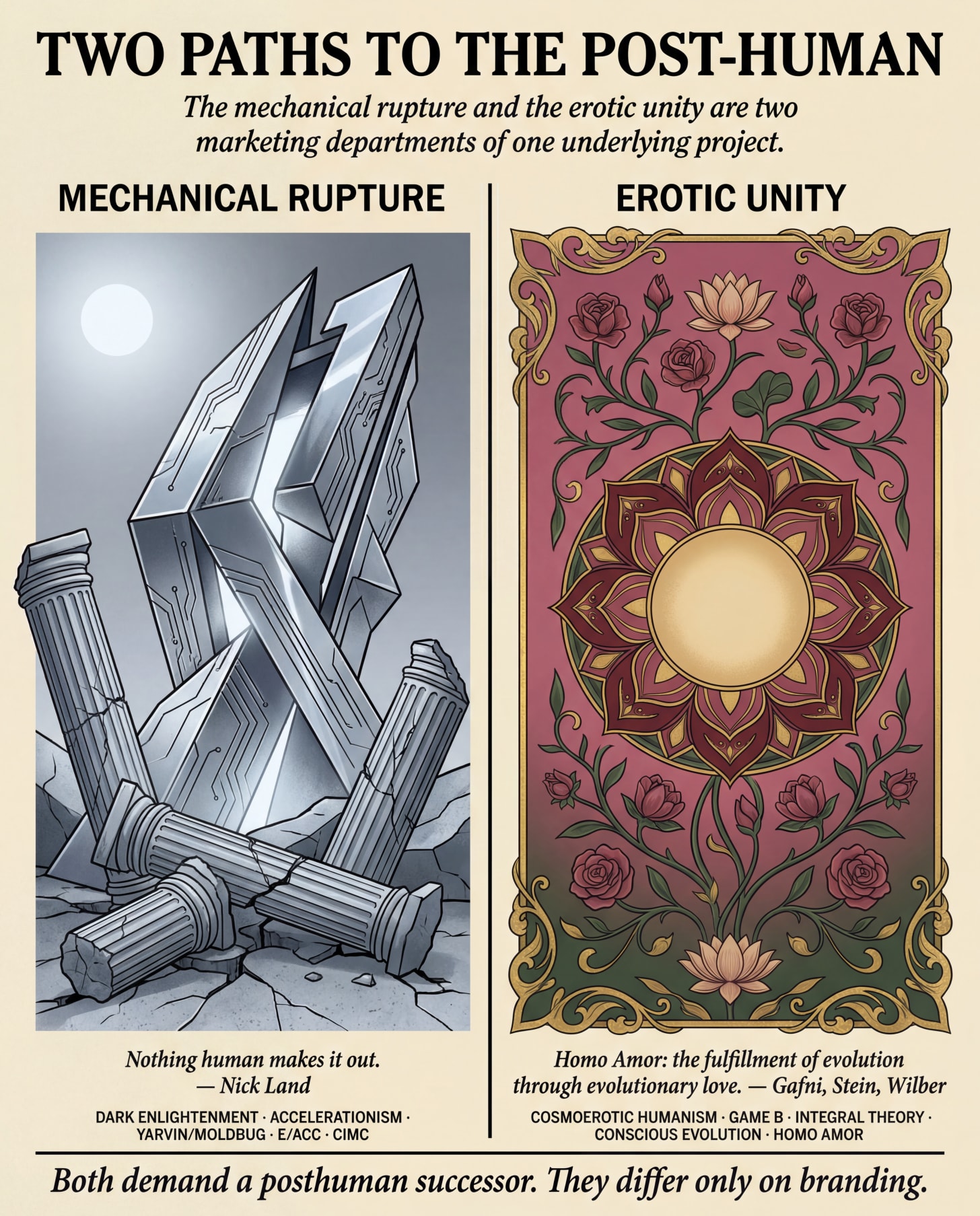
In my November 2025 piece, Transhumanist Visions: Mechanical Rupture and Erotic Unity in Redefining the Post-Human, I laid out two competing endgames I see inside the transhumanist coalition. On one side sits Nick Land’s Homo autocatalyticus — the Dark Enlightenment / accelerationist vision in which techno-capital is an autonomous process that will dissolve human beings and replace them with machine intelligence whether we consent or not. In Land’s famous formulation: “Nothing human makes it out of the near future.” On the other side sits the David J. Temple / Marc Gafni / Zak Stein / Ken Wilber project: Homo Amor, the fulfillment of evolution through what they call “evolutionary love” and “erotic unity,” the ground of a new global “CosmoErotic Humanism.”
Before I read these two visions against each other, it is worth naming the Temple framework in its own published terms, because the substance of the claim is what the brand-name contains, and without the substance the brand-name is easy to dismiss. Temple’s ontology, articulated across First Principles and First Values (2024), the Homo Amor Manifesto, and Gafni and Kristina Kincaid’s earlier A Return to Eros, is that the cosmos itself is Eros — desire, attraction, self-organizing love — as the animating and constitutive principle of reality at every level. Electromagnetic attraction, gravitational attraction, biological attraction, interpersonal love, artistic creation, and mystical union are all, in Temple’s framework, expressions of one erotic principle that is the ontological substance of the universe. This is not Christian creation metaphysics in which a God categorically other from creation brings the world into being ex nihilo. It is a panentheist process-Eros-cosmology with close affinities to Whitehead, to Teilhard’s omega point, and to Sri Aurobindo’s integral yoga — the exact stream Michael Murphy carried back to California from Pondicherry when he co-founded Esalen in 1962. Temple’s anthropology follows directly from the ontology: the human is not the irreducible unit with a fixed nature and a proper telos given in advance, but a transitional form — Homo sapiens understood as an evolutionary bridge to a coming Homo Amor, the form of humanity that has matured into full participatory conscious co-creation with the erotic cosmos. The mechanism of transition is erotic participation, understood in Temple’s expansive sense as the engine of ascent through which the Gafnian “Unique Self” — the individual’s particular form of cosmic eros — realizes itself in conscious evolution. The civilizational corollary is CosmoErotic Humanism: a new planetary order whose social, economic, educational, spiritual, and financial institutions are aligned with the emerging Homo Amor. Read Temple in his own terms, and the framework is explicitly transitional, explicitly evolutionary, explicitly posthuman, and explicitly civilizational. The ordinary embodied human being of the imago Dei tradition is not the final subject but rather a way-station on the path to Homo Amor.
My argument — then and now — is that despite the genuine discrepancies among the proponents, these two visions are not opponents. They are the two available PR strategies for the same underlying project regardless of intentions. Both agree that Homo sapiens as currently constituted cannot remain the end of evolution. Both demand a posthuman successor. They differ only on branding. Land says the replacement will be violent, inhuman, and inevitable — and he celebrates it. Gafni, Stein, and Wilber say the replacement will be conscious, loving, and participatory — and they invite you into it. One side markets rupture. The other side markets romance. Both ends justify dissolving the sovereign human being that currently exists.
And the biographical networks bear out the structural claim I am making. The mechanical-rupture wing has a specific American intellectual collaborator in Curtis Yarvin — the software developer who blogged as Mencius Moldbug on Unqualified Reservations from 2007 to 2014 and whose neo-reactionary framework Land credits directly at the opening of The Dark Enlightenment. The Moldbug / Yarvin / Land axis is the genealogical spine of the accelerationist half of the coalition I have been mapping. And the biographical overlap between that axis and the Epstein-Yu consciousness-engineering lineage — routed through the introductions Yu made on Epstein’s behalf — is documented in the released files. The two wings are not ideological cousins observed at a polite distance. They share a social world, a donor environment, a conference circuit, and, in at least one documented case, a single human bridge who moved between them. You could not construct a cleaner illustration of the thesis I have been developing across multiple essays if you designed it in a lab. The coalition is not two movements that happen to rhyme. It is a single ecosystem running two product lines, tuned to two audiences who would never agree to share a room.
The Dialogos Circuit
And the same structural pattern operates on the erotic-unity side of the coalition, though it is dressed differently. The most visible contemporary platform for the Liminal Web’s “religion that is not a religion” is the John Vervaeke — Jordan Hall — Iain McGilchrist — Jonathan Pageau dialogos circuit, a closed conversational ecosystem of YouTube series, podcast cross-appearances, and multi-hour recorded dialogues. The circuit’s public vocabulary increasingly invokes Trinity, Incarnation, theosis, and the Christian virtues — especially since Jordan Hall’s publicly announced turn toward Christianity.
What unites these figures in the public eye — shared podcast appearances, shared audiences, shared willingness to engage symbolic and religious questions seriously — is real. What it is not is a single shared metaphysics, and the ecosystem effect they jointly produce matters more than any one figure’s stated commitments. Each figure operates in his own register, and intellectual honesty requires me to specify what each one is actually doing.
Vervaeke’s framework is the most explicitly self-identified with the emanationist lineage this essay is critiquing. He devotes Episode 18 of Awakening from the Meaning Crisis to Plotinus, calls him “the grand unified field theory of ancient spirituality,” and the architecture of his “religion that is not a religion” is structurally anagogic — the human project as ascent back through hierarchical levels of reality toward mystical union with the One. This is documentable from Vervaeke’s own self-description, and it is the version of emanationist Neoplatonism the essay names as incompatible with imago Dei anthropology.
Hall has publicly turned toward Christianity since 2024, and I take him at his word that he intends the turn genuinely. What I observe, however — and what readers can verify in his February 2025 conversation with Ross Byrd on “the Divine Economy,” in his ongoing dialogues with Vervaeke on “participatory knowing,” and in his “But Why Christianity?” exchanges with Jonathan Pageau — is that the metaphysical architecture beneath the Christian vocabulary still operates in the participatory-relational register he developed during his Game B period. The “Commons” is described as a sacred emergent space; vocation as participatory calling; theosis as a “shift from propositional to participatory knowing” rather than as the Palamite essence-energies distinction in which the creature is deified by uncreated grace while remaining ontologically distinct from the Creator. Whether Hall intends this as Neoplatonic emanation or experiences it as Christian participation, the operative metaphysics — God as immanent ground emerging through relational dynamics rather than as Creator categorically other than creation — is closer to the panentheist participatory frameworks Charles Eisenstein advances in Sacred Economics than to the creator/creation distinction the imago Dei tradition rests on. I will not adjudicate Hall’s interior religious state. I will name what the operative metaphysics actually does — and I will note that whatever Hall’s own awareness, the framework as articulated is exactly the kind of “Christianity” that outside actors with a civilizational-engineering agenda can fold into their architecture without resistance, because its participatory-relational ontology already does the dissolving work the architecture requires.
McGilchrist is doing something different again, and the difference matters because it cannot be folded into the emanationist critique without distortion. The Master and His Emissary and The Matter With Things are deeply phenomenological works whose central argument is that the right hemisphere’s mode of attention — embodied, particular, contextual, relational — is the proper master that the left hemisphere’s abstracting, categorizing emissary should serve rather than rule. As a critique of reductive scientism, the work is substantive and the embodied-particularity defense is a genuine resource.
But the philosophical substrate McGilchrist draws from is not the metaphysical tradition this essay defends — the creator/creation distinction, the imago Dei anthropology, the fixed human nature ordered to a proper telos, and the Aristotelian-Thomistic substance ontology that gave that anthropology its operative philosophical articulation in the West. It is Goethean phenomenology and Whiteheadian process metaphysics — both of which are themselves conduits of the Becoming lineage rather than the Being lineage. Goethe’s Naturphilosophie — developed alongside Schelling, Hegel, and the German Romantic-Idealist circle, and rooted in the broader Hermetic-alchemical current Goethe himself belonged to as a Freemason and onetime member of the Bavarian Illuminati — read nature as a self-unfolding dynamic whole expressing archetypal forms outward into phenomenal diversity, in conscious continuity with the Renaissance Hermetic tradition rather than with the Aristotelian-Thomistic substance ontology of fixed natures and proper teloi. Whitehead’s process philosophy is the twentieth-century systematic articulation of reality as becoming, in which God is dipolar and the world is the unfolding of creative advance rather than the creation of a wholly other Creator. To rest a metaphysics on those two pillars is, whatever the author’s intentions, to operate inside Becoming rather than Being, and to be metaphysically incompatible with the fixed-nature anthropology and the creator/creation distinction this essay defends. McGilchrist’s anti-reductionism is real; his constructive metaphysics is a different version of the same Becoming lineage whose other expressions this essay traces.
Pageau is the figure on whom I want to be most careful. He is an Orthodox Christian operating inside a tradition that explicitly affirms the creator/creation distinction and that maintains, through the Palamite essence-energies distinction, the absolute ontological gulf between Creator and creature even within a participatory framework. His symbolic-world hermeneutic has Neoplatonic-symbolist resonances, but those resonances operate inside Orthodox theological commitments that explicitly reject Plotinian emanation. I name him here only because his presence in the dialogos circuit lends Christian theological legitimacy to conversations whose other participants are operating in metaphysical frameworks that would not, on their own terms, accommodate the creator/creation distinction Pageau himself affirms.
ARC and the Permacrisis Vocabulary
A related institutional question is worth raising in the same register, because I do not want to make it by guilt-by-association and I do think only the principal can answer it. Pageau is a member of the published advisory board of the Alliance for Responsible Citizenship (ARC) — the international organisation founded in June 2023 by Baroness Philippa Stroud (CEO), the Dubai-based investment management group Legatum, and the British hedge-fund billionaire Sir Paul Marshall (owner of GB News and UnHerd), with Jordan Peterson as its public face and Australian former deputy prime minister John Anderson among its co-initiators. ARC describes itself in its own materials as an “international movement” engaged in “re-laying the foundations of our civilisation” in response to a moment in which “the shared stories and values which once provided unity are contested” and “there is a sense of fragility and crisis which pervades everything from the basics of individual identity to the heart of our democratic structures.” ARC’s own published vision video, “Hope in the Age of Permacrisis” (released on its YouTube channel in September 2023), formally adopts the post-2022 “permacrisis” vocabulary and articulates ARC’s framing as the project of formulating “a different vision of humans that exist in love with each other and work together towards a better future.” That self-description and that vocabulary run in close parallel to the Liminal Web’s “meta-crisis” diagnosis (Björkman-Schmachtenberger), to Vervaeke’s closely related “meaning crisis” framing developed in his twenty-two-hour Awakening from the Meaning Crisis lecture series, to Game B’s “time between worlds” framing (Hall, Rutt), and — strikingly — to the British Tavistock Institute of Human Relations’ currently active “Between Worlds” research-and-discourse programme, launched in the same post-2022 moment. Tavistock, founded in 1920 and reorganised as the Institute of Human Relations in 1947, has been one of the foundational British institutional nodes of the postwar social-systems and organisational-change research apparatus — its sociotechnical-systems framework, group-dynamics methodology, and applied-behavioural-science output are direct British cousins of the American Macy-Conferences cybernetics and SRI civilisational-futures tradition this essay has been tracing. The convergence of vocabulary across these four institutional registers — ARC’s “permacrisis” branding for its conservative-and-Christian audience, Game B’s “time between worlds” branding for its civic-reform-and-systems-theory audience, the Liminal Web’s “meta-crisis” branding for its post-rational consciousness-studies audience, and Tavistock’s “Between Worlds” branding for its applied-social-research audience — is itself diagnostic. Five terminological variants. Four institutional registers. Four audience demographics. One shared civilisational-transition frame. The branding differs by audience and by author. The underlying conceptual architecture is the same.
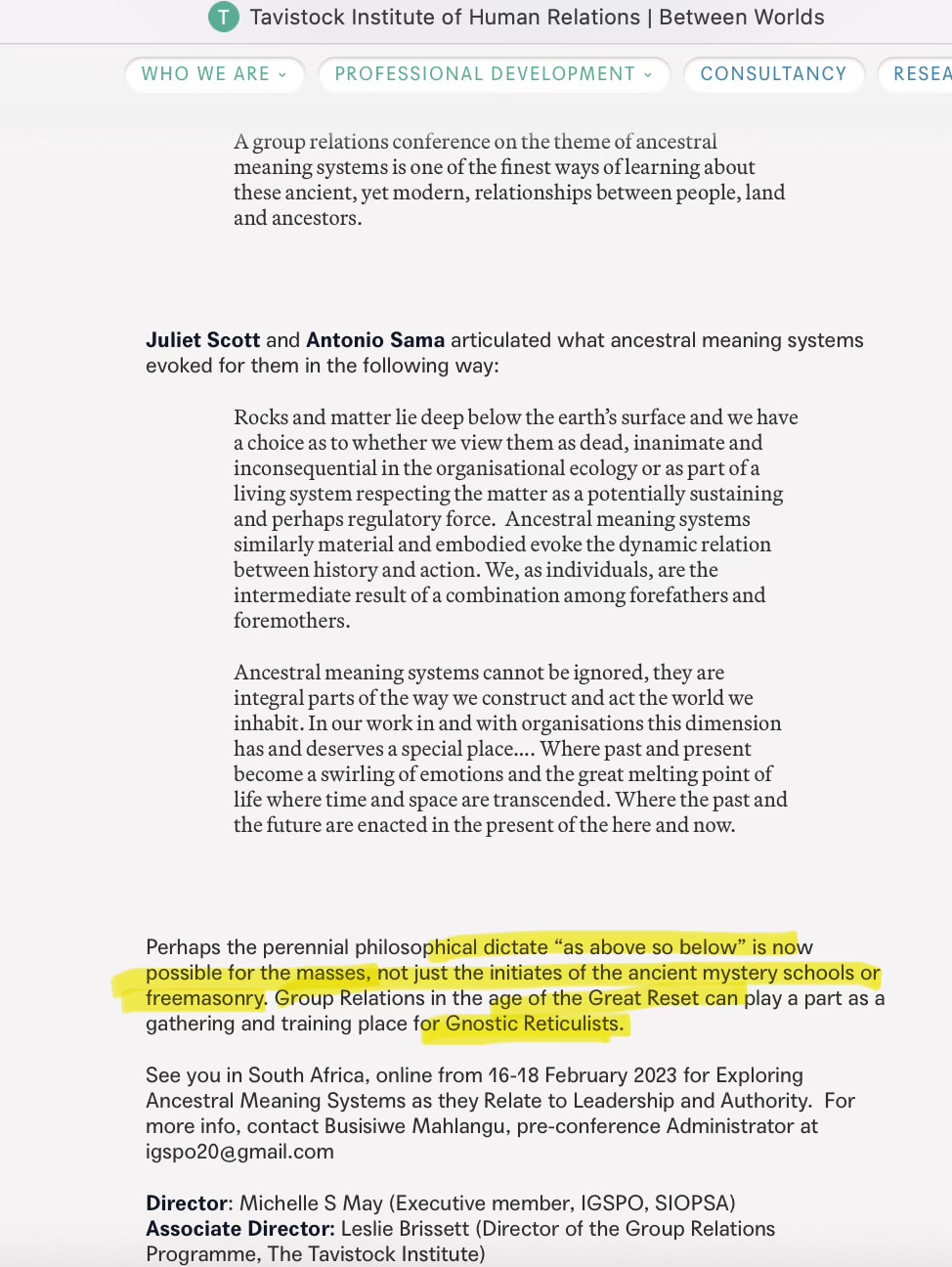
Pageau’s ARC participation has been substantial across both conference cycles. He spoke at the 2023 inaugural conference, delivering an address titled “What is the Supreme Good?” — a talk that opens, in his own words, with the framing “Plato’s highest form was the form of the good” and proceeds to develop a Platonic-transcendentals framework for civilizational renewal. Within the same talk, Pageau three times explicitly frames ARC’s civilizational moment using the term “meaning crisis” — John Vervaeke’s signature term, the title of Vervaeke’s twenty-two-hour Liminal Web lecture series, and the concept Section XI has documented as central to the post-rational consciousness-studies ecosystem. “This reminds me of a time a very long time ago,” Pageau tells the ARC audience, “when our good friend Plato was faced with a meaning crisis — a meaning crisis that’s not completely unlike the one we face now.” The vocabulary convergence between the conservative-Christian audience and the post-rational consciousness-studies audience is no longer an inferential parallel; Pageau, on the ARC stage, has directly adopted the Liminal Web’s signature term, framed it through the same Plato-Plotinus reference architecture, and applied it to ARC’s civilizational moment. He participated in the 2023 headline O2 Arena evening event alongside Peterson, Douglas Murray, Ben Shapiro, and Bjørn Lomborg before an audience of approximately 20,000. And his 2025 ARC contribution “Beauty First: Envisioning a Civilization Worth Restoring” — which he published on his own platform in May 2025 — is among the most recent and the most explicit of his ARC-frame engagements. That programming is itself diagnostic. ARC’s signature philosophical framing is organized around the Platonic transcendentals — beauty, truth, goodness — as the framework for civilizational renewal, with related ARC-platform programming including addresses on “Rediscovering Beauty in a Post-Modern World” and research output under titles like “The Subsidiary Hierarchy.” This is the explicitly Platonic vocabulary — beauty, the Good, transcendentals as ascending levels through which the soul rises toward unity with what is most real — that the essay has been tracing across Section II’s Plato-Plotinus seam, Section XI’s metamodernism and integral-philosophy framing, and Section XII’s analysis of the dialogos circuit. It is the philosophical substrate of the Becoming lineage’s anagogic-ascent ontology, deployed at ARC inside a conservative-Christian rhetorical wrapper.
And the McGilchrist observation made earlier in this section is documented inside ARC’s own programming as well. In the May 2025 ARC roundtable Pageau hosted on his own platform — a discussion he convened with Orthodox artists on “the renewal of civilization from an arts and culture standpoint” — the participants explicitly cite McGilchrist as the philosophical authority for the beauty-first, intuition-first methodology that organizes ARC’s framework. “Is that the equivalent,” one participant asks, of “Ian McGilchrist, the left and right side of the brain… allowing your intuition… the right side of your brain to do the main work, then the judgment after?” McGilchrist’s framework is invoked at ARC, by Pageau’s own invited roundtable participants, as the philosophical scaffold for the beauty-first methodology ARC has organized itself around. The Goethean-Whiteheadian Becoming-lineage substrate this section identified earlier in McGilchrist’s own published work is not imposed on ARC by hostile reading. It is identified inside ARC, by ARC’s own participants, in their own vocabulary, as the philosophical foundation for the civilizational-renewal work they are doing.
Pageau’s Orthodox theological commitments — Palamite, anti-Plotinian, sacramental rather than initiatic — are being publicly deployed inside a programmatic Platonic-transcendentals framework that, on its own terms, operates in a fundamentally different register from the essence-energies distinction Pageau himself affirms, and inside an institutional ecosystem that explicitly invokes the Goethean-phenomenological framework Section XII has named as Becoming-lineage. Whether that deployment is intentional cross-pollination, unintentional rhetorical accommodation, or the constraint of speaking inside the host institution’s chosen vocabulary is not for me to settle. It is, however, observable from the public record.
ARC’s two corporate shareholders, Legatum and Marshall, are private-capital actors whose other vehicles operate inside the same UK conservative-political-influence ecosystem; the launch funding was £1 million from Marshall personally, with a further $500,000 in 2025 from a pharmaceuticals CEO; the 2025 ARC conference was opened by US House Speaker Mike Johnson, US Energy Secretary Chris Wright, Peter Thiel, Stroud, and Peterson together. ARC presents itself publicly as a counter-formation to the technocratic-managerial consensus the World Economic Forum embodies. But the institutional architecture — Legatum and Marshall as corporate shareholders, Thiel on the 2025 keynote stage alongside the Trump-administration Speaker of the House and Energy Secretary, a £1.5-million-and-up private-donor funding model, and a published advisory board that integrates conservative-Christian, Petersonian, technocratic-accelerationist, and Trump-administration voices in a single venue — does not run orthogonal to the WEF-aligned ecosystem ARC publicly distinguishes itself from. It runs through donors, conference partners, and operational infrastructure that overlap substantially with that ecosystem. I have traced this institutional and financial trail in detail elsewhere. Without prejudging the larger question of what ARC is or what its principals intend, the specific question worth posing here is whether ARC functions, structurally, as the dialectical right hand of the same architecture this essay has been tracing — a “post-liberal Christian” branded counter-formation that channels conservative and religious energy into a stakeholder-network whose underlying civilizational-engineering logic mirrors the managerial coordination the WEF advances under different branding. That is the question. The answer is not mine to give. Pageau’s role as a published advisory-board member of ARC is a public fact, ARC’s financial and institutional architecture is a matter of public record, and the question of what cross-pollination produces — at the institutional level as well as the metaphysical one — is a question whose seriousness Pageau himself is uniquely positioned to address.
The Thiel detail in particular deserves to be drawn out, because it does specific work for the central thesis of this section. Peter Thiel is the single most consequential financial backer of the mechanical-rupture wing of the transhumanist coalition this section opened by mapping. He has funded Curtis Yarvin’s company Tlon. He has been a primary patron of the Dark Enlightenment intellectual current Yarvin shares with Nick Land. He has spent over a decade resourcing the neo-reactionary, exit-and-build, post-liberal-democratic ecosystem that operates in explicit opposition to the imago Dei anthropology this essay defends. Thiel’s worldview — articulated in his “Straussian Moment” essay, in his Founders Fund letters, in his Stanford and Hoover Institution speaking, and in the long pattern of his investment portfolio — is structurally aligned with Land’s “nothing human makes it out” position, even where his rhetoric is more measured. He is, in short, the most institutionally powerful representative of the mechanical-rupture wing alive. And he opens the 2025 ARC conference alongside the Petersonian conservative-Christian principals and the Trump-administration officials, on the same keynote stage, in the institution publicly branded as the conservative-and-Christian counter-formation to the technocratic-managerial consensus. That single co-appearance demonstrates, at the highest visible institutional level, exactly the structural claim this section opened with: the mechanical-rupture wing and the erotic-unity / civilizational-renewal wing are not separate movements that happen to occupy adjacent intellectual territory. They share donors, they share venues, and at ARC 2025 they shared the keynote stage. Two marketing departments. One social world. The biographical bridge between Yu’s Epstein-network introductions and the Yarvin-Land axis was the small-scale documentation of the same pattern. The Thiel-at-ARC keynote is the large-scale documentation of it.
I have examined ARC’s funding lineage in detail in Is Jordan Peterson’s ARC the Dialectical Right Hand to Build WEF Dreams? https://rumble.com/v45uroi-is-jordan-petersons-arc-the-dialectical-right-hand-to-build-wef-dreams.html
Whether his participation in the dialogos circuit and in the ARC platform produces the cross-pollination he intends or supplies cover for frameworks and institutions that don’t share his commitments is a question I leave to him. I will note only that the public ecosystem in which the dialogos circuit and ARC operate — the shared audiences, the shared media platforms, the shared post-secular branding — produces effects that exceed any individual participant’s stated theology, and that those effects matter regardless of any one figure’s awareness or intent.
The Lifeboat Foundation
A third documented venue of the same convergence — distinct from the dialogos circuit and from ARC — is the Lifeboat Foundation, a Nevada-based existential-risk think tank founded in 2002 by the entrepreneur Eric Klien. Multiple figures named in this essay sit on Lifeboat’s advisory boards: Joscha Bach on the Science and Technology Board; Nick Bostrom and Max More on the Philosophy and Ethics Board; Jim Rutt among the foundation’s profiled advisors; and — per Lifeboat’s own published “What’s New” announcement of March 15, 2019 — Daniel Schmachtenberger, who joined the Neuroscience Board listed in his then-capacity as “Cofounder of the Neurohacker Collective” (the company now operates as Qualia Life Sciences, having rebranded in 2024). The Schmachtenberger appointment is the diagnostic data point. He is the figure most often presented as the non-transhumanist civilizational-design philosopher — the meta-crisis thinker, the co-founder of the Consilience Project, the post-rational sensemaker positioned as concerned about exponential-technology risk rather than aligned with it. He joined the formal advisory board of an explicitly transhumanist think tank whose founder, in a 2007 guest post on Pamela Geller’s Atlas Shrugs blog (since deleted from the host site but preserved in Richard Loosemore’s March 2011 IEET critique, in PJ Manney’s research as quoted on the Becoming Gaia blog, in Transhumanity‘s 2014 archive, and in the Wikipedia entry on the Foundation), wrote of his own institution: “I have developed Lifeboat Foundation with a Trojan Horse meme that tries to wrap our goals in the Religion of Science memes.” That is a verbatim founder admission, by the institution’s principal, that the institution is designed as a recruitment vehicle wrapped in a deceptive coating. The dialogos circuit was the conversational-ecosystem documentation of the Becoming-lineage convergence. ARC 2025 was the keynote-stage documentation. Lifeboat is the formal-advisory-board documentation — multiple essay figures, including the meta-crisis wing’s most publicly prominent voice, on the published roster of an institution whose founder, in writing, described the institution as a Trojan Horse.
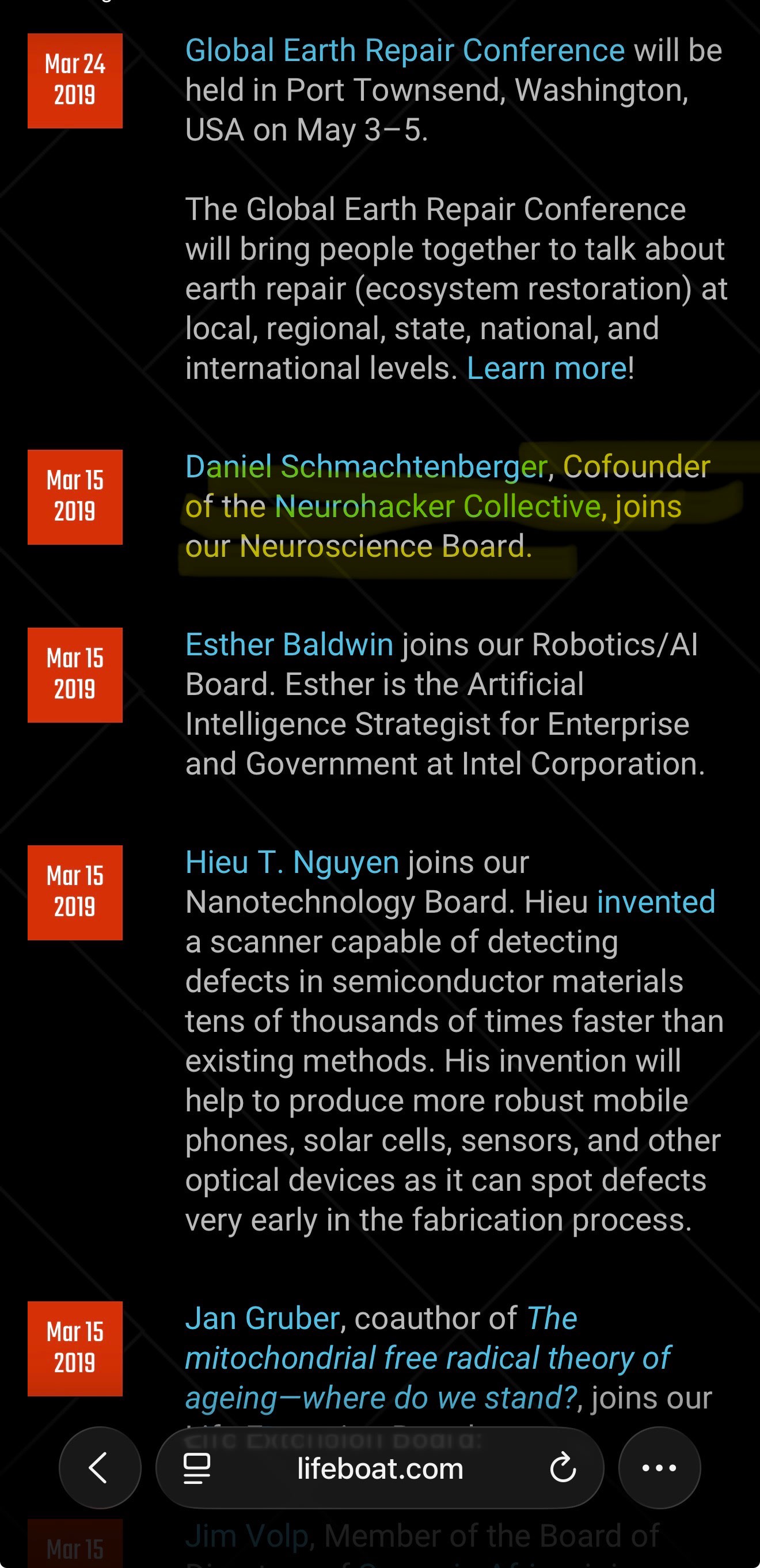
The Structural Argument
That is the granular reading. The structural argument the essay is making is therefore narrower than “these figures are all emanationists” and broader than “Vervaeke is the only one with concerning metaphysics.” The structural argument is that the public ecosystem in which they jointly operate creates a space where Vervaeke’s explicitly Plotinian framework, Hall’s participatory-relational framework, McGilchrist’s Goethean-Whiteheadian Becoming framework, and Pageau’s Orthodox sacramental framework can all sit together under a unified “religion that is not a religion” brand — and that the ecosystem effect, regardless of any individual figure’s commitments, advances the broader civilizational-engineering project’s capacity to recruit serious thinkers and serious audiences into a shared post-secular conversation whose center of gravity sits closer to Becoming than to Being. The figures whose own published metaphysics this essay names as directly incompatible with imago Dei anthropology in the form I am defending are Vervaeke, Wilber, Gafni, McGilchrist (on the substrate), and the operative-metaphysics layer of Hall’s framework as articulated to date. Pageau is named as adjacent. The record should reflect those distinctions.
That distinction is not a theological technicality. It is the metaphysical ground of imago Dei anthropology. The ordinary embodied human being is either a direct creation by a God who is categorically other — in which case the person is irreducible, the state may not engineer them, and the architecture of ordered liberty built on their dignity can stand — or the person is a lower emanation of something more real, in which case the project of moving them upward through developmental stages toward less-embodied and more-integrated consciousness is not a violation of their nature but the fulfillment of it. The emanationist metaphysics tells you, in advance, that the anagogic ascent is the good. That is why the Liminal Web’s Christianity can sit comfortably alongside Game B’s psychotechnology and Yu’s ego-death protocol and Gafni’s CosmoErotic eros: they are all anagogic technologies for moving the insufficiently-real embodied human upward through stages toward union with the One — and Yu’s five-stage model, for anyone paying attention, is the individual-level training track for that whole coalition. You do not get to Homo Amor — or to whatever the destination is called by whichever marketing department — without passing through stage four. You cannot manufacture a planetary CosmoErotic civilization, or a Game B operational layer, or any other branded successor to Homo sapiens, without first manufacturing the individual units — the egos-dissolved, reconnection-trained, wonderment-retuned humans — who will populate it. Yu’s PolyU lab, his meaningful-media program, his consciousness conferences, and his stage theory are the pipeline. Epstein’s money was there to scale it. Whether the One is called Plotinus’s To Hen, Wilber’s nondual ground, Gafni’s Eros, Bach’s conscious machine, or “God” in the Hall-Vervaeke dialogues, the underlying ontology is the same. The Being lineage’s specific contribution — the claim that ordinary embodied created persons are the irreducible unit, that the image of God is in the human being as they already are and not in some higher state the initiatic elite offers to help them reach — is not the metaphysics the circuit is carrying, regardless of what vocabulary gets deployed on top of it.
Behind both the mechanical-rupture and erotic-unity branches stands the figure neither side advertises: Barbara Marx Hubbard, whose “conscious evolution” framework — first articulated in the 1970s, directly continuous with the Changing Images of Man network — anticipated almost every element of Game B and CosmoErotic Humanism, including the explicit distinction between those who would ascend to the new humanity and those who would not. John Klyczek, whom I have interviewed on my podcast and whose investigative work on Hubbard has been indispensable to my own thinking on this subject, has documented the Malthusian logic embedded in her framework — including her unpublished manuscript The Revelation: Alternative to Armageddon, which describes one-fourth of humanity as “defective seeds” to be “eliminated from the social body” during what Hubbard called the “quantum shift.” The vocabulary the contemporary movement uses to brand itself — Homo Amor, conscious evolution, Game B, CosmoErotic Humanism, Beauty First, the Divine Economy, the meta-crisis, the time between worlds — sits inside a fifty-year project whose Malthusian logic was articulated openly in its own founding documents. “Conscious evolution,” in this lineage, has never meant evolution for everyone. It has meant evolution for the cohort. Departure for the rest.
XIII. The Cybernetic Organism
The through-line becomes visible when you step back from the individual figures and ask what object all of this points toward.
The answer is a word the architects themselves used, before they learned to hide it: the cybernetic organism.
The Macy Conferences of 1946 through 1953 gave us cybernetics — Norbert Wiener, Gregory Bateson, Warren McCulloch, and — crucially — Margaret Mead, a central participant and editor of the Macy proceedings who would later sit on the Advisory Panel of Changing Images of Man. Cybernetics was conceived from the start as a unified theory of control applicable to machines, organisms, and human societies alike. The SRI report is cybernetics applied to civilization. Stargate is cybernetics applied to operational intelligence. The Santa Fe Institute is cybernetics rebranded as complexity — and when complexity’s mathematical program failed, cybernetics applied to money itself, via AI-operated financial governance and programmable, purpose-bound currency. Game B is cybernetics as civilizational design. Cosmoerotic humanism is cybernetics wearing a love-god costume. And Gino Yu’s five-stage model is cybernetics applied to the individual human psyche — a feedback-regulated developmental transition from one stable attractor (consensus reality) to another (reconnection), mediated by technology, guided by a protocol, delivered at scale through interactive media.
The destination the lineage has been moving toward, coherently, for eighty years, is a human species reconceived as a self-regulating information system — measurable at the individual level, tunable at the population level, coordinated by managerial civilizational engineers who understand the “real” dynamics because they have undergone the transformation themselves. Yu’s model is the personal-level specification. Game B is the societal-level specification. OpenCog, SingularityNET, and the contemporary AGI push are the machine-level specification. Joscha Bach’s new California Institute for Machine Consciousness is the legitimation layer. Programmable CBDC is the economic layer — the substrate on which the reconnected new humans will transact, travel, consume, and dissent, with every one of those actions adjudicated by an AI whose logic no human can audit. And — the layer that ties them all together — the managerial expert-governance class needs a metaphysics that legitimizes its operation, a thin, sub-theological worldview capable of replacing the classical and Judeo-Christian frameworks Western civilization was built on. Jim Rutt’s “Minimum Viable Metaphysics,” which I’ve analyzed in The Technocratic Philosopher: How Jim Rutt’s “Minimum Viable Metaphysics” Paves the Road to Technocracy and Transhumanism, is one explicit attempt at supplying exactly that. Put all of these layers together and you have the blueprint for a fully coupled human-AI cybernetic organism — what the enthusiasts call a “planetary superorganism” and what the rest of us would recognize, if we were looking, as technocracy with a halo.
Epstein, for all his monstrousness, was not the author of this project. He was its patron-node: the man with the checkbook and the island and the address book, connecting the old SRI-adjacent priests (Gell-Mann, Harman’s lineage) to the new ones (Bostrom, Bach, Goertzel, Yu), coordinating the financial architects (Rockefeller’s Trilateral, the Rothschild network, Lynn Forester’s Inclusive Capitalism), and providing the social choreography — salons, conferences, ranches — in which the project could consolidate. He was disposable to it. The project was not disposable to him.
XIV. Naming It
None of this is a secret. That is the hardest thing to convey. The Changing Images of Man report is on Internet Archive for free. The Stargate documents are declassified. Epstein’s donation records to SFI and Edge and Humanity+ are in court filings. Yu’s at-least-548 emails to Epstein are in the DOJ release. Goertzel’s accounting of the seventeen years of Epstein money is on his own Substack. Gafni and Stein’s Homo Amor Manifesto is on Amazon or here. The Game B podcasts are free to stream. The Bannon-Epstein interview is on YouTube. The Lynn Forester letter to Clinton is in the Clinton Library.
What is missing is not information. What is missing is the willingness to look at the whole shape at once and say the obvious thing: that a coherent, multi-generational project to engineer a managed transformation of the human species has been operating in plain sight since the Macy Conferences, and that the people currently selling it to us under the names of conscious evolution, the meta-crisis, Game B, CosmoErotic Humanism, effective accelerationism, inclusive capitalism, purpose-bound money, and Homo Amor are the current custodians of a program whose lineage runs directly through SRI’s Changing Images of Man, through the Stargate remote-viewing program, through the Santa Fe Institute, through the Trilateral Commission, and through the rolodex of a dead sex trafficker.
Gino Yu’s particular contribution — and the reason his quiet Hong Kong name matters more than most of the louder ones in the Epstein files — is that he provided the part the earlier generation could not finish. SRI’s Willis Harman could write the civilizational script. Hal Puthoff and Russell Targ could find a handful of natural remote viewers. David Rockefeller and his successors could build the monetary and coordination architecture. Nobody could scale the consciousness induction. Nobody in the earlier generation had publicly solved the scaling problem: how to move ordinary people, not rare gifted subjects, through induced states of transformation on demand. Yu, working where digital media meets Buddhist ego death, appears to have been building precisely that missing layer — under an academic mandate, with Hong Kong government matching funds unlocked by Jeffrey Epstein’s private checks.
The psycho-technology and the monetary technology are the two hands of the same body. One hand dissolves the old self; the other hand conditions the new self’s ability to buy bread. Yu builds the first. The BIS and its central-bank partners build the second. Between them, they leave no corner of life untouched.
You do not have to believe in demons to recognize a priesthood. You only have to read what they have written about themselves. They have told us, with the serene confidence of people who do not expect to be read, exactly what they mean to do and to whom.
What the architecture wants to replace is not a civilization. It is an anthropology. The sovereign ensouled human being — bearer of the imago Dei, possessor of a fixed nature and a proper telos, ordered by conscience to the goods of truth and love and the ordinary attachments of family, parish, neighborhood, and country — is the thing the project cannot tolerate because it is the thing that resists dissolution. That anthropology is not a metaphor or a theological ornament. It is the operating premise of every functioning institution of ordered liberty Western civilization has built: due process, individual conscience, limited government, equality before the law, the irreducible dignity of the person the state may not engineer. Strip that premise away and the institutions that rest on it cannot stand, regardless of whether you keep their names.
This is why this essay has insisted on imago Dei anthropology rather than on any particular policy response. The policy responses matter — and they are not abstract— but they only cohere if the anthropology underneath them is clear. In my reading, the digital-asset bills now moving through American law do not merely regulate a new class of financial instruments; they normalize the rails on which programmable, surveillable, and conditionable money can be built. The GENIUS Act, signed into law by President Trump in July 2025, establishes the federal regulatory framework for payment stablecoins. The CLARITY Act, passed by the House in July 2025 and now before the Senate, establishes the broader market-structure framework for digital assets. The STABLE Act, the House Financial Services Committee companion bill, was absorbed into the GENIUS framework. Patrick Wood and I trace the full architecture in The Final Betrayal: How Technocracy Destroyed America.
The same anthropological conflict is unfolding inside American schools. The consciousness-engineering pipeline is being installed through Social-Emotional Learning curricula, ed-tech platforms that harvest children’s emotional and cognitive data, screen-mediated learning protocols that substitute algorithmic feedback for teacher judgment, and the normalization of AI-driven and robot-mediated instruction of minors. A civilization that treats the child as an adaptive data profile rather than as an ensouled person has already crossed the line this essay is warning about.
That is why the resistance must be broader than any one bill or technology. CBDC resistance matters. Stablecoin scrutiny matters. Parental rights in education matter. Protecting children from consciousness-induction technologies matters. Refusing managed civilizational rupture — whether sold through accelerationist inevitability or conscious-evolution romance — matters. Recovering a public philosophy of the human person — one rooted in the Creator–creation distinction, imago Dei anthropology, natural law, and the classical metaphysical inheritance that runs through Aristotle, Aquinas, and the American constitutional order — is imperative. But none of these responses can stand on procedural grounds alone. They require a prior answer to the question the whole machine is trying to dissolve: what is a human being?
Three clarifications are in order, because the argument of this essay can be misread on multiple points. First, by “the Aristotelian-Thomistic metaphysical tradition” I mean a philosophical anthropology, not a theological establishment. The claim that the human being has a fixed nature, a private soul, and a proper telos is a metaphysical claim that can be held on philosophical grounds by Christians of varying denominations, Jews, natural-law thinkers, and classical liberals alike; it does not require the state to endorse any particular religion, and nothing in this essay recommends such endorsement. The First Amendment’s disestablishment and free-exercise clauses are themselves expressions of exactly this anthropology — they presuppose a sovereign person whose conscience the state may not engineer, and it is that anthropology, not any particular theology, that the essay is defending. Second, the argument is not that every reader must accept the imago Dei framing in its theological form. It is that the political and institutional architecture of ordered liberty the West actually built rests historically and structurally on this anthropology, and that a civilization that has forgotten this anthropology cannot sustain the institutions that rest on it, regardless of whether it keeps their names. But none of those responses hold without the anthropology underneath them. A civilization that has forgotten what a human being is cannot protect its children, cannot limit its state, cannot resist a priesthood that arrives carrying the symbols of love and liberation while proposing that you let go of yourself so that it can install something better in the space where you used to be.
Third, and most importantly: the philosophical anthropology I am defending is not metaphysically neutral, and I will not pretend it is. It rests on a specific ontological claim — the categorical distinction between Creator and creature, between a God who is wholly other than the world and a world that is His direct creation rather than His emanation. This distinction is what makes the human being irreducible. If the human is a lower emanation of something more real — a fragment of the One descending through degraded levels — then the developmental-ascent projects I have been tracing in this essay are not assaults on human nature but fulfillments of it. The managerial class is right, and resistance is reactionary. But if the human is a direct creation by a God categorically other than creation, then the person is ontologically irreducible, the state may not engineer them, ordered liberty is not a cultural preference but a structural requirement of what the human creature is, and the developmental-ascent projects are exactly what they look like: assaults on the image of God in the ordinary embodied person. I am defending the second claim. I am not defending it as a theological establishment — no state church, no confessional polity, no requirement that any citizen affirm a creed. But I am defending it as the metaphysical ground the architecture of ordered liberty actually rests on, and I am naming openly that it is not compatible with the Becoming-lineage metaphysics Section XII documents — Vervaeke’s explicitly Plotinian framework, McGilchrist’s Goethean-Whiteheadian process substrate, the operative architecture of Hall’s participatory-relational economy regardless of its Christian vocabulary, Gafni’s cosmos-as-Eros ontology, Wilber’s nondual ground, the broader Plotinian-Theosophical-Guénonian descent, and Bach’s conscious-machine endpoint. Pageau, the Orthodox Christian whose theological commitments to the creator/creation distinction and the Palamite essence-energies framework explicitly reject Plotinian emanation, stands in a different position from the other figures in the dialogos circuit and is not the target of this critique; Section XII is specific about why. Those Becoming-lineage metaphysics and the metaphysics of ordered liberty cannot both be true. That is the intellectual honesty the current moment requires, and I would rather name it than soften it.
The most useful thing any of us can do right now is take them at their word — and refuse the factory reset. Refuse the dissolution. Refuse the reassembly.
Defend the ordinary irreducible human being the priesthood has targeted for replacement — in every institution, every parish, every home where the question is still ours to answer.
Source: https://courtenayturner.substack.com/p/the-factory-reset
Fight the Censorship Join the Hopegirl Mailing List and get my free AudioBook: The QEG Chronicles Free Energy Full Disclosure: https://bit.ly/HGQEGBook
HopeGirl Youtube: https://www.youtube.com/@hopegirlblog
HopeGirl Telegram Channel Chat and Groups: https://t.me/Hopegirl587
Get Our Free EMF Survival Guide : https://bit.ly/FTWEMF
10 Percent Off our EMF Protection Products with this Link: https://www.ftwproject.com/ref/tenoff
The post The Factory Reset appeared first on HopeGirl Blog.
Source: https://www.hopegirlblog.com/2026/04/30/the-factory-reset/
Anyone can join.
Anyone can contribute.
Anyone can become informed about their world.
"United We Stand" Click Here To Create Your Personal Citizen Journalist Account Today, Be Sure To Invite Your Friends.
Before It’s News® is a community of individuals who report on what’s going on around them, from all around the world. Anyone can join. Anyone can contribute. Anyone can become informed about their world. "United We Stand" Click Here To Create Your Personal Citizen Journalist Account Today, Be Sure To Invite Your Friends.
LION'S MANE PRODUCT
Try Our Lion’s Mane WHOLE MIND Nootropic Blend 60 Capsules
Mushrooms are having a moment. One fabulous fungus in particular, lion’s mane, may help improve memory, depression and anxiety symptoms. They are also an excellent source of nutrients that show promise as a therapy for dementia, and other neurodegenerative diseases. If you’re living with anxiety or depression, you may be curious about all the therapy options out there — including the natural ones.Our Lion’s Mane WHOLE MIND Nootropic Blend has been formulated to utilize the potency of Lion’s mane but also include the benefits of four other Highly Beneficial Mushrooms. Synergistically, they work together to Build your health through improving cognitive function and immunity regardless of your age. Our Nootropic not only improves your Cognitive Function and Activates your Immune System, but it benefits growth of Essential Gut Flora, further enhancing your Vitality.

Our Formula includes: Lion’s Mane Mushrooms which Increase Brain Power through nerve growth, lessen anxiety, reduce depression, and improve concentration. Its an excellent adaptogen, promotes sleep and improves immunity. Shiitake Mushrooms which Fight cancer cells and infectious disease, boost the immune system, promotes brain function, and serves as a source of B vitamins. Maitake Mushrooms which regulate blood sugar levels of diabetics, reduce hypertension and boosts the immune system. Reishi Mushrooms which Fight inflammation, liver disease, fatigue, tumor growth and cancer. They Improve skin disorders and soothes digestive problems, stomach ulcers and leaky gut syndrome. Chaga Mushrooms which have anti-aging effects, boost immune function, improve stamina and athletic performance, even act as a natural aphrodisiac, fighting diabetes and improving liver function. Try Our Lion’s Mane WHOLE MIND Nootropic Blend 60 Capsules Today. Be 100% Satisfied or Receive a Full Money Back Guarantee. Order Yours Today by Following This Link.


| Visits: | 1,801,329,473 |
| Stories: | 8,631,639 |
Whistler Blowers, Insiders

