

Why Are Passports Different Colors? The Real Meaning Behind Passport Covers


The world’s passports may look similar at first glance, but the colors on their covers often tell very different stories about national identity, regional alignment, diplomatic hierarchy, and the political image a state wants to project abroad.
WASHINGTON, DC.
When travelers ask why passports are different colors, they are usually noticing one of the quietest but most revealing details in global travel culture, because passport covers often look simple while carrying layers of political, regional, and symbolic meaning. There is no worldwide legal rule assigning one fixed color to one fixed type of country, and no treaty that says blue belongs to one continent while green belongs to another. Instead, governments choose passport colors for reasons that often sit somewhere between branding, tradition, diplomacy, and national storytelling. That is why passport colors matter, even though they do not by themselves change the legal power of the document.
The most important starting point is that passport color is symbolic rather than legally determinative. A red passport is not automatically stronger than a blue one, a green passport does not automatically carry religious legal privileges, and a black passport does not automatically create immunity or elevated status simply because it looks more dramatic than an ordinary civilian booklet. The actual force of a passport still comes from citizenship, issuing authority, document category, visa arrangements, and, in rare official cases, the recognized status of the person carrying it. Color helps tell the story of the passport, but it does not replace the law behind the passport.
Passport color is political before it is decorative.
A passport is one of the few state-issued objects an ordinary citizen carries repeatedly across foreign borders, which means its appearance matters in a way that many domestic documents never do. Governments know the cover will be handled by immigration officers, photographed by travelers, recognized by foreign officials, and remembered as part of the country’s image abroad. That is why color choices are rarely random and often survive for decades after they become publicly recognizable. A passport cover is not merely packaging. It is a compact signal of how a state wants itself to be seen.
That symbolism becomes clearer when a government changes colors. The document itself stays a passport, but the meaning of the cover can shift quickly in public debate because people understand instinctively that a visible state object is being repainted for a reason. That is exactly why passport color changes so often attract more attention than outsiders expect. A cover is small, but it is also intimate, official, and global at the same time. It travels with the citizen and represents the state. Governments understand this, which is why color becomes part of politics.
Red and burgundy passports often suggest Europe, institutional continuity, or older state traditions.
Red and burgundy covers became especially recognizable in Europe after European states converged on burgundy styles during the late twentieth century, and that made the color feel continental in public imagination, even where the exact political history differed from country to country. Burgundy passports started to look like the passports of the established institutional order, which is why people still read them as European even when the legal meaning lies elsewhere. The visual effect matters because once a region normalizes a color, the color begins to function almost like an unofficial regional brand.
The broader story is not only European, though. Red also carries connotations of state continuity, seriousness, and in some places, ideological history, which helps explain why many governments still use deep red shades for ordinary passports. Romania’s profile in the U.S. State Department reciprocity schedule is a useful official example because it lists a red regular passport, a black diplomatic passport, and a dark blue official passport, showing how one state uses cover color both to fit a wider regional pattern and to sort internal document hierarchy at the same time. That is the kind of detail that makes passport colors more revealing than they first appear.
Blue passports often signal sovereignty, maritime identity, or what many people recognize as a New World style.
Blue passports became strongly associated with the Americas because countries across North America, the Caribbean, and parts of South America used blue often enough that travelers began to read the color as a Western Hemisphere identity cue. That association is real, but it is still not exclusive. Blue passports also appear well outside the hemisphere, which means the color works better as a strong regional tendency than as a strict geographic rule. It is a style that became recognizable, not a law that became binding.
Blue has been especially useful to governments because it can signal national self-possession without looking severe or ceremonial. It works well for ordinary passports because it feels official while still appearing accessible and civic rather than rarefied. The political side of blue became especially visible when Britain returned to blue passports after Brexit, a move described in this Reuters report on the post-Brexit passport change as a return to national identity rather than a minor design refresh.
In the American context, blue also became part of the broader visual language of ordinary citizenship rather than exceptional state privilege, which is one reason it feels different from black. Readers interested in how symbolism around official documents often spills into confusion about status can see that same tension in Amicus coverage of diplomatic passports and immunity. The cover color may project meaning, but the law still depends on what category of document the state has actually issued.
Green passports usually carry religious, regional, or postcolonial meaning, though the message changes by country.
Green is widely associated with Muslim-majority states because of its long-standing connection to Islamic tradition in public imagination, and that association remains one of the most persistent readings in modern travel culture. Yet green is not reducible to religion alone. In different national settings, it can signal regional alignment, administrative tradition, or a specific class of state-issued document rather than ordinary civilian travel. That flexibility is part of what makes green so interesting and also why it should never be read too mechanically.
The United Arab Emirates offers a useful official example of how fluid the symbolism can be. The U.S. State Department’s reciprocity page says the UAE issues a navy-blue regular passport, a green special passport, and a red diplomatic passport. That single example is enough to show why color should be treated as suggestive rather than fixed. A traveler who assumes green always means ordinary national identity, or always means Islam in a straightforward sense, would misread the document immediately in that case. Governments use the same color to tell different stories.
Green, therefore, matters because it carries overlapping histories at once. In some settings, it evokes religion. In others, it suggests administrative distinction, regional belonging, or the legacy of shared political traditions. That layered meaning is one reason passport colors remain so resilient. They are flexible enough to carry multiple narratives at once without losing their basic visual force.
Black passports are the rarest, which is why they attract the most mystique.
Black stands out because it is less common in ordinary civilian travel and therefore reads immediately as formal, hierarchical, and exceptional. In many national systems, black is used for diplomatic passports, which helps explain why the public so often treats the black cover as shorthand for state privilege, diplomatic mobility, or elite legal status. That symbolism can be powerful even when the underlying law is much narrower than the cover suggests. A rare color tends to collect more myth than an ordinary one.
Official sources show clearly that black is often a category marker rather than a random design choice. Romania’s black diplomatic passport and Oman’s black diplomatic passport are both listed in State Department reciprocity materials, while their ordinary passports use different colors. That pattern tells border officers and foreign governments something at a glance, namely that the bearer may be traveling in a different official lane than the ordinary citizen. The cover becomes part of the sorting mechanism of the state.
That visual distinction is one reason black passports remain so culturally overcharged. Readers who want a more detailed look at how document appearance and status confusion overlap can compare Amicus material on how to spot fake identity documents with its coverage of diplomatic passports and status questions. Taken together, those pieces highlight a larger truth, because rare-looking documents attract stronger assumptions even when the real legal meaning depends on role, issuance, and recognition rather than on dramatic presentation alone.
Governments also use color to separate ordinary, official, and diplomatic travel.
Passport color does not only speak to national identity. It also helps states sort document classes quickly. That is why some countries reserve one shade for regular passports, another for official passports, and another for diplomatic passports. The system works partly as visual bureaucracy. Before a passport is opened, scanned, or read in detail, its cover may already indicate which general category of traveler is standing at the counter.
This administrative role is part of the reason color matters at all. The passport cover is doing quiet work before the data page is ever examined. It helps tell foreign authorities whether the document belongs to the mass public, to a narrower official class, or to a diplomatic structure operating under different rules and expectations. The design choice is small, but the practical effect can be significant.
What passport color does not tell you is just as important as what it suggests.
A blue passport is not automatically better than a red passport. A green passport does not guarantee cultural or religious affinity abroad. A black passport does not automatically confer immunity, unrestricted travel, or diplomatic protection. Those outcomes depend on nationality, document type, host-state rules, and official recognition, not on the visible shade of the cover.
This is why cover color should be read as a clue rather than a verdict. It can tell you something about the issuing state’s history, the document’s category, or the political image being projected, but it cannot by itself tell you what the holder can legally do, how strong the passport is for visa-free travel, or how the bearer will be treated in every jurisdiction. Passport color is a signal. It is not the source of the passport’s real legal force.
The real meaning behind passport covers is that they tell national stories in a very small space.
Governments keep returning to red, blue, green, and black because those colors look formal enough for state documents and carry enough symbolic weight to communicate something larger than design taste alone. Burgundy can suggest institutional continuity, blue can suggest sovereignty and ordinary citizenship, green can carry religious or regional resonance, and black can signal hierarchy or diplomatic distinction. None of those meanings is absolute, but all of them are strong enough to survive repeated global use.
That is why passports are different colors. The covers are not random, and they are not governed by a single universal code. They are chosen because they help states tell visible stories about identity, status, region, and belonging before the document is ever opened. The passport may be a travel document in law, but in design it is also a national signal, and the color on the cover is one of the quietest ways that signal is sent.
Anyone can join.
Anyone can contribute.
Anyone can become informed about their world.
"United We Stand" Click Here To Create Your Personal Citizen Journalist Account Today, Be Sure To Invite Your Friends.
Before It’s News® is a community of individuals who report on what’s going on around them, from all around the world. Anyone can join. Anyone can contribute. Anyone can become informed about their world. "United We Stand" Click Here To Create Your Personal Citizen Journalist Account Today, Be Sure To Invite Your Friends.
LION'S MANE PRODUCT
Try Our Lion’s Mane WHOLE MIND Nootropic Blend 60 Capsules
Mushrooms are having a moment. One fabulous fungus in particular, lion’s mane, may help improve memory, depression and anxiety symptoms. They are also an excellent source of nutrients that show promise as a therapy for dementia, and other neurodegenerative diseases. If you’re living with anxiety or depression, you may be curious about all the therapy options out there — including the natural ones.Our Lion’s Mane WHOLE MIND Nootropic Blend has been formulated to utilize the potency of Lion’s mane but also include the benefits of four other Highly Beneficial Mushrooms. Synergistically, they work together to Build your health through improving cognitive function and immunity regardless of your age. Our Nootropic not only improves your Cognitive Function and Activates your Immune System, but it benefits growth of Essential Gut Flora, further enhancing your Vitality.
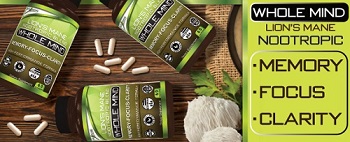
Our Formula includes: Lion’s Mane Mushrooms which Increase Brain Power through nerve growth, lessen anxiety, reduce depression, and improve concentration. Its an excellent adaptogen, promotes sleep and improves immunity. Shiitake Mushrooms which Fight cancer cells and infectious disease, boost the immune system, promotes brain function, and serves as a source of B vitamins. Maitake Mushrooms which regulate blood sugar levels of diabetics, reduce hypertension and boosts the immune system. Reishi Mushrooms which Fight inflammation, liver disease, fatigue, tumor growth and cancer. They Improve skin disorders and soothes digestive problems, stomach ulcers and leaky gut syndrome. Chaga Mushrooms which have anti-aging effects, boost immune function, improve stamina and athletic performance, even act as a natural aphrodisiac, fighting diabetes and improving liver function. Try Our Lion’s Mane WHOLE MIND Nootropic Blend 60 Capsules Today. Be 100% Satisfied or Receive a Full Money Back Guarantee. Order Yours Today by Following This Link.


| Visits: | 1,830,241,698 |
| Stories: | 8,694,320 |
Whistler Blowers, Insiders

