

Why We're Helpless When Things Break Down

Only then do we realize that by optimizing profit and efficiency, we’ve also optimized systemic failure.
In my essay AI, Money, Human Nature and the Problem with Problems, I refer to boundary conditions but didn’t offer a thorough explanation of the role this concept plays in understanding not just how the world works but more importantly, how things break down.
Boundary conditions define what the system needs to function. The more complex the machine / system, the greater the number of conditions. For example, a car needs a source of power, fuel, tires, control mechanisms, seats, and so on–hundreds of components are required for the car to function optimally.
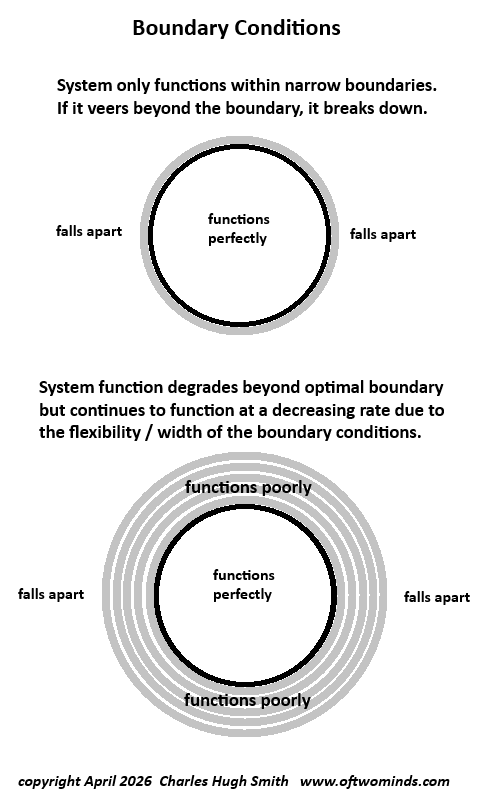
Some boundary conditions are narrow–there’s little or no wiggle-room in what the system needs to function. Everything has to function perfectly or the system breaks down. We can call these tight systems as there’s very little leeway in what they need to function.
In contrast, loose systems have boundary conditions with leeway: some components can fail or function poorly and the system will degrade–i.e. not operate optimally–but it will still function.
Consider a tire. A tire is a fairly loose system. If the optimal tire pressure is 32 pounds, the tire will still function if pressure falls to 28 or is overinflated to 34 pounds.
Now imagine a tire that fails if pressure exceeds 32.5 pounds or falls below 31.5 pounds. Those are unforgiving, tight boundary conditions with very little wiggle room. If tire pressure declines even slightly, it fails.
Which tire do you want–the one optimized for price/efficiency or the one with looser boundary conditions? Our entire way of life is dominated by systems optimized for price/efficiency, not survivability when the system veers outside its boundary conditions.
If a critical semiconductor chip fails in a modern vehicle, the vehicle breaks down and ceases to function. The chip controlled an essential subsystem, and once the chip failed, the subsystem failed, and the vehicle rolls to a stop: complete breakdown.
Certain characteristics of systems create tight boundary conditions that we don’t see until they break down. During the pandemic in the early 2020s, the supply chain of some semiconductors broke down, and as a result the production of cars and trucks that needed those chips broke down.
Supply chains with single-source suppliers within long dependency chains (this part needs this part which needs this part) have exacting boundary conditions: since the supply chain depends on a single source for a critical part, if that supplier is disrupted, the entire chain breaks down.
Since the economy is optimized to maximize profit, it’s maximized for efficiencies which demand tight boundary conditions and lengthy dependency chains: the system only works if every component works perfectly and every condition is met.
Centralization generates tight boundary conditions. Consider a mega-farm growing a single crop–a mono-crop that the region depends on. This centralized mega-system is optimized to maximize yield of a single crop via optimized subsystems: specific seeds, fertilizers, mechanized equipment, soil sensors, irrigation, harvesting and transport, and at the end, a market price for the crop that covers all the costs and yields a profit.
Financially, this is an optimized system. In the real world, it is a system prone to failure due to its tight boundary conditions. A pest or plague that evades the genetically modified seeds’ defenses can wipe out the crop, a sudden bout of extreme weather at the wrong time can wipe out the harvest, and a drop in the market value of the crop can make it unprofitable to even harvest, so it’s left to rot or plowed under.
Contrast this with a system of 100 independent, decentralized farms. Financially, this system is inefficient and not optimized to maximize profit, so it’s anathema in a financial system that demands optimizing everything to optimize profits. Some of the farms will grow crops with low profit margins or non-optimal yields, and some will be inefficient due to raising a variety of crops instead of one financially optimized crop.
When the pest, plague or price collapse wipes out the mega-farm, the system of 100 farms growing a variety of crops continues to function, albeit at a reduced yield as some farms will suffer lower yields and incomes while many will be unaffected.
When a centralized system / mono-crop fails, everyone depending on that system / mono-crop starves. Once the system veered outside the boundary conditions, it broke down.
Here’s a graphic illustrating tight and loose boundary conditions:
Analog – physical systems tend to be more forgiving than digital-dependent systems. When a bracket on a home appliance breaks, it’s typically possible to substitute a non-optimized part to fix it. In other words, the manufacturer’s bracket is nice to have but not essential, as some other piece of metal can be worked to serve the same function.
When the digital motherboard on the modern appliance fails, there is no replacement except that exact board. Some other mix of semiconductors and circuitry can’t be substituted. The appliance–or vehicle, digital device, etc.–is now a brick. And if that one component is no longer available, the appliance is unrepairable.
In an old analog auto engine, if one of the four cylinders was no longer functioning optimally–the gasket was leaking, valves clogged, etc.–the engine would still function, albeit generating lower horsepower and dirtier exhaust.
The majority of systems we rely on for life’s essentials–water, power, food, transport, banking, healthcare, etc.–are now digitally dependent systems with tight boundary conditions. They work perfectly until some critical component in a dependency chain fails, and then the entire system fails.
There are no replacements or substitutes for what failed, and so the entire system ceases to function. All the features of systems that optimize efficiency and profits tighten boundary conditions. Everything that widens boundary conditions–i.e. everything that increases survivability and flexibility–increases costs and reduces profits and optimization of efficiency: redundancy, warehousing of spare parts, constant training of personnel to deal with unlikely emergencies, etc.
The vulnerabilities of our optimized way of life are hidden until systems veer outside their boundary conditions and break down. We’ve witnessed many such breakdowns as every system is optimized for efficiency and profit by stripping out redundancies, second suppliers, spare parts, analog backups in favor of digital efficiencies, etc.
This is why we’re surprised–and helpless–when they break down. We think they’re robust because they work so well within their boundary conditions, but the narrowness of their boundary conditions makes them extremely sensitive to failures in critical components. This fragility is invisible until the system breaks down.
Only then do we realize that by optimizing profit and efficiency, we’ve also optimized systemic failure. Go ahead and hold control-alt-delete, but the system won’t reboot or repair itself, for it’s been optimized to break down.
My book Investing In Revolution is available at a 10% discount ($18 for the paperback, $24 for the hardcover and $8.95 for the ebook edition). Introduction (free)
Check out my updated Books and Films.
Become a $3/month patron of my work via patreon.com
Subscribe to my Substack for free
NOTE: Contributions/subscriptions are acknowledged in the order received. Your name and email remain confidential and will not be given to any other individual, company or agency.
|
Thank you, Simons C. ($32.40), for your wondrously generous subscription to this site — I am greatly honored by your support and readership. |
Thank you, Ferrema S. ($7/month), for your marvelously generous subscription to this site — I am greatly honored by your support and readership. |
|
|
Thank you, Scott T. ($300) for your beyond-outrageously generous subscription to this site — I am greatly honored by your support and readership. |
Thank you, Don A. ($70) for your enormously generous subscription to this site — I am greatly honored by your support and readership. |
Source: http://charleshughsmith.blogspot.com/2026/05/why-were-helpless-when-things-break-down.html
Anyone can join.
Anyone can contribute.
Anyone can become informed about their world.
"United We Stand" Click Here To Create Your Personal Citizen Journalist Account Today, Be Sure To Invite Your Friends.
Before It’s News® is a community of individuals who report on what’s going on around them, from all around the world. Anyone can join. Anyone can contribute. Anyone can become informed about their world. "United We Stand" Click Here To Create Your Personal Citizen Journalist Account Today, Be Sure To Invite Your Friends.
LION'S MANE PRODUCT
Try Our Lion’s Mane WHOLE MIND Nootropic Blend 60 Capsules
Mushrooms are having a moment. One fabulous fungus in particular, lion’s mane, may help improve memory, depression and anxiety symptoms. They are also an excellent source of nutrients that show promise as a therapy for dementia, and other neurodegenerative diseases. If you’re living with anxiety or depression, you may be curious about all the therapy options out there — including the natural ones.Our Lion’s Mane WHOLE MIND Nootropic Blend has been formulated to utilize the potency of Lion’s mane but also include the benefits of four other Highly Beneficial Mushrooms. Synergistically, they work together to Build your health through improving cognitive function and immunity regardless of your age. Our Nootropic not only improves your Cognitive Function and Activates your Immune System, but it benefits growth of Essential Gut Flora, further enhancing your Vitality.

Our Formula includes: Lion’s Mane Mushrooms which Increase Brain Power through nerve growth, lessen anxiety, reduce depression, and improve concentration. Its an excellent adaptogen, promotes sleep and improves immunity. Shiitake Mushrooms which Fight cancer cells and infectious disease, boost the immune system, promotes brain function, and serves as a source of B vitamins. Maitake Mushrooms which regulate blood sugar levels of diabetics, reduce hypertension and boosts the immune system. Reishi Mushrooms which Fight inflammation, liver disease, fatigue, tumor growth and cancer. They Improve skin disorders and soothes digestive problems, stomach ulcers and leaky gut syndrome. Chaga Mushrooms which have anti-aging effects, boost immune function, improve stamina and athletic performance, even act as a natural aphrodisiac, fighting diabetes and improving liver function. Try Our Lion’s Mane WHOLE MIND Nootropic Blend 60 Capsules Today. Be 100% Satisfied or Receive a Full Money Back Guarantee. Order Yours Today by Following This Link.


| Visits: | 1,801,557,257 |
| Stories: | 8,632,182 |
Whistler Blowers, Insiders

