
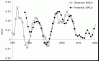
Spatio-temporal evolution of low-magnitude seismicity before the May 24, 2013, Sea of Okhotsk earthquake recovered by waveform cross correlation. Is it an earthquake prediction case?

Abstract
According to the International Data Centre (IDC), the Sea of Okhotsk earthquake occurred at 05:44:49.7 on May 24, 2013, had coordinates 54.89°N,153.31°E, mb=6.27, and depth of 604 km. The USGS moment magnitude is 8.3. The previous event detected by the IDC in the surrounding volume 53°N-57°N, 151°E-155°E, depth from 400 to 700 km occurred on February 6, 2012. Using the same seismic data from the stations of the International Monitoring System together with detection and phase association methods based on waveform cross correlation, a series of low-magnitude earthquakes was recovered immediately before this major earthquake. More than 200 events obeying the Event Definition Criteria adapted by the IDC were found between May 13 and the mainshock, with a sudden increase in their occurrence rate starting on the afternoon May 19. The evolution of the numbers of these low-magnitude earthquakes in various ranges of statistical significance within the source volume demonstrates some features, which can be related to the approaching initiation of the Sea of Okhotsk earthquake.
Key words: Sea of Okhotsk earthquake 2013, earthquake prediction, IDC, IMS, waveform cross correlation
Introduction
The Sea of Okhotsk is a well-known area of deep earthquakes. The subducting Pacific plate reaches here the boundary between the upper and lower mantle with the deepest earthquakes located at ~700 km as reported by the International Data Centre (IDC) using data from seismic stations of the International Monitoring System (IMS). The deepest earthquakes are of higher interest not only because of their seismic features but also they provide valuable data for other geophysical fields. The evolution of seismicity at the depths of 400 to 700 km may differ from that near the surface as related to temperature, lithostatic pressure, rheology, chemical and mineralogical structure of the plate relative to the surrounding mantle, etc.
The IMS provides continuous seismic data to the IDC since 2001. It includes seismic arrays which are characterized by much higher sensitivity and resolution than collocated three-component (3-C) stations. The usage of arrays allows to reduce the detection threshold worldwide and to detect earthquakes with much lower magnitudes than with the 3-C networks. Dense regional seismic networks of 3-C stations can detect events with lower magnitudes, but within the remote regions such as the Sea of Okhotsk there are no possibility to install enough bottom seismic stations just for the deep earthquakes study. With the array stations, the IMS is the best instrument to observe the evolution of seismicity in remote regions of the earth and the IDC provides a quality list of reliable event hypotheses as defined by the adapted version of Event Definition Criteria [Coyne et al., 2012]. The interactive analysis serves as a quality filter for the Reviewed Event Bulletin (REB) – the IDC final internal product of data processing. The REB contains up to 40% of events added by analysts, which have no counterpart in the automatically generated standard event lists (SELs) of the IDC.
The natural seismic process is characterized by repeatability of events in location and size. The magnitude distribution of repeating earthquakes is well described by recurrence curves introduced in [Gutenberg, Richter, 1936,1945]. As the time sequence of earthquakes in a given area is characterized by close locations one can effectively use not only the arrival times of the signals from them to find new events, but also the full waveform [Schaff, Richards, 2025]. This allows for finding many more events with much lower magnitudes in the vicinity of well-defined historical sources [Israelsson, 1990; Joswig, 1990; Schaff, Richards, 2004; Gibbons, Ringdal, 2004, 2006; Gibbons et al., 2007, 2011, 2017; Waldhauser, Schaff, 2008; Adushkin et al., 2015, 2017, Kitov, Sanina, 2022]. The matched filter is an optimal detector for signals similar in shape [Turin, 1960] and it uses waveform cross correlation (WCC) to maximize the signal-to-noise ratio. When applied to deep earthquakes, the WCC-based detection and phase association techniques may recover the seismic events missed by standard IDC processing of the IMS data.
The main objective of this study is to recover the low-magnitude seismic events during eleven days before the May 24, 2013 earthquake in the Sea of Okhotsk and three days after it. According to the IDC, this earthquake occurred at 05:44:49.7 on May 24, 2013, had coordinates 54.89°N,153.31°E, mb=6.27, and depth of 604 km. The USGS moment magnitude is 8.3. There was no events detected by the IDC in the surrounding area 53°N-57°N, 151°E-155°E since February 6, 2012. The same seismic data from the stations of the IMS is used together with detection and phase association methods based on WCC. The recovered events are studied additionally in various magnitude ranges in order to estimate the evolution of the size distribution just before the mainshock. The sequence of mechanical effects before the mainshock may be revealed as the evolution from micro-cracking to the final rupture runs over increasing sizes of fracturing.
Data and method
Data sources and general features
The IMS seismic network consists of arrays and 3-C stations. There are IMS primary stations defining the statistical significance of the created event hypotheses matching the EDC and auxiliary stations assisting in location and magnitude estimation of the valid hypotheses [Coyne et al., 2012]. This division is prescribed by the Comprehensive Nuclear-Test-Ban Treaty (CTBT) as providing uniform distribution of detection threshold worldwide. The civilian applications of the IMS data are not constrained by this rule and all stations are treated according to their performance in the statistical sense. The IMS data is available via virtual Data Exploitation Centre (vDEC) of the CTBT Organization (CTBTO) [vDEC, 2026].
As only the IMS data is used in this study, the REB is a natural source of events and associated detections used for comparison with the result of WCC processing. For the purposes of WCC processing, the REB provides event locations (epicenters and depths), magnitudes mb and Ms, origin times as well as arrival times at IMS stations with a 0.001 s precision, and signal-to-noise ratio (SNR) for the associated signals. Selected properties of the deep seismicity in the Sea of Okhotsk region are also obtained from the REB. Figure 1 shows the recurrence curve for the region 42°N-65°N, 140°E-165°E and depth>410 km obtained from the REB. This curve uses the data from 2001 to the end of 2025 with the total number of approximately 1000 events. The corner seismic magnitude is in the range between 3.0 and 3.4. The regression line is extended beyond the corner magnitude to demonstrate the increasing deficit of low-magnitude earthquakes, which can be partially recovered by WCC.
For the purposes of WCC processing, the signals associated with a set of REB events are used as waveform templates. At 3-C stations, the templates may have one- or three components depending on seismic phase and the station-event distance. For the IMS arrays, multichannel templates are used, with only vertical channels involved. Cross correlation coefficient, CC, is a common measure of the angle between two data vectors representing digital time series of a template and a sought signal. As a measure of similarity, this angle is calculated by a textbook dot product of two data vectors. The CC is not the best variable for detection purposes, however, as it depends on signal spectrum and duration. In the presence of ambient seismic noise, both the template and the sought signal may differ significantly even being identical in their unique source.
The search for a similar signal with a high-quality template, i.e. using a signal with large SNR, meets the noise as an important obstacle. By definition, the matched filter is an optimal detector maximizing SNR only in presence of stochastic and additive noise [Turin, 1960]. On average, such theoretical noise has the minimum CC value with any regular signal. In practice, there is no such actual noise realization, which could be considered as stochastic and allowing for perfect detection conditions. Any ambient noise realization can have a component that is coherent with any real signal, from very low similarities up to a fully identical case. The latter case is related to the search of a signal from an aftershock of a catastrophic earthquake, as a multitude of other aftershocks in the same area simultaneously generate almost identical signals. As a result, the immediate aftershocks of large-magnitude earthquakes are difficult to find.

Source: http://mechonomic.blogspot.com/2026/03/spatio-temporal-evolution-of-low_23.html
Anyone can join.
Anyone can contribute.
Anyone can become informed about their world.
"United We Stand" Click Here To Create Your Personal Citizen Journalist Account Today, Be Sure To Invite Your Friends.
Before It’s News® is a community of individuals who report on what’s going on around them, from all around the world. Anyone can join. Anyone can contribute. Anyone can become informed about their world. "United We Stand" Click Here To Create Your Personal Citizen Journalist Account Today, Be Sure To Invite Your Friends.
LION'S MANE PRODUCT
Try Our Lion’s Mane WHOLE MIND Nootropic Blend 60 Capsules
Mushrooms are having a moment. One fabulous fungus in particular, lion’s mane, may help improve memory, depression and anxiety symptoms. They are also an excellent source of nutrients that show promise as a therapy for dementia, and other neurodegenerative diseases. If you’re living with anxiety or depression, you may be curious about all the therapy options out there — including the natural ones.Our Lion’s Mane WHOLE MIND Nootropic Blend has been formulated to utilize the potency of Lion’s mane but also include the benefits of four other Highly Beneficial Mushrooms. Synergistically, they work together to Build your health through improving cognitive function and immunity regardless of your age. Our Nootropic not only improves your Cognitive Function and Activates your Immune System, but it benefits growth of Essential Gut Flora, further enhancing your Vitality.

Our Formula includes: Lion’s Mane Mushrooms which Increase Brain Power through nerve growth, lessen anxiety, reduce depression, and improve concentration. Its an excellent adaptogen, promotes sleep and improves immunity. Shiitake Mushrooms which Fight cancer cells and infectious disease, boost the immune system, promotes brain function, and serves as a source of B vitamins. Maitake Mushrooms which regulate blood sugar levels of diabetics, reduce hypertension and boosts the immune system. Reishi Mushrooms which Fight inflammation, liver disease, fatigue, tumor growth and cancer. They Improve skin disorders and soothes digestive problems, stomach ulcers and leaky gut syndrome. Chaga Mushrooms which have anti-aging effects, boost immune function, improve stamina and athletic performance, even act as a natural aphrodisiac, fighting diabetes and improving liver function. Try Our Lion’s Mane WHOLE MIND Nootropic Blend 60 Capsules Today. Be 100% Satisfied or Receive a Full Money Back Guarantee. Order Yours Today by Following This Link.


| Visits: | 1,789,729,182 |
| Stories: | 8,607,946 |
Whistler Blowers, Insiders

