

Is the trade deficit a problem? Not for the U.S.

Is this good news or bad news?
Country’s trade deficit narrows to a 5-year low. By Ana Swanson, The New York Times.
WASHINGTON — The U.S. trade deficit in goods and services narrowed more than 10% from August to September, as the Trump administration’s tariffs continued to weigh on trade,
data from the Commerce Department showed.
Imports grew just 0.6% from August to $342.1 billion, while exports rose 3% in the month, to $289.3 billion, according to data released Thursday.
Because exports grew more than imports, the U.S. trade deficit shrank, in line with the Trump administration’s goals.
At $52.8 billion, the trade deficit in goods and services hit its lowest level in September since June 2020, when the United States was in the midst of the COVID-19 pandemic.
Trade experts have cautioned against drawing too many conclusions from a few months of Data and said that trade patterns have recently been distorted by businesses’ efforts to avoid paying tariffs.
President Donald Trump has long seen the trade deficit as a sign of economic weakness.
Trump repeats a standard error: treating the trade deficit as a report card on national health. His reason: The word “deficit” confuses people.
If we send more money to foreigners than they send us, that’s a money deficit. If they send us more goods and services than we send them, that’s our goods and services surplus.
A trade is an exchange of presumed equals (“I’ll send you ‘A’ if you send me ‘B.’”)
So why is it called a trade “deficit”? Isn’t it also a trade “surplus”?
Further, the U.S. creates dollars at will by pressing a few computer keys. Virtually no labor or raw materials are required, and we can make dollars endlessly.
The goods and services we receive rely on labor and raw materials, which are limited resources. We offer something that costs us nothing to create, and in return, we receive valuable items; yet, we refer to this as a “deficit.”
It’s quite strange. I would gladly accept that kind of “trade” any day of the year.
It feels more like stealing than trading. Each year, I experience what some might call a “deficit” with my grocer, my favorite restaurants, my gas station, and others. I exchange dollars—currency that my government can produce at no cost—for valuable food and gasoline.
I don’t feel cheated. While I worked for some of my income, as a retiree, most of my current earnings come to me effortlessly. Despite that, I can still exchange those dollars for valuable goods and services.
And still, by the current definition, I’m running a “trade deficit.” It’s nuts.
I wouldn’t have had to work as much if my government had given me dollars for health care, food, housing, education, etc., which it easily could have done at virtually no effort, just by punching a few more computer keys.
The sweeping tariffs Trump has imposed on imports from countries around the world this year, including on automobiles, metals and furniture, have led to big swings in trade.
Before tariffs went into effect, many U.S. businesses brought in a surge of products to avoid paying import taxes.
After Trump’s global tariffs took effect on August 7, imports slowed sharply, then recovered somewhat in September.
On August 29, the Trump administration also ended the “de minimis” exemption, which allowed foreign shipments valued at less than $800 to come into the United States tariff-free.
Opponents criticized the rule as a loophole that penalized U.S. manufacturers in favor of foreign competitors.
That’s another way of saying, “Make imports more expensive to consumers, so American manufacturers can charge consumers more and/or deliver inferior products.“
That might help a few American manufacturers, but do you want higher prices and inferior quality?
Is this good news or bad news? If Americans are buying fewer goods because they are more expensive or harder to obtain, the deficit will decrease. However, this also means a reduction in consumer welfare, which is essentially what inflation and recessions mean.
Currently, we are trading inflation for a shrinking trade deficit—a lousy trade by any definition.
In short, Trump has made trade worse to make the “trade deficit” numbers look better.
SUMMARY
The term “trade deficit” is often misunderstood; it can actually be considered a trade surplus by logical standards. We receive valuable and often scarce goods and services in exchange for dollars, which our government can produce in unlimited quantities at virtually no cost or effort.
Rodger Malcolm Mitchell
Twitter: @rodgermitchell
Search #monetarysovereignty
Facebook: Rodger Malcolm Mitchell;
MUCK RACK: https://muckrack.com/rodger-malcolm-mitchell;
……………………………………………………………………..
A Government’s Sole Purpose is to Improve and Protect The People’s Lives.
MONETARY SOVEREIGNTY
Source: https://mythfighter.com/2025/12/17/is-the-trade-deficit-a-problem-not-for-the-u-s/
Anyone can join.
Anyone can contribute.
Anyone can become informed about their world.
"United We Stand" Click Here To Create Your Personal Citizen Journalist Account Today, Be Sure To Invite Your Friends.
Before It’s News® is a community of individuals who report on what’s going on around them, from all around the world. Anyone can join. Anyone can contribute. Anyone can become informed about their world. "United We Stand" Click Here To Create Your Personal Citizen Journalist Account Today, Be Sure To Invite Your Friends.
LION'S MANE PRODUCT
Try Our Lion’s Mane WHOLE MIND Nootropic Blend 60 Capsules
Mushrooms are having a moment. One fabulous fungus in particular, lion’s mane, may help improve memory, depression and anxiety symptoms. They are also an excellent source of nutrients that show promise as a therapy for dementia, and other neurodegenerative diseases. If you’re living with anxiety or depression, you may be curious about all the therapy options out there — including the natural ones.Our Lion’s Mane WHOLE MIND Nootropic Blend has been formulated to utilize the potency of Lion’s mane but also include the benefits of four other Highly Beneficial Mushrooms. Synergistically, they work together to Build your health through improving cognitive function and immunity regardless of your age. Our Nootropic not only improves your Cognitive Function and Activates your Immune System, but it benefits growth of Essential Gut Flora, further enhancing your Vitality.
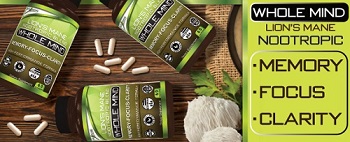
Our Formula includes: Lion’s Mane Mushrooms which Increase Brain Power through nerve growth, lessen anxiety, reduce depression, and improve concentration. Its an excellent adaptogen, promotes sleep and improves immunity. Shiitake Mushrooms which Fight cancer cells and infectious disease, boost the immune system, promotes brain function, and serves as a source of B vitamins. Maitake Mushrooms which regulate blood sugar levels of diabetics, reduce hypertension and boosts the immune system. Reishi Mushrooms which Fight inflammation, liver disease, fatigue, tumor growth and cancer. They Improve skin disorders and soothes digestive problems, stomach ulcers and leaky gut syndrome. Chaga Mushrooms which have anti-aging effects, boost immune function, improve stamina and athletic performance, even act as a natural aphrodisiac, fighting diabetes and improving liver function. Try Our Lion’s Mane WHOLE MIND Nootropic Blend 60 Capsules Today. Be 100% Satisfied or Receive a Full Money Back Guarantee. Order Yours Today by Following This Link.


| Visits: | 1,759,824,245 |
| Stories: | 8,551,975 |
Whistler Blowers, Insiders

