

Skies in Transition: The Network Behind the FAA Ground Stop


Freddie Ponton
21st Century Wire
On 13 November 2026 the Federal Aviation Administration ordered a nationwide ground stop after instability spread through the network that carries radio and radar signals for air traffic controllers. At a radio site in El Dorado, Arkansas, the contractor L3Harris was installing a new router as part of the switch from copper lines to fibre. Transportation Secretary Sean Duffy said the copper service was being discontinued.
The administration pointed to ageing infrastructure in making the case for faster modernisation. FAA Administrator Bryan Bedford described the upgrade as ordinary work on the existing network, separate from the larger modernisation programme. Yet the FAA’s own budget describes work on that existing network as providing the infrastructure to “power” the new air traffic system.
L3Harris was installing new equipment on a network that still had to carry communications between controllers and pilots. The contractor had described how it would test the new system alongside the old, then switch services over with backups in place.
The network was also being prepared for a different kind of aviation. L3Harris said it was rebuilding the network to support more drones, electric air taxis and AI-assisted air traffic management.
VIDEO: Promotional video by contractor L3Harris detailing its FAA Telecommunications Infrastructure modernization, highlighting copper-to-fiber replacement, a claimed 99.999% uptime, and preparation for drones and electric air taxis. (Source: L3Harris Technologies)
.
The company had backed publication of an international industry concept for that transformation, now being advanced through a programme called Skies in Transition.

IMAGE: CANSO’s Airspace Magazine introduces Skies in Transition, an international industry initiative aimed at accelerating airspace automation, shared flight data, and new entrants. (Source: CANSO Airspace Magazine)
At about 3:30 p.m. Eastern, connection attempts began flooding the network at a rate of roughly 1,000 every four to five seconds. Radio communications and radar feeds became unstable at 17 of the FAA’s 22 en-route centres, which manage aircraft between airports. The disruption spread to several facilities that handle traffic near airports. The FAA held departures nationwide, but aircraft already in the air could land and critical flights continued. L3Harris blocked traffic from two suspected sources and the network stabilised. Air traffic resumed at 8:15 p.m.
One site was the radio facility at El Dorado. The other was a radar facility in Amarillo, Texas, where equipment had been replaced three weeks earlier. Duffy said Amarillo began sending disruptive traffic after the El Dorado router was switched on.
Hewlett Packard Enterprise, which owns router maker Juniper Networks, said the El Dorado device worked as the installer had configured it and “did not fail or act improperly”. That account does not rule out the sequence Duffy described, but neither account explains why Amarillo began sending disruptive traffic when the El Dorado router came online.
The FAA disabled the broadcasting function on the routers involved and, as a precaution, on more than 60 similar units. It also paused further installations.
The Dual-Running Process That Put New Equipment on the Live Network
L3Harris operates the FAA Telecommunications Infrastructure network. A written procedure for the installation was submitted to the FAA, Reuters reported. An FAA employee oversaw the work, and the agency signed off and took the service back. The problems appeared shortly afterwards. The Professional Aviation Safety Specialists union said its members did not perform the upgrades. Duffy said a risk assessment had been done for the switch from copper to fibre. He did not identify one for the El Dorado installation.
FAA Administrator Bryan Bedford said the El Dorado upgrade was not part of Peraton’s modernisation programme. The FAA’s budget shows the scale of the work on the existing network. Roughly 170 interfaces across more than 70 aviation systems still used older technology. Some would need to be upgraded or replaced, while others would need equipment to translate between the old technology and the new.
DOCUMENT: The FAA’s fiscal year 2027 budget links telecommunications upgrades to its Brand New Air Traffic Control System (BNATCS). On printed page 86, it states, “These programs support the BNATCS effort by providing the necessary telecommunications upgrades and infrastructure to power the BNATCS” (Source: Federal Aviation Administration (FAA))BUDGET ESTIMATES FISCAL YEAR 2027
An FAA configuration-management order distinguishes between the supplier’s responsibility for its equipment and the FAA’s responsibility for how the service connects to other systems and how reliably it must perform. HPE said the El Dorado router was configured to broadcast. It could also have been set to send traffic directly to one destination. HPE did not say which setting should have been used. On 17 November, Duffy said investigators had recreated the El Dorado event but had not established the root cause.
A Failure the Same Network Had Already Produced
On 19 November 2009, a router configuration error disrupted service at 129 air traffic facilities during an earlier move to fibre. The error had gone unnoticed for weeks. When a replacement router went into service, about three-quarters of the routes across the FAA’s fibre-optic telecommunications network were blocked. An automated alert failed to flag the disruption. Five hours into the outage, technicians began restoring service after taking a router at a second site offline.
In April 2010, an independent panel convened by the FAA Administrator urged the agency to consider having router changes checked independently and building a model to test them before they went live. In a June letter to Congress, Transportation Department Inspector General Calvin Scovel faulted the FAA’s oversight of Harris and laid out steps the agency should consider, including peer review, checks to verify changes and periodic independent reviews of the network’s design. The FAA and Harris had retired the design involved in the outage, but both acknowledged that more critical outages could occur as services moved onto fibre.
In September 2026, a white paper convened by the Civil Air Navigation Services Organisation known as CANSO and the Global ATC Alliance warned that “Small technical or procedural changes can produce disproportionately large operational effects, with consequences surfacing in unexpected ways or places.” Its authors called for fallback plans while old and new systems ran side by side, and for clear authority to pause or reverse a deployment.
The FAA had no single schedule for the first phase of its modernisation programme. The Government Accountability Office found 11,389 separate project schedules, with installations planned at the same facilities and generally not coordinated to minimise disruption to controllers. A broad waiver from the FAA’s usual acquisition requirements, the auditors said, bought speed at the risk of higher costs and disruption.

IMAGE: Legacy copper wiring (left) and the fibre-optic cabling replacing it (right), shown in a DOT/FAA Modern Skies Summit handout. (Source: U.S. Government Accountability Office)
The FAA had already rehearsed the loss of several systems at once. A separate audit records a tabletop exercise in May 2024, a resilience test in September and an after-action report in December. The public account does not say what, if anything, those exercises changed about how the FAA moved live services onto new routers.
Tests That Passed Before the Network Flooded
A sample of the new Juniper routers passed tests at the FAA Technical Center before deployment, Senate Commerce Committee Democrats said in a 16 November letter. They asked whether the tests reflected operating conditions and why the network’s backups had not contained the disruption.
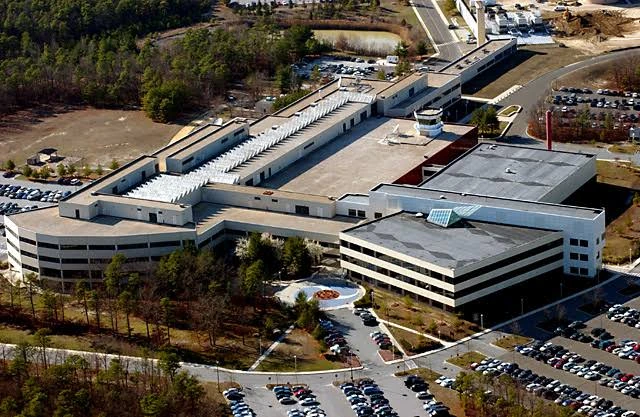
IMAGE: The FAA’s William J. Hughes Technical Center near Atlantic City, New Jersey, where a sample of Juniper routers passed pre-deployment tests, according to Senate Commerce Committee Democrats. (Source: Margaret’s Circle Wiki on Fandom)
L3Harris told the senators that 3,648 routers were due to be replaced with Juniper devices. About 400 had been installed and 69 were in service. Duffy said the El Dorado unit was the 69th of its type and that the earlier ones had worked.
Before more routers went in, the senators wanted independent checks and proof that the FAA could switch to backups or undo a change. On 17 November, the FAA confirmed that further installations were on hold pending more testing.
The Industry Programme That Needed the Fibre Capacity
On 25 May 2026, more than 300 aviation leaders met in Lisbon under the banner From Vision to Delivery. They were advancing Skies in Transition, a programme that runs from 2026 to 2028 under the Complete Air Traffic System Global Council, convened by CANSO. It starts with shared flight data and the infrastructure to carry it. More advanced automation comes later.

IMAGE: Aviation leaders discuss how to put air traffic modernisation plans into practice at the CANSO Leadership Summit in Lisbon on 25 May 2026. (Source: Airspace World)
If airlines, drone operators and air taxi companies share where and when they intend to fly, software can spot congestion before aircraft get there. A dispatcher could reroute a flight or delay its departure. L3Harris said the FAA network it was rebuilding would support real-time weather sharing and cloud-based information management while continuing to carry the radio and radar signals controllers rely on.
The council’s plan for future airspace would bring in AI tools while older systems were still running. The tools would be introduced as separate services, tested in operating environments and evaluated using digital twins, or software replicas of the systems they would work with. For functions that affect flight safety, the CATS concept calls for testing before deployment and “continuous probing of production systems” once they are live.
DOCUMENT: The April 2025 Complete Air Traffic System (CATS) Concept of Operations for Future Skies sets out how automated systems should be tested and monitored. Across pages 52–53, it states, “Automated testing, simulation, and validation prior to deployment, along with progressive deployment monitoring and continuous probing of production systems, are essential to ensure reliability” (Source: CATS Global Council)CATS_CONOPS_for_Future_Skies_-_April_2025
The company rebuilding the FAA’s telecommunications network was also backing the industry’s plan for what would come next. When CANSO published the plan, Kathy Crandall, who leads L3Harris’s Mission Networks business, said the company wanted to help its customers adopt the technologies it described. The FAA was already part of that discussion: CANSO had listed the agency as a member of the council in 2023.
On 7 April 2026, electric air taxi developer Joby Aviation announced a partnership with software company Air Space Intelligence to model where its aircraft would fly and when as it expanded operations in busy airspace. The companies planned live exercises later that year. Rival air taxi developer Archer had teamed up with Palantir the previous year to develop software for air traffic control, route planning and aircraft movements.
Air Space Intelligence and Palantir were also working with the FAA to anticipate congestion before aircraft took off. They joined aviation technology company Thales in a spring trial of Strategic Management of Airspace, Routes and Trajectories, or SMART. Each company had a lab at FAA headquarters in Washington, Thales executive Todd Donovan told Politico in May.
In June, the FAA chose Air Space Intelligence to replace its traffic-flow software with Flow Management Data and Services. The Department of Transportation described SMART as part of that broader system. The contract has a potential value of about $876 million. In August, the FAA issued Palantir a separate $500,000 purchase order for SMART. The federal spending entry does not specify what Palantir was to deliver.

IMAGE: The USAspending award record names Palantir Technologies Inc. as the recipient of a $500,000 purchase order. Its description reads, “SMART – PALANTIR PURCHASE ORDER” (Source: USAspending.gov)
In its third-quarter investor update, Palantir said the FAA was using its Artificial Intelligence Platform to bring data from separate aviation safety systems together to assess risk nationwide. The disclosure did not mention SMART.
In September, Surf Air Mobility said it had signed an agreement to help the FAA evaluate SMART. The airline operator said it would contribute operational data and staff expertise, drawing in part on its experience developing SurfOS, its Palantir-powered software.
Airline dispatchers attended a SMART demonstration on 24 August. A month later, the FAA began using the tool around Washington to recommend a limited set of reroutes before departure. A separate planning function ran in shadow mode, so the agency could assess its recommendations without acting on them.
On 9 October, members of Congress asked the FAA to pause SMART. They asked whether the agency had formally approved its use, signed a safety-risk assessment or shortened or waived any reviews. They also asked how SMART performed when data quality deteriorated or systems went offline.
On 10 November, the FAA announced it would extend SMART to the airspace served by all 22 en-route centres. FAA specialists reviewed the information before recommendations went to local leaders. The agency said SMART did not feed data into air traffic control and played no part in the ground stop.
Air Space Intelligence says it uses data from System Wide Information Management, the FAA’s aviation-data exchange. L3Harris helps run the exchange. The FAA’s 2015 architecture placed its messaging servers on the same network that carries radio and radar signals for controllers.
The FAA was also changing how organisations could use the exchange. In September, messaging supplier Solace said the FAA’s Enhanced SWIM Cloud Services would give its data partners a way to publish information back into SWIM. Solace said that two-way flow could support future AI tools for flight planning.
In September, autonomous air taxi developer Wisk reported on a simulation with airspace software company SkyGrid and the FAA Technical Center. Houston-area controllers took part as the teams tested how autonomous aircraft sharing airspace with conventional traffic would respond if they had to abandon an approach or a landing site suddenly closed. In SkyGrid’s longer-term model, air traffic control providers would focus more on how much traffic the airspace could handle, while digital services would help plan flights, monitor them and resolve conflicts.
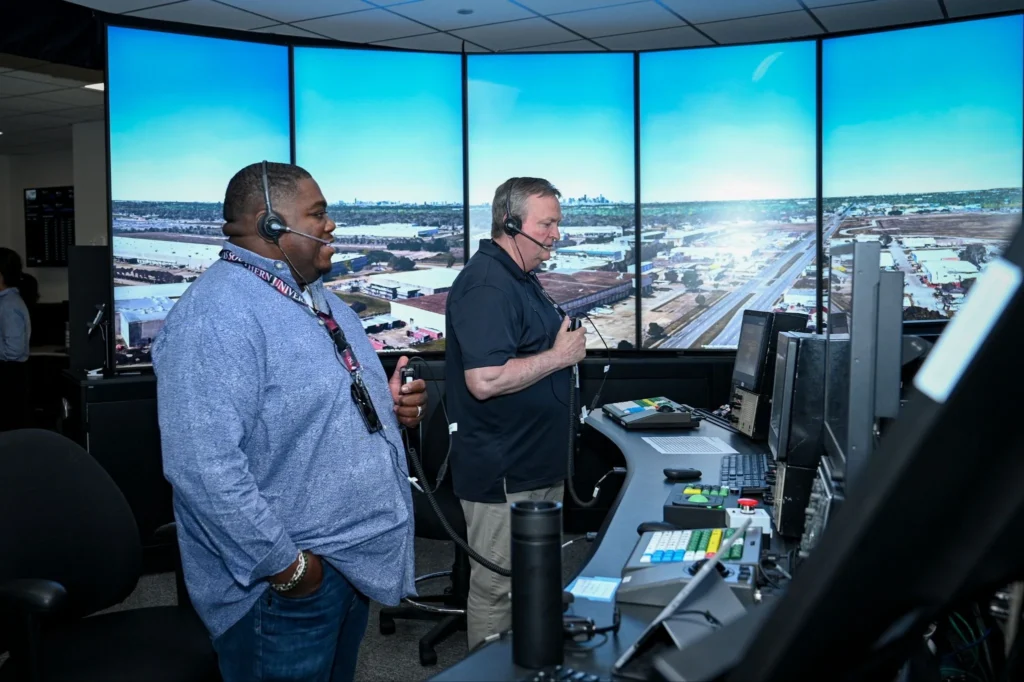
IMAGE: Participants at a simulated air traffic control tower during a Wisk, SkyGrid and FAA Technical Center exercise testing how autonomous air taxis could share Houston-area airspace with conventional traffic. (Source: Wisk Aero)
In July, L3Harris announced a separate FAA surveillance contract to upgrade and run the civil aircraft-tracking network through 2045. More than 700 ground stations are scheduled for upgrades. Two months later, L3Harris proposed adapting that same civil network for defence and homeland security. The company wants to extend its ability to track unidentified drones, low-flying aircraft and cruise missiles and share those tracks with government users outside civil aviation.
In 2025, L3Harris signed an agreement with state-owned Israel Aerospace Industries to pursue an Israeli light-attack aircraft programme, with planned testing involving Israel’s defence ministry and air force. Palantir separately disclosed a partnership with Israel’s Ministry of Defense to supply technology for the country’s war effort. In its FAA surveillance proposal, L3Harris was offering defence users something different: access to information from a network built to track civilian aircraft.
The Funding Request That Followed the Flood
On 12 November, the day before the ground stop, Duffy and White House budget director Russell Vought asked congressional appropriators for $30.1 billion, Roll Call reported. On the night of the disruption, Duffy called for $50 billion in emergency funding. On 17 November, Duffy, Vought and FAA Administrator Bryan Bedford cited the ground stop in a signed request for $50.1 billion, $20 billion above the earlier reported total.

IMAGE: Transportation Secretary Sean Duffy, alongside Homeland Security Secretary Markwayne Mullin, calls for $50 billion in emergency funding at a White House briefing on 13 November 2026, hours after the nationwide FAA ground stop. (Source: The BayNet)
The 17 November request included $10.1 billion for air traffic control modernisation. It set aside $7.2 billion for common automation and controller workstations, $2 billion for cloud computing and telecommunications, $600 million for strategic traffic-flow management and $300 million for consolidating facilities that handle traffic near airports. The other $40 billion was divided equally among airport infrastructure, airport terminals, en-route control centres and control towers.
DOCUMENT: The joint funding request dated 17 November 2026 invokes disrupted communications and radar feeds “forcing the FAA to initiate a nationwide ground stop” in its opening paragraph on page 1. Further down the same page, it states, “The Administration urges Congress to provide $50.1 billion to deliver a truly world-class air traffic control network” (Source: U.S. Department of Transportation (DOT))Funding request
Congress had already appropriated $4.75 billion for telecommunications modernisation and system upgrades. Senate Democrats asked how the additional money would address the weaknesses exposed on 13 November.
L3Harris had backed an industry plan for airspace shared by conventional aircraft, drones and air taxis. At El Dorado, it was changing the network the FAA’s budget said would help power the next air traffic system. That network still had to carry the radio and radar signals controllers used to keep aircraft apart.
After the 2009 outage, an independent panel urged the FAA to consider checking router changes independently and testing them against a model of the network. A sample of the new routers passed tests before deployment. Yet during the El Dorado changeover, instability reached 17 en-route centres. The records of that installation could show what the tests covered and what the FAA and L3Harris had in place to keep a disruption from spreading.
In the United States, making good on the plans set out in Skies in Transition means upgrading the network to support drones, air taxis and AI-assisted traffic management while it still carries the radio and radar signals controllers use to keep aircraft apart. A sample of the new routers passed tests before deployment; yet, at El Dorado, a router change still disrupted service across the country. The records of that installation could show what the tests covered and what the FAA and L3Harris had in place to keep a disruption from spreading.
The administration cited the ground stop in asking Congress for $50.1 billion, $20 billion more than it had sought the day before the disruption. The $10.1 billion for air traffic control modernisation was already in the earlier request. When Speaker Mike Johnson said the outgoing Congress would take up the larger package, that put the additional $20 billion on the agenda before the January handover. Did the administration use the ground stop to justify the increase and try to secure it before Democrats took control of both chambers?
READ MORE US NEWS AT: 21st Century Wire US News Files
SUPPORT OUR INDEPENDENT MEDIA PLATFORM – BECOME A MEMBER @21WIRE.TV
VISIT OUR TELEGRAM CHANNEL
21st Century Wire is an alternative news agency designed to enlighten, inform and educate readers about world events which are not always covered in the mainstream media.
Source: https://21stcenturywire.com/2026/11/19/skies-in-transition-the-network-behind-the-faa-ground-stop/
Anyone can join.
Anyone can contribute.
Anyone can become informed about their world.
"United We Stand" Click Here To Create Your Personal Citizen Journalist Account Today, Be Sure To Invite Your Friends.
Before It’s News® is a community of individuals who report on what’s going on around them, from all around the world. Anyone can join. Anyone can contribute. Anyone can become informed about their world. "United We Stand" Click Here To Create Your Personal Citizen Journalist Account Today, Be Sure To Invite Your Friends.
LION'S MANE PRODUCT
Try Our Lion’s Mane WHOLE MIND Nootropic Blend 60 Capsules
Mushrooms are having a moment. One fabulous fungus in particular, lion’s mane, may help improve memory, depression and anxiety symptoms. They are also an excellent source of nutrients that show promise as a therapy for dementia, and other neurodegenerative diseases. If you’re living with anxiety or depression, you may be curious about all the therapy options out there — including the natural ones.Our Lion’s Mane WHOLE MIND Nootropic Blend has been formulated to utilize the potency of Lion’s mane but also include the benefits of four other Highly Beneficial Mushrooms. Synergistically, they work together to Build your health through improving cognitive function and immunity regardless of your age. Our Nootropic not only improves your Cognitive Function and Activates your Immune System, but it benefits growth of Essential Gut Flora, further enhancing your Vitality.

Our Formula includes: Lion’s Mane Mushrooms which Increase Brain Power through nerve growth, lessen anxiety, reduce depression, and improve concentration. Its an excellent adaptogen, promotes sleep and improves immunity. Shiitake Mushrooms which Fight cancer cells and infectious disease, boost the immune system, promotes brain function, and serves as a source of B vitamins. Maitake Mushrooms which regulate blood sugar levels of diabetics, reduce hypertension and boosts the immune system. Reishi Mushrooms which Fight inflammation, liver disease, fatigue, tumor growth and cancer. They Improve skin disorders and soothes digestive problems, stomach ulcers and leaky gut syndrome. Chaga Mushrooms which have anti-aging effects, boost immune function, improve stamina and athletic performance, even act as a natural aphrodisiac, fighting diabetes and improving liver function. Try Our Lion’s Mane WHOLE MIND Nootropic Blend 60 Capsules Today. Be 100% Satisfied or Receive a Full Money Back Guarantee. Order Yours Today by Following This Link.


| Visits: | 1,839,053,574 |
| Stories: | 8,740,110 |
Whistler Blowers, Insiders

