
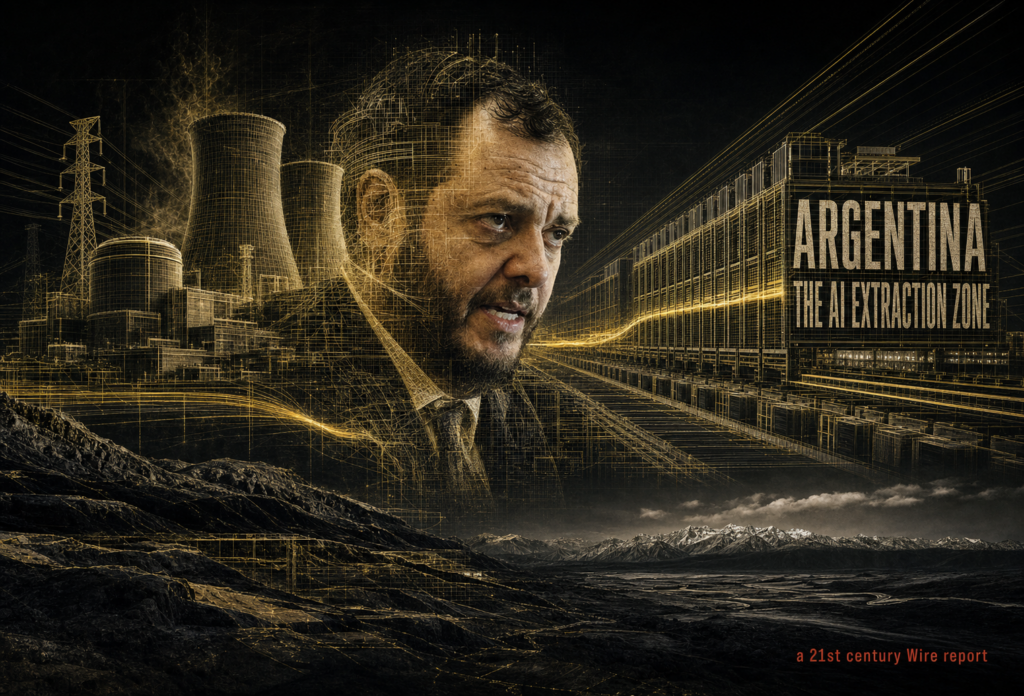
ARGENTINA: The Ai Extraction Zone

Freddie Ponton
21st Century Wire
When Javier Milei announced on December 20, 2024, that new modular reactors would anchor Argentina’s nuclear revival, he was laying the energy foundation for a much larger plan built around artificial intelligence, uranium exports and private investment. Yet construction on the country’s existing reactor had already been halted for three months. The Central Argentina de Elementos Modulares, or CAREM, was roughly 85 per cent complete, and hundreds of contractors had been dismissed from a project that had taken Argentina more than a decade to design and build. Rather than complete it, Milei’s government proposed privately financed 300-megawatt modular reactors at Atucha in Buenos Aires Province as the first stage of a wider plan linking nuclear power to artificial-intelligence data centres proposed separately for Patagonia, while the smaller public reactor Argentina had nearly finished was being dismantled.
This investigation traces who shaped that shift, how Argentina’s public nuclear expertise and strategic resources were redirected towards privately controlled projects, and who stood to benefit.
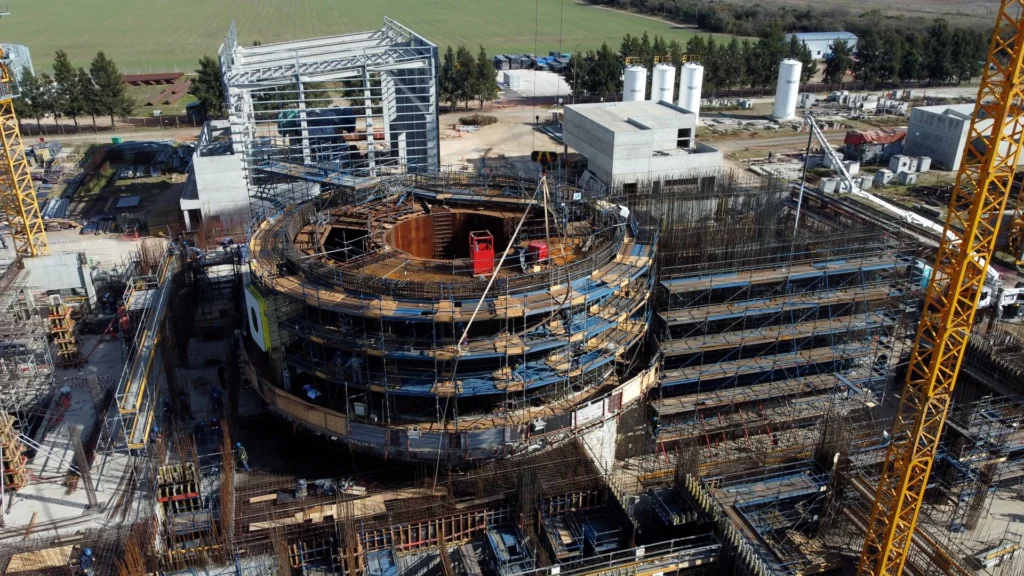
IMAGE: The unfinished CAREM reactor at the Atucha nuclear complex in Buenos Aires Province. Construction was halted in September 2024 after the project was reported to be roughly 85 per cent complete. (Source: Buenos Aires Herald)
As the Buenos Aires Herald reported, Milei’s proposal went beyond the new reactors. The government also wanted to expand uranium production and build a “Nuclear City” in Patagonia, where nuclear power would supply data centres used for artificial intelligence. Milei did not mention CAREM, even though the Organisation for Economic Co-operation and Development Nuclear Energy Agency, or OECD-NEA, ranked it among only seven small modular reactor designs worldwide to have entered construction. It was also one of only four licensed for construction before 2025, and up to 70 per cent of its components were to be made in Argentina.
The government’s decision to halt CAREM in September 2024 had immediate consequences. Around 470 contractor jobs disappeared, according to the Buenos Aires Herald. Another round in June 2026 removed 61 workers from the National Atomic Energy Commission, or CNEA, including specialised technicians associated with CAREM, the outlet later reported. The cuts extended across CNEA. APF Digital reported that 571 scientists and technicians had left as the institution’s budget fell 42% in real terms between 2023 and 2025.
The contradiction did not end with CAREM. As the public reactor lost workers and funding, Milei’s government began building a different nuclear programme financed by private capital. As Rest of World reported, the new programme would support uranium exports and provide power for artificial-intelligence projects, including the proposed $25 billion Stargate Argentina data centre. It would later converge with Pax Silica, a US-led alliance organised around the energy, minerals and infrastructure needed for AI.
Demian Reidel, one of President Milei’s closest advisers on nuclear energy and artificial intelligence, helped shape the policies behind both tracks. Following Reidel’s path through government shows how the same circle of officials and business figures came to influence Argentina’s reactors, AI infrastructure and strategic minerals, and how private interests around that circle positioned themselves to profit as public assets and expertise moved into private hands.

IMAGE: From left, Demian Reidel, then chairman of President Milei’s Council of Advisors, President Javier Milei, and Rafael Grossi, director general of the International Atomic Energy Agency, present the Argentine Nuclear Plan at the Casa Rosada on December 20, 2024. Photo: Argentine Presidency. (Source: Buenos Aires Herald)
The plan before Stargate
Reidel was a former JPMorgan and Goldman Sachs executive who held several influential government roles. He chaired the Argentine Nuclear Council, became president of Nucleoeléctrica Argentina, the state company that operates Argentina’s three nuclear power plants, Atucha I, Atucha II and Embalse, and advised Milei on artificial intelligence and technology. He had also chaired the president’s Council of Advisors. These responsibilities overlapped as the government was designing its nuclear and AI policies. Reidel therefore had major influence over both the proposed energy supply and the industry expected to use it
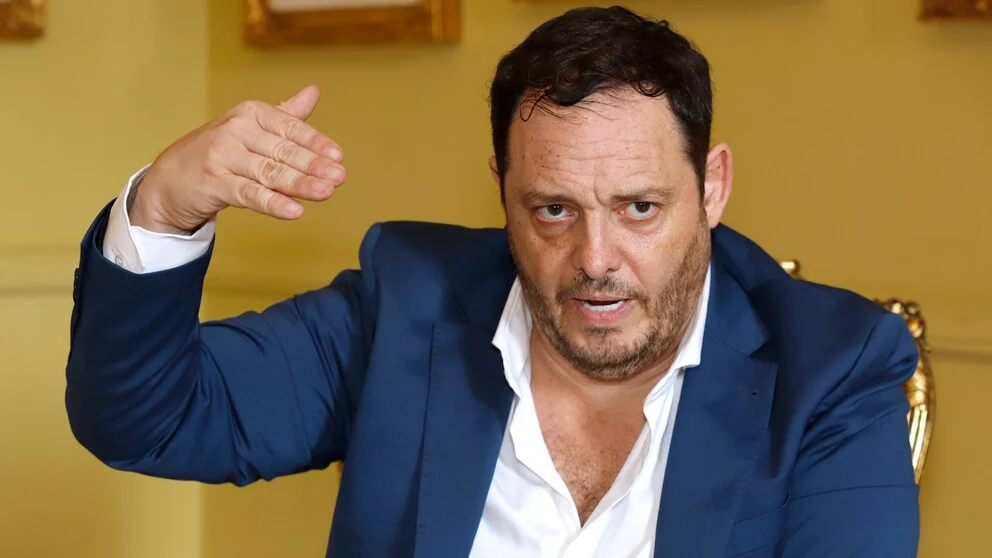
IMAGE: Demian Reidel, then chairman of President Milei’s Council of Advisors and later president of Nucleoeléctrica Argentina, helped shape the government’s nuclear and artificial-intelligence policies. (Source: Infobae)
“This is my baby,” he told Rest of World in May 2025. “We have the planets aligned.” The Nuclear Plan described by the outlet had three phases. The first involved four 300-megawatt modular reactors based on the ACR-300 design developed by INVAP, the technology company owned by Río Negro Province, and financed with private capital. The second phase involved developing uranium production for export. The final phase was a Nuclear City in Patagonia, where nuclear power would supply artificial-intelligence data centres.
This programme connected reactors, uranium and computing before Stargate Argentina had a name. Milei’s government unveiled Stargate in October 2025, less than three weeks before the midterm elections. It presented OpenAI and a little-known Argentine company called Sur Energy as partners in a Patagonian data centre requiring as much as $25 billion in investment. Reuters reported that the data centre could consume 500 megawatts of electricity at full scale.

IMAGE: President Javier Milei with representatives of OpenAI and Sur Energy at the announcement of the proposed $25 billion Stargate Argentina data centre on October 10, 2025. (Source: Buenos Aires Herald)
The size of the announcement obscured how little had been settled because OpenAI had signed only a letter of intent, not a final investment agreement. It was expected mainly to buy computing capacity rather than provide the money needed to build the data centre, according to New Energy Events. Sur Energy would have to assemble the companies, infrastructure and financing required to deliver it. The $25 billion figure therefore described the possible scale of a project that still lacked identified investors, rather than money OpenAI had committed to Argentina. By presenting that figure as an investment before the financing existed, Milei’s government turned an unfinanced proposal into a major economic announcement days before the midterm elections.
Milei’s government had already created a programme to attract investments of this size. The Large Investment Incentive Regime, known by its Spanish acronym RIGI, offers qualifying investors reduced corporate income tax, exemptions from duties on imported equipment and greater freedom to retain export earnings abroad. It also promises that the main tax, customs and foreign-exchange terms will remain stable for 30 years. The existing RIGI sets a fixed corporate income-tax rate of 25 per cent for qualifying projects, while the proposed Super RIGI would reduce the rate to 15 per cent for eligible investments of at least $1 billion.
RIGI was already drawing foreign capital towards the strategic resources needed for Milei’s nuclear and artificial-intelligence plans. El Inversor Energético reported that US and Canadian capital was pursuing uranium projects through RIGI, while a bill later introduced in Congress sought to extend the same benefits to rare-earth development. While the projects themselves remained uncertain, the investment regime revealed itself as the financial mechanism beneath both the nuclear and mineral tracks.
Seven months after the Stargate announcement, the project still had no confirmed final site, disclosed financing structure or publicly identified company to build and operate the data centre. It had not even been presented to RIGI, the Buenos Aires Times reported. Sur Energy also had no visible record of delivering infrastructure on anything approaching this scale. The government had announced a $25 billion project before its basic details existed in public, but the investment programme capable of protecting it for three decades was already in place. The sequence suggested that securing favourable conditions for future investors had moved faster than establishing whether the project itself could be built.
VIDEO: Sam Altman, chief executive of OpenAI, announces the company’s letter of intent with Sur Energy to explore the development of Stargate Argentina. (Source: Sur Energy)
.
The limits of Stargate’s promised economic benefits extended to employment, as Emiliano Kargieman, a Sur Energy co-founder and the founder and chief executive of satellite company Satellogic, acknowledged in an interview with La Nación. Data centres could employ thousands of people during construction but only “about a hundred people” once they began operating. They were “not a direct source of employment,” he said, arguing that their contribution would come instead through exports of computing services and the dollars those exports generated.
The same interview identified two possible sources of electricity. Sur Energy had signed non-exclusive memoranda of understanding with Central Puerto and Genneia, but neither agreement made the company Stargate’s final energy supplier. Genneia’s chief financial officer, Carlos Palazón, later told investors, as reported by BNamericas, “We are working to be the energy supplier of this project,” while adding that the company still had no exact timetable.
Argentina would provide the energy, land, water, infrastructure and regulatory privileges, while only a fraction of the construction workforce would remain once the servers began running. Stargate had not created the connection between nuclear power and artificial intelligence but had become the largest proposed project within the programme Reidel was already building around privately financed reactors, uranium exports and Patagonian computing infrastructure. What still appeared to be a domestic programme was about to become part of a wider struggle over the energy, minerals and infrastructure needed to control artificial intelligence.
Pax Silica and the network
Launched in December 2025, Pax Silica marked Washington’s attempt to organise the resources and infrastructure needed for artificial intelligence into a US-led strategic alliance. According to a State Department fact sheet, it covers critical minerals, energy, semiconductors, telecommunications, data centres and computing capacity. Argentina could supply much of that foundation through its uranium, lithium, copper, rare earths, nuclear expertise, energy and territory. Stargate was not formally identified as a Pax Silica project, but its dependence on the same combination of resources placed it squarely within the strategic landscape the alliance was created to shape.

IMAGE: Argentina’s ambassador to the United States, Alec Oxenford, with US Under Secretary of State Jacob Helberg after signing Argentina into Pax Silica in Washington. (Source: Embassy of Argentina in the United States / X)
Argentina had begun aligning its mineral policy with Washington before formally joining Pax Silica, signing a Framework Instrument with the United States on February 4, 2026, covering the mining and processing of critical minerals. The agreement sought to strengthen supply chains, attract long-term investment and expand secure mineral supplies, according to Panorama Minero. The following month, the State Department created a $250 million fund for projects across Pax Silica’s technology and resource chains.
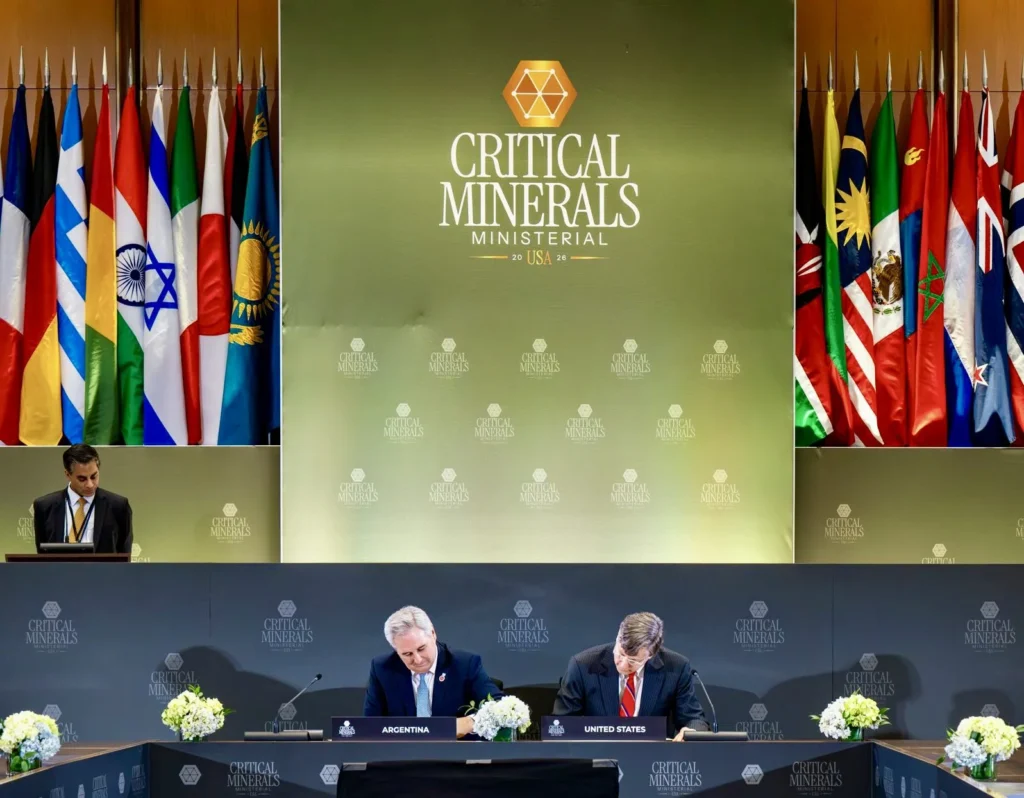
IMAGE: Argentina’s Foreign Minister Pablo Quirno and US Deputy Secretary of State Christopher Landau sign the February 2026 critical-minerals framework in Washington. (Source: Pablo Quirno / X via Latin America Reports)
Washington’s effort to secure critical minerals also extended to Project Vault, a public-private initiative creating a strategic reserve for US manufacturers. The US Export-Import Bank (EXIM) approved a loan of up to $10 billion, alongside nearly $2 billion in private capital, to acquire and store critical minerals in the United States. The programme did not allocate $12 billion to Argentina, but it created a large US-backed market for minerals supplied through the wider network Washington was assembling.
Argentina formally entered that network when Foreign Minister Pablo Quirno announced on June 24 that the country would join Pax Silica. Two days later, Argentina’s embassy in Washington confirmed that Ambassador Alec Oxenford had signed the declaration. Argentina joined with extensive uranium, lithium, copper and rare-earth deposits, an advanced nuclear sector and Patagonian territory already being promoted for large-scale AI infrastructure.
Argentina entered Pax Silica without publicly disclosing what it had agreed to or how the arrangement would affect provincial control over the resources the alliance sought to secure. A formal request filed in the Chamber of Deputies said the full text had neither been published nor submitted for congressional approval. That secrecy carried particular weight because Article 124 of Argentina’s Constitution grants the provinces original ownership of the natural resources within their territories. The provinces supplying Argentina’s minerals and energy to the alliance therefore had no public account of what obligations had been assumed, whether their authority had been recognised or who would control the terms under which those resources were developed.
Argentina’s accession to Pax Silica did not place its mineral and technology sectors exclusively within Washington’s orbit. El Estratégico reported that the government had made no public commitment to exclude Chinese investment, leaving Milei free to align with the US-led alliance while continuing to seek capital from both sides of the strategic rivalry.
US interest in Argentina’s uranium emerged before Project Vault and the country’s accession to Pax Silica. In October 2025, the Wall Street Journal reported that US Treasury Secretary Scott Bessent and Economy Minister Luis Caputo had discussed expanding US access to Argentine uranium while limiting China’s access to the country’s critical minerals. Project Vault later provided a US-backed mechanism to finance and stockpile strategic minerals, while Pax Silica brought Argentina into a broader US-led effort to secure critical-resource supply chains and reduce dependence on China.
Argentina’s largest industrial groups also recognised the wider importance of the alliance. In remarks covered by Radio Gráfica, Techint chief executive Paolo Rocca described Pax Silica as part of an economic “reset” for Argentina, placing the framework within the country’s broader industrial debate rather than only opposition or government rhetoric.
No public document identifies Stargate Argentina as a Pax Silica project, and there is no evidence of a secret contract linking them. Instead, the connection emerges from a series of overlapping policies. Reidel’s Nuclear Plan tied reactors and uranium exports to the development of data centres in Patagonia, while RIGI offered long-term protections to attract the investors required to build that infrastructure. Pax Silica then placed the same strategic assets, including energy, minerals and digital infrastructure, within Washington’s broader AI strategy.
Oxenford’s overlapping roles linked Milei’s government to Argentina’s technology and investment networks. He served with Reidel on the president’s Council of Advisors before he was appointed ambassador to the United States in November 2024, as documented by Bloomberg Línea. His position on Endeavor Argentina’s board, listed in his official Foreign Ministry biography, extended that connection into the private sector. His appointment therefore placed a member of Milei’s inner circle with established technology and investment ties in Washington as Argentina sought US support for its nuclear, data-centre and AI ambitions.
Kargieman’s connection to Endeavor dates back more than a decade, as the organisation’s profile confirms. Whitney Webb documented that history, but our review of Endeavor’s records uncovered another link. Kargieman, the public face of Stargate Argentina, and Oxenford, Argentina’s ambassador to the United States, belonged to the same entrepreneurial network. Oxenford had also served on the presidential council chaired by Reidel before signing Argentina into Pax Silica. Endeavor thus formed a previously unreported institutional bridge between the figures representing Stargate Argentina and Pax Silica, two initiatives centred on the same convergence of nuclear energy, strategic minerals and AI infrastructure.
Behind the AI push, Milei’s government was preparing to move strategic nuclear assets out of state hands.

IMAGE: Emiliano Kargieman, co-founder of Sur Energy, the Argentine company partnering with OpenAI on the proposed Stargate Argentina data-centre project. (Source: La Nación)
The nuclear transfer
In February 2025, Milei’s government transferred its 84.9 per cent stake in IMPSA to Industrial Acquisitions Fund, a US-led consortium whose principal partner was ARC Energy, an oil-and-gas equipment supplier. For a $27 million capital commitment and the restructuring of roughly $576 million in debt, the consortium gained control of a company with four decades of Argentine nuclear manufacturing experience.

IMAGE: IMPSA’s industrial plant in Mendoza. Milei’s government transferred its controlling stake in the nuclear manufacturer to a US-led consortium in February 2025. (Source: IMPSA)
Among the assets changing hands was IMPSA’s work on CAREM, Argentina’s first domestically designed small modular reactor. The company had manufactured auxiliary components and was building its 200-tonne pressure vessel, commissioned as the first reactor vessel of its kind to be produced in Argentina. CAREM gave IMPSA commercially valuable experience inside the country’s public nuclear programme, even as CNEA Resolution 236/2009 kept information about the reactor’s design, construction, operation, maintenance and commissioning confidential. The government had not merely sold a factory. It had transferred a private company carrying capabilities developed inside one of Argentina’s most strategic state projects.
IMPSA’s new owners were also connected to the political network returning to power in Washington. Forbes Argentina identified ARC founder Jason Arceneaux as a Trump donor. Agenda Malvinas reported that several company directors had also donated to Trump and that company figures met members of his circle at Mar-a-Lago.
A year after the sale, the commercial value of IMPSA’s CAREM experience began to surface. The company sought CNEA’s permission to identify private financing for the unfinished pressure vessel. On March 6, project manager María Magdalena Villaverde authorised preliminary approaches to potential funders, while reminding IMPSA that CAREM information remained confidential. The state reactor was stalled, its manufacturer was under foreign-led ownership, and capabilities developed through the public project now had an international market.
IMPSA president Jorge Salcedo soon made that ambition explicit. The pressure vessel would be completed with private capital and used to sell expertise developed through CAREM to reactor companies abroad. “From there, we will work with CNEA to sell this expertise to the rest of the world,” IMPSA reported him as saying.
The announcement forced a question the sale had left unanswered: where did IMPSA’s industrial experience end and CAREM’s protected knowledge begin? In a formal request for information, lawmakers asked whether IMPSA had access to confidential CAREM information, what compensation the state would receive for any such access, and whether the proposed exports would breach restrictions imposed in 2009. They also sought details of an agreement between Salcedo and CNEA president Martín Porro concerning the export of vessels originally developed for CAREM. No public response appears to have resolved whether knowledge financed and protected by the Argentine state could now underpin commercial work abroad.
The losses were already reaching beyond designs and machinery. Adriana Serquis, a physicist and former CNEA president, said that 40 per cent of the personnel assigned to CAREM had resigned or been displaced. Many, she said, were recruited by Meitner Energy, the private company preparing another modular reactor at Atucha. CAREM was not simply frozen. Its accumulated capacity was beginning to reappear outside the public project.

IMAGE: IMPSA workers beside a CAREM 25 reactor component. The company’s state-funded nuclear manufacturing experience passed into US-led ownership in 2025. (Source: IMPSA)
While the state reactor shed personnel, the government opened another part of the nuclear system to investors. In September 2025, with Reidel serving as president of Nucleoeléctrica, it announced plans to sell 44 per cent of the company operating Argentina’s three nuclear power plants through an international tender. Decree 695/2025 authorised the process, leaving 51 per cent with the state and reserving up to 5 per cent for employees. By May 2026, Espacio Tech reported that no specifications, bidding deadline or award had been published. There was no evidence that ARC Energy had submitted a bid.
But another private nuclear project was already taking shape at Atucha. Infobae reported that Meitner proposed investing $1.2 billion in the ACR-300, a 300-megawatt modular reactor based on Argentine technology. The company was owned 60 per cent by Ansari Group and 40 per cent by Black River Technology, the US subsidiary of Río Negro’s state-owned technology company INVAP. The private venture had absorbed specialists from the public reactor and connected foreign capital to an Argentine state technology company. It was also presented as eligible for the enhanced Super RIGI regime then under consideration in Congress.
CAREM remained unfinished while the capabilities assembled around it moved towards new employers, investors and foreign markets. Its manufacturer sought to commercialise expertise acquired through the public project. Its specialists moved into a privately controlled reactor venture. That venture, unlike CAREM, was being positioned for exceptional tax and regulatory protection.
Meitner executive Omar Adra described the resulting division of labour with unusual clarity. Argentina would enter the market, he told Desafío Energético, “not as an equal. As a supplier.”
The formulation echoed Kargieman’s vision for the data centre, in which Argentina would provide land, energy, technology and expertise, while control of the commercial system rested elsewhere. Reidel had helped shape that transition from inside government, and would soon emerge on the private side of it.
Reidel crosses the line
Reidel spent almost two years at the centre of Milei’s nuclear policy, joining the presidential Council of Advisors in March 2024 and taking control of Nucleoeléctrica in April 2025. When he left the council that July, he said he would concentrate on the state operator and the Argentine Nuclear Plan. He remained in charge as the government prepared Nucleoeléctrica for partial privatisation, then left the company in February 2026 and founded a nuclear venture of his own later that year.
VIDEO: Demian Reidel addresses the International Symposium on AI and Nuclear Energy. After directing Milei’s Nuclear Plan and Argentina’s state nuclear operator, he founded the private nuclear venture Siderian. (Source: International Symposium on AI and Nuclear Energy)
.
Reidel resigned from Nucleoeléctrica on February 9 as allegations of inflated procurement shook the company. An internal complaint alleged that a cleaning contract had been priced 140 per cent above market rates and that the company had paid 1,000 per cent above its original budget for software. General manager Marcelo Famá and administrative coordination manager Hernán Pantuso, both appointed during Reidel’s presidency, resigned after being targeted by the complaint, while all but one member of the board was replaced when he left. Reidel denied the procurement allegations and requested an investigation.
Later that year, Reidel founded Siderian, where he assumed responsibility for “systems architecture.” The company draws directly on his government record to explain what he brings to the business, describing itself as an “evidence and decision system” that would identify viable AP1000 projects, verify their suppliers and determine how scarce industrial capacity should be allocated. It places itself between “industrial evidence, capital allocation, and public authority,” restricts additional commercial disclosures to qualified counterparties and names no client, contract or counterparty in the material available publicly.
Siderian’s founder page cites Reidel’s work on Milei’s Nuclear Plan and his “board-level exposure to nuclear governance” at Nucleoeléctrica as relevant to the business, even while acknowledging that he has never delivered or operated an AP1000 plant. Experience accumulated while directing Argentina’s nuclear policy had become part of the commercial case for his private company.
Seven weeks after resigning from Nucleoeléctrica, Reidel returned to the Casa Rosada for Milei’s March 30 meeting with US Senator Rand Paul and Ambassador Peter Lamelas, despite holding no announced government position.
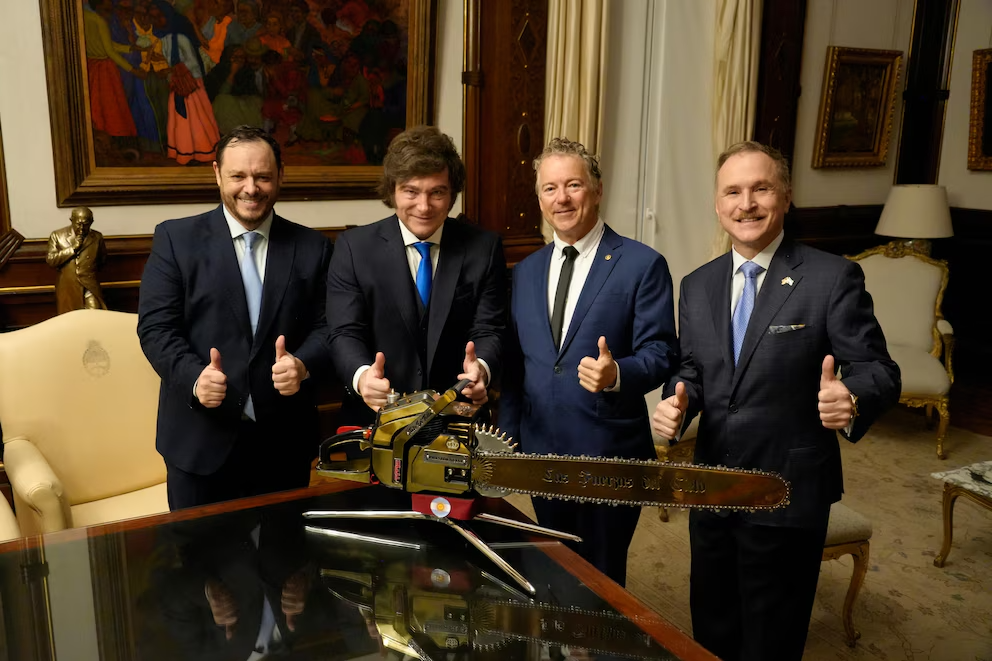
IMAGE: Demian Reidel with Javier Milei, US Senator Rand Paul and Ambassador Peter Lamelas at the Casa Rosada, seven weeks after leaving Nucleoeléctrica. (Source: Infobae)
Reidel’s trajectory showed where the value of Milei’s nuclear reorganisation was accumulating. The authority that allowed him to shape policy, direct the state operator and navigate government had become part of Siderian’s commercial proposition, while his access to presidential power survived his departure from office. Argentina had financed the technology, trained the specialists and built the industrial base, yet the emerging model reduced the country to supplying the uranium, expertise and research infrastructure upon which privately controlled ventures could build. Meanwhile, officials who shaped that model were carrying the authority, knowledge and connections acquired in public office into businesses of their own.
What remains with Argentina
The trail began with Sur Energy’s announcement of a vast data centre in Patagonia, whose intended builder and source of financing remained undisclosed, and led into Argentina’s atomic laboratories and beneath the ground in Chubut and Mendoza, where uranium and rare earths were being prepared for the new energy and computing economy.
Generations of public investment had already given Argentina a domestic reactor design, research facilities, uranium deposits, specialist manufacturers and a workforce capable of operating one of the most advanced nuclear programmes in the Global South. Milei inherited an integrated system that could turn scientific knowledge and natural resources into national industrial power, then froze CAREM, cut its institutions, sold IMPSA, prepared Nucleoeléctrica for private investment and offered the pieces back to investors under RIGI.
Milei called it an opening, but access ran through a closed circle. Reidel moved from the presidential advisory council and the state nuclear operator into Siderian, a company selling nuclear decision systems. Oxenford moved from Endeavor into the embassy and signed Pax Silica. Kargieman, another Endeavor figure, fronted Stargate while the identity of the company expected to build it and the source of its financing remained hidden. RIGI gave foreign investors 30 years of tax, customs and regulatory stability through a process ordinary Argentines could neither inspect nor easily reverse.
Far beyond that circle, scientists and engineers watched CAREM stop while expertise developed through public investment moved into private ventures. Workers saw an industrial champion pass into US-led ownership. Communities were expected to provide the land, water and electricity for projects offering limited permanent employment, while the Treasury relinquished future tax and customs revenue and the state remained responsible for the infrastructure and institutional capacity those ventures required.

IMAGE: CNEA workers protest layoffs at Argentina’s National Atomic Energy Commission.(Source: Adriana Serquis / X
Argentina had the uranium, reactor technology, laboratories, manufacturers and trained personnel needed to build a nuclear industry under national control. Milei’s programme broke those capabilities apart and reassigned their value. Uranium became an export opportunity, public expertise a private asset and the national reactor a suspended project, while electricity and territory became inputs for a data centre whose builder and financing the government would not disclose.
Argentina retained the costs that could not be transferred, including pressure on its water and power systems, the maintenance of public infrastructure, the loss of scientists and technicians and the consequences borne by communities living above the resources. Protected revenue, commercial control and the authority to decide how those assets were used moved into private hands.
Milei sold this programme to Argentines as freedom from a predatory state. Instead, the state has been stripped of its capacity to act for the public and mobilised to protect private capital, open strategic assets and bind future governments to decisions negotiated beyond public scrutiny. Argentina’s uranium, energy and nuclear expertise are being drawn into foreign-controlled projects as the country loses the power to determine its own development, all under the promise that surrender will bring prosperity. Assets built over generations are being broken apart, their value redirected and their future placed beyond the reach of the people who paid for them. Milei calls it freedom. For Argentina, it is the heist of the century.
READ MORE ARGENTINA NEWS AT: 21st CENTURY WIRE Argentina FILES
SUPPORT OUR INDEPENDENT MEDIA PLATFORM – BECOME A MEMBER @21WIRE.TV
VISIT OUR TELEGRAM CHANNEL
21st Century Wire is an alternative news agency designed to enlighten, inform and educate readers about world events which are not always covered in the mainstream media.
Source: https://21stcenturywire.com/2026/08/27/argentina-the-ai-extraction-zone/
Anyone can join.
Anyone can contribute.
Anyone can become informed about their world.
"United We Stand" Click Here To Create Your Personal Citizen Journalist Account Today, Be Sure To Invite Your Friends.
Before It’s News® is a community of individuals who report on what’s going on around them, from all around the world. Anyone can join. Anyone can contribute. Anyone can become informed about their world. "United We Stand" Click Here To Create Your Personal Citizen Journalist Account Today, Be Sure To Invite Your Friends.
LION'S MANE PRODUCT
Try Our Lion’s Mane WHOLE MIND Nootropic Blend 60 Capsules
Mushrooms are having a moment. One fabulous fungus in particular, lion’s mane, may help improve memory, depression and anxiety symptoms. They are also an excellent source of nutrients that show promise as a therapy for dementia, and other neurodegenerative diseases. If you’re living with anxiety or depression, you may be curious about all the therapy options out there — including the natural ones.Our Lion’s Mane WHOLE MIND Nootropic Blend has been formulated to utilize the potency of Lion’s mane but also include the benefits of four other Highly Beneficial Mushrooms. Synergistically, they work together to Build your health through improving cognitive function and immunity regardless of your age. Our Nootropic not only improves your Cognitive Function and Activates your Immune System, but it benefits growth of Essential Gut Flora, further enhancing your Vitality.

Our Formula includes: Lion’s Mane Mushrooms which Increase Brain Power through nerve growth, lessen anxiety, reduce depression, and improve concentration. Its an excellent adaptogen, promotes sleep and improves immunity. Shiitake Mushrooms which Fight cancer cells and infectious disease, boost the immune system, promotes brain function, and serves as a source of B vitamins. Maitake Mushrooms which regulate blood sugar levels of diabetics, reduce hypertension and boosts the immune system. Reishi Mushrooms which Fight inflammation, liver disease, fatigue, tumor growth and cancer. They Improve skin disorders and soothes digestive problems, stomach ulcers and leaky gut syndrome. Chaga Mushrooms which have anti-aging effects, boost immune function, improve stamina and athletic performance, even act as a natural aphrodisiac, fighting diabetes and improving liver function. Try Our Lion’s Mane WHOLE MIND Nootropic Blend 60 Capsules Today. Be 100% Satisfied or Receive a Full Money Back Guarantee. Order Yours Today by Following This Link.


| Visits: | 1,830,386,257 |
| Stories: | 8,695,359 |
Whistler Blowers, Insiders

