

Yemen’s Prisoner Swap and the UAE–Israel Project Saudi Arabia Couldn’t Bury

Freddie Ponton
21st Century Wire
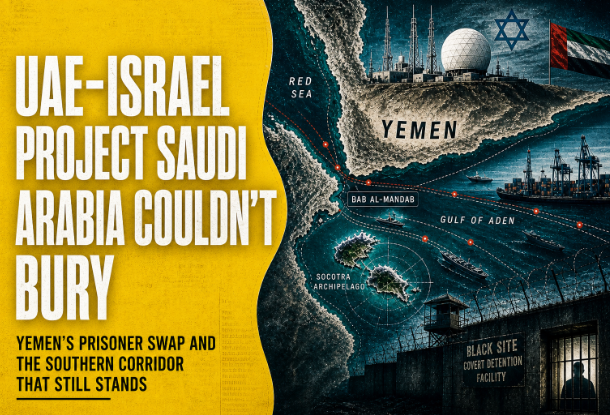
Behind a UN-backed prisoner exchange between Yemen’s internationally recognised government and the Houthis lies a deeper story of islands, radar, black sites, and a southern Yemen security order Riyadh chose to dismantle after years of coalition decay. This proxy network stretching from Yemen’s Socotra Island to Bosaso on Somalia’s coast, across the maritime corridor between the Red Sea and the Horn of Africa, was built on torture, constant sea surveillance and coalition infighting, only to be sold to the world by Western navies as “freedom of navigation.”
After January 2026, we were told that this decade-long tripartite between the UAE, Israel, and the Yemeni separatist Southern Transitional Council (STC) had been dismantled. But how much of that machinery still stands, under new flags and quieter names, waiting for the next round? Since January 2026, the noise has been about “dissolving” the STC and managing Saudi–UAE friction, but what almost no one has asked is whether the UAE–Israel island pact, its radars, runways and black‑site prisons strung along Yemen’s southern waters, ever stopped operating, or just slipped under friendlier flags.
Riyadh’s strike on the STC shattered a larger Red Sea order
On 14 May 2026, negotiators for Yemen’s Presidential Leadership Council and Ansarallah signed the country’s largest prisoner exchange since the war began, agreeing in Amman to swap more than 1,600 detainees under UN auspices. Saudi Arabia helped facilitate the deal behind the scenes, while the Emirati-backed Southern Transitional Council stayed out of sight and the UAE had no formal role at the table, even though some of the war’s most notorious detention networks grew out of the southern security order they built together. For families searching prisons, camps, and unofficial detention sites, the agreement offered a rare opening in a war that turned disappearance into routine.

IMAGE: Yemeni gov’t, Houthis strike deal on largest prisoner exchange (Source: Bastille Post)
The deal also cast light on how much the balance inside the anti-Houthi camp has shifted since the start of 2026. Riyadh now speaks through the Presidential Leadership Council, the STC has been broken in name, and Abu Dhabi’s southern instrument no longer appears openly in the diplomacy, even though its legacy still shapes the coast, the islands, and the coercive structures left behind. The timing of the swap, coming weeks after Houthi missile launches toward Israel and amid a wider regional escalation, gives Riyadh a way to cool one front with Ansarallah while the region may slide toward a broader war that its own past interventions helped stoke.
When Saudi Arabia moved in January 2026 to dismantle the Southern Transitional Council (STC), it was doing far more than disciplining a troublesome Yemeni ally. It was tearing into a southern security order the UAE had spent years building through proxy forces, island facilities, surveillance infrastructure, and political patronage across one of the most sensitive maritime corridors in the world. That order had already begun to intersect with Israel’s post-Abraham Accords security agenda in the Red Sea and Gulf of Aden, while on the ground it rested on a coercive system of detention and torture that rights groups, UN investigators, and Yemeni activists have traced to UAE-backed and STC-linked forces.
To understand why the Saudi move carried such weight, it helps to begin with the shape of the Yemen war itself. Ansarallah consolidated control over most of the north after taking Sanaa in 2014 and forcing the Saudi-backed government from the capital, while the Saudi-led coalition entered the war in 2015, claiming it would restore that government and roll back Houthi gains. Yet the coalition always contained rival projects: Saudi Arabia sought a formally unified Yemeni state that would secure its border, while the UAE built power in the south through local militias and parallel institutions that answered less to Yemen’s government than to Abu Dhabi’s strategic vision.
The Southern Transitional Council (STC) emerged in 2017 as the clearest political expression of that vision. As RUSI’s December 2025 analysis makes plain, it was largely trained, supplied, and financed by the UAE, drawing on Emirati-sponsored formations such as the Security Belt Forces, Giants Brigades, and Hadrami Elite Forces. What appeared on paper as a separatist movement was, in practice, the local anchor of a broader Emirati project that fused politics, military force, and maritime strategy in southern Yemen.
By late 2025, the STC had pushed that project further than Riyadh was willing to tolerate. On 2 December 2025, STC forces opened a rapid offensive across southern Yemen (Code name: Operation Promising Future), rolling into key districts of Hadramawt while tightening their hold over Aden and long stretches of the southern coastline. The push brought STC units into direct confrontation with the Presidential Leadership Council (PLC) local allies and triggered a shutdown of PetroMasila when fighters deployed around the company’s facilities, underlining how far the STC was prepared to go in using territory and resources to rewrite the balance of power in the south.
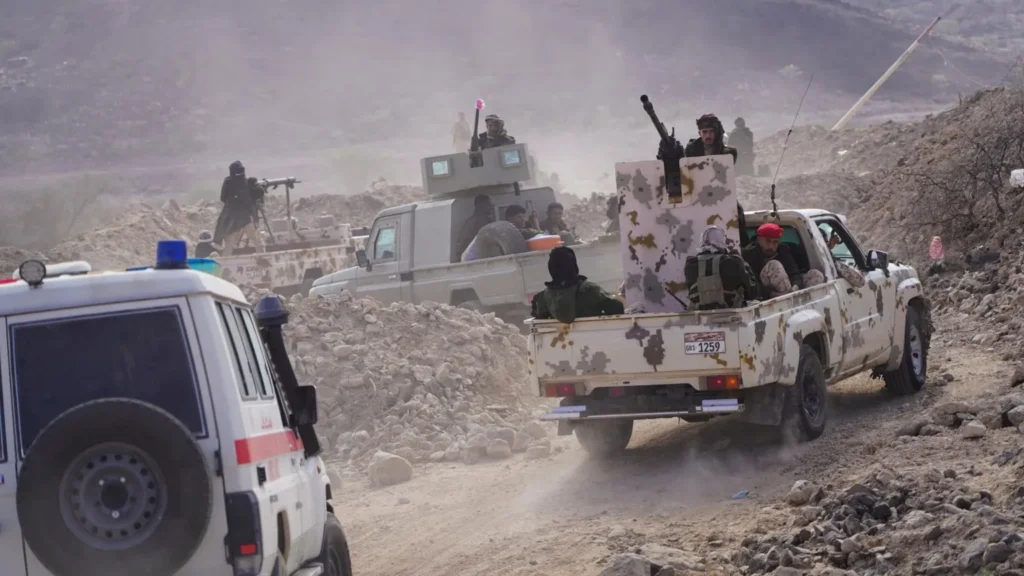
IMAGE: The separatist Southern Transitional Council’s forces launched offensives in eastern Yemen in December 2, 2025 (Source: BBC)
Regional and international coverage at the time, and follow‑up reporting that traced the Saudi–UAE rift opened up by the crisis, described the January 2026 rupture as more than a routine Yemeni reshuffle. For Abu Dhabi, bolstering the STC meant leverage, via an effective surrogate, ahead of any future national political settlement negotiated between Saudi Arabia and the Houthis. For Riyadh, by contrast, the STC had become the vehicle through which the UAE was hollowing out the very state structure Saudi Arabia still claimed to defend.
The southern corridor
The deeper story begins on the map. Southern Yemen lies beside the Bab al-Mandab, the narrow passage linking the Red Sea to the Gulf of Aden, and any force that can shape the islands and coast around that chokepoint acquires influence far beyond Yemen’s own borders. This is why the south came to occupy such an outsized place in Emirati strategy.
RUSI describes southern Yemen as a key Emirati area of influence because of its resources and its position near major global shipping routes, while also placing it inside a larger UAE effort to secure maritime influence across the Red Sea basin and the Horn of Africa through ports, military facilities, logistics hubs, and islands. The same study says the UAE invested in radar systems, runway extensions, and surveillance infrastructure on Abd al-Kuri and Samhah in the Socotra archipelago, as well as on Mayyun Island in the Bab al-Mandab, creating a chain of monitoring positions with reach across the surrounding waters.
The satellite evidence assembled by Middle East Eye’s reporting on the Bosaso radar deployment placed hard geometry beneath that political logic. Taken with the RUSI findings, the result is not a scatter of disconnected installations but a basin-wide chain of positions linking Abd al-Kuri, Samhah, Mayyun, Socotra, Berbera, and Bosaso, allowing the UAE and its partners to watch maritime traffic, project force, and embed influence from the Yemeni coast to the African shore.
January’s troop withdrawals and the formal dissolution of the STC did not flatten that chain into history. Runways, hangars, radar sites, docks, and logistics platforms built up on Abd al-Kuri, Samhah, Mayyun, and Socotra over the better part of a decade are not the sort of assets that vanish between one press conference and the next, and there is no public record of wholesale demolition to match the official language of closure. On the contrary, reporting around the January rupture described continued Emirati-linked shipping activity, persistent restricted access around strategic island sites, and Saudi frustration that cargoes arriving in Socotra were being unloaded through old patronage networks despite the new line out of Riyadh.
One detailed Arabic investigation asked, “Despite withdrawal claims, is Abu Dhabi concealing the reality of its military presence in Yemen?”, documenting how Emirati-backed networks and island positions continued to function discreetly after January under Saudi pressure rather than disappearing altogether.
On islands and along the southern littoral, the STC provided the local political cover, the armed ground presence, and the administrative permissiveness that turned Emirati access into durable control. RUSI notes that the UAE partnered with STC-aligned authorities in Socotra to establish local governance, upgrade ports, and install advanced early warning systems, a formulation that captures how deeply southern politics had merged with maritime infrastructure.
Aden served as the political and logistical hub, Mukalla and the eastern approaches opened onto shipping lanes, smuggling routes, and the Arabian Sea, while Socotra offered a commanding vantage point between the Red Sea, the Gulf of Aden, and the wider Indian Ocean. Abu Dhabi’s project in this arc went far beyond backing one Yemeni faction. It carved out a corridor of access across the southern gate of the Red Sea.
That is why the post-withdrawal picture matters so much. Even Maritime Executive’s account of the Socotra pullout, which broadly accepts the official withdrawal story, concedes uncertainty over whether the UAE actually ended its financial and commercial role on the island. Other reporting went further, describing how Abu Dhabi appeared to be circumventing the withdrawal decision on Socotra rather than accepting a clean handover. What changed fastest were the badges and the press lines; what changed more slowly, if at all, were the loyalties, the contracts, the offloading networks, and the strategic uses of the islands themselves.
That corridor did not stop at sovereignty lines on a map. A UNODC assessment of illicit weapons trafficking in the Gulf of Aden and Red Sea found that arms moved in both directions across the Gulf of Aden and noted that smaller mixed cargoes of mostly used weapons travelled from Yemeni ports such as Mukalla and Al Shihr toward Somalia, including Berbera and Bossaso. Some of those flows ultimately reached armed actors such as al-Shabab and Islamic State affiliates, placing southern Yemeni waters inside a wider field of insecurity whose effects were felt on the African coast as well.
REPORT: United Nations Office on Drugs and Crime (UNODC) 2024 Assessment Of The Response to Illicit Weapons Trafficking In the Gulf of Aden and the Red Sea (Source UNODC)
UNODC Assessment_of_the_response_to_illicit_weapons_trafficking_in_the_Gulf_of_Aden_and_the_Red_Sea
Israel’s function
Israel entered this landscape through convergence rather than authorship. By the time the Abraham Accords formalized Emirati-Israeli normalization in 2020, the UAE had already spent years building positions, proxies, and influence in southern Yemen. Normalization widened the strategic uses of that network by opening the way for cooperation in intelligence, maritime surveillance, defense technology, and anti-Houthi positioning.

IMAGE: Israeli Foreign Minister Yair Lapid shakes hands with United Arab Emirates Foreign Minister Abdullah bin Zayed al-Nahyan in Abu Dhabi, United Arab Emirates, June 29, 2021 (Source: Shlomi Amsalem/Government Press Office via AP)
The Arab Center Washington study on Israel, the UAE, and Yemen’s south notes that STC vice president Hani Bin Braik publicly welcomed the Abraham Accords soon after 2020. The report also mentions Aidarous al-Zubaidi the governor of Aden Governorate from 2015 to 2017, who later told The National during an interview that an independent southern state could join the Accords, and recalls how the UAE and Israel moved ahead with plans for a facility on Socotra before reports emerged, in February 2021, of Emirati aircraft transporting Israeli personnel to the archipelago. Set against that outreach, subsequent investigations have tracked UAE–Israeli intelligence and surveillance facilities on Socotra and Abd al-Kuri being expanded under US oversight, turning the archipelago into a shared platform for monitoring Red Sea and Gulf of Aden traffic rather than a purely Emirati project. It also places the November 2021 Red Sea maritime exercise with Bahrain, the UAE, Israel, and US Naval Forces Central Command inside the same arc of growing cooperation.
Across Yemen, including the southern provinces where the STC hoped to carve out its state, the Palestinian cause remains one of the few shared convictions in a fragmented society, and hostility to Israeli power is woven into political identity in a way the STC cannot easily wish away. Rivals from Ansarallah (the Houthis) to Islah, Yemen’s main Sunni Islamist party, and al-Qaeda in the Arabian Peninsula (AQAP) have already seized on the group’s outreach to Tel Aviv to paint it as a client of foreign powers, and protests in Socotra and the south over talk of ties with Israel have been met not with concession but with repression.
By November 2023, this alignment had grown sharper because the Red Sea itself had become a live front. RUSI says that after October 2023, Israel increasingly viewed the Red Sea and Gulf of Aden as an extension of its confrontation with Iran, because Houthi missile and drone capabilities threatened Israeli-affiliated shipping transiting toward Eilat and the Suez route. In that setting, a southern Yemeni partner aligned with Abu Dhabi and hostile to Ansarallah acquired real strategic value for Israel, especially when paired with Emirati island infrastructure and basin-wide surveillance ambitions.
A 2025 Ynet/INSS analysis described a UAE-backed South Yemen as a potential Israeli ally on the doorstep of the Houthis, while the Arab Centre’s discussion of the Crystal Ball platform showed how the partnership had already widened into cyber-intelligence and regional surveillance. Even if some Yemeni nodes changed hands after January 2026, the Emirati-Israeli layer was regional in design and never depended solely on the uninterrupted public life of one Yemeni proxy.
The hidden machinery
What took shape in ports, islands, and coastlines was sustained on land by a darker architecture of rule. The black sites story belongs at the center of the southern file because it reveals how this order governed when rhetoric about stability and counterterrorism gave way to the practice of control. Here, the record is unusually dense because local documentation, international reporting, human rights investigations, and UN findings converge on the same pattern.

IMAGE: Satellite image from 18 June 2018 shows the site in Aden of the defunct Bir Ahmed I prison and the newer Bir Ahmed II, which became an official black site detention facility in November 2017. (Source: DigitalGlobe, Inc)
The indispensable investigation remains The Intercept’s reconstruction of Huda al-Sarari’s work exposing UAE-run prisons in Yemen. It describes how, after 2015, the UAE created a parallel security apparatus in southern Yemen and trained and armed Yemeni special forces, including the Security Belt in Aden and the Hadrami Elite in Hadramawt, while al-Sarari and other activists built a database that at one point contained more than 10,000 names of men and boys detained outside the ordinary judicial system. That documentation helped expose a network of secret prisons run by the UAE with the knowledge and, at times, direct involvement of US forces.
The Associated Press investigation is still crucial on that last point. In AP’s reporting on Yemen’s secret prisons, unnamed US officials acknowledged that American personnel participated in interrogations at those sites, supplied questions to partner interrogators, and received transcripts of the interrogations. Former detainees and Yemeni officials said they saw Americans around detention centers or were questioned by them, while released prisoners described being separated into those of interest to American interrogators and those of interest to the UAE.
The abuses were not a closed historical episode that ended once the first reports surfaced. Human Rights Watch’s January 2026 statement on UAE-backed forces detaining investigators in Socotra reported that STC-linked forces detained members of Yemen’s National Commission for the Investigation of Alleged Violations of Human Rights after the team visited an unofficial detention center there, and later detained former detainees who had spoken to the investigators. The reflex to suppress scrutiny survived even as Saudi Arabia publicly restructured the southern file.
The clearest recent detail comes from the Cairo Institute for Human Rights Studies (CIHRS) and the Abductees’ Mothers Association report on Waddah Hall. It describes how Waddah Hall in Aden came under the control of STC-affiliated counterterrorism and security units backed by the UAE and led by figures such as Yusran Al Maqtari and Shallal Ali Shayea, and how the site became a byword for incommunicado detention and torture. The same reporting, citing the UN Panel of Experts’ final report S/2023/833, says credible evidence showed STC forces systematically tortured men in official and secret prisons, including Waddah, resulting in deaths and disappearances.
REPORT: The Cairo Institute for Human Rights Studies (CIHRS) and Abductees Mothers Association report on Waddah Hall (Source: CIHRS)
CIHRS-«HE LOOKED LIKE HE WAS BACK FROM THE DEAD» – THE UNANSWERED FATE OF WADDAH HALL’s DETAINEES IN ADEN
This was not a vague suggestion about a harsh environment or a few bad actors. It was a direct finding that systematic torture in STC-linked detention sites formed part of the way the southern order was enforced. Such cases make clear that the southern order was not experienced by ordinary Yemenis as a polished architecture of maritime security. It was experienced through fear, disappearance, and the knowledge that armed units backed by foreign patrons could seize bodies as easily as territory.
The wider rupture
Once these layers are placed together, the January 2026 rupture looks very different. Saudi Arabia’s back Presidential Leadership Council (PLC) move against the STC was an intervention in a southern system already shaped by years of Emirati military patronage, island development, clandestine detention, and expanding convergence with Israeli security priorities in the Red Sea and the Horn of Africa. Riyadh did not restore a healthy Yemeni state, because the state had already been hollowed out by war and by the proxy structures built in its place. What it did was break the most coherent local vehicle through which the UAE had organized its influence across the southern gateway to the Red Sea.
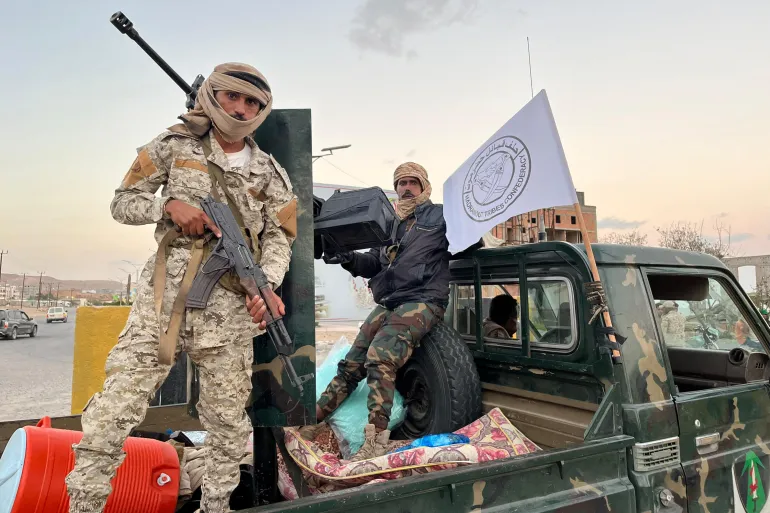
IMAGE: January 3, 2026, Saudi-backed forces (PLC) took control of the Second Military Region Command on the outskirts of Mukalla, the capital of Hadramout (Source: AFP)
Arabic analysis by Al‑Estiklal has already framed this phase as “from dismantling the STC to reshaping security,” arguing that Riyadh is less interested in erasing Emirati-built networks than in bringing them under its own management, while highlighting “the limitations of the Saudi approach to managing the southern file”.
“In this context, Ahmed Humaidan, head of the Aden Cultural Forum, said that recent developments do not represent the complete collapse of the STC, but rather the removal of its leadership, while the political structure on which it was built remains intact. (Al Estiklal)
For the formal withdrawal side of the story, the clearest public report can be found in The National, December 2025 report on the UAE announcing the withdrawal of its remaining counter-terrorism teams from Yemen. For the political collapse of the STC as a vehicle, one useful analytical marker is the Mokha Center’s paper “After the Dissolution of the Southern Transitional Council”. Taken together, they show why Riyadh, the PLC, and much of the international press were able to present, if not promote, January 2026 as closure.
But the material record points somewhere else. The runways on Abd al-Kuri and Mayyun did not tear themselves out of the earth; the radars and surveillance platforms built across the Socotra archipelago were not vaporized with the STC’s press release; the Emirati commercial and shipping ties that helped sustain control on Socotra did not suddenly lose their utility; and the former proxy forces through which Abu Dhabi once governed much of the south were more often rebadged, absorbed, or left in place than dismantled outright. Even where Riyadh and the PLC have assumed formal command, they have done so pragmatically, inheriting infrastructure whose strategic purpose remains intact and whose value lies precisely in keeping watch over the Bab al-Mandab and the Gulf of Aden.
That is why the claim that the UAE–Israel–STC architecture has vanished should be treated less as a fact than as a political message. What the evidence suggests, four months on, cannot be characterised as an obituary but most certainly as a reconfiguration, with a network shaken by Saudi pressure, partially nationalized, partially concealed, still visible in concrete and tarmac, very much alive in logistics and local loyalties, and still useful to every actor that wants eyes on the southern gate of the Red Sea.
What was sold for years as stabilization is, from Yemen’s shorelines, nothing short of a project of corridor control, enforced by proxies, shared with Israeli security planners, shielded by Western naval rhetoric, and able to survive even the fall of its most visible local champion; a system that will keep reproducing war at the water’s edge for as long as its architects are spared any real cost or consequence.
READ MORE YEMEN NEWS AT: 21st Century Wire Yemen Files
SUPPORT OUR INDEPENDENT MEDIA PLATFORM – BECOME A MEMBER @21WIRE.TV
VISIT OUR TELEGRAM CHANNEL
21st Century Wire is an alternative news agency designed to enlighten, inform and educate readers about world events which are not always covered in the mainstream media.
Source: https://21stcenturywire.com/2026/05/18/yemens-prisoner-swap-and-the-uae-israel-project-saudi-arabia-couldnt-bury/
Anyone can join.
Anyone can contribute.
Anyone can become informed about their world.
"United We Stand" Click Here To Create Your Personal Citizen Journalist Account Today, Be Sure To Invite Your Friends.
Before It’s News® is a community of individuals who report on what’s going on around them, from all around the world. Anyone can join. Anyone can contribute. Anyone can become informed about their world. "United We Stand" Click Here To Create Your Personal Citizen Journalist Account Today, Be Sure To Invite Your Friends.
LION'S MANE PRODUCT
Try Our Lion’s Mane WHOLE MIND Nootropic Blend 60 Capsules
Mushrooms are having a moment. One fabulous fungus in particular, lion’s mane, may help improve memory, depression and anxiety symptoms. They are also an excellent source of nutrients that show promise as a therapy for dementia, and other neurodegenerative diseases. If you’re living with anxiety or depression, you may be curious about all the therapy options out there — including the natural ones.Our Lion’s Mane WHOLE MIND Nootropic Blend has been formulated to utilize the potency of Lion’s mane but also include the benefits of four other Highly Beneficial Mushrooms. Synergistically, they work together to Build your health through improving cognitive function and immunity regardless of your age. Our Nootropic not only improves your Cognitive Function and Activates your Immune System, but it benefits growth of Essential Gut Flora, further enhancing your Vitality.

Our Formula includes: Lion’s Mane Mushrooms which Increase Brain Power through nerve growth, lessen anxiety, reduce depression, and improve concentration. Its an excellent adaptogen, promotes sleep and improves immunity. Shiitake Mushrooms which Fight cancer cells and infectious disease, boost the immune system, promotes brain function, and serves as a source of B vitamins. Maitake Mushrooms which regulate blood sugar levels of diabetics, reduce hypertension and boosts the immune system. Reishi Mushrooms which Fight inflammation, liver disease, fatigue, tumor growth and cancer. They Improve skin disorders and soothes digestive problems, stomach ulcers and leaky gut syndrome. Chaga Mushrooms which have anti-aging effects, boost immune function, improve stamina and athletic performance, even act as a natural aphrodisiac, fighting diabetes and improving liver function. Try Our Lion’s Mane WHOLE MIND Nootropic Blend 60 Capsules Today. Be 100% Satisfied or Receive a Full Money Back Guarantee. Order Yours Today by Following This Link.


| Visits: | 1,806,043,841 |
| Stories: | 8,641,947 |
Whistler Blowers, Insiders

