

The Raskin Bill: When Presidential Capacity Becomes a Constitutional Emergency


Freddie Ponton
21st Century Wire
Jamie Raskin has now done what Congress avoided for nearly six decades. With Trump’s Iran war spiraling and public trust collapsing, he has finally tabled a bill to build the “other body” the 25th Amendment quietly promised back in 1967. On paper, it is a nonpartisan commission,but in reality, it is an attempt to answer a question the American system has never dared to face head-on. You are staring at a question that is much bigger than Donald Trump, the man. It is about whether the United States has a credible, non-partisan mechanism to stop a president from escalating toward catastrophic war when he is no longer functionally fit to do so. The 25th Amendment is the only tool the Constitution provides. If it fails, the world pays the price in blood, not in politics.
This article is not about cheering for Democrats or damning Trump. It is about the machinery behind the myth. Section 4 of the 25th Amendment allows the vice president and a majority of the Cabinet or of such other body as Congress may by law provide to declare that the president is unable to discharge the powers and duties of his office. For nearly sixty years, Congress has left this clause half-used, half-forgotten, while the United States has dragged the planet into one illegal war after another.
The real story is not whether Trump is unfit, but it is who gets to decide.
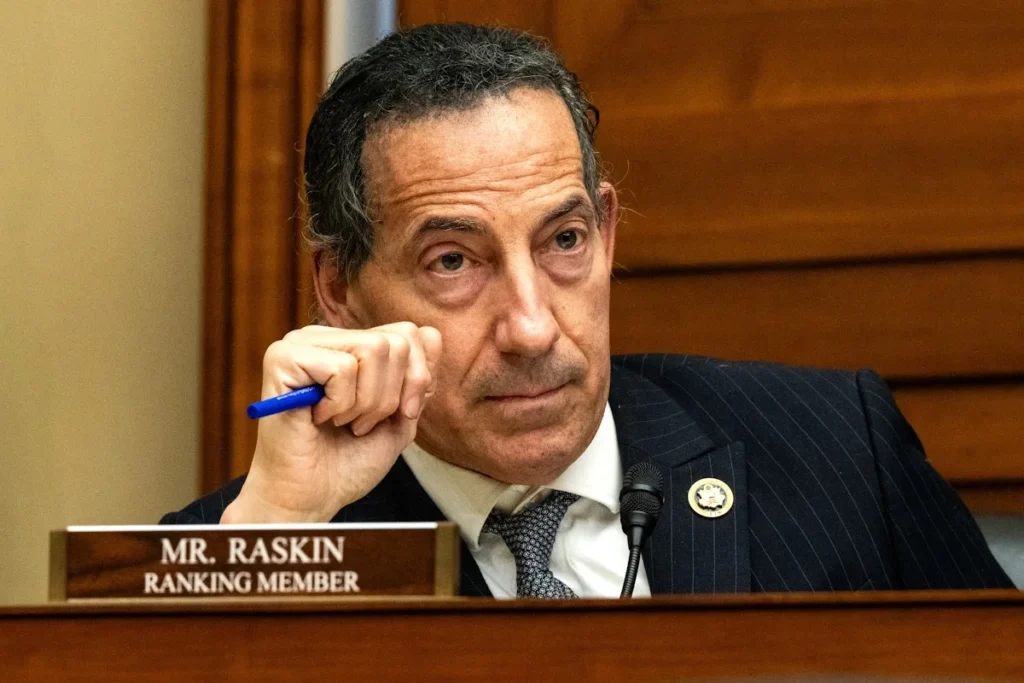
IMAGE: United States Representative Jamie Raskin (Source: Yahoo News)
Who Decides When a President Is No Longer Fit to Rule
Imagine a president who can threaten to destroy an entire civilisation, launch strikes across the Middle East without congressional consent, and insult the head of the Catholic Church with the same casual arrogance he uses to sell real estate. That is not a caricature. It is a description of the current moment.
Democrats like Jamie Raskin argue that Donald Trump’s conduct during the Iran crisis has crossed the line from reckless rhetoric into something more dangerous: the appearance of a president whose judgment is so unstable that it endangers the lives of millions. They are not just asking whether Trump should be removed. They are asking who, in the Constitution, has the right to decide if a president has become too dangerous to remain in charge of war powers.
The 25th Amendment is the only clause that answers that question. Section 4 explicitly allows the vice president, plus a majority of the Cabinet or of such other body as Congress may by law provide, to declare that the president is unable to discharge the powers and duties of his office. For almost six decades, Congress has left that power unused. The trigger has remained in the hands of the president’s own appointees.
DOCUMENT: Reader’s Guide to the never-before-invoked Section 4 of the Twenty-Fifth Amendment (Source: Law Yale)
mn082208_ls_readerguide_interior_final
Raskin wants to change that. His bill proposes a Commission on Presidential Capacity to Discharge the Powers and Duties of Office, a standing body composed of retired executive-branch officials and medical experts, appointed by congressional leaders from both parties. If Congress were to pass this bill, the commission would replace the Cabinet as the vice president’s partner for triggering incapacity review. That is the heart of the conflict.
In a revealing move, Raskin did not wait for the political circus to start. He sent a formal letter to the White House physician demanding an immediate and comprehensive cognitive and neurological evaluation of Trump, expressly grounding that request in the fact that the United States is at war and that Trump initiated that war without congressional authorization. He made the Commander-in-Chief’s mental capacity a national security question, not a partisan talking point. That letter is the bridge between Trump’s Iran-war behavior and the 25th-Amendment-style incapacity-review framework lawmakers now want to build.

IMAGE: President John F. Kennedy and Jacqueline Kennedy in Dallas, Texas, 1963. (Courtesy of John Fitzgerald Kennedy )
The 25th Amendment was drafted in the wake of JFK’s assassination, when lawmakers realized the Constitution had no clear rule for presidential disability. The framers intentionally left the “other body” clause flexible, but they also feared giving Congress too much power over the presidency, and many doubted the body would ever be created. Sixty-one years later, Congress is finally being forced to confront that long-deferred decision under the pressure of a president whose conduct has exposed the danger of leaving it unfinished.
That is not a case of lawmakers forgetting, but a case of lawmakers consciously deferring a power they feared to use.
Inability or Misconduct
The 25th Amendment is not about impeachment, and it is not about whether a president has broken the law or been caught in a lie. It is about whether he is still capable of exercising the powers of the presidency. The line between misconduct and inability is thin and deliberate. The Constitution does not give a clear medical definition of incapacity. It leaves the question open to political and constitutional judgment.
That ambiguity is a feature rather than a bug. The framers wanted flexibility. They did not want to force Congress to diagnose a president as clinically insane before they could act, and they left instead a hook for the most dangerous scenario, with a president who is still breathing, still speaking, still signing orders, but whose mind is no longer capable of holding the line between escalation and annihilation.
Democrats are now using that hook. They are not arguing that Trump violated the law. They are arguing that his conduct as commander-in-chief has made his mental and cognitive fitness a national security concern. The 25th Amendment gives them a constitutional framework to make that argument. Whether the frame is abused or not depends on who controls the trigger.
Trump’s own conduct, however, only sharpens the underlying tension Section 4 was built to manage. Whether it is his repeated threat rhetoric, his pattern of escalating public pronouncements toward Iran, or his habit of talking about “whole civilizations” being destroyed in a single night, his behavior has already conditioned the public and the parties to expect a president who prefers to raise the rhetorical and operational stakes rather than defer to internal brakes on decision‑making.
That is precisely the kind of political environment in which lawmakers, once they start talking about the president as “unable to discharge the powers and duties of his office,” slide from the deliberately ambiguous language of the 25th Amendment into highly personalized judgments about a living president’s judgment under war conditions. The risk is not only that a president will be formally disabled from acting; it is that the line between genuine incapacity and politically inconvenient judgment will itself become another weapon in the partisan struggle for control of the nuclear trigger.
The 1967 debates around the 25th Amendment reveal how deliberately the framers linked “inability” to an emergency tool, not a routine accountability mechanism. They insisted that a president judged “unable to discharge the powers and duties of his office” must be removed through a process that is harder than impeachment for misconduct, precisely because the line between poor judgment and genuine incapacity is so easily politicized.
That design choice now haunts the current fights over Trump. On one side Democrats reach for the “inability” language when they say his conduct exposes the danger of an unchecked president, whilst critics argue that the real threat is not his mental state but his political choices—choices that should be challenged at the ballot box or through impeachment, not through a constitutional emergency clause that could just as easily be turned against a successor.
Who Controls the Trigger
The trigger is the vice president plus the Cabinet. That is the default under Section 4. The vice president can act with a majority of the principal officers of the executive departments. But the clause has a second clause: “or of such other body as Congress may by law provide.” That is the escape hatch.

IMAGE: 25th Amendment, section 4 “or of such other body as Congress may by law provide” (Source: law. cornell)
Congress has never used it. The Cabinet-based trigger has remained the only option, and the Cabinet has every incentive not to act. Cabinet members are appointed by the president. They serve at his pleasure and can be fired on very short notice. They are surrounded by the same political ecosystem that rewards loyalty and punishes dissent. That is the ultimate structural flaw, as the very people who are supposed to judge presidential incapacity are the ones who have the most to lose if they do.
Raskin’s bill is an attempt to correct that flaw. The proposed commission would be a standing body, composed of retired executive-branch officials and medical experts, appointed by congressional leaders. It would be designed to act with the vice president, not with the president’s own appointees. In this case, the choice is simple. It keeps the trigger in the hands of loyal insiders, or hands it to a body that is, in theory, insulated from the president’s orbit.
The Yale Law School Reader’s Guide to the 25th Amendment stresses a point that is easily buried in the legal jargon. Once Congress creates such a body, that body becomes the exclusive partner of the vice president for initiating Section 4, unless the Cabinet is folded into it. The mechanism is either the vice president plus the Cabinet, or the vice president plus the other body. It is an “either/or,” not a “both/and.” That is the hinge of the entire constitutional power struggle. It is not just adding a new body; it is also about restructuring the front-end trigger for declaring presidential incapacity.

IMAGE: JD Vance, Vice President of the United States (Source: Tom Brenner / Getty)
Legal scholars have long warned that Congress never created this body because of the same structural problem Raskin’s bill now tries to solve. The Cabinet-based mechanism may be structurally paralyzed when it is most needed. A president can reshape the Cabinet, replace dissenters, and promote acting officials, effectively neutralizing the only group that is supposed to be able to check him. That is not paranoia. It is a constitutional reality lawmakers are now trying to rewrite.lawreview.law.
What Happens If Raskin’s Bill Succeeds
Imagine a world where Raskin’s bill passes. Congress adopts a concurrent resolution directing the Commission on Presidential Capacity to examine the president. The commission carries out that examination within 72 hours, as the bill specifies. Within 72 hours after the exam, the commission reports its findings to the Speaker and the president pro tempore.
If the commission finds that the president is mentally or physically unable to discharge the powers and duties of the office, and the vice president concurs in writing, the vice president immediately becomes Acting President. The president’s orders to military commanders, his nuclear codes, and his daily authority over the executive branch are suspended. The world does not change with a bang. It changes with a written declaration and a signature.
The president is allowed to fight back. He can submit a written declaration that he is fully capable. The Constitution gives the vice president and the commission four days to reaffirm their incapacity finding. If they do, Congress has 21 days to decide. During that window, the president retains the title of president, but the vice president holds the constitutional powers of the presidency.
If Congress ratifies the incapacity finding by a two-thirds vote in both the House and the Senate, the president loses his authority. If Congress fails to reach that threshold, the president regains full power. The mechanism is set up so that it is easier to block than to use. Using Section 4 in this way is not a shortcut. It is a higher bar than impeachment itself.
That is the scenario. A president who has threatened to destroy civilizations, who has launched strikes across the Middle East without congressional authorization, and who has provoked the world into a spiral of violence could be stripped of power in a matter of days. Or he could be restored to full authority, stronger and more defiant than before.
What If Congress Fails
The 25th Amendment is not a magic wand. It is a high-risk, high-stakes mechanism. If Congress fails to ratify the incapacity finding, the president does not merely survive. He returns to power with the restored constitutional shield of a presidency that has been tested and, in effect, vindicated. In other words, the Presidential succession process is a double-edged sword.
That is the hidden incentive not to act. Congress is not just risking the chaos of removing a president. It is risking the backlash of empowering the very figure it sought to contain. The 25th Amendment is designed only for emergencies so severe that lawmakers would rather face the fallout of using it than the fallout of leaving it dormant. If they flinch at the 21-day showdown, the system reveals its true priority—the survival of the presidency as an institution, not the safety of the world.
The 21-day window and the two-thirds threshold are not just technical details. They are the Constitutional failsafes against coup-like power grabs. They protect the president from being removed too easily, but they also protect the world from presidents who escalate too easily. The irony is that the same safeguards that block casual coups may also block the only constitutional path to restraint for a president who is on the verge of launching an illegal, unprovoked war.
The Bigger Picture: Rule of Law Under Stress
The 25th Amendment sits at the heart of a broader debate about the fragility of constitutional checks in an era of polarized, personalized leadership. The United States has already dragged the planet into one illegal war after another. The smear campaign against Iran, the sanctions, the provocations, the assassinations, the aerial strikes on Hezbollah, the creeping occupation of Lebanon under the guise of “democracy promotion,” the Zionist project of permanent expansion dressed as a response to terror, the British machinery of embedded “governance” and intelligence-driven reform—all of it depends on a presidency that can be pushed to the edge of nuclear conflagration by a single, unstable mind.

The 25th Amendment is the only constitutional tool that can, in theory, stop that cascade. It is not about scoring points for or against Trump. It is about whether the system can prevent a president from turning a diplomatic crisis into a global war when he is no longer fit to do so. The United States has a long history of ignoring such safeguards. It has a long history of turning the Constitution into a weapon of elite consensus and public spectacle. The continuity of presidential duties is the formal language, but the real question is whether that continuity serves peace or merely preserves the machinery of escalation.
The question is not whether Trump is unfit. The question is whether the system is
That system includes not only the president, but also the vice president. Figures like J D Vance have already been tested on the world stage. His high-profile trip to Hungary produced no meaningful diplomatic gains, and his role in the Islamabad talks was limited and quickly overshadowed by what many believe to be Israeli assets, disguised as experienced negotiators, namely Jared Kushner and Steve Witkoff. Reporting from those episodes paints a picture of a politician who moves comfortably inside the same Republican national-security ecosystem, not a figure capable of breaking from it.
The 25th Amendment-style trigger is being handed to someone drawn from the same security-state-and-war-machine network, which raises a hard question: when the time comes to judge a president’s capacity to wage or end war, will those sitting in judgment be any less invested in the system than the man whose hand is on the trigger?
READ MORE TRUMP NEWS AT: 21st Century Wire TRUMP Files
SUPPORT OUR INDEPENDENT MEDIA PLATFORM – BECOME A MEMBER @21WIRE.TV
VISIT OUR TELEGRAM CHANNEL
21st Century Wire is an alternative news agency designed to enlighten, inform and educate readers about world events which are not always covered in the mainstream media.
Source: https://21stcenturywire.com/2026/04/15/the-raskin-bill-when-presidential-capacity-becomes-a-constitutional-emergency/
Anyone can join.
Anyone can contribute.
Anyone can become informed about their world.
"United We Stand" Click Here To Create Your Personal Citizen Journalist Account Today, Be Sure To Invite Your Friends.
Before It’s News® is a community of individuals who report on what’s going on around them, from all around the world. Anyone can join. Anyone can contribute. Anyone can become informed about their world. "United We Stand" Click Here To Create Your Personal Citizen Journalist Account Today, Be Sure To Invite Your Friends.
LION'S MANE PRODUCT
Try Our Lion’s Mane WHOLE MIND Nootropic Blend 60 Capsules
Mushrooms are having a moment. One fabulous fungus in particular, lion’s mane, may help improve memory, depression and anxiety symptoms. They are also an excellent source of nutrients that show promise as a therapy for dementia, and other neurodegenerative diseases. If you’re living with anxiety or depression, you may be curious about all the therapy options out there — including the natural ones.Our Lion’s Mane WHOLE MIND Nootropic Blend has been formulated to utilize the potency of Lion’s mane but also include the benefits of four other Highly Beneficial Mushrooms. Synergistically, they work together to Build your health through improving cognitive function and immunity regardless of your age. Our Nootropic not only improves your Cognitive Function and Activates your Immune System, but it benefits growth of Essential Gut Flora, further enhancing your Vitality.

Our Formula includes: Lion’s Mane Mushrooms which Increase Brain Power through nerve growth, lessen anxiety, reduce depression, and improve concentration. Its an excellent adaptogen, promotes sleep and improves immunity. Shiitake Mushrooms which Fight cancer cells and infectious disease, boost the immune system, promotes brain function, and serves as a source of B vitamins. Maitake Mushrooms which regulate blood sugar levels of diabetics, reduce hypertension and boosts the immune system. Reishi Mushrooms which Fight inflammation, liver disease, fatigue, tumor growth and cancer. They Improve skin disorders and soothes digestive problems, stomach ulcers and leaky gut syndrome. Chaga Mushrooms which have anti-aging effects, boost immune function, improve stamina and athletic performance, even act as a natural aphrodisiac, fighting diabetes and improving liver function. Try Our Lion’s Mane WHOLE MIND Nootropic Blend 60 Capsules Today. Be 100% Satisfied or Receive a Full Money Back Guarantee. Order Yours Today by Following This Link.


| Visits: | 1,796,829,147 |
| Stories: | 8,621,920 |
Whistler Blowers, Insiders

