

The Hormuz Trap: Where Iran Turns US Power Into Vulnerability

Freddie Ponton
21st Century Wire
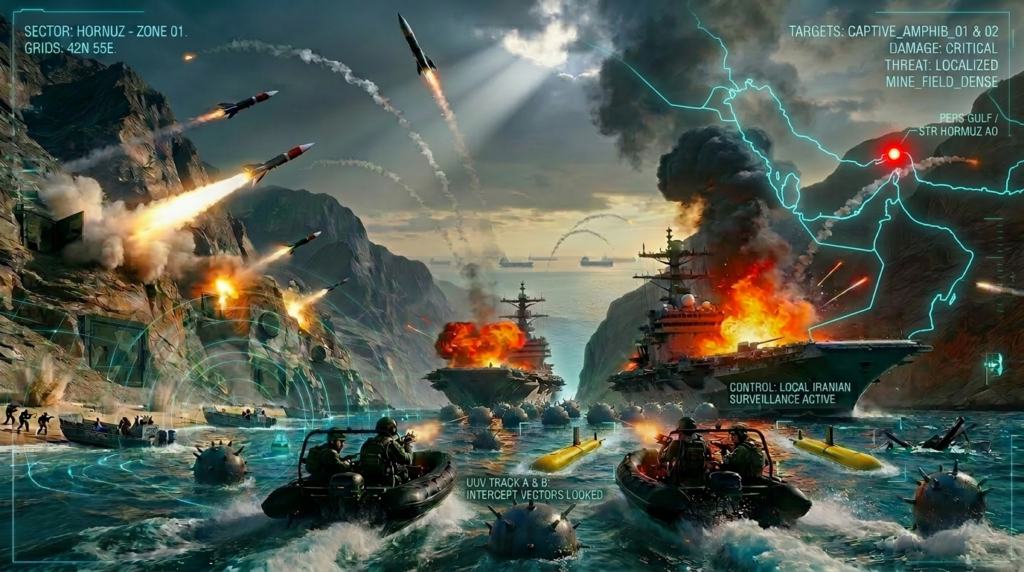
For weeks, Western media have been selling audiences a familiar fantasy. Viewers are told the United States is preparing a decisive “battle for the Strait of Hormuz” in which elite Marines, airborne units and special forces (SOF) will smash Iranian defenses, escort tankers through and restore “freedom of navigation.” The graphics are slick, the talking points rehearsed. Lost in this spectacle is a harder reality in which the US–Israel strategy is not a clean frontal victory in the Strait but a multi‑front pressure campaign designed to stretch Iran everywhere at once.
Tehran, for its part, has spent decades preparing to turn that campaign into a mutual attrition trap, not a replay of “shock and awe.” The real centre of gravity in this war is not only a narrow shipping lane but the web of oil routes, food flows and trade corridors that bind Iran and its neighbours into the global economy.
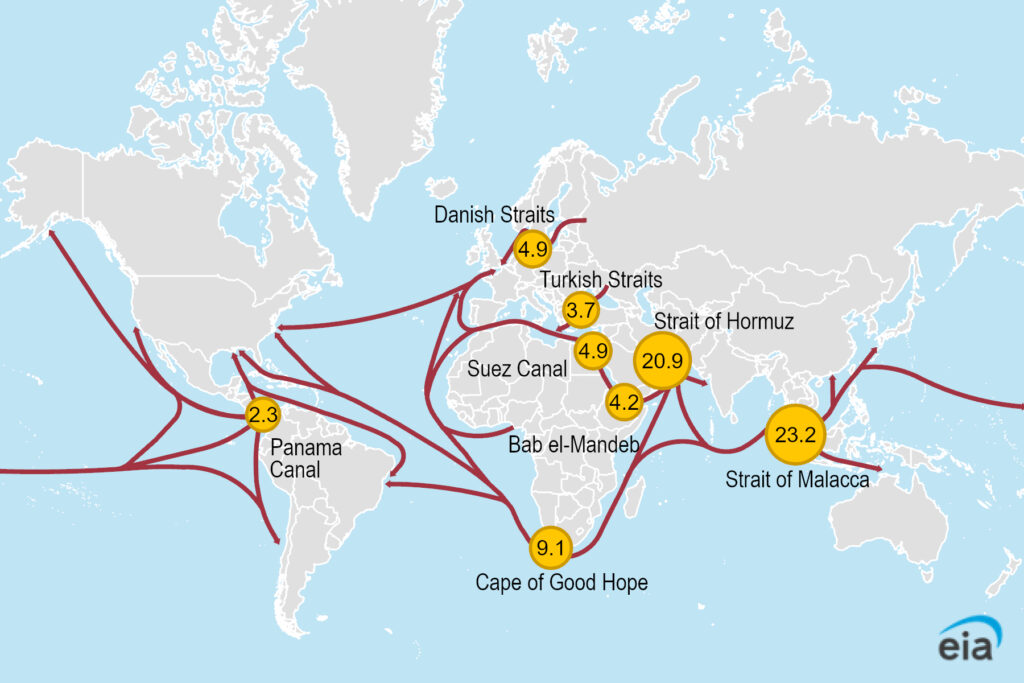
IMAGE: 2025 – Map of daily transit volumes of petroleum and other liquids through world maritime oil chokepoints (million barrels per day) – (Source: U.S. Energy Information Administration | EIA)
On any honest map, the Strait of Hormuz is the world’s most important oil transit chokepoint. At its narrowest, the strait is about 21 nautical miles wide, with two shipping lanes only a few miles across. Around a fifth of the world’s petroleum‑liquids consumption and more than a quarter of seaborne oil trade normally passes through those lanes. The ships that carry this cargo cannot manoeuvre like warships; they are slow, predictable and dependent on fixed routes. Large US formations would have to move through water that is narrow, shallow and lined with Iranian missile batteries, radar, drones and fast‑attack craft built precisely to bleed a stronger adversary. Pushing two Marine Expeditionary Units (MEU), Ranger battalions, elements of the 82nd Airborne and special operations teams into this choke point turns them into high‑value targets strung out across a confined sea route. Every logistics ship, tanker, hospital vessel and helicopter circuit would sit under overlapping fields of Iranian fire from shore‑based missiles, mines, swarming boats and cheap loitering munitions.
The Pentagon understands this. Which is why so much of the “we may have to seize Hormuz” talk, carefully staged for a US public already reeling at being dragged into yet another Middle East war, functions less as a serious operational concept than as psychological warfare. It is abundantly clear that the Hormuz-baiting is designed to intimidate Iran, soothe jittery markets and discipline Gulf monarchies, without admitting that a sustained attempt to hold islands like Kharg would be a logistical and political suicide mission. Even sympathetic “reopening the Strait of Hormuz” studies admit it could take weeks of high‑intensity strikes, require a large escort fleet and still leave commercial shipping exposed to mines and drones. The US can close Hormuz, but it cannot easily turn it into a safe, one‑way American corridor at a bearable cost.
The US multi‑front pressure grid: stretching Iran to hide American weakness
If a frontal victory in Hormuz is a dangerous illusion, the real US concept of operations has to be found elsewhere. Once you zoom out from the strait itself, a pattern emerges. Washington is not planning one decisive Gulf battle. It is assembling a pressure grid that encircles Iran with overlapping fronts because it does not trust its ability to win a concentrated fight at the chokepoint.
Across the Gulf littoral, US air and naval hubs form a dense ring. Al Udeid Air Base in Qatar, long the largest US air base outside the continental United States, now shares that role with a rapidly reinforced Prince Sultan Air Base in Saudi Arabia, which has absorbed many of the high‑value tankers and command‑and‑control aircraft once concentrated in Qatar. Al Dhafra in the UAE, Isa Air Base in Bahrain and American facilities in Kuwait and Oman (see mapping) host additional squadrons and logistics units. Between them, these hubs can generate hundreds of sorties per day into Iranian airspace. Amphibious assault ships and carrier strike groups positioned in the Arabian Sea and Gulf act as floating airfields and missile batteries backing this fixed infrastructure, as described in recent overviews of the 2026 US military buildup in the Middle East.
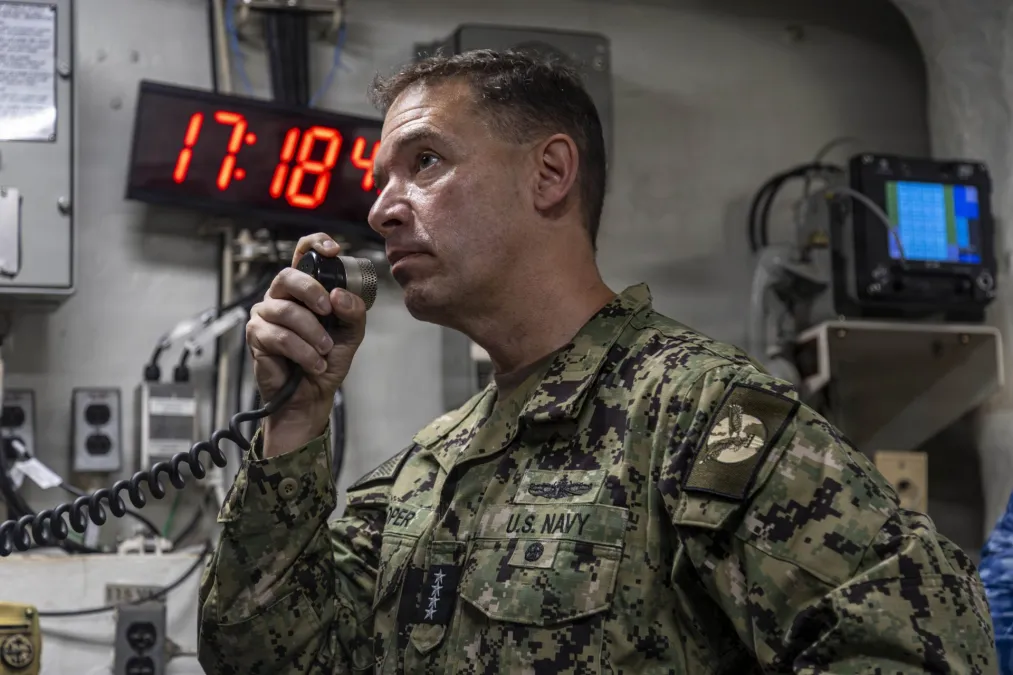
IMAGE: U.S. Navy Adm. Brad Cooper, commander of U.S. Central Command, makes an announcement aboard Nimitz-class aircraft carrier USS Abraham Lincoln (CVN 72) in the Arabian Sea, Feb. 7, 2026. (Source: U.S. Navy photo by Mass Communication Specialist 2nd Class Sonny Escalante)
At the same time, US and Israeli strike packages have repeatedly hit missile factories, radar sites and command centres deep inside Iran, especially in its western provinces, degrading long‑range strike systems and forcing Tehran to pull air‑defense assets inland. This is not random targeting, but rather a deliberate attempt to thin out the very arsenal Iran would use to punish Gulf bases and choke Hormuz, a pattern documented in operational analyses of early strikes in the Iran war.
Further west and south, a second belt of power is taking shape. Under the banner of “protecting global shipping,” US and European warships and aircraft have tightened their posture in the Red Sea and Bab el‑Mandeb, creating an alternate corridor for energy and trade and a second chokepoint Iran has to think about if it escalates at Hormuz, as noted in maritime security updates on the Red Sea and Gulf corridors. On land, strikes on Iran‑aligned militias and logistics networks in Iraq and Syria tie down the IRGC’s external arm and keep proxy forces focused on survival rather than on orchestrating a single, coordinated response to a Hormuz crisis.
Taken together, this looks less like the strategy of a confident hegemon than the behaviour of a state trying to compensate for vulnerability at the main chokepoint. By threatening Iran’s interior, its allies, its northern corridors and its coastline at the same time, Washington hopes to split Iran’s attention and create temporary holes in its coverage around Hormuz—holes it can then exploit with limited convoy operations and raids while avoiding the concentrated fight the ship‑killing gauntlet would impose.
Israel, the Caspian flank and the shadow war on Iran’s arteries
Within this grid, Israel plays the role Washington prefers to keep in the shadows. It is the long‑range strike arm willing to hit politically sensitive targets and frontiers that US forces would rather not touch directly. That has long been obvious in Syria and in covert attacks inside Iran. The decision to open a northern maritime front in the Caspian Sea makes the picture starker.
By striking Iranian naval assets and infrastructure at Bandar‑e Anzali, Israel did not just add another pin to its kill map. It went after the emerging Russia–Iran supply lifeline that runs through the Caspian to Astrakhan and onward via the Volga-Don Canal. Since Western sanctions on Moscow intensified, this north–south corridor has carried Iranian drones, shells and other munitions north into Russia and, increasingly, Russian drones, components, and perhaps targeting assistance south into Iran. It also handles sanctioned trade, food and industrial goods, as detailed in coverage of Israel’s strike on a key Russia–Iran weapons supply route in the Caspian. Hitting Anzali damaged Iranian patrol and support vessels and signalled that the port itself, a key node in this chain, is now fair game. Ukrainian strikes on Russian Caspian targets over the last two years had already exposed the vulnerability of this route; Israel’s move now knots the Russia–Ukraine and Iran theatres together in a single contested logistics space.
The move carries several messages. It tells Tehran that the Caspian, long treated as a secure rear area, is now a front where its tiny northern fleet and concentrated infrastructure can be attrited relatively cheaply. It warns Moscow that its discreet marriage of convenience with Iran will be contested even in a sea where outside navies are formally barred, and Russia dominates, something Russian statements on Caspian spillover already hint at. It also gives Washington a deniable tool to bleed Iran’s northern arteries while publicly insisting it is only concerned with “smuggling routes.” Combined with long‑running efforts by Western‑aligned contractors to gain data access and “monitoring” roles in strategic ports across the region, such as those revealed in Jack Poulson’s reporting on Middle East–focused US/UK intel contractors, the Caspian strike looks less like an isolated stunt and more like the visible edge of a wider infrastructure war. The target is not just Iran’s launchers. It is the entire web of ports, corridors and partnerships that keep the Iranian war economy, and its partnership with Russia, alive.
Iran’s counter‑plan: prepared attrition instead of quick collapse
Against this, Western coverage still prefers to talk as if Iran is sleepwalking into a war it cannot withstand. The public record shows otherwise. After the short but intense bombardments of 2025, Iranian commanders themselves acknowledged the vulnerabilities that had been exposed, including over‑reliance on fixed launch infrastructure, predictable command nodes and insufficient dispersal. The response was not capitulation but a visible shift in doctrine and posture, described in analyses asking whether Iran’s military is ready for a US–Israeli war.

IMAGE: IRGC commander‑in‑chief, Brigadier General Ahmad Vahidi (Source: Muslim Mirror)
Over the last year, Iran has fielded more mobile transporter‑erector‑launcher units for its ballistic missiles, expanded underground bases carved into mountains along the Gulf and elsewhere, and dispersed drone production and launch sites across multiple provinces. It has rehearsed combined missile‑and‑drone salvos in exercises and hardened its communications against disruption, moves covered in detail in pieces on Iran’s asymmetric warfare doctrine. The clear intent is to survive the inevitable first rounds of US–Israeli strikes with enough capacity intact to keep firing. In parallel, official doctrine has edged away from purely defensive slogans toward a more open embrace of offensive retaliation as a pillar of deterrence. Senior officers now speak bluntly about treating all US bases and allied infrastructure in the region as legitimate targets if war deepens, a stance reflected in early‑2026 warnings that any US buildup would be met with “all‑out war”.
Iran is not trying to build a symmetrical equivalent to US power. It is building a layered, cheap and resilient ability to make aggression unbearably costly. That means fast‑attack boats and mines in the Strait, coastal missile batteries and UAV swarms along its shores, but also proxy and partner forces in Lebanon, Syria, Iraq and Yemen able to open secondary fronts if needed. It means being willing to absorb early damage, including on its own territory, to demonstrate that escalation will not be one‑sided. Tehran’s wager is brutally simple and demonstrates that in a long and grinding confrontation where Iranian cities, Gulf skylines and perhaps Israeli infrastructure are all under intermittent fire, it is Washington and its allies, with their exposed economies, restless publics and fragile coalitions, whose will erodes first.
The hidden war on food, fuel and trade corridors
Alongside the visible clash of missiles and ships runs a quieter contest that may ultimately decide how long this war can last. We must pay attention to who has control over calories, inputs, and corridors. Iran can export oil, but it cannot feed itself without imports. For instance, a significant share of its grain, animal feed and fertilisers arrives by sea, much of it from Brazil and other exporters, and much of it through the same bottleneck now being militarised.
Food‑system analysts have pointed out that in recent years Brazil has become a key supplier of corn and soy to Iran’s livestock sector, with millions of tonnes a year shipped to the Gulf; one investigation bluntly described this as “The Strait That Starves: Iran’s 2026 food shock.” Disrupt that flow for even a few weeks, and the impact is not limited to higher prices. Farmers are forced to slaughter animals early. Herd sizes shrink, and protein availability drops for months, while fertiliser imports, which also depend heavily on seaborne trade, face similar exposure. Regional and agricultural reporting now estimates that roughly one‑third of the global nitrogen fertiliser trade relies on Middle Eastern exporters, and that the Iran war has put about one‑third of global fertiliser flows at risk. The same corridor underpins food imports for tens of millions of people across the wider region.

IMAGE: One-third of the global fertiliser trade at risk due to the Iran war – ESN nitrogen fertiliser granules (Source: National Observer)
What we are seeing now is not a binary open‑versus‑closed Hormuz. A narrow strip of Iranian oil exports, especially to Asian buyers, is still moving, often on state‑linked tankers under bespoke insurance and tracking arrangements, because Washington and its partners have no interest in detonating a global oil shock, as noted in coverage of US tolerance for some Iranian crude flows through the Strait. At the same time, a far wider array of cargoes faces prohibitive insurance costs, legal risks and direct physical danger from both Iranian and coalition operations. Major container lines have suspended calls. Bulk food and input shipments are delayed, rerouted at high cost or left unbooked. Iranian officials, for their part, have begun talking openly about a “vetting system” and registration regime for ships allowed to transit Hormuz. Since mid‑March, the IRGC has effectively implemented that system, closing the Strait to “unfriendly nations” while allowing approved, escorted vessels, notably tankers bound for China and India, to pass.
This asymmetry is not accidental. It allows US officials to claim they are “protecting global energy markets” even as the overall war and risk environment strangles Iran’s access to what it needs most: food, feed, fertilisers, and spare parts. It also weaponises Hormuz against the wider world. Analysts and agencies now warn that disruption in this single corridor threatens global food production by raising fuel and fertiliser prices and cutting access for import‑dependent countries far from the Gulf. On top of that, policy papers openly discuss “distant blockade” options, interdicting Iranian tankers in the Arabian Sea and along routes to the Strait of Malacca under sanctions pretexts, while strikes like the one on Bandar‑e Anzali go after the Russia–Iran Caspian lifeline that moves not only arms but food and sanctioned goods, as highlighted in Investinglive analyses of Israel’s expanded conflict footprint against the Caspian supply route.
Taken together, this is a vision of war that reaches into grain elevators, livestock sheds, port cranes and insurance desks as much as bunkers and runways. It is less cinematic than amphibious assaults. It is also more revealing. The underlying goal is not just to blunt Iran’s missiles, but instead to keep the country’s economic circulation and its partnerships with other sanctioned states in a state of chronic crisis.
When escalation backfires: the risks Washington and its allies cannot control
Official language still dresses this campaign up as a limited, necessary effort to “punish aggression” and protect trade. Once you follow the chains of cause and effect, the risks look more like a series of loaded guns pointed in all directions, including back at those pulling the trigger.
For the United States, a drawn‑out conflict around Hormuz, the Caspian and distant sea lanes threatens to supercharge an already fragile global economy. If the war drags on, energy prices, fertiliser costs and shipping rates all rise. That flows into higher food prices and inflation from North Africa through the Middle East to South and Southeast Asia, fuelling unrest and eroding support for US policy in precisely the regions Washington claims to stabilise, a risk already flagged in coverage of how war in the Middle East threatens global food production. At home, an open‑ended war with no clear victory condition and visibly rising global costs feeds into a political mood that is far less forgiving of foreign adventures than it was when the tanks rolled into Iraq.
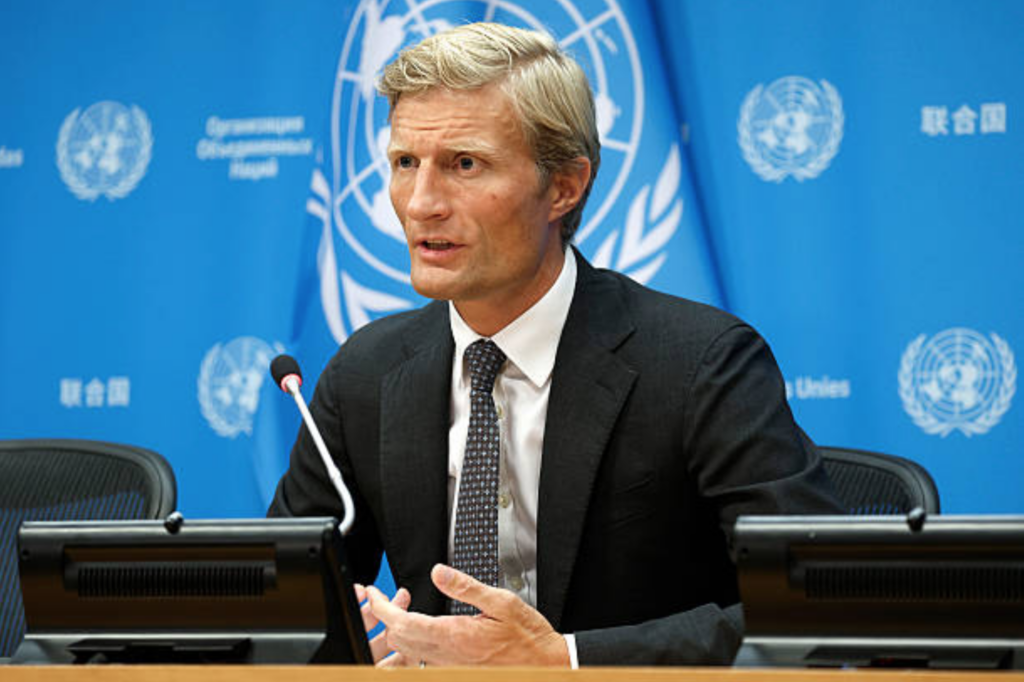
IMAGE: Deputy Executive Director and Chief Operating Officer, World Food Programme – U.S.-Israeli Strikes on Iran Set to Drive Hunger to Record Levels (Source: John Lamparski/Getty Images| NYT)
Israel, having pushed hardest for escalation, risks winning itself into overextension. It has already burned through large stocks of precision munitions and missile interceptors in Gaza and along the northern front, as even mainstream reporting on Israel’s munitions strain notes. Opening sustained fronts against Iran proper and Iranian assets in the Caspian, while bracing for direct Iranian and proxy retaliation on its own cities and infrastructure, is not something a small state can maintain indefinitely. If the US appetite for a grinding campaign wanes, as it has in every major US expeditionary war of the last two decades, Israel could find itself exposed in a conflict whose escalation ladder it helped construct but cannot easily climb down from alone.
The Gulf monarchies, portrayed as grateful clients under an American security umbrella, may in fact be the most exposed actors of all. Their electricity, water and financial systems are tightly interlocked. Their populations depend on energy‑intensive desalination. Their economies rely on being seen as safe hubs for capital, tourism and logistics. A prolonged exchange of missile and drone strikes that hit refineries, LNG terminals, ports or even a few iconic skylines would not just cause irreparable damage. It would undercut the central premise of their development strategy, which promises a stable haven in a chaotic region. Recent conflict‑event data show that Iranian strikes have already hit targets across all six GCC states, while Gulf rulers respond with “strategic restraint” civil-defense measures, and diplomatic moves, but no direct war entry, precisely because they fear what a wider conflict could unleash.
And when this war ends, whether with a chastened but intact Islamic Republic or a fractured, militarised Iran, they will still be living next to the wreckage. Some of their own strategists quietly warn that a shattered, fragmented Iran could be even more dangerous than the current state—a belt of proxy‑ridden territory, mass displacement and uncontrolled weapons that no US security guarantee can fully contain, a scenario explored in depth in regional endgame studies of the 2026 US–Israel war on Iran.
Seen in full, the coming battle is not a tidy morality tale about “freedom of navigation.” It is a high‑risk attempt by a fading superpower and an embattled regional ally to impose their will on a state that has spent four decades preparing to survive precisely such a moment. They are betting that multi‑front pressure, covert economic warfare and calibrated brutality will finally break Iranian resistance. Iran is betting that its own readiness to absorb pain and hit back, combined with the structural vulnerabilities of US allies and the global economy, will make that project self‑defeating.
A reference article worthy of the name does not cheer for either side. It shows readers, in detail, how fragile and dangerous that bet really is, and I sincerely hope we have achieved just that.
READ MORE IRAN NEWS AT: 21st Century Wire IRAN Files
SUPPORT OUR INDEPENDENT MEDIA PLATFORM – BECOME A MEMBER @21WIRE.TV
VISIT OUR TELEGRAM CHANNEL
21st Century Wire is an alternative news agency designed to enlighten, inform and educate readers about world events which are not always covered in the mainstream media.
Source: https://21stcenturywire.com/2026/03/26/the-hormuz-trap-where-iran-turns-us-power-into-vulnerability/
Anyone can join.
Anyone can contribute.
Anyone can become informed about their world.
"United We Stand" Click Here To Create Your Personal Citizen Journalist Account Today, Be Sure To Invite Your Friends.
Before It’s News® is a community of individuals who report on what’s going on around them, from all around the world. Anyone can join. Anyone can contribute. Anyone can become informed about their world. "United We Stand" Click Here To Create Your Personal Citizen Journalist Account Today, Be Sure To Invite Your Friends.
LION'S MANE PRODUCT
Try Our Lion’s Mane WHOLE MIND Nootropic Blend 60 Capsules
Mushrooms are having a moment. One fabulous fungus in particular, lion’s mane, may help improve memory, depression and anxiety symptoms. They are also an excellent source of nutrients that show promise as a therapy for dementia, and other neurodegenerative diseases. If you’re living with anxiety or depression, you may be curious about all the therapy options out there — including the natural ones.Our Lion’s Mane WHOLE MIND Nootropic Blend has been formulated to utilize the potency of Lion’s mane but also include the benefits of four other Highly Beneficial Mushrooms. Synergistically, they work together to Build your health through improving cognitive function and immunity regardless of your age. Our Nootropic not only improves your Cognitive Function and Activates your Immune System, but it benefits growth of Essential Gut Flora, further enhancing your Vitality.

Our Formula includes: Lion’s Mane Mushrooms which Increase Brain Power through nerve growth, lessen anxiety, reduce depression, and improve concentration. Its an excellent adaptogen, promotes sleep and improves immunity. Shiitake Mushrooms which Fight cancer cells and infectious disease, boost the immune system, promotes brain function, and serves as a source of B vitamins. Maitake Mushrooms which regulate blood sugar levels of diabetics, reduce hypertension and boosts the immune system. Reishi Mushrooms which Fight inflammation, liver disease, fatigue, tumor growth and cancer. They Improve skin disorders and soothes digestive problems, stomach ulcers and leaky gut syndrome. Chaga Mushrooms which have anti-aging effects, boost immune function, improve stamina and athletic performance, even act as a natural aphrodisiac, fighting diabetes and improving liver function. Try Our Lion’s Mane WHOLE MIND Nootropic Blend 60 Capsules Today. Be 100% Satisfied or Receive a Full Money Back Guarantee. Order Yours Today by Following This Link.


| Visits: | 1,790,714,750 |
| Stories: | 8,610,461 |
Whistler Blowers, Insiders

