
The Helium War: How Iran’s Strikes on Qatar Threaten the Semiconductor and AI Economy


Freddie Ponton
21st Century Wire
The helium shock is not a fluke of geology or a quirky subplot in the energy markets. It is a direct consequence of a war that Washington and Tel Aviv chose to escalate, and of a global economic order that concentrated a critical industrial gas in a handful of facilities and choke points scattered around the Gulf. When Iranian drones and missiles slammed into Ras Laffan in Qatar and when warships began circling the Strait of Hormuz, they did not just interrupt LNG flows. They tore out a hidden load-bearing beam of the AI economy, of modern medicine, of space launch and high-end manufacturing. That beam is helium.
IMAGE: Helium (He) is the chemical element of atomic number 2, an inert gas which is the lightest member of the noble gas series. (Source: Wikipedia)
For years, helium sat at the edge of public consciousness as a party-balloon punchline. In reality, the balloon trade is the least of it and will be the first to be sacrificed. The real story runs through semiconductor clean rooms in South Korea and Taiwan, through MRI suites from São Paulo to Seoul, through rocket assembly buildings in Florida and Kourou, and through industrial gas terminals from Texas to Tianjin. In that circuitry, Qatar’s role as the world’s second-largest helium producer, supplying roughly one third of global volumes before the war, now looks less like an economic success story and more like a carefully laid trap.

IMAGE: Qatar contributes a major share of global helium supply—around 63 million cubic feet in 2025—making it the seconf largest producer in the World (Source: Kornbluth Helium Consulting)
Ras Laffan was built as a monument to the North Field and LNG, but helium rode along in its shadow. Three helium plants, with combined capacity on the order of forty to fifty million cubic metres of helium per year, quietly turned offcuts from gas processing into a strategic export that few outside the industry even realised existed. That output represented around 33% of the global helium supply. After Iran’s March strikes, QatarEnergy’s own executives acknowledged that missiles and drones cut about 17% of the country’s LNG export capacity and left roughly 14% of gas-linked output permanently damaged for 3 to 5 years, while the rest of the complex has been forced into a total short-term shutdown. In plain terms, about a third of the world’s helium has gone offline overnight, and at least a seventh of Qatar’s production will not return this decade, even if the shooting stopped tomorrow.
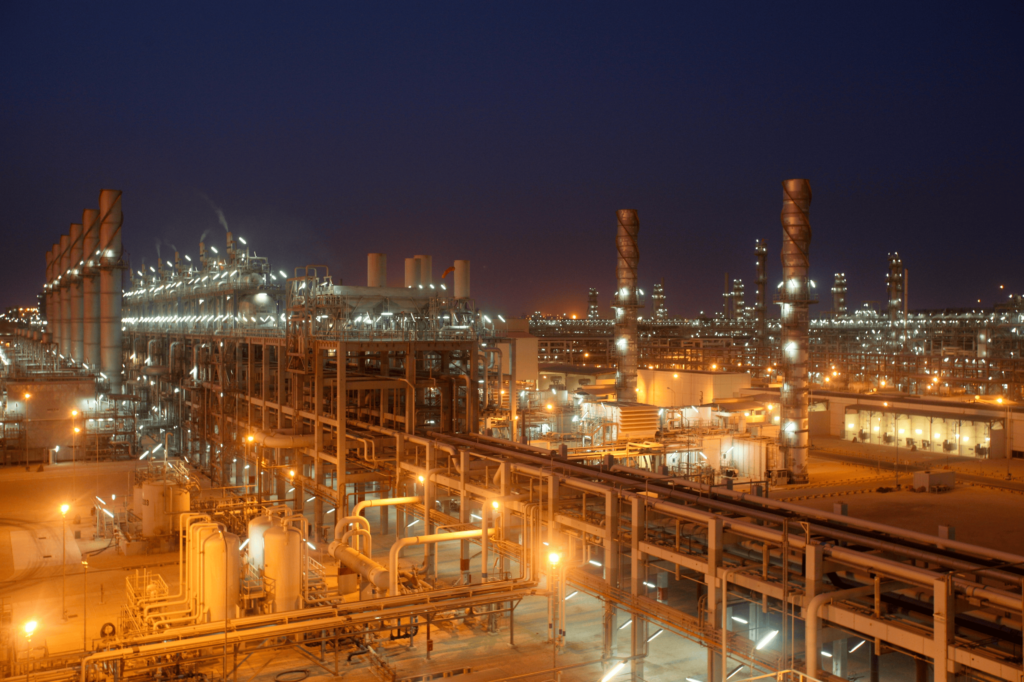
IMAGE: View Of Qatar’s Ras Laffan LNG Export Complex (Source QatarEnergy LNG)
While the Strait of Hormuz is not effectively closed to normal traffic, the tankers that used to carry Qatari helium out of the Gulf now sit idle or circle in safe waters, turning what might have been a partial production issue into a full-blown export freeze. Cryogenic helium cannot be rerouted through back roads or flown in on cargo jets at scale. It moves in a small fleet of specialised ships through a narrow, militarised strait that Iran can shut down faster than any insurance underwriter or naval strategist can react.
Iran saw this long before most investors did. For Tehran, watching its scientists assassinated, its infrastructure sabotaged, and its economic lifelines throttled by sanctions, NATO navies and Israeli cyber-operations, Ras Laffan and Hormuz were never neutral. They were levers, and when US and Israeli actions crossed Iranian red lines, the response was not random. It ultimately went straight to those levers.
Korea’s countdown and the AI memory choke
The cleanest way to see the stakes is to follow a single line from the gas fields outside Doha to the server racks in an AI data centre.
It starts at Ras Laffan, where QatarEnergy’s helium trains turn gas from the North Field into liquid helium sold on long-term contracts to firms like Air Liquide and Linde. Those companies in turn feed industrial users, including Samsung and SK hynix M16 and M15 manufacturing plants in South Korea, which pump out much of the world’s DRAM and high-bandwidth memory. Trade data and industry briefings show that South Korea imported roughly 64,7% of its helium from Qatar in 2025.
Seoul’s officials tell investors that, between Samsung, SK Hynix and local gas distributors, they hold about six months of strategic inventory. Analysts who actually run the numbers warn that at current burn rates, and with High Bandwidth Memory (HBM) production still running hot to feed Nvidia’s and AMD’s AI accelerators, the effective buffer is closer to three to four months before real cutbacks become unavoidable.

IMAGE: Advanced semiconductor fab in Asia (Source: Air Innovations)
Inside Samsung’s HBM3E memory system, engineers now talk about their helium tanks the way ICU doctors talk about oxygen. The dashboard no longer treats helium as a background utility. It shows a countdown tied to specific lines, with older Dynamic Random-Access Memory (DRAM) products quietly pushed to the back of the queue so that H100 and H200 board supply can keep breathing as long as possible. SK hynix, which dominates the High Bandwidth Memory (HBM) market alongside Samsung, is doing the same triage in its manufacturing plant in Icheon and Cheongju. No one says this on earnings calls, but inside the fabs, there is no mystery about which dies matter most to US cloud landlords and their military clients.

IMAGE: AMD next-generation graphics memory solution – HBM: high bandwidth memory (Source: AMD via PC Perspective)
Even before a single missile hit Ras Laffan, the AI hardware pipeline was already colliding with a hard wall at the packaging stage. NVIDIA’s H100 and H200 accelerators, and AMD’s MI300 series, rely on advanced 2.5D and 3D packaging such as CoWoS and glass substrates that TSMC IC Foundry and a handful of others simply cannot scale fast enough. Analysts estimate that roughly 70% of advanced memory capacity in 2026 is tied up in HBM for these AI parts, and that CoWoS slots were effectively sold out for much of the year. The helium shock does not create that bottleneck; it presses on it from below, threatening the memory supply that makes those already scarce packaging runs worthwhile.
Korea is not alone in this position. TSMC Fab 18 in Tainan, where three-nanometre logic dies are cut for Apple, Nvidia and other premium customers, has its own helium contracts and inventories, but it operates in the same distorted market. Micron fabs in the US and Japan, Intel’s new plants in Arizona and Ohio, TSMC Arizona, and Samsung Texas, all depend on helium that is suddenly more expensive, more politicised and more vulnerable. They were sold to US voters as insurance against geopolitical risk. In reality, they remain tethered to Gulf gas geology and to shipping lanes Donald Trump now threatens to “open” by force, as if he were talking about a casino door rather than a strait lined with missiles.
Timelines, markets and the slow tightening
The timeline of impact is uneven, but it is not mysterious. In the first zero to three months, pain shows up mainly in price and psychology. Industrial gas majors honour their existing long-term contracts as far as they can and squeeze smaller, spot-market buyers. Balloon and novelty suppliers vanish. Some welding and leak-testing operations switch early to argon or nitrogen mixes where process tolerances allow. Samsung, SK Hynix, TSMC, Intel and Micron run from inventories and reassure investors that production is “unaffected” for now, while privately updating their risk dashboards and pushing reclaim systems harder. Hospitals grumble about higher refill costs but keep their magnets cold. Launch providers like SpaceX and ULA shuffle non-urgent payloads down the manifest but do not cancel missions.
Financial markets are already reading the clock. After Qatar confirmed the extent of the Ras Laffan damage, shares of Samsung and SK Hynix slid, and tech indices in Seoul and Taipei dipped on analyst notes that labelled Korea and Taiwan “most exposed” to a helium crunch. Semiconductor supply-chain briefings talk openly about a “two-to-six-month clock” before memory output, and some logic lines feel the full effect if Gulf helium does not return. This is not doomsday rhetoric but how traders react when a third of a critical input disappears, and there is no believable plan to replace it quickly.
Between three and twelve months, constraints harden. Korean and Taiwanese fabs most dependent on Qatari helium start to face real allocation choices, especially if alternative volumes from the US and Algeria cannot fully backfill, and if Russian Amur helium remains politically restricted for Western clients. Memory lines that feed PC and mobile markets are cut back, while HBM and other high-margin AI-linked products continue to get first call on whatever helium can be secured. Some planned ramp-ups of new nodes are slowed or re-sequenced. MRI vendors accelerate the push to helium-light systems, but hospitals in India, Brazil, Eastern Europe and Africa postpone upgrades and stretch maintenance intervals, quietly rationing imaging for poorer patients when supply is uncertain.
In India, where almost every MRI magnet still depends on large liquid helium fills, hospital administrators have already started to feel the ground shift. One manager at a private chain in Delhi describes watching his storage levels tick down to less than three weeks of helium while quoted refill prices surge toward eighty dollars per cubic metre. He cannot conjure a helium-free scanner out of thin air. All he can do is stretch the interval between non-urgent scans, delay maintenance and hope the magnet does not quench. Public hospitals tied into the government system have even less room to manoeuvre. They will be last in line when US and European buyers throw money and political weight at the same limited pool of gas. Similar stories are emerging from Brazil’s overburdened SUS hospitals and from imaging centres in Eastern Europe and North Africa, where procurement officers now read Middle East war reports as closely as radiologists read scans, because a few lines in a QatarEnergy press release can mean the difference between an operating MRI and a dead, multimillion-dollar magnet.

IMAGE: Royal Philips next-generation 1.5T BlueSeal MRI with helium-free magnet (Source: Imaging Technology news, ITN)
Beyond the one-year mark, if Ras Laffan’s damaged trains are still offline and shipping patterns remain distorted, the crisis becomes structural rather than cyclical. What began as an emergency response congeals into a new hierarchy. Semiconductors, high-end medical imaging and aerospace become permanent privileged users of helium. Balloons and non-essential lifting disappear. High-precision welding and leak detection in marginal industries are forced into more dangerous substitutes or reduced activity. Tanzanian helium projects that were once curiosities are dragged to the centre of Western energy diplomacy. Russian Amur gas becomes a long-term lever in Moscow’s dealings with Asian buyers, even if Western sanctions keep it largely out of US and EU hands. Decisions made in the US and Israeli war rooms about bombing Iranian territory echo for years through every industrial system that depends on helium.
Who stands where when the gas runs short
The shock does not hit abstractions. It lands on specific plants, companies and countries. In Korea, it lands on Samsung’s Hwaseong and Pyeongtaek campuses and on SK Hynix’s Icheon and Cheongju fabs, all heavily reliant on imported helium and now at the centre of warnings about helium-related chip exposure. In Taiwan, it lands on TSMC’s advanced fabs in Tainan and Hsinchu that produce three and five-nanometre (3nm and 5nm manufacturing technology) logic for Apple, Nvidia and AMD. In the United States, it lands on Intel’s and Micron’s new flagship plants, on TSMC’s and Samsung’s American fabs, and on the smaller foundries that keep defence and automotive supply chains supplied with specialised chips.

IMAGE: SK Hynix, together with Samsung Electronics and Micron Technology, dominates the global supply of memory chips. (Source: AFP )
On the medical side, it affects public and private hospital networks in India, from Hospitals and radiology center, to regional chains that run conventional MRI fleets and are now facing higher costs and uncertain supply. It bears down on Brazilian hospitals tied into the SUS system that were already struggling with equipment budgets before helium prices spiked. It bears down on Eastern European imaging centres that bought refurbished scanners precisely because they could not afford the premium for helium-free magnets, now wondering whether they will be last in line once US and Western European hospitals pull rank. Philips, Siemens Healthineers, and GE HealthCare may boast about thousands of helium-light and helium-free scanners installed, but the majority of MRI capacity worldwide still depends on bulk liquid helium. The helium-rich future was never evenly distributed. In a crisis, it is the poor who discover that helium was quietly rationed away from their needs.
In aerospace, it squeezes SpaceX’s launch cadence out of Florida and California, Arianespace’s Ariane 6 programme in Kourou, ULA’s Vulcan missions, ISRO launches from Sriharikota and the smaller fleets of Rocket Lab and others. All of them run tank pressurisation and purging regimes designed in a world where helium was assumed to be there whenever needed. That world is gone.

IMAGE: SpaceX and Blue Origin – Second New Glenn rocket lifts off from Cape Canaveral, Florida, in November 2025 (Source: Blue Origin)
An honest account has to say where the ground is solid and where it is an informed extrapolation. On the firm side, we know roughly how much helium Ras Laffan could produce and that Qatar accounted for about one-third of global supply before the war. We know from QatarEnergy that two LNG trains and a GTL unit were damaged, that around 17% of LNG capacity is gone for 3 to 5 years, and that helium production has been halted under force majeure. We know from trade and government sources that Korea sourced around two-thirds of its helium from Qatar, that Korean and Taiwanese authorities list helium as a critical vulnerability, and that US production and Algerian volumes cannot simply replace Ras Laffan overnight. We know that AWS data centres in the UAE and Bahrain have been struck, that major MRI vendors have helium-light systems in the field and that most MRI capacity still relies on bulk liquid helium.
On the uncertain side, we do not have plant-by-plant helium figures for each Ras Laffan train, nor do we have hard numbers from Samsung, SK Hynix, TSMC or Intel about exactly how many wafers or how much HBM output they will cut under specific helium scenarios. Hospital and fab inventories are closely held, and long-term helium contract prices and clauses are opaque. The ten to twenty percent output reduction figures and multi-month inventory windows that analysts cite are scenarios, not guarantees. The mapping from helium shortfall to GPU availability is real but noisy, mediated by political pressure, stockpiles, substitution and corporate choices.
Naming those limits does not weaken the argument. It clarifies who is hiding behind confidentiality when the costs of their decisions are pushed onto workers, patients and consumers who never had a say in any of this.
Helium and the AI war economy
The link between helium and the AI-centred economy is not a side note, and unfortunately, must be seen as the central battlefield of this war. The AI evangelists prefer to talk about “compute is the new oil,” about seamless clouds and weightless apps. They do not talk about the fact that their stacks still rest on gas geology and shipping lanes that can be closed in a day. Helium is the most fragile of those hidden pillars. It is extracted at Ras Laffan and a handful of other gas hubs, liquefied in cryogenic plants that take years to build and minutes to damage, then pushed through Hormuz in specialised tankers before it ever touches a wafer, a GPU or a data-centre rack.
Iran has now shown that it understands this chain from end to end and is willing to treat it as a legitimate target in a war it did not start. At the bottom of the stack sits Ras Laffan, where helium is stripped out of the same gas streams that feed Qatar’s LNG exports. That helium used to be invisible to anyone who did not read trade bulletins and technical reports. It flowed to industrial gas giants who then piped it quietly into the veins of the global tech economy. Samsung and SK Hynix in South Korea, TSMC in Taiwan, Micron and Intel in the United States, Sony and Kioxia in Japan, all built their fabrication strategies around the assumption that volumes from Qatar, Russia, Algeria and a few North American fields would be there whenever needed. They did the usual corporate risk dance, hedging some contracts and adding some recovery equipment on site, but they never planned seriously for a scenario where a third of the world’s supply could disappear because Washington and Tel Aviv wanted to see how far they could push Iran without provoking a response.
The Ras Laffan strikes and the effective closure of Hormuz have blown up that assumption. The first shock travels through the helium market itself. Supplies contract. Prices spike. Spot cargoes vanish. Executives at Air Liquide, Linde, Messer and a long list of smaller distributors suddenly find they cannot fulfil all of their contracts. They do what capital always does under stress. They triage and tell balloon suppliers, entertainment clients and non-critical industrial users that they are out of luck. They raise prices sharply for everyone else and quietly reassure their biggest customers, the chip fabs, the MRI vendors, the rocket firms, that they will do what they can, but nothing is guaranteed.
The second shock hits the fabrication plants that sit at the heart of the AI economy’s mythology. All of the top companies we have mentioned above now look at their helium tanks as countdown timers, not background infrastructure. The lines that feed the AI war economy, the advanced logic for data-centre CPUs and cloud chips, custom silicon for US platforms that help enable Israel’s campaign and Washington’s sanctions, are now pushed to the front of the allocation queue.
On top of that material choke sits the cloud.
Less visibly, helium also runs through optical-fibre manufacturing, especially in fibre drawing and in high-purity process stages tied to preform production. That extends the shock beyond chips, MRIs and rockets into the communications backbone itself, because disruptions in helium supply do not just threaten compute but the physical fibre networks that carry data between data centres, telecom systems and 5G infrastructure. Helium’s role in fibre-optic production is less publicly discussed than its role in semiconductors, but it belongs to the same story—a supposedly weightless digital economy resting on fragile industrial gases and vulnerable supply chains.
Iran has already demonstrated that it can hit the front end of this architecture directly. Strikes on AWS data centres in the UAE and Bahrain were not isolated provocations, but only proof that the Middle Eastern arms of Amazon Web Services can be physically degraded by relatively cheap systems. The same goes for Microsoft Azure regions anchored in deals with G42, and for Google Cloud joint projects with Saudi sovereign funds. These campuses sit on published lists of potential targets for a reason. Their visibility is the point. They are meant to remind Washington that its “weightless” power is attached to concrete buildings full of servers sitting on contested ground.

IMAGE: Amazon Web Services Hyperscale data centre (Source: RDS)
This is where Trump’s latest ultimatum around Hormuz tightens the knot. When he threatens to force the Strait of Hormuz open, he is not just posturing about shipping lanes in the abstract. He is signalling that Washington is willing to escalate a confrontation in exactly the theatre where Iran now has the most leverage over the material base of the AI and information-technology markets. If US forces attempt to break the blockade by force, Tehran has every incentive to respond not only at sea but across the whole helium-IT stack.
That could mean more strikes on Ras Laffan and other gas hubs that co-produce helium. It could mean attacks on cryogenic plants and export terminals that were not hit in the first wave. It could mean targeting Qatari helium supplies as they move through the Gulf export system. It could mean additional strikes on visible cloud and data-centre infrastructure in the UAE and Bahrain that serve US and Israeli interests in the region. None of these moves requires Iran to match US firepower. They only require it to keep showing that the most celebrated sectors of the US-led economic model, AI, cloud, medical imaging, aerospace and fibre-optic manufacturing, now depend on fragile inputs that can be disrupted much faster than they can be replaced.
Seen from this angle, the helium market and the information-technology market are no longer separate domains. They have been fused into a single battlespace by choices made far from Qatar. One of these choices was to treat Iran as a problem to be bombed into submission, the choice to stack ever more of the world’s AI capacity on top of a few gas fields and a few shipping lanes, the choice to let a handful of tech and energy giants design a “future economy” that only works if no one ever fights back.
The empire’s hidden line of retreat
The lesson is not that helium is a quirky vulnerability that can be patched with a few new contracts. It is that the entire AI project, as imagined in Washington, Silicon Valley and the Gulf, rests on a fantasy of permanent impunity. Iran’s strikes at Ras Laffan Industrial City, its threats over Hormuz and the damage to Gulf AWS facilities are the first serious attempt to puncture that fantasy. They show that a state under existential threat can reach past sanctions and air strikes to the quiet, physical systems that keep the empire’s machines running.
President Donald Trump’s sudden, five-day pause on strikes against Iranian power plants and energy infrastructure is not a gesture of restraint so much as a hedge against blowback. Washington understands that further hits on the Gulf’s information-technology and energy nodes would not only invite Iranian retaliation against cloud campuses and shipping, but also risk turning billions of dollars of Gulf sovereign investment in AI data centres into literal smoke. For the same investors who sold “Gulf AI hubs” as geopolitical insulation, the prospect of Iranian drones visiting those sites is an existential threat to the narrative as much as to the hardware.
As long as Washington and Tel Aviv keep pushing for dominance by force, whether through kinetic strikes, sanctions or ultimatums over the Strait of Hormuz, that line will only get shorter. The collision between the helium market and the AI economy is not an aberration. It is just a preview.
READ MORE IRAN NEWS AT: 21st Century Wire IRAN Files
SUPPORT OUR INDEPENDENT MEDIA PLATFORM – BECOME A MEMBER @21WIRE.TV
VISIT OUR TELEGRAM CHANNEL
21st Century Wire is an alternative news agency designed to enlighten, inform and educate readers about world events which are not always covered in the mainstream media.
Source: https://21stcenturywire.com/2026/03/23/the-helium-war-how-irans-strikes-on-qatar-threaten-the-semiconductor-and-ai-economy/
Anyone can join.
Anyone can contribute.
Anyone can become informed about their world.
"United We Stand" Click Here To Create Your Personal Citizen Journalist Account Today, Be Sure To Invite Your Friends.
Before It’s News® is a community of individuals who report on what’s going on around them, from all around the world. Anyone can join. Anyone can contribute. Anyone can become informed about their world. "United We Stand" Click Here To Create Your Personal Citizen Journalist Account Today, Be Sure To Invite Your Friends.
LION'S MANE PRODUCT
Try Our Lion’s Mane WHOLE MIND Nootropic Blend 60 Capsules
Mushrooms are having a moment. One fabulous fungus in particular, lion’s mane, may help improve memory, depression and anxiety symptoms. They are also an excellent source of nutrients that show promise as a therapy for dementia, and other neurodegenerative diseases. If you’re living with anxiety or depression, you may be curious about all the therapy options out there — including the natural ones.Our Lion’s Mane WHOLE MIND Nootropic Blend has been formulated to utilize the potency of Lion’s mane but also include the benefits of four other Highly Beneficial Mushrooms. Synergistically, they work together to Build your health through improving cognitive function and immunity regardless of your age. Our Nootropic not only improves your Cognitive Function and Activates your Immune System, but it benefits growth of Essential Gut Flora, further enhancing your Vitality.

Our Formula includes: Lion’s Mane Mushrooms which Increase Brain Power through nerve growth, lessen anxiety, reduce depression, and improve concentration. Its an excellent adaptogen, promotes sleep and improves immunity. Shiitake Mushrooms which Fight cancer cells and infectious disease, boost the immune system, promotes brain function, and serves as a source of B vitamins. Maitake Mushrooms which regulate blood sugar levels of diabetics, reduce hypertension and boosts the immune system. Reishi Mushrooms which Fight inflammation, liver disease, fatigue, tumor growth and cancer. They Improve skin disorders and soothes digestive problems, stomach ulcers and leaky gut syndrome. Chaga Mushrooms which have anti-aging effects, boost immune function, improve stamina and athletic performance, even act as a natural aphrodisiac, fighting diabetes and improving liver function. Try Our Lion’s Mane WHOLE MIND Nootropic Blend 60 Capsules Today. Be 100% Satisfied or Receive a Full Money Back Guarantee. Order Yours Today by Following This Link.



| Visits: | 1,789,888,990 |
| Stories: | 8,608,302 |
Whistler Blowers, Insiders


Without helium how will they ever keep their “Satellites” in orbit. NASA is the largest user of the stuff and has been so for decades. Ever ask yourself why? Read the head stone of Vernon Von Braun for the answer.