

The Jerusalem Calling: Trilateral Elites, Banking Dynasties, and the New Order

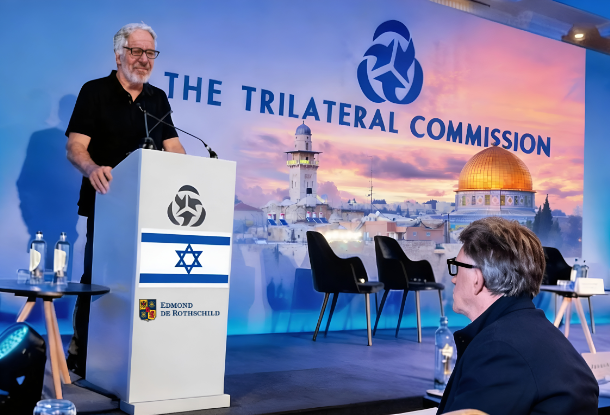
Freddie Ponton
21st Century Wire
The Department of Justice released 3.5 million pages of documents on the final day of January 2026, and within that avalanche of photocopies and PDFs lay confirmation that investigators had long suspected but could never fully substantiate until now. The records explicitly cite Epstein’s documented ties to the Trilateral Commission, the same US-based invitation-only organisation that currently counts UK Prime Minister Keir Starmer among its active membership. Meanwhile, his former ambassador to the US, Peter Mandelson, a long-standing and prominent member of the Trilateral Commission, was arrested on February 23, 2026, on suspicion of misconduct in public office for allegedly disclosing sensitive government information to the convicted sex offender.
This is not merely a footnote in the saga of a dead predator, nor is it a peripheral detail about elite social networking. It is the key that unlocks the architecture of how power actually operates in the transatlantic system, how policies are crafted far from any ballot box, and how a particular vision of global governance, one articulated publicly by Macron’s mentor (handler) Jacques Attali when he envisioned Jerusalem as the capital of a future unified world government, is being constructed through financial networks that remain deliberately invisible to the populations whose lives they control.
The timeline is analytically crucial and cannot be emphasised strongly enough for those who would dismiss these connections as coincidence or conspiracy. Jeffrey Epstein gained admission to the Trilateral Commission in 1998 through a personal invitation extended by David Rockefeller himself, the organisation’s founder and the architect of its governing philosophy. This recruitment occurred seven full years before the Palm Beach Police Department opened its investigation into Epstein’s sexual exploitation of minors, which means his institutional credibility was granted on entirely different grounds than wealth or philanthropic reputation. It is not clear whether or not the Commission knew anything about his criminality because that criminality had not yet been exposed to law enforcement, but they certainly recognised in the Brooklyn-born college dropout something far more valuable than charitable donations. They saw utility in the form of financial expertise that career politicians lack, access to capital flows that institutions require, and the ability to operate in the shadows between formal governmental structures where deniable influence can be exercised without electoral accountability or journalistic scrutiny.
To understand how this network functions and why it matters for the present political moment, one must look beyond the surface membership lists that the Trilateral Commission publishes for public consumption and examine instead the executive committees and leadership structures where actual decisions are made. The July 2011 Executive Committee document reveals a concentration of Rothschild interests that is impossible to dismiss as incidental or merely reflective of the family’s historical prominence in European finance. General The Lord Guthrie appears as a former director of N M Rothschild and Sons, while Nigel Higgins served as Chief Executive of the Rothschild Group and Alfonso Cortina operated as Vice Chairman of Rothschild Europe.
This is not simply a matter of banker representation in an economic forum. The Rothschild banking dynasty founded the modern state of Israel through the 1917 Balfour Declaration addressed to Lord Walter Rothschild, and provided the crucial financing that transformed Zionist aspirations into geopolitical reality. When Rothschild executives occupy leadership positions in the European Group of the Trilateral Commission while simultaneously financing an array of child protection and humanitarian NGOs, including foundations dedicated to helping Ukrainian children (Save the Children) and various safeguarding initiatives, they are not advancing abstract charitable interests. They are operating within a historical continuity where diaspora banking networks function as extensions of state power, where capital flows serve strategic objectives, and where the minimal formal Israeli membership in the organisation masks a far deeper penetration of influence through financial rather than diplomatic channels.
This architecture of influence extends far beyond London and into the continental capitals where European sovereignty is being systematically dismantled. In France, President Emmanuel Macron ascended to power directly from Rothschild and Cie Banque, where he orchestrated the Nestlé-Pfizer merger and advised the French government on economic policy while being groomed for political leadership by the same Attali Commission that envisioned Jerusalem as a world capital. His presidency has overseen the acceleration of French economic integration into EU structures that remove decision-making from national parliaments, while his former banking colleagues continue to profit from the privatisation of public assets. In Germany, Chancellor Friedrich Merz assumed office in May 2025 after serving as Chairman of BlackRock Deutschland from 2016 to 2020, placing the world’s largest asset manager at the centre of the EU’s largest economy. Merz’s tenure at BlackRock saw the systematic accumulation of stakes in German DAX companies, creating silent power through proxy voting rights that now shape industrial policy without democratic visibility.
These are not isolated career trajectories. They represent the convergence of banking intelligence networks with state power, where former investment bankers and asset managers transition seamlessly into political leadership while maintaining loyalties to the financial architectures that built their careers.
The question of why Peter Mandelson maintained his relationship with Epstein after the 2008 conviction, going so far as to write messages assuring the convicted sex offender that his friends loved him and urging him to show the world how big a person he was, cannot be answered only through psychological speculation about personal loyalty or moral failure. The context also lies in Mandelson’s professional position during those exact years when he was offering support to a man who had pleaded guilty to procuring a child for prostitution. During this period, Mandelson served as Chairman of Global Counsel and Senior Advisor at Lazard, the historic banking house whose Lazard Frères arm provided crucial funding for early Israeli infrastructure and which maintains deep connections to the same Zionist networks that the Rothschild family has cultivated for over a century.
This is not a coincidence. It is the interlocking financial-directorship architecture that allows influence to flow through banking relationships, advisory positions, and cross-memberships in elite organisations without ever appearing on the official registers of lobbying or diplomatic representation. When Mandelson wrote those supportive messages to Epstein, he was not merely expressing personal solidarity with a disgraced friend. He was participating in a system of elite mutual protection that prioritises network maintenance over institutional accountability, that shields useful operatives from consequences, and that ultimately advances Israel’s strategic interests through deniable channels.
This system of protection extends into the judicial apparatus itself, weaponising the rule of law to serve power rather than constrain it. The 2008 non-prosecution agreement negotiated by Alexander Acosta, who would later become Trump’s Labour Secretary, violated the Crime Victims’ Rights Act by concealing the deal from Epstein’s victims while granting immunity to potential co-conspirators. Federal Judge Kenneth Marra ruled in 2019 that prosecutors had broken the law, yet the appeals system reversed this finding in 2020, ruling that victims lacked standing to enforce their rights before indictment. This judicial sleight-of-hand ensured that the architecture of protection remained intact, that the networks facilitating Epstein’s crimes would never face exposure in open court, and that the powerful individuals who utilised his services could continue operating without fear of accountability.
The same week that Mandelson was arrested, the Metropolitan Police confirmed that investigations continue into allegations that he disclosed sensitive government information to Epstein, yet the broader pattern remains unchanged: individual operatives may be sacrificed when their toxicity becomes unmanageable, but the networks that recruited them, protected them, and profited from their utility remain firmly in place. These are the people that needs to be brought to justice. The fact that Ariane de Rothschild has still not been questioned despite her numerous and proven links with the pedophile Jeffrey Epstein speaks volumes. Her name appears 4,504 times in the DOJ Epstein library, but the mainstream media won’t touch it. They won’t because many of the pro-Israel billionaire class have been purchasing stakes in mainstream Media across the Western world. Larry Ellison → Paramount Global/CBS (2025) -Len Blavatnik → Warner Bros. Discovery, Reshet 13 -Sheldon Adelson → Israel Hayom – Rothschild → The Economist (2002-2025) – Patrick Drahi → Next Radio Group and Israeli TV channel i24news – Dassault Family – Le Figaro, and this is only the tip of the iceberg.
The Trilateral Commission presents itself to the public as a forum for international cooperation committed to democratic principles and European unification, yet its founding document reveals a starkly different operating philosophy. The 1975 report titled The Crisis of Democracy, authored by Samuel Huntington and his colleagues, explicitly diagnosed the problems of Western societies as stemming from an excess of democracy and recommended more moderation in democratic participation as the necessary cure. This was not abstract academic theory, but an operational manual for governance that removes decision-making from popular accountability and transfers it to technocratic elites who can manage capital flows and policy coordination without the inconvenience of electoral consent.
When the same organisation that published this anti-democratic philosophy admits figures like Jeffrey Epstein to its membership, maintains ties with them after criminal conviction, and currently includes the Prime Minister of the United Kingdom among its roster while Rothschild executives occupy its leadership positions, we are witnessing not a conspiracy in the conventional sense but the visible operation of privatised statecraft. Israeli interests are advanced not through the single global member that represents the state formally but through the banking networks that founded the state historically and continue to operate within the Commission’s leadership structures, creating a form of influence that bypasses diplomatic protocols and democratic oversight alike.
The Epstein files provide a rare and fleeting window into how these networks actually function when the usual mechanisms of elite solidarity and document classification fail to prevent exposure. They reveal a system where convicted sex offenders can maintain relationships with sitting cabinet ministers, where former prime ministers can conduct backchannel diplomacy through private fixers, and where the policies that shape the lives of millions can be crafted in rooms where no elected representative holds a seat and no voter has granted consent.
The question that emerges from the investigation conducted by Paul Knaggs, which we are featuring today, is whether democracy can survive rule by those who consider it excessive, and the answer depends entirely upon whether citizens are willing to look past the official narratives of international cooperation to see the architecture of undemocratic power that operates beneath the surface. The Trilateral Commission is not merely a discussion club for the wealthy and well-connected. It is infrastructure for deniable governance, a venue where the interests of capital and the interests of particular nation-states like Israel can advance through financial networks and government back channels that remain largely invisible to the public whose lives they shape.
Jeffrey Epstein was an operative within this architecture, recruited for his utility, protected for his valued allegiance to Israel, but also to other intelligence agencies, and ultimately expendable when his criminality became too publicly toxic to manage.
The network that welcomed him, shielded him, and continues to operate without him remains in place, shaping policy at the highest levels of Western governments while the citizens of those democracies remain deliberately uninformed about who actually holds power and to what ends it is being exercised.

Blueprint for Governance: The Trilateral Commission, Epstein, and the Shaping of Modern Britain
Paul Knaggs reports for Labour Heartlands…
INVESTIGATION: From Rockefeller to Starmer: Mapping the Trilateral Network in the Epstein Files
The Vision
In 1949, George Orwell imagined a world divided into three perpetually warring superstates: Oceania, Eurasia, and Eastasia. Each bloc controlled its population through surveillance, managed information, and the systematic erosion of independent thought. The Party’s slogan was clear: “War is Peace. Freedom is Slavery. Ignorance is Strength.”
In 1973, David Rockefeller founded an organisation that divided the world into three regions: North America, Europe, and Asia-Pacific. Its membership would be drawn from those who control finance, media, academia, and (notably) “a few trade union chiefs.” Its operating philosophy, published two years later, argued that Western societies suffered from “an excess of democracy” and that the solution required “some measure of apathy and non-involvement on the part of some individuals and groups.”
The Trilateral Commission does not call itself an oligarchy. It describes itself as a forum for cooperation, “committed to the pursuit of the European unification process” and “democratic principles.” But its structure tells a different story. Membership is strictly invitation-only. Representatives are allocated by “economic weight and political influence.” Meetings operate under the Chatham House Rule, permitting participants to use information but prohibiting attribution, “thereby enabling candid exchanges among elites without fear of public misquotation or reprisal.”
The vision is elegant in its simplicity: a world organised into three trading blocs, coordinated by those who own capital rather than those who work for wages, governed through institutions sufficiently removed from popular accountability that policy can be made without the inconvenience of consent. Workers are not represented in this system; they are managed. Trade unions are not partners; selected leaders are recruited to ensure compliance. Elections continue, but the range of acceptable outcomes narrows until voting becomes a ritual that changes nothing fundamental.
The European Union, in this framework, is not a deviation from the plan. It is the plan’s most successful implementation: a supranational structure where economic policy is set by unelected commissioners and central bankers, where treaty obligations override parliamentary sovereignty, and where the bureaucratic complexity of governance ensures that only those with resources and access can effectively participate.
This vision operates in shadow, not because its architects are ashamed of it, but because it cannot survive public scrutiny. The Commission’s own founding document admits as much. When Samuel Huntington diagnosed “an excess of democracy,” he was acknowledging that popular participation tends to produce demands incompatible with elite preferences: higher wages, stronger protections, constraints on capital mobility, and accountability for those who wield power. The solution was not to win the argument but to remove the argument from the democratic contest.
Jeffrey Epstein was a member of this organisation. So is Keir Starmer. So is Peter Mandelson.
To understand why this matters, we must first understand what the Trilateral Commission is, what it wants, and how it recruits those who serve its purposes.
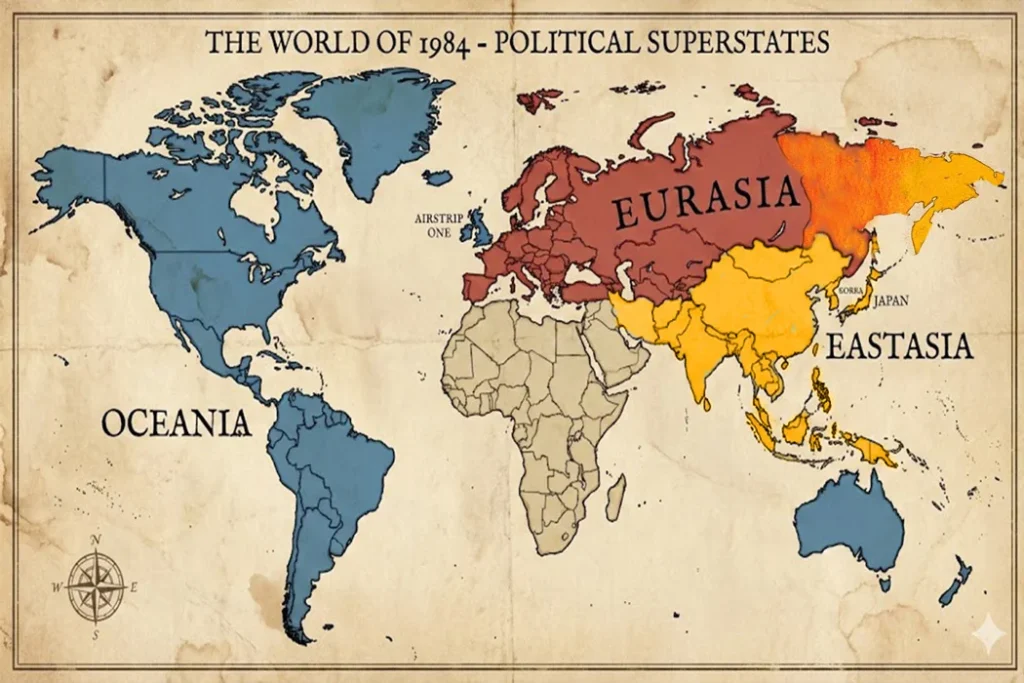
IMAGE: Oceania-Eurasia-and-Eastasia
An investigation into how a convicted child sex trafficker became embedded in the same elite policy networks that now shape British political leadership
On 30 January 2026, the United States Department of Justice released 3.5 million pages of documents relating to Jeffrey Epstein, the convicted sex offender who died in custody in 2019. Buried within this avalanche of material was a quiet confirmation of what investigators had long suspected: multiple pages explicitly reference “Epstein’s ties to the Trilateral Commission.”
For those unfamiliar with this organisation, what follows is essential context. For those who recognise the name, the implications are immediately apparent.
The Document That Explains Everything
I. The Document That Explains Everything
Before examining the network, we must understand its operating philosophy. The Trilateral Commission’s 1975 report remains the clearest statement of elite hostility to popular democracy ever committed to paper by mainstream political figures.
Huntington looked back with nostalgia to a time when “Truman had been able to govern the country with the cooperation of a relatively small number of Wall Street lawyers and bankers.” The problem, as he saw it, was that during the 1960s “special interests” began “trying to get into the act,” causing “too much pressure” on government. His solution was “more moderation in democracy,” which is to say, less democracy.
Noam Chomsky has described this report as “one of the most interesting books showing the modern democratic system is not democracy at all, but controlled by elites.” In Chomsky’s analysis, the Commission’s report divides intellectuals into two categories: “technocratic and policy-oriented” intellectuals who serve power obediently, and “value-oriented” intellectuals who are dangerous because they “unmask institutions” and challenge established authority. Of course, Chomsky has also been implicated in the Epstein files, both as a visitor to Epstein’s island and a correspondent.
VIDEO: Sir Keir Starmer Trilateral Commission (Source: Labour Heartlands | Youtube)
.
The report’s authors were not marginal figures. Michel Crozier was a leading French sociologist with regular access to the government. Joji Watanuki advised Japanese policymakers. Huntington went on to advise multiple American administrations and wrote the influential (and controversial) “Clash of Civilisations” thesis.
When the Jimmy Carter administration took office in 1977, it was staffed with Trilateral Commission members to a degree that should have raised constitutional questions. Vice President Walter Mondale, Secretary of State Cyrus Vance, National Security Advisor Zbigniew Brzezinski, Défense Secretary Harold Brown, Federal Reserve Chairman Paul Volcker, and economic advisor Alan Greenspan were all Commission members.
The report’s recommendations were not academic theory. They were an operational manual.
The Credentials of a Predator
How did Jeffrey Epstein, a college dropout from Brooklyn with no formal financial qualifications, become a member of one of the world’s most exclusive policy forums?
The conventional explanation is that he donated his way in. This is too convenient, and it does not survive scrutiny.
The Trilateral Commission is strictly invitation-only. According to its own documentation, membership is determined by “economic weight and political influence.” The US group receives only five to ten openings per year, selected from “a list of candidates many times larger than the number of openings.” Members include former prime ministers, central bank chiefs, Fortune 500 executives, and senior diplomats. Britannica describes them as “influential politicians; banking and business executives; media, civic, and intellectual leaders.”
Jeffrey Epstein was none of these things. He was a college dropout whose only documented billionaire client was Leslie Wexner. He had no verifiable business model justifying his wealth. The suggestion that he simply wrote a cheque and received membership insults the intelligence of anyone familiar with how elite institutions actually function.
Fortunately, we do not need to speculate. Epstein explained it himself.
VIDEO: Jeffrey Epstein: The Credentials of a Predator (Source: Labour Heartlands | Youtube)
.
In an interview with Steve Bannon, Epstein described precisely how he gained entry to the network. The account is worth quoting at length because it reveals not merely how one man was admitted, but how the entire recruitment system operates.
Epstein recounted being invited onto the board of Rockefeller University in the late 1980s: “There was a money manager who said Rockefeller needs someone with financial expertise because the university is growing… I met with Nancy Kissinger and a bunch of other people, and David Rockefeller and I got along very well.”
Bannon pressed him: “How did a schmuck like you get on the board of Rockefeller? What year was that?… That’s one of the most prestigious research places in the world. How did a guy like you get on the board, a blueblood, internationally known… Nobel Prize winners all over the place? How do they pick a guy like you, a trader from, or basically some guy from Bear Stearns?”
Epstein’s answer was revealing. He explained that “up until the mid 80s or sort of early mid 70s, the most important thing was your name. If you were a Rockefeller, you were already considered to be brilliant. If you were a head of General Motors, it was your reputation. It was who you knew, who your family was.” But then came calculators, and then computers, and suddenly “the most important parts of business were really now going to calculations.”
Institutions like Rockefeller “needed someone to say, look, we are entering a different world with numbers.”
In other words: Epstein was recruited because he was useful.
The Trilateral Invitation
What happened next is even more significant. In Epstein’s telling, David Rockefeller began to explain “world politics” to him. And then came the invitation.
“He formed something called the Trilateral Commission,” Epstein told Bannon. “The Trilateral Commission is some spooky stuff. People said it was something the people that the Illuminati and there’s some mystery about it, people that ran the world…”
Epstein then recounted Rockefeller’s explanation of the Commission’s purpose: “David said most countries, the politicians get elected for four years or eight years, separate from the royal families in England or in the Middle East. Someone’s there for four years and then they’re not there anymore. The most important people to have stability and consistency would be businessmen. So he formed this trilateral commission of businessmen and politicians from three major continents.”
Here, in Epstein’s own words, is the Commission’s operating philosophy: elected politicians are temporary; businessmen provide continuity; therefore, businessmen should coordinate policy across national boundaries.
Rockefeller then asked the young Epstein: “Would you like to be on the Trilateral Commission?”
Epstein was, by his own account, thirty to thirty-two years old. “I looked at the list of people and that was Bill Clinton, former president of the United States. Paul Volcker, every great leader in America, the Asians, the Japanese, and with a very long description of the history.”
When asked to provide a biography for the Commission’s records, Epstein wrote: “Jeffrey Epstein, comma, just a good kid.”
“Which I thought was funny,” he told Bannon. “Nobody else did.”
The Recruitment Operation

IMAGE: Trilateral Commission
This account demolishes the “donation” narrative. Epstein did not buy his way in. He was personally recruited by David Rockefeller because he possessed skills the network required.
But Epstein was not unique. The Trilateral Commission’s membership, according to its own documentation, is drawn from “business, media, academia, public service, labor unions, and other nongovernmental organisations.” This is not a random collection of wealthy individuals. It is a systematic recruitment operation spanning every sector that shapes public opinion and policy.
The Commission’s European Group is explicit about its purpose. According to the Trilateral Commission’s own website, European members “are also committed to the pursuit of the European unification process which remains the driving force under a strong European Group leadership faithful to Europe’s Founding Fathers such as Max Kohnstamm (1973-1976) and Georges Berthoin (1976-1992) who were both close collaborators of Jean Monnet.”
Jean Monnet, the architect of European integration, is described in academic literature hosted by the European Commission’s own library as having established the European project “with a particular character (marked by technocracy and elitism).”
The Trilateral Commission’s website celebrates this legacy: “The progress of the European Community over the past decades, to fold into a broader and deeper European Union since, has validated the vision of the Commission’s founders.”
This is not a conspiracy theory. This is the Commission describing itself. The European Union, in this telling, represents the successful implementation of Trilateral principles: supranational coordination of policy by unelected elites, insulated from the inconvenience of democratic accountability.
What Epstein Provided
Epstein explained to Bannon why his particular skills were valuable: “Most political leaders don’t come out of a background of finance. Most political leaders come out of a background of being popular… Their expertise, if they have any financial knowledge, is of their own checking account or bank account and filling in their own taxes. So many world leaders who don’t really have a financial underpinning make fundamental errors when it comes to money on a country or institutional level.”
Epstein positioned himself as the man who could translate between the world of finance and the world of politics. But the documentary evidence suggests his services extended considerably further.
Trump’s Commerce Secretary Howard Lutnick, who lived next door to Epstein on Manhattan’s Upper East Side, offered a blunter assessment in October 2025. Lutnick described Epstein as “the greatest blackmailer ever.” He alleged that Epstein’s “massage room” was almost certainly on video, that “there were people on those videos,” and that this explained both Epstein’s inexplicable wealth and his lenient 2008 plea deal.
This was not speculation from a conspiracy theorist. This was a sitting Cabinet secretary describing his former neighbour.
VIDEO: Howard Lutnick: Epstein was the ‘greatest blackmailer ever’ (Source: ABC 7 Chicago | Youtube)
.
The documentary evidence supports this characterisation. According to the Department of Justice, Epstein kept compact discs locked in his safe with handwritten labels including descriptions like “young [name] + [name].” Victims and staff confirmed that hidden cameras operated throughout his properties. Maria Farmer, an early victim, testified that Epstein’s New York mansion was “staffed with young female masseuses” in a room with “massage table, lubricants and, no doubt, cameras.” Virginia Giuffre described the operation as “a kompromat factory.”
Epstein told a New York Times reporter in 2018, off the record, that he “had dirt on powerful people, including information about their sexual proclivities and recreational drug use.”
The Prince Andrew Pattern

IMAGE: Images of Andrew Mountbatten Windsor Epstein files release
The case of Prince Andrew illustrates how this service functioned in practice.
Andrew served as Britain’s Special Representative for International Trade and Investment from 2001 to 2011, undertaking 757 public engagements in 2009 alone, 550 in his trade envoy capacity. His role was explicitly described by Buckingham Palace: “Middle East potentates like meeting princes. He comes in as the son of the Queen and that opens doors. He can raise problems with a crown prince and four or five weeks later, we discover that the difficulties have been overcome and the contract can be signed.”
Finish reading this investigation at Labour Heartlands…
READ MORE EPSTEIN NEWS AT: 21st Century Wire Epstein Files
SUPPORT OUR INDEPENDENT MEDIA PLATFORM – BECOME A MEMBER @21WIRE.TV
VISIT OUR TELEGRAM CHANNEL
21st Century Wire is an alternative news agency designed to enlighten, inform and educate readers about world events which are not always covered in the mainstream media.
Source: https://21stcenturywire.com/2026/02/24/the-jerusalem-calling-trilateral-elites-banking-dynasties-and-the-new-order/
Anyone can join.
Anyone can contribute.
Anyone can become informed about their world.
"United We Stand" Click Here To Create Your Personal Citizen Journalist Account Today, Be Sure To Invite Your Friends.
Before It’s News® is a community of individuals who report on what’s going on around them, from all around the world. Anyone can join. Anyone can contribute. Anyone can become informed about their world. "United We Stand" Click Here To Create Your Personal Citizen Journalist Account Today, Be Sure To Invite Your Friends.
LION'S MANE PRODUCT
Try Our Lion’s Mane WHOLE MIND Nootropic Blend 60 Capsules
Mushrooms are having a moment. One fabulous fungus in particular, lion’s mane, may help improve memory, depression and anxiety symptoms. They are also an excellent source of nutrients that show promise as a therapy for dementia, and other neurodegenerative diseases. If you’re living with anxiety or depression, you may be curious about all the therapy options out there — including the natural ones.Our Lion’s Mane WHOLE MIND Nootropic Blend has been formulated to utilize the potency of Lion’s mane but also include the benefits of four other Highly Beneficial Mushrooms. Synergistically, they work together to Build your health through improving cognitive function and immunity regardless of your age. Our Nootropic not only improves your Cognitive Function and Activates your Immune System, but it benefits growth of Essential Gut Flora, further enhancing your Vitality.

Our Formula includes: Lion’s Mane Mushrooms which Increase Brain Power through nerve growth, lessen anxiety, reduce depression, and improve concentration. Its an excellent adaptogen, promotes sleep and improves immunity. Shiitake Mushrooms which Fight cancer cells and infectious disease, boost the immune system, promotes brain function, and serves as a source of B vitamins. Maitake Mushrooms which regulate blood sugar levels of diabetics, reduce hypertension and boosts the immune system. Reishi Mushrooms which Fight inflammation, liver disease, fatigue, tumor growth and cancer. They Improve skin disorders and soothes digestive problems, stomach ulcers and leaky gut syndrome. Chaga Mushrooms which have anti-aging effects, boost immune function, improve stamina and athletic performance, even act as a natural aphrodisiac, fighting diabetes and improving liver function. Try Our Lion’s Mane WHOLE MIND Nootropic Blend 60 Capsules Today. Be 100% Satisfied or Receive a Full Money Back Guarantee. Order Yours Today by Following This Link.


| Visits: | 1,781,189,307 |
| Stories: | 8,591,601 |
Whistler Blowers, Insiders

