

How Deep Does Epstein’s French Connection Go?

Freddie Ponton
21st Century Wire
In the gilded corridors of Parisian power, where luxury handbags command the price of modest apartments and financial dynasties trace their lineage back centuries, a shadow has emerged that threatens to stain the immaculate marble of France’s most revered institutions. The recent release of thousands of pages of documents by the United States Department of Justice has torn through the carefully constructed narratives of Europe’s business aristocracy, exposing connections that were never meant to see the light of day—connections that stretch from the sun-drenched Pantin workshops of Hermès on the outskirtt of Paris, to the private banking suites of Geneva, weaving together a tapestry of complicity that implicates some of the continent’s most untouchable figures.
What we are witnessing is not merely another chapter in the sordid saga of Jeffrey Epstein, the convicted sex offender and accused child trafficker whose 2019 death in a federal prison cell spawned a thousand conspiracy theories and a thousand more uncomfortable silences among the elite. This is something far more insidious: a glimpse into the machinery of access that allowed a registered predator to move through the upper echelons of European society with impunity long after his crimes had been publicly adjudicated, long after the world should have recoiled in horror rather than extending yet another gilded invitation.
The photographs are deceptively mundane—three men smiling in a luxury workshop, the kind of corporate hospitality that unfolds daily in the world of high fashion. Yet when one of those men is Axel Dumas, CEO of the Hermès dynasty and guardian of one of France’s most storied corporate names, and another is Jeffrey Epstein, freshly emerged from an eighteen-month prison sentence for soliciting prostitution from a minor, the image takes on a more sinister hue. That this encounter occurred in 2013, five years after Epstein’s conviction and registration as a sex offender, and was later followed by dinner plans brokered through Ariane de Rothschild—head of the Edmond de Rothschild banking empire and confidante to presidents—suggests not ignorance of Epstein’s nature but a calculated indifference to it.
READ MORE: Buried in DOJ Files: Epstein Was a Fixer for Rothschild Banking Dynasty
The French establishment would have you believe these were chance encounters, the unfortunate byproducts of social circles that are perhaps too insular for their own good. Anne Méaux, the formidable communications strategist who has built an empire managing the reputations of France’s corporate elite, initially insisted that Dumas had firmly declined Epstein’s overtures, a narrative that crumbled instantly when confronted with photographic evidence. The subsequent pivot—that the visit was really for Woody Allen, and Dumas barely knew his notorious companion—rings hollow when one examines the email trails that document Epstein’s persistent efforts to cultivate the Hermès chief, efforts that included arranging private viewings, proposing intimate dinners, and positioning himself as an advisor worth consulting.
But the Hermès connection, troubling as it is, merely scratches the surface of a relationship network that reveals how Epstein operated not as a pariah to be shunned but as a gatekeeper to be courted. In the vaults of the Edmond de Rothschild Group, where discretion is the most valuable currency, Epstein’s presence was not merely tolerated but celebrated. Ariane de Rothschild, whose name appears in the released documents with a frequency rivaling that of Donald Trump himself, did not merely exchange pleasantries with the convicted criminal; she confided in him, sought his counsel on matters of succession and family crisis, and ultimately paid him twenty-five million dollars for services rendered in navigating a treacherous settlement with American authorities who were investigating the bank’s role in shielding assets.
To understand the magnitude of these revelations is to understand how power actually functions in Europe’s financial capitals, where the formal structures of governance and corporate responsibility often dissolve into something more ancient and less accountable. The emails between Epstein and de Rothschild do not read like business correspondence between professionals; they read like the intimate exchanges of co-conspirators, complete with lifestyle advice, university application assistance for daughters, and shared vacation plans. When de Rothschild confessed her fears of inadequacy upon taking the reins of the banking empire, it was Epstein who reassured her that nothing she could say would shock him—a statement that, in retrospect, carries chilling weight given what we now know about the secrets he kept and the leverage he accumulated.
The tentacles of this network extend into the highest reaches of French political power, touching figures who have shaped the nation’s destiny across multiple administrations. Jack Lang, the former Minister of Culture whose long career has made him a fixture of the Socialist Party establishment, emerges from these documents not as an unwitting acquaintance but as a node in a relationship web that stretches back to the 1980s, to the days of Robert Maxwell and the privatisation battles over TF1. The Lang family’s connections to the Maxwell empire—connections that Caroline Lang, Jack’s daughter, developed through her employment at Maxwell Communication in London—provide the missing context for understanding how Epstein, heir to the Maxwell intelligence and financial apparatus, could move so effortlessly through Parisian society.
What the Epstein files reveal, ultimately, is the architecture of impunity that protects the powerful from the consequences of their associations. When Epstein suggested to Steve Bannon that Axel Dumas had a “better advisor” during LVMH’s attempted takeover of Hermès, he was not merely making conversation; he was demonstrating the depth of his penetration into the strategic counsels of Europe’s corporate elite. The dinner plans that materialised and evaporated, the introductions brokered over lunches at private clubs, the seamless integration of a convicted sex offender into the financial advisory structures of a banking dynasty—all of this speaks to a culture of elite immunity that persists even when the evidence becomes undeniable.
As the documents continue to emerge, as the story deepens to include connections to Israeli intelligence, arms dealers, and the shadowy financial networks of post-Soviet Russia, the French establishment finds itself cornered by a truth it cannot manage or massage away. The communications consultants are working overtime, the crisis managers are crafting narratives of distance and decline, and the influential voices are being mobilised to remind the public that correlation is not causation, that proximity is not complicity. Yet the photographs remain, and the emails remain, and the twenty-five million dollars paid to a Virgin Islands shell company remains—a testament to the price of admission to a world where the normal rules do not apply, where the convicted are welcomed back into the salons of the powerful, and where the only crime that truly matters is the crime of being caught.
From the workshops of Hermès to the private vaults of the Rothschilds, Marc Endeweld exposes how the European elite welcomed a convicted predator into their inner circle. This is the story of the open doors, the secret dinners, and the deafening silence that protected Jeffrey Epstein long after his crimes were known…

Marc Endeweld write on The Big Picture on Substack…
Between Paris and Geneva, the many facets of Jeffrey Epstein
In 2013, the CEO of Hermès welcomed a convicted pedophile, a friend of Ariane de Rothschild. Advisor, confidant, blackmailer, agent, or financial criminal: Epstein’s ways in the business world.
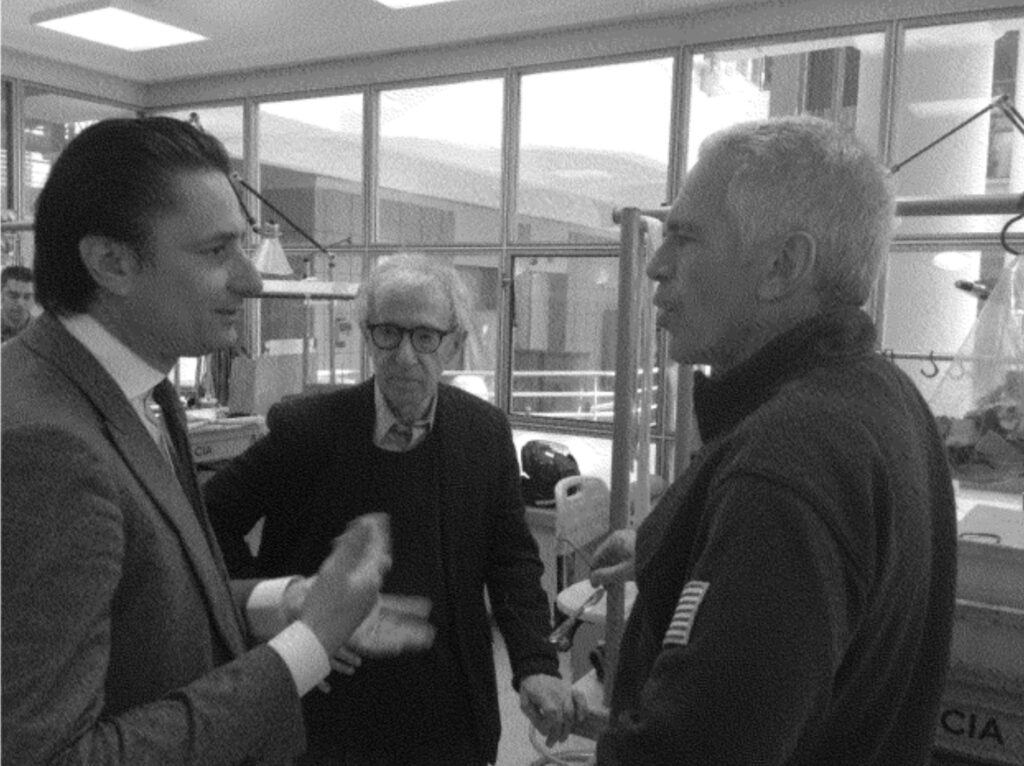
IMAGE: A visit by Jeffrey Epstein and Woody Allen to the Hermès workshops in Pantin, near Paris, accompanied by Axel Dumas, the CEO of the luxury group (on the left in the photo). (Source: DOJ Epstein file EFTA01897697)
It’s a meeting that Axel Dumas, CEO of Hermès, must regret. And one that the luxury group would very much like to forget. At the very end of March 2013, the head of this flagship of French luxury received Jeffrey Epstein, accompanied by Woody Allen, at the Hermès workshops in Pantin (Seine-Saint-Denis). Among the millions of documents publicly released by the US Department of Justice over the past several weeks are several photos attesting to the meeting in emails exchanged on March 28 and 29, 2013. The three men are seen smiling. Also present during this privileged visit to the luxury group’s workshops was Bali Barrett, the deputy artistic director of Hermès’ “women’s universe.”
This meeting took place five years after the American was sentenced to 18 months in prison for soliciting prostitution from a minor. As of 2008, the businessman, a friend of the powerful, was therefore registered for life as a sex offender. This didn’t bother Woody Allen, his friend, in the slightest, nor did it seem to deter the head of the luxury group who was hosting the two men.
Last week, I contacted Anne Méaux, head of Image 7, which handles communications for Hermès and its CEO, to find out what they had to say about the CEO’s presence in the Epstein files. The communications specialist initially told me that while “Jeffrey Epstein tried several times to approach the Hermès CEO,” the latter “declined both invitations.”
A Parisian getaway with Woody Allen
It was only when I told her that there were photos proving a meeting between the two men that Anne Méaux confirmed the visit to the Hermès workshops, while trying to downplay it. She explained that the visit had initially been planned for Woody Allen and that Axel Dumas “therefore did not know” Jeffrey Epstein, who was accompanying his friend. In fact, an email from Jeffrey Epstein dated November 21, 2013, reveals that it was Soon-Yi Previn , the filmmaker’s wife, who arranged the visit to the workshops with Hermès.
During this Parisian getaway, Epstein spent a good deal of time with Allen and his family, even making his private jet available to them on Sunday, March 30, for a trip to a second destination. Did he take advantage of his friends to meet with the CEO of Hermès? Was the latter a “target”? The visit to the Hermès workshops by the convicted sex offender was far from an accidental encounter. As early as February 2013, Jeffrey Epstein intended to see Axel Dumas in Paris. This is evident in a note written by the convicted sex offender’s assistant, in which the name of the Hermès CEO appears among several close friends of Jeffrey Epstein in Paris, including Jack Lang and his daughter Caroline, but also “Daniel” (Siad) and “Jean-Luc” (Brunel):

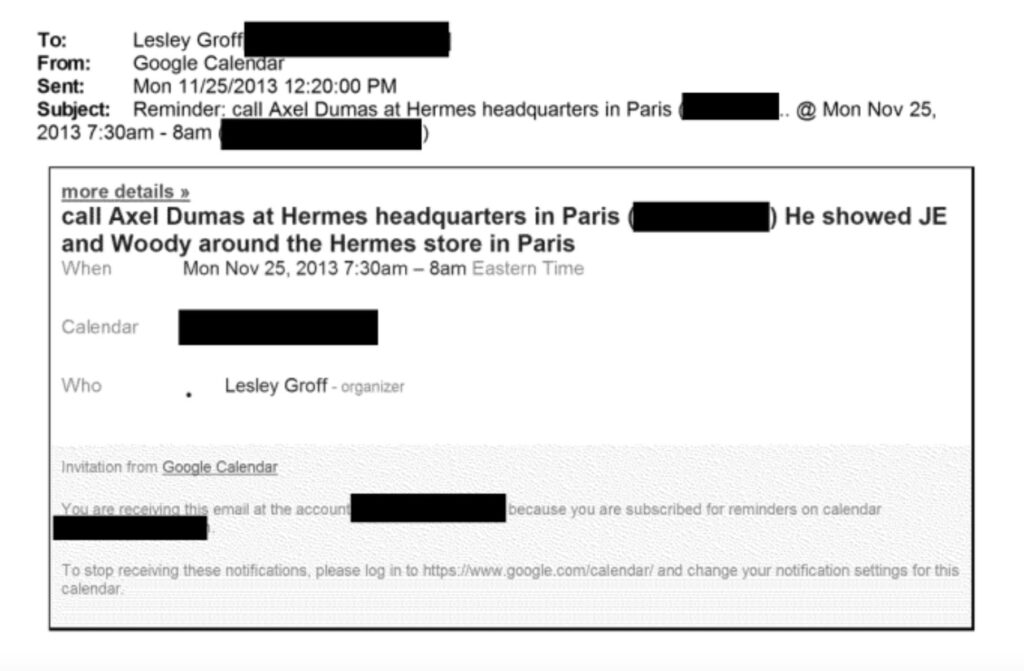
On November 20, 2013, Jeffrey Epstein finally had the opportunity to see Axel Dumas again in Paris, during a performance by the artist and actress Tilda Swinton at the Paris Fashion Museum. Among high society, this kind of encounter is common. But the very next day, the American contacted the secretary of the head of Hermès. While the latter’s assistant replied that he would be unable to meet with him soon due to his schedule, a call was clearly arranged for four days later, along with a visit to one of the Hermès stores, again in the presence of Woody Allen (see email below).
On the same day, Jeffrey Epstein’s assistant wrote in an email addressed to him: “I spoke with Elodie at Mr Dumas’s office. She will check her schedule and contact me later this week to arrange a time to talk .” These initial details already undermine the version of events that were firmly denied.
But it’s a much later conversation between Steve Bannon, the inspiration behind the American far right, and Jeffrey Epstein that raises even more questions. In this exchange from July 16, 2018, Bannon asks Epstein if he knows Bernard Arnault, the head of the LVMH group, a competitor of Hermès. Epstein replies that they have “very close mutual friends,” specifically mentioning Jack Lang. He doesn’t mention Lang in his text message, but Jeffrey Epstein was also associated with Jean-Yves Le Fur (mentioned in the infamous “black book” ) in Paris. Le Fur was then the owner of the Le Montana nightclub, located near the Café de Flore in Saint-Germain-des-Prés, a place Epstein frequented. A producer and media mogul (founder of DS and Numéro magazines, and also, for a time, the owner of Lui ), Le Fur was a prominent figure in the Parisian fashion world and knew the luxury goods magnate. In his next message, Bannon refers not to the social whirl of Parisian fashion but to the battle waged by Bernard Arnault from 2010 onwards for control of Hermès and the difficulties he encountered in this endeavour. Epstein’s response, somewhat ambiguously, was: “Axel Dumas, at the head of Hermès, had a better advisor  ”.
”.

IMAGE: This exchange of SMS messages between Bannon is attested by other documents, notably EFTA00782489, in which it is understood that the person who responds to Steve Bannon (in blue on the screenshot) is indeed Jeffrey Epstein. (Source: DOJ Epstein Files)
The plan for a dinner at Ariane de Rothschild’s
Today, at Hermès, concerns are focused more on a certain dinner project and exchanges dating from January 2014 between Jeffrey Epstein and his very close French friend Ariane de Rothschild, head of the Edmond de Rothschild financial group based in Geneva, also a close friend of Axel Dumas.
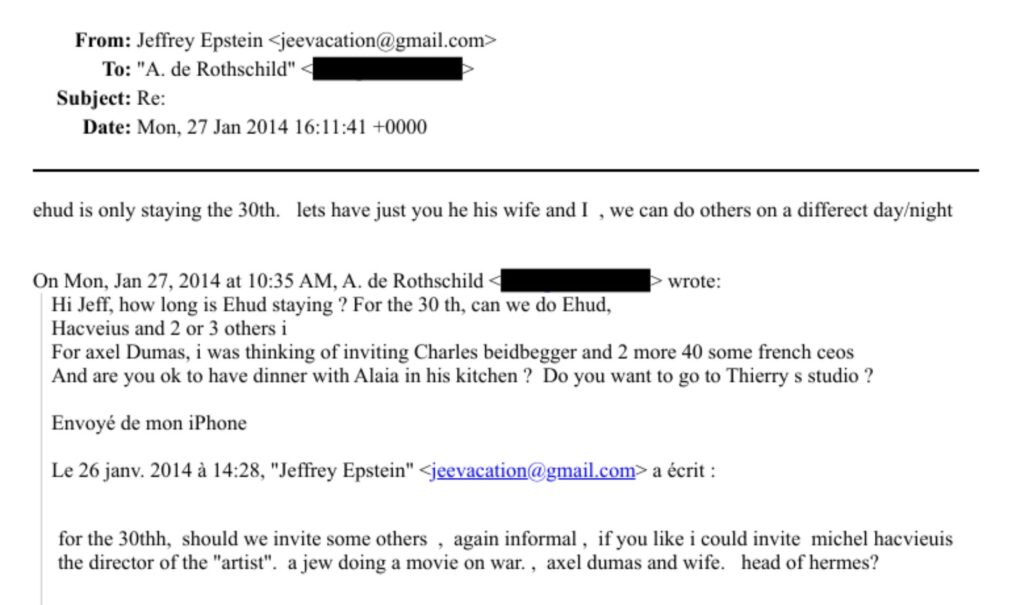
On January 22, 2014, Epstein’s assistant contacted the Hermès CEO’s office again, informing them of the American’s upcoming visit to Paris and proposing a meeting between the three of them, including Ariane de Rothschild. Two days later, Axel Dumas’s assistant replied that he, far from declining, “would be delighted” to meet Jeffrey Epstein in the company of their mutual friend, and suggested they meet at the Sofitel Le Faubourg on rue Boissy d’Anglas in the 8th arrondissement at 5:30 p.m. on January 30, 2014.
Two days later, Epstein changed his mind about the circumstances of the meeting and decided to invite Axel Dumas to a more relaxed dinner at Ariane de Rothschild’s home on January 30, this time around 8:30 p.m., in the company of former Israeli Prime Minister Ehud Barak. In emails exchanged on January 27 with Ariane de Rothschild (see below), Jeffrey Epstein now proposed organising a group, “informal” dinner, notably with film director Michel Hazanavicius, but also with “Axel Dumas and his wife .” In response, his host also suggested inviting businessman Charles Beigbeder and ” two other CEOs in their forties. “
Ultimately, the dinner plans fell through, as Ehud Barak only intended to stay in Paris for one day, and Axel Dumas’s office warned that the CEO had a scheduling conflict. In early February, Jeffrey Epstein tried again to meet with the head of the luxury group a few days later, but Epstein had his assistant say he was travelling. In the messages released so far by the US Department of Justice, no further exchanges between the two assistants appear.
Today, the Epstein files are sending shivers down the spines of the Parisian and European business world. Meanwhile, crisis communications teams have been working flat out for the past few days, responding to journalists and trying to influence the media narrative. A few hours after my exchanges with Anne Méaux, the X CitizenMedia account conveniently published an email from the Epstein files dating back to 2016, revealing that Hermès refused a financial donation from Jeffrey Epstein as part of a philanthropic initiative led by the luxury group. Surprisingly, within a few hours, this message posted on X, which doesn’t mention Axel Dumas, garnered 2.2 million views. Several journalists and influencers began sharing it, emphasizing that the luxury group seemed beyond reproach regarding Jeffrey Epstein and far more cautious than Jack Lang. Was this an attempt to make people forget the 2013 visit to the Hermès workshops and the discussions about the dinner?

IMAGE: Here is the message from the X CitizenMedia account, shared by Joseph Macé-Scaron, a columnist on CNEWS. The former journalist worked between 2017 and 2025 as a communications consultant for Image 7, the company of Anne Méaux, communications advisor to Axel Dumas and Hermès. (Source: X CitizenMedia)
Ariane de Rothschild appears 4440 times
The Epstein files shed a harsh light on what I often describe in my work: the insular world of Parisian and global business circles. To gain access to key figures in the Parisian economic and financial sector and the CAC 40, Jeffrey Epstein skillfully leveraged his professed connections and numerous contacts. It is clear that, despite their often exorbitant fees for advice on communications, security, and even private intelligence, economic and political leaders fell prey to the traps set by these unscrupulous courtiers. Faced with this serial criminal, the protective insularity of the elite turned against those who usually benefited from it.
Thus, on the morning of June 27, 2012, Karim Wade, a consultant to African heads of state and in the mining sector, and also the son of the former Senegalese president, emailed Epstein asking for the address of his Paris apartment (see below). Epstein responded, providing the access codes… before Wade informed him that he would forward them to Anne Lauvergeon, who had left the chairmanship of Areva a year earlier, before telling his friend, “See you this afternoon .” When contacted, Anne Lauvergeon quickly denied any such meeting: “Completely surprised: I have never met Epstein. And I don’t recall any invitation of this kind.”

It is also in the Epstein Files that we learn, through an email dated June 17, 2013, that his journalist friend Edward Jay Epstein (often called Ed Epstein) invited him to lunch in New York six days later with Serge Weinberg, then CEO of the pharmaceutical group Sanofi, who was also a director of Rothschild & Co. bank and close to President Macron (it was notably thanks to Weinberg that Macron joined Rothschild & Co. between 2008 and 2012). When questioned about this lunch plan, Serge Weinberg was categorical: “Ed Epstein is an investigative journalist, an acquaintance of my wife, whom I have met three times. I was never informed that he had invited Jeffrey Epstein to lunch at his home. The lunch you are referring to never took place, and I knew nothing about it. I have never been to Ed Epstein’s home. ” ²
Another example: in an email dated August 13, 2016, conductor Frédéric Chaslin informed his American friend that he had had lunch a few days earlier with Sébastien Bazin, the head of the Accor group, who was then president of the Théâtre du Châtelet, and who had told him, “He told me he knew you .” I contacted one of Bazin’s advisors about this mention, and they should get back to me soon.
But let’s return to the now undeniable and particularly intense friendship and working relationship between Jeffrey Epstein and Ariane de Rothschild, head of the Edmond de Rothschild financial group. By comparison, her name appears 4,440 times in the Epstein files, while Trump’s appears 4,732 times. It’s difficult for her to deny this close relationship now.
As the Financial Times rightly points out, Jeffrey Epstein was much more than an advisor to Ariane de Rothschild: for the bank executive, he quickly became a confidant. This position gave the American “a privileged position at the heart of one of the most powerful banking families in Europe,” the British financial daily emphasises. After the death of Edmond de Rothschild, the founder, Epstein brought Ariane de Rothschild (Edmond’s daughter-in-law) into the operational management of the bank, while her husband, heir Benjamin de Rothschild, remained chairman of the executive committee until his sudden death in January 2021 (he died of a heart attack): “It was clear that Ariane was in charge,” the FT commented.

In 2013, the United States launched a major offensive against Swiss banks, accused of helping American citizens conceal their assets. Threatened by US judicial authorities, the Edmond de Rothschild Group successfully negotiated a $45 million fine on December 18, 2015, largely thanks to Jeffrey Epstein’s intervention. The banking group paid him the modest sum of $25 million for this intervention, paid to one of its companies registered in the US Virgin Islands, Southern Trust Company.
In 2023, Ariane de Rothschild attempted to downplay this relationship, admitting to the Wall Street Journal, which had broken the story, that she had only had a few exchanges with Jeffrey Epstein. However, today, the Financial Times rightly points out that the thousands of emails and exchanges released by the DOJ paint a very different picture, in which “the French banker shared private confidences with Jeffrey Epstein. ” Or, to use Le Monde ‘s phrase from this week, a “real closeness.” Speaking to the evening daily, the Edmond de Rothschild Group acknowledges the existence of a “professional relationship” between the two, upon which “a more personal relationship developed over the years.”
“I’m freaking out and afraid I won’t be up to the job,” Ariane de Rothschild confessed surprisingly openly in February 2015, shortly after taking over the bank. “You never have to hide from me, I can listen and advise or just listen, there’s nothing you could tell me that would shock me,” Jeffrey Epstein wrote to her in May of that year in response to a message about difficulties in his marriage. Numerous email exchanges between Jeffrey and Ariane also attest to gifts, visits, and dinners. They exchanged lifestyle advice; he provided her with contacts for one of her daughters’ university applications; they shared vacation ideas and details of their daily lives. We also learn that Ariane de Rothschild didn’t hesitate to travel with one of her daughters to see Jeffrey Epstein in the United States. Another daughter exchanged numerous messages with him. In short, between 2013 and 2019, “Jeff” quickly became a friend of the family.
In several emails, Jeffrey Epstein hinted to Ariane de Rothschild that private investigators were looking into her husband’s alleged drug problems. The advisor then tried to convince Ariane de Rothschild to further distance her husband from the bank’s day-to-day operations. In April 2015, he wrote: “I think you should file for guardianship of Benjamin, and give him the choice between filing the petition or resigning.” He added: “He is out of control and a danger to you and your family.” This advice was ignored: Benjamin de Rothschild remained chairman of the bank until his death.
Conflict between Ariane and David: Epstein pulling the strings
On the business front, Epstein was handling numerous other matters for Edmond de Rothschild, which was decidedly going through a turbulent period. While the bank’s management was undergoing a major overhaul, the highly sought-after advisor proposed a series of candidates to replace senior executives and initiated discussions with the American fund Apollo Global Management, co-founded by his close friend Léon Black, regarding a potential merger. He also had to manage the Luxembourg investigation into the scandal linked to the Malaysian sovereign wealth fund 1MDB. In this sprawling case of embezzlement estimated at $4 billion , the Geneva-based bank was raided by police and fined €9 million by the Luxembourg financial regulator.
Finally, Epstein will advise Ariane de Rothschild on very specific points in the conflict opposing her to the Parisian investment bank Rothschild & Co, and its founder, David de Rothschild, concerning the commercial use of the family name for their respective businesses. Over the course of a few years, this case will poison relations between the different branches of the family before an agreement is reached in early 2018 and the hatchet is buried, at least for a time.
The American advisor is not the only one interested in this matter: “ Emmanuel Macron played a role in reconciling Rothschild & Co and the Edmond de Rothschild group,” a Parisian banker assured me a few years ago, as I wrote in *L’Emprise *. As is his wont, Emmanuel Macron has skillfully navigated opposing networks, working for Rothschild & Co while maintaining ties with Edmond de Rothschild. It’s a balancing act he relishes. Ariane de Rothschild and Emmanuel Macron share many acquaintances, including the powerful insurance broker Pierre Donnersberg, founder of Diot Siaci ( originally established in 1988 within Compagnie Financière Edmond de Rothschild), and the banker Tidjane Thiam (CEO of Credit Suisse between 2015 and 2020). On January 26, 2016, Ariane de Rothschild sent Epstein the following email: “I am with the heads of the main French insurance companies to prepare (hopefully) future investments in public real estate. I should see Macron in the coming weeks. I am having lunch tomorrow with Tidjane Thiam.” For his part, Jeffrey Epstein also seems to know Thiam, if we are to believe the strange message that lawyer David Stern left as a comment on a press article about the banker: “He was even more drunk, standing next to us.”
It was at Edmond de Rothschild that Jeffrey Epstein met Olivier Colom in 2013. Colom, a former advisor in Nicolas Sarkozy’s diplomatic unit at the Élysée Palace, had become an advisor and then secretary general of the Geneva-based bank. As the Epstein Files revealed, the two men became very close, exchanging numerous sexist emails in which, for example, the American businessman confided to the French diplomat that he was “on [his] island in the Caribbean, with an aquarium full of girls .” Today, Colom works as a consultant for several African heads of state (through his company, OC Advisory Ltd).
Sarkozy’s former advisor proposes a deal in North Korea
In their articles about this high-ranking civil servant with his unsuspected connections, Mediapart and Politico overlook several important details. First, before being appointed advisor at the Élysée Palace during Sarkozy’s presidency, Colom worked for two years with Tony Blair, the former British Prime Minister turned international consultant. Second, after his time at Edmond de Rothschild bank, Colom joined the board of directors of Endeavour Mining, a gold mining company then headed by his friend Sébastien de Montessus, former number three at Areva ( as I mention in this article ), and whose main shareholder is the Egyptian billionaire Naguib Sawiris ( who was seen in September 2025 with Tony Blair regarding his “plan” for Gaza ).
This close business relationship with Endeavour Mining’s main shareholder could explain why Olivier Colom offered his friend Jeffrey Epstein a “huge” and “ultra-confidential” opportunity with “North Korea .” Indeed, between 2008 and 2018, Naguib Sawiris, through his telecom subsidiary Orascom, dared to invest in this highly isolated country, equipping it with a 3G network. Jeffrey Epstein replied to Colom that he was “very interested.” Clearly, the North Korean totalitarian regime piqued his interest, appearing in over a thousand messages in the Epstein Files, particularly concerning its nuclear program.
The convicted sex offender Jeffrey Epstein was never just a businessman, jet-setter, and multi-millionaire. This case is so sensitive because it intersects with intelligence issues worldwide. Behind the self-contained world he cultivated (on the surface) and the establishment of a system of sexual predation (behind the scenes), lie motives that are still difficult to define in France, while the Anglo-American press has already extensively documented them: espionage and major financial crime. The Epstein Files include a 2020 FBI report citing the testimony of an anonymous informant who claims that Jeffrey Epstein was a “co-opted Mossad agent . “
The Maxwell connection dates back to the 1980s
As early as July 2019, Israeli-South African journalist Zev Shalev, a former CBS producer and current author of the Narativ newsletter , revealed this aspect of the case. In an exclusive interview, former Israeli intelligence agent Ari Ben-Menashe disclosed that British media mogul Robert Maxwell, also a triple agent for Mossad, KGB, and MI6, originally introduced Epstein to Israeli military intelligence in the early 1980s. Ben-Menashe later confirmed that Epstein and Robert’s daughter, Ghislaine Maxwell, both acted as agents for Israeli military intelligence: “These guys were considered agents… They had found their niche, blackmailing Americans and other figures on behalf of the Israelis. ” This story sheds light on the very close relationship between Jeffrey Epstein and Ehud Barak, who headed the Israeli military intelligence directorate (Aman) before becoming Chief of Staff of the IDF (1991-1995) and then Prime Minister of Israel.
Starting out in the mid-1970s as a trader at Bear Stearns, Epstein quietly left the financial firm following an internal investigation into insider trading. He then began working for two prominent arms dealers, the British Douglas Leese and the Saudi Adnan Khashoggi.
Under their tutelage, Epstein became an expert in clandestine financial structures: “The next job Jeffrey Epstein was able to get was with CEO Douglas Leese, who ran a group of offshore companies,” Steven Hoffenberg, one of Epstein’s mentors, told Narativ. “Jeffrey Epstein was hired to handle money laundering, investment banking, financial fraud, and all sorts of criminal activities around the world. Adnan Khashoggi was connected to this group of companies that helped train Jeffrey Epstein.” According to this account, Epstein went on to work for Robert Maxwell, first on the Iran-Contra operation, and then by putting his skills to use in a vast money laundering scheme originating from the collapsing Soviet Union. Epstein inherited this financial architecture between East and West just after the suspicious death of Robert Maxwell in November 1991, as Steven Hoffenberg told Zev Shalev: “It was a transfer of power from father Robert Maxwell to his daughter Ghislaine, who called on her lover and boyfriend Jeffrey Epstein to take over her father’s espionage activities. “
However, according to the official biography, Jeffrey Epstein only met Ghislaine Maxwell during his “exile” in New York starting in 1992. This documented version of a meeting between Maxwell and Epstein as early as the 1980s, presented by Shalev and many other Russia specialists, completely changes the story. During the same period, Epstein met Donald Trump, who would become a key player in the system established under Maxwell’s umbrella, a system that would benefit numerous Russian oligarchs in the 1990s.
Robert Maxwell, Jack Lang and the privatisation of TF1
And this is where the lies of Jack Lang and his daughter Caroline, both cornered by Mediapart ‘s revelations, become clear. Last week, father and daughter tried to downplay their relationship with Jeffrey Epstein and explained at length in their numerous media appearances that they only met the American businessman starting in 2013. This version aligns with the material made available by the American justice system: most of the documents released to the public consist of exchanges on a few email accounts and text messages after that period. But it doesn’t stand up well to scrutiny or historical evidence.
Caroline Lang began her career in the audiovisual and cultural world by joining Maxwell Communication in London in 1989 (the media company then headed by Robert Maxwell). This was because her father, Jack Lang, Minister of Culture and Communication between 1981 and 1986, knew the British magnate very well and had been acquainted with him since that time. Surprisingly, this story is never mentioned, even though it explains the Lang family’s close ties to the Maxwell system. To understand this, one must revisit the seminal book by journalists Pierre Péan and Christophe Nick, TF1, un pouvoir (TF1, a Power ), published in 1997 by Fayard (by the renowned publisher Claude Durand ).
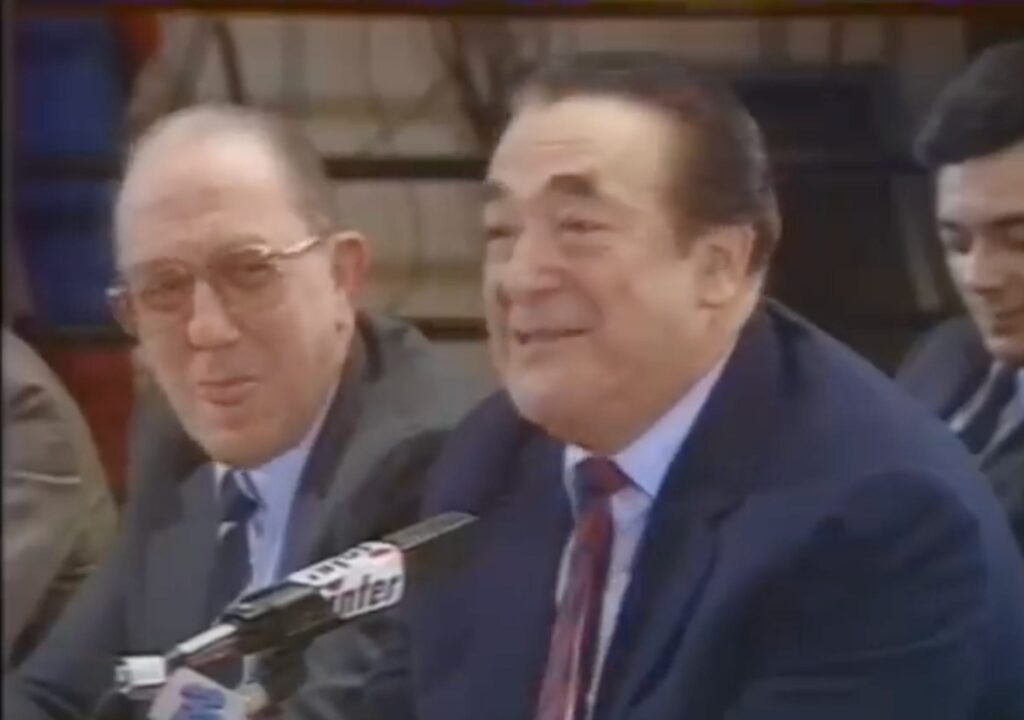
IMAGE: On April 3, 1987, Robert Maxwell was publicly questioned by the CNCL (National Commission for Communication and Freedoms), which was then tasked with evaluating the bids for the privatisation of TF1. He testified alongside Francis Bouygues and Bernard Tapie, the three men being partners in the takeover of the leading public television channel against their competitor, Jean-Luc Lagardère’s Hachette group. (Screenshot taken from the documentary “Television, Secret Histories”)
While Robert Maxwell’s wife is French (his family hails from the Southwest), the tycoon also loves France for its financial and political opportunities. It’s often forgotten, but in the 1980s, the British businessman burst onto the French business scene, particularly in the rapidly changing audiovisual sector, which was undergoing a major transformation with the creation of private channels by the new socialist government.
And as Péan and Nick tell us, under Mitterrand, Maxwell had excellent connections at the Élysée Palace. In August 1985, the magnate met with the French president to discuss the future La Cinq television channel. He was up against Silvio Berlusconi, who already owned television channels in Italy. To curry favor with the government, the Briton decided to put 150 million francs on the table to complete the budget for the Grande Arche de la Défense, one of the “Grands Travaux” (major public works projects) initiated by François Mitterrand, partly overseen by Jack Lang on the political side, and carried out mostly by… the Bouygues group. These ties were thus strengthened during this rescue of the La Défense project: “Bouygues, Maxwell, and Mitterrand thus came together around the Grande Arche ,” the journalists note in their book.
If he doesn’t get his way regarding the future La Cinq, Maxwell makes a major move during the Chirac-Mitterrand cohabitation. At the end of 1986, the media mogul was very active in Paris, especially at the Élysée Palace. The Bouygues team was looking for a major shareholder to complete its upcoming financing for the privatization of TF1, a decision made by the right wing upon taking office. A successful construction entrepreneur, Francis Bouygues wanted to acquire the leading public television channel, but he lacked the necessary funds. Facing the frontrunner, Jean-Luc Lagardère ‘s Hachette group , which had the support of Prime Minister Jacques Chirac, Mitterrand welcomed the emergence of a competing bid. While Bouygues was far from left-wing, he had always been careful to maintain good relations with the Socialist president and had assured him of his neutrality should he become head of TF1. The Élysée Palace can be satisfied: in November 1986, the first contact between “Bouygues” and Maxwell was established.
Maxwell “brings in Lang”
For Mitterrand, former minister Jack Lang closely followed the TF1 case. After the passage of the Léotard law on broadcasting, which ratified the privatisation of TF1, Lang had lunch with Francis Bouygues. And the Socialist Party figure was in constant contact with Robert Maxwell. Following a brief visit by Patrick Le Lay (future head of TF1) to the British magnate’s London offices in February 1987, Maxwell decided to put 750 million francs on the table, representing 12.5% of the future privatised TF1, the maximum stake allowed for a foreign investor. “Maxwell’s entry into the shareholder structure was seen as another positive sign: ‘Captain Bob’ was well regarded at the Élysée Palace since he had saved the Grande Arche. The President was charmed by him, and also supported by Jacques Attali and Jack Lang.” “Maxwell then said he was ‘ready to buy up anything that moves’,” says Jean-Claude Colliard, the former chief of staff to President Mitterrand.
On April 3, 1987, before the CNCL (National Commission for Communication and Freedoms), tasked with evaluating the bids, Francis Bouygues presented his co-investor in TF1 as follows: “I would say, so you know, that Robert Maxwell was born in Czechoslovakia. During the German invasion of his country, he joined the Resistance. He was sentenced to death. He escaped and entered France. He enlisted in the French army and then, in June 1940, he crossed the Channel and joined the British army, and, in 1945, he married a French woman. His group is the world’s leading group in the field of scientific publishing. It is the world’s second-largest printing company. Robert Maxwell owns a group that includes about ten daily newspapers, the main one being the Daily Mirror, which has a circulation of three and a half million copies a day . ” In their book, Péan and Nick remark ironically: “The other side of the character (…) is reminiscent of Stavisky in France in the 1930s .”
This cordial understanding between Francis Bouygues and Robert Maxwell was short-lived. While they jointly won the privatisation of TF1, their alliance quickly crumbled over the issue of control of the channel. The two business leaders had previously signed a secret shareholders’ agreement granting Maxwell significant control. But Bouygues had other ideas and quickly sidelined Ian Maxwell, the British magnate’s son, who had been appointed head of international operations for the channel. After Mitterrand’s second victory in 1988, the battle became all-out.
The Bouygues group believes that the Élysée Palace is closely linked to Maxwell’s activism. “He even got Jack Lang involved with the president of the CSA [Conseil Supérieur de l’Audiovisuel, which succeeded the CNCL],” assert Péan and Nick. The CSA president met with Maxwell’s lawyer, Samuel Pisar, regarding a breach of the secret agreement. Throughout this period, the British magnate also inserted himself into the battle for control of the Havas communications company (at one point acquiring 4.7% of the group). “Robert Maxwell was building his network both at the Élysée Palace and at the Ministry of the Economy and Finance,” comment Péan and Nick. In addition to Lang and Attali, Maxwell also forged closer ties on this latter matter with Jean-Charles Naouri, the former chief of staff to Pierre Bérégovoy, who had become an investment banker at Rothschild and was soon to be a major figure in the Paris financial scene. In early 1991, Maxwell decided to throw in the towel and sold her shares in TF1 to Goldman Sachs, which subsequently resold them to the French banks backing Bouygues. Strangely, this whole story wasn’t mentioned by Jack Lang himself to explain his close ties to Jeffrey Epstein and Ghislaine Maxwell…
In the long run, it at least helps to partially explain his relationship. The former Minister of Culture may not want to reopen the Maxwell case, a legacy of the Mitterrand era.
Read more articles from The Big Picture Substack
READ MORE EPSTEIN NEWS AT: 21st Century Wire Epstein Files
SUPPORT OUR INDEPENDENT MEDIA PLATFORM – BECOME A MEMBER @21WIRE.TV
VISIT OUR TELEGRAM CHANNEL
21st Century Wire is an alternative news agency designed to enlighten, inform and educate readers about world events which are not always covered in the mainstream media.
Source: https://21stcenturywire.com/2026/02/11/how-deep-does-epsteins-french-connectiongo/
Anyone can join.
Anyone can contribute.
Anyone can become informed about their world.
"United We Stand" Click Here To Create Your Personal Citizen Journalist Account Today, Be Sure To Invite Your Friends.
Before It’s News® is a community of individuals who report on what’s going on around them, from all around the world. Anyone can join. Anyone can contribute. Anyone can become informed about their world. "United We Stand" Click Here To Create Your Personal Citizen Journalist Account Today, Be Sure To Invite Your Friends.
LION'S MANE PRODUCT
Try Our Lion’s Mane WHOLE MIND Nootropic Blend 60 Capsules
Mushrooms are having a moment. One fabulous fungus in particular, lion’s mane, may help improve memory, depression and anxiety symptoms. They are also an excellent source of nutrients that show promise as a therapy for dementia, and other neurodegenerative diseases. If you’re living with anxiety or depression, you may be curious about all the therapy options out there — including the natural ones.Our Lion’s Mane WHOLE MIND Nootropic Blend has been formulated to utilize the potency of Lion’s mane but also include the benefits of four other Highly Beneficial Mushrooms. Synergistically, they work together to Build your health through improving cognitive function and immunity regardless of your age. Our Nootropic not only improves your Cognitive Function and Activates your Immune System, but it benefits growth of Essential Gut Flora, further enhancing your Vitality.

Our Formula includes: Lion’s Mane Mushrooms which Increase Brain Power through nerve growth, lessen anxiety, reduce depression, and improve concentration. Its an excellent adaptogen, promotes sleep and improves immunity. Shiitake Mushrooms which Fight cancer cells and infectious disease, boost the immune system, promotes brain function, and serves as a source of B vitamins. Maitake Mushrooms which regulate blood sugar levels of diabetics, reduce hypertension and boosts the immune system. Reishi Mushrooms which Fight inflammation, liver disease, fatigue, tumor growth and cancer. They Improve skin disorders and soothes digestive problems, stomach ulcers and leaky gut syndrome. Chaga Mushrooms which have anti-aging effects, boost immune function, improve stamina and athletic performance, even act as a natural aphrodisiac, fighting diabetes and improving liver function. Try Our Lion’s Mane WHOLE MIND Nootropic Blend 60 Capsules Today. Be 100% Satisfied or Receive a Full Money Back Guarantee. Order Yours Today by Following This Link.


| Visits: | 1,776,537,818 |
| Stories: | 8,583,416 |
Whistler Blowers, Insiders

