

The Rise of the Isaac Accords: How Israel is Redrawing South America’s Political Landscape

Freddie Ponton
21st Century Wire
Foreign influence in the Global South rarely arrives in uniform. It comes disguised as ethics, stability, and shared values, only revealing its true cost once the rules are set. In Latin America, such a transformation is now underway. A new architecture of alignment is being quietly assembled, presented as moral course correction but functioning as a geopolitical filter. At its core lie the Isaac Accords, a project deliberately modelled on the Abraham Accords. Where the latter normalised Israel’s position in the Middle East through elite deals brokered by Washington, the Isaac Accords aim to reorder Latin American politics by locking governments, economies, and security institutions into Israeli and U.S. strategic orbit.
The Accords are not simply about Israel’s image or diplomatic isolation. They operate as a filter of legitimacy: governments that align are embraced, financed, and promoted; those that resist are marginalised, sanctioned, or framed as moral outliers. Venezuela, long aligned with Palestine and the broader Axis of Non-Alignment, sits squarely in the crosshairs.
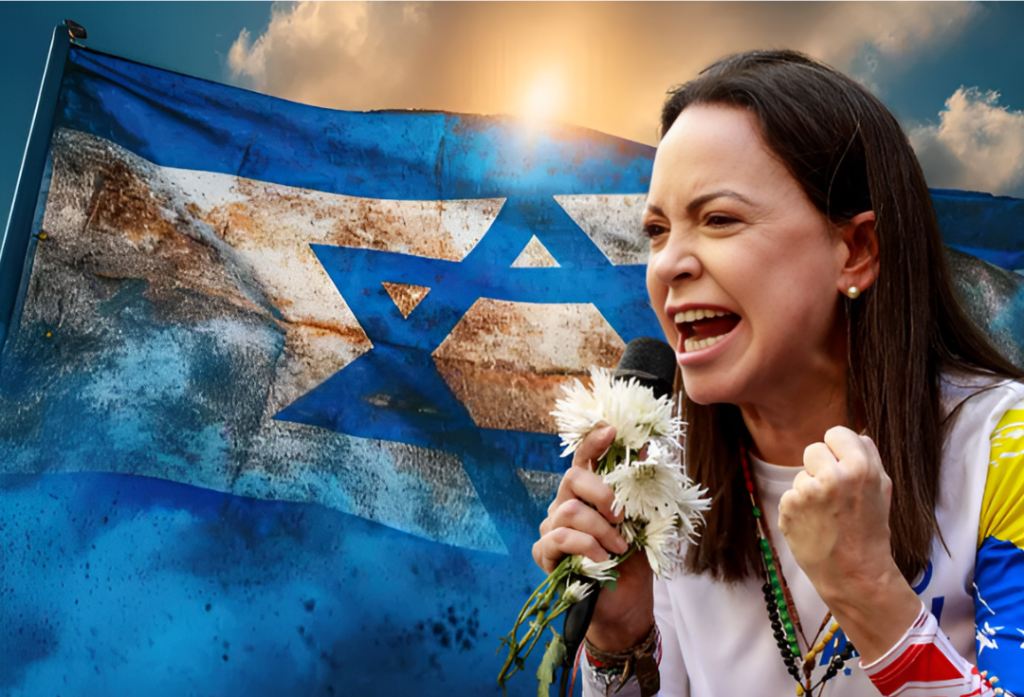
This article examines how the Isaac Accords function in practice, why figures such as Javier Milei and María Corina Machado have become central to their rollout, and what this strategy reveals about Israel’s ambitions in South America, not as a neutral partner, but as an active geopolitical actor working in tandem with U.S. power.
The Isaac Accords: A Latin American Reboot of the Abraham Model
The Isaac Accords did not emerge in a vacuum. They are consciously modelled on the Abraham Accords, which rebranded Israel’s regional integration in the Middle East as “peace” while bypassing Palestinian self-determination entirely. The lesson Israeli and U.S. policymakers appear to have drawn is simple: normalisation works best when imposed from above, through elite alignment, financial incentives, and security integration.
Latin America is the new testing ground!
The Accords are administered through a U.S.-based nonprofit, American Friends of the Isaac Accords, and financially seeded through institutions closely linked to Israeli state and diaspora networks. Their stated aim is to counter antisemitism and hostility toward Israel. Their operational requirements, however, reveal a far broader ambition.
Countries seeking entry are expected to:
- Relocate embassies to Jerusalem, recognising Israeli sovereignty over a contested city
- Redesignate Hamas and Hezbollah in line with Israeli security doctrine
- Reverse voting patterns at the UN and the OAS, where Latin America has historically voted in favour of Palestinian rights
- Enter intelligence-sharing agreements targeting Chinese, Iranian, Cuban, Bolivian, and Venezuelan influence
- Open strategic sectors: water, agriculture, digital governance, security, to Israeli firms
This is not neutral cooperation. It is political conditionality.
Israel’s own diplomats have described the Isaac Accords as a way to pull “undecided” Latin American states into Israel’s orbit at a moment when European public opinion has become less reliable. In other words, the Global South is being repositioned as Israel’s strategic rear guard.
The role of Javier Milei in Argentina illustrates how this model operates. Milei has not merely improved relations with Israel; he has embraced it as an ideological reference point. He has pledged to move Argentina’s embassy to Jerusalem, framed Israel as a civilisational ally, and positioned himself as the Isaac Accords’ flagship political figure.

IMAGE: Co-Founder and Chairman of The Genesis Prize Foundation Stan Polovets presents the Genesis Prize to 2025 Laureate Javier Milei at a ceremony on June 12 in Jerusalem. (Source: American Friends of Isaac Accords)
That role was formalised in 2025 when Milei became the Genesis Prize Laureate, an award frequently described as the “Jewish Nobel Prize.” The Genesis Prize is not politically neutral. It is explicitly awarded to figures who strengthen Israel’s global standing and its ties with the diaspora. Milei’s decision to donate the prize money directly back into the Isaac Accords ecosystem symbolised how moral recognition, political allegiance, and financing now operate as a single circuit.
This is alignment rewarded, visibly, materially, and publicly.
As reported by AP in August, the Isaac Accords are set to extend to Brazil, Colombia, Chile, and potentially El Salvador by 2026, as stated by the organizers, the American Friends of the Isaac Accords.
Recent New York Times reporting situates Brad Parscale’s involvement in the Honduran election within Numen, a Buenos Aires–based political consultancy he co-founded with Argentine strategist Fernando Cerimedo, highlighting how transnational firms operate beyond traditional regulatory scrutiny. Critics warn that Numen’s methods reflect a broader global political influence ecosystem that often draws on data-driven targeting, psychological profiling, and digital amplification techniques associated with Israeli-linked political technology and messaging firms that have operated in elections worldwide.
SEE MORE: The Shadow Consultant: How Brad Parscale Slipped Into the Honduran Election
When combined with U.S. political endorsements, strategic pardons, and offshore consulting structures, this model raises serious concerns about how advanced data analytics and covert messaging infrastructures are used to shape voter behavior in vulnerable democracies, eroding electoral sovereignty while remaining largely insulated from accountability.
Venezuela, Palestine, and the Manufacturing of Illegitimacy
If the Isaac Accords require a moral antagonist, Venezuela fulfils that role perfectly.
Since Hugo Chávez severed diplomatic relations with Israel in 2009, in response to Israel’s assault on Gaza, Venezuela has positioned itself as one of Palestine’s most consistent supporters in the Western Hemisphere. Chávez, and later Nicolás Maduro, framed Palestinian resistance not as terrorism but as an anti-colonial struggle, aligning Venezuela with much of the Global South rather than the Atlantic bloc.
Under the Isaac Accords’ logic, this position is intolerable.
Opposition to Israel is no longer treated as a political stance but as evidence of extremism or antisemitism. Zionism and Judaism are deliberately conflated, allowing criticism of Israeli state policy to be reframed as hatred. This narrative provides the moral justification for isolation, sanctions, and, potentially, regime change.

IMAGE: Maria Corina Machado in Venezuela, Thursday, July 25, 2024. (Source: AP – Matias Delacroix)
Into this context steps María Corina Machado, the Venezuelan opposition figure most warmly received by Israeli and U.S. political networks. Machado’s alignment with Israel is not rhetorical or recent. In 2020, her party, Vente Venezuela, signed a formal inter-party cooperation agreement with Israel’s ruling Likud Party, led by Benjamin Netanyahu. The agreement committed both parties to shared political values, strategic cooperation, and ideological alignment.
This is a remarkable document. It ties a Venezuelan opposition movement directly to a foreign ruling party, well before any democratic transition, and signals how a post-Maduro Venezuela is expected to orient itself internationally.
DOCUMENT: Vente Venezuela signs cooperation agreement with Israel’s Likud party – Agreement signed by María Corina Machado and Eli Vered Hazan, representing Likud’s Foreign Relations Division (Source: Vente Venezuela)
Inter-Party-Agreement-Likud-Vente-Signed
Machado has since gone further, pledging to:
- Restore full diplomatic relations with Israel
- Move Venezuela’s embassy to Jerusalem
- Open Venezuela’s economy to privatisation and foreign investment
- Align Venezuela with Israel and the United States against Iran and regional leftist governments
Her narrative rests on a crucial claim: that Venezuela itself is not anti-Israel, only its government is. According to this framing, Venezuelans are inherently pro-Israel and pro-West, their “true” preferences suppressed by an illegitimate regime.
In a November interview with Israel Hayom, Machado asserted that “The Venezuelan people deeply admire Israel.”
This argument is politically useful and historically thin. Venezuelan solidarity with Palestine predates Maduro and reflects a wider Latin American tradition of identifying with colonised peoples. To erase that history is to deny Venezuelans their own political agency.
SEE MORE: The Final Nail That Sealed The Nobel Peace Prize’s Coffin
The Anti-Defamation League (ADL) has repeatedly accused the Venezuelan government of fomenting “anti-Israel” and anti-Semitic rhetoric. Yet, a closer look tells a different story. Caracas’ statements are largely expressions of solidarity with the Palestinian people and their right to self-determination, combined with pointed criticism of Israeli state policies. By framing these positions as attacks on Jews or Israel itself, the ADL distorts the narrative, turning principled political stances into a perceived moral failing. This tactic underscores a broader pattern in which international organizations can paint Global South governments as rogue actors whenever they resist the gravitational pull of Israeli and U.S. influence, subtly laying the groundwork for diplomatic pressure or intervention.
DOCUMENT: Mini report from the Anti-Defamation League (ADL), formerly known as the Anti-Defamation League of B’nai B’rith, accuses Venezuela of fuelling an incendiary anti-Israel and anti-Semitic environment.(Source (ADL)
minireport-in-venezuela-government-fuels-incendiary-anti-israel-and-anti-semitic-environment-8-4-2014-1
Security, Economics, and the Cost of Obedience
Beneath the moral language of the Isaac Accords lies a familiar architecture of control: security integration, economic restructuring, and ideological discipline.
Israel is a leading exporter of surveillance technologies, border systems, cyber-intelligence platforms, and urban security tools, many developed under conditions of occupation and internal repression. In South America, these systems are marketed as solutions to crime and narcotrafficking, but their real function is often political: expanding state surveillance capacity during periods of transition.
Security cooperation creates dependency. Once intelligence-sharing, training, and doctrine are integrated, political autonomy narrows. Policy divergence, particularly toward China, BRICS, or non-aligned partners, becomes risky.
The economic dimension is equally strategic. Israeli firms are deeply involved in water rights, desalination, agrotechnology, digital governance, and infrastructure, sectors that determine long-term sovereignty. These investments are typically tied to privatisation, deregulation, and long-term concessions, transferring control of strategic resources away from the public sphere.
Venezuela is the ultimate prize. A post-sanctions transition would open one of the world’s most resource-rich economies to restructuring. Machado’s commitment to rapid privatisation aligns seamlessly with this vision, raising an unavoidable question: who benefits from “democracy” when it arrives pre-packaged with foreign economic priorities?
SEE MORE: Gunboat Diplomacy Reloaded: How the U.S. Stormed the Skipper and Stole Venezuela’s Oil
This strategy is inseparable from U.S. power. The Trump administration’s framing of global politics as a permanent war on terror and narcotrafficking, a framing echoed by figures like Marco Rubio, has provided cover for sanctions, covert operations, and extrajudicial violence across the Caribbean and Pacific. Israel’s partnership reinforces this logic, supplying both technology and moral framing.
Conclusion: The Global South and the Right to Choose
The Isaac Accords are not simply about Israel’s diplomatic standing. They are about reordering South America’s political horizon at a moment when the Global South is rediscovering multipolarity.
Israel’s role in this process is active, strategic, and consequential. Through political patronage, economic leverage, security integration, and narrative control, it is shaping which governments are deemed legitimate and which are disposable.
For South America, and the wider Global South, the warning is familiar. When alignment is framed as morality, dissent becomes deviance. When sovereignty is conditional, development serves external interests. When history is rewritten, intervention soon follows.
Non-alignment was never about isolation. It was about the right to choose. That very right, today, is being quietly renegotiated, and the cost of refusing may soon become very clear.
SEE MORE: Senate Sanctions War by Omission: U.S. Sleepwalking Into Conflict with Venezuela
READ MORE SOUTH AMERICA NEWS AT: 21st CENTURY WIRE SOUTH AMERICA FILES
VISIT OUR TELEGRAM CHANNEL
SUPPORT OUR INDEPENDENT MEDIA PLATFORM – BECOME A MEMBER @21WIRE.TV
21st Century Wire is an alternative news agency designed to enlighten, inform and educate readers about world events which are not always covered in the mainstream media.
Source: https://21stcenturywire.com/2025/12/15/the-rise-of-the-isaac-accords-how-israel-is-redrawing-south-americas-political-landscape/
Anyone can join.
Anyone can contribute.
Anyone can become informed about their world.
"United We Stand" Click Here To Create Your Personal Citizen Journalist Account Today, Be Sure To Invite Your Friends.
Before It’s News® is a community of individuals who report on what’s going on around them, from all around the world. Anyone can join. Anyone can contribute. Anyone can become informed about their world. "United We Stand" Click Here To Create Your Personal Citizen Journalist Account Today, Be Sure To Invite Your Friends.
LION'S MANE PRODUCT
Try Our Lion’s Mane WHOLE MIND Nootropic Blend 60 Capsules
Mushrooms are having a moment. One fabulous fungus in particular, lion’s mane, may help improve memory, depression and anxiety symptoms. They are also an excellent source of nutrients that show promise as a therapy for dementia, and other neurodegenerative diseases. If you’re living with anxiety or depression, you may be curious about all the therapy options out there — including the natural ones.Our Lion’s Mane WHOLE MIND Nootropic Blend has been formulated to utilize the potency of Lion’s mane but also include the benefits of four other Highly Beneficial Mushrooms. Synergistically, they work together to Build your health through improving cognitive function and immunity regardless of your age. Our Nootropic not only improves your Cognitive Function and Activates your Immune System, but it benefits growth of Essential Gut Flora, further enhancing your Vitality.

Our Formula includes: Lion’s Mane Mushrooms which Increase Brain Power through nerve growth, lessen anxiety, reduce depression, and improve concentration. Its an excellent adaptogen, promotes sleep and improves immunity. Shiitake Mushrooms which Fight cancer cells and infectious disease, boost the immune system, promotes brain function, and serves as a source of B vitamins. Maitake Mushrooms which regulate blood sugar levels of diabetics, reduce hypertension and boosts the immune system. Reishi Mushrooms which Fight inflammation, liver disease, fatigue, tumor growth and cancer. They Improve skin disorders and soothes digestive problems, stomach ulcers and leaky gut syndrome. Chaga Mushrooms which have anti-aging effects, boost immune function, improve stamina and athletic performance, even act as a natural aphrodisiac, fighting diabetes and improving liver function. Try Our Lion’s Mane WHOLE MIND Nootropic Blend 60 Capsules Today. Be 100% Satisfied or Receive a Full Money Back Guarantee. Order Yours Today by Following This Link.


| Visits: | 1,767,409,680 |
| Stories: | 8,564,220 |
Whistler Blowers, Insiders

